
| name | Amanita proxima |
| name status | nomen acceptum |
| author | Dum. |
| english name | "Near Neighbor Amidella" |
| images |
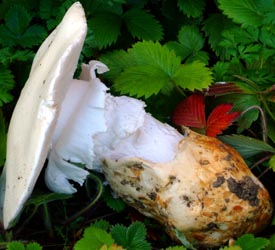  1. photo by Carmine Lavorato, Tarsia, Cosenza, Italy 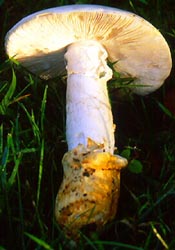 2. photo by Francis Massart SW France |
| intro | The macroscopic description is based on notes with material examined by RET. The reader should also refer to the recent treatment by Neville and Poumarat (2004). |
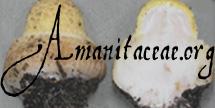
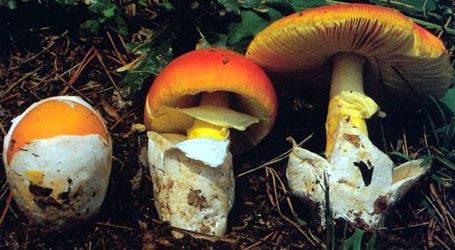
| cap | The cap of Amanita proxima is 75 - 150 mm wide, fleshy, at first ovoid then convex, finally nearly planar, whitish to ivory, smooth, viscid, silky, and with a smooth margin. The cap's flesh is white and unchanging. |
| gills | The gills are free, distant, thick, cream, and 8 - 12 mm wide; the short gills are truncate to rounded truncate to concave-truncate or subattenuate. |
| stem |
The stem is 120 - 210 × 25 - 45 mm, white, solid, firm, and narrows upward; it is more clavate than bulbous. It also bears a membranous and persistent white ring. The universal veil is ochraceous to reddish brown, and its free limb makes up about one third of its height. |
| spores | The spores measure (8.2-) 8.9 - 12.4 (-17.5) × (5.0-) 5.5 - 7.2 (-9.9) µm and are ellipsoid to elongate (occasionally cylindric) and amyloid. Irregularly shaped "giant spores" are sometimes observed. There are no clamp connections at the bases of basidia. |
| discussion |
This species has been repeatedly reported as poisonous. The symptoms are very similar to those of the amino acid syndrome recorded for A. smithiana Bas. The species is associated with oak and conifers and is generally believed to be thermophilic. Several authors cite an association with calcareous soils, which is also supported by notes in collections I reviewed. The species is found during the months of October through December. The species is distinguished from A. ovoidea (Bull.:Fr.) Link by, among other characters, its colored volva, its smaller and somewhat more gracile habit, the size and shape of its spores, by the presence of human toxins (possibly (a) nonprotein amino acid(s)), and by its membranous annulus. The reader may also wish to compare the present species with A. neoovoidea Hongo, which is similar on a number of counts. The present species is most commonly collected in southern Europe and probably occurs around the Mediterranean basin. Most of the material available to me has been from France, Italy, and Spain.—R. E. Tulloss |
| brief editors | RET |

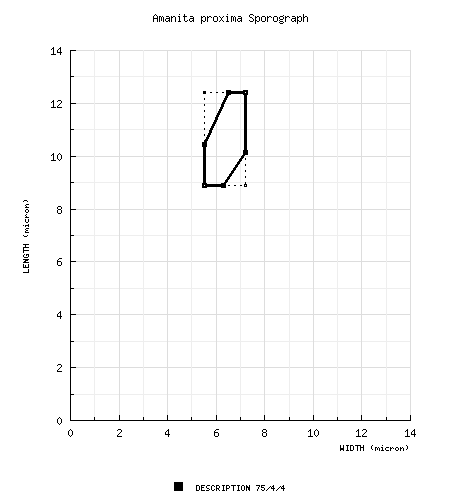
 Spore data sets and their composite