| name |
Amanita rhopalopus |
| author |
Bas. 1969. Persoonia 5: 416, figs. 137-141. |
| name status |
nomen acceptum |
| english name |
"American Club-Footed Lepidella" |
| synonyms |
≡ Amanita radicata Peck. 1900. Bull. Torrey Bot. Club 27: 609.
≡ Lepiota radicata (Peck) Morgan. 1907. J. Mycol. 13: 13. non Amanita radicata Voglino. 1894. Bull. Soc. Bot. Ital. [1894]: 120. [The protolog of Voglino's speciea appears to describe a species of sect. Lepidella, possibly Amanita boudieri var. beillei.]
= Amanita rhopalopus f. turbinata Bas. 1969. Persoonia 5: 418, fig. 142.
The editors of this site owe a great debt to Dr. Cornelis Bas
whose famous cigar box files of Amanita nomenclatural information
gathered over three or more decades were made available to RET for computerization
and make up the lion's share of the nomenclatural information presented on this site.
|
| MycoBank nos. |
308584, 347748 |
| GenBank nos. |
Due to delays in data processing at GenBank, some accession numbers may lead to unreleased (pending) pages.
These pages will eventually be made live, so try again later.
|
| holotypes |
A. rhopalopus f. turbinata—CUP. |
| lectotypes |
A. radicata Peck—NYS. |
| lectotypifications |
Bas. 1969. Persoonia 5(4): 417. |
| type studies |
A. radicata Peck—Jenkins. 1978a. Mycotaxon 7: 40. |
| intro |
The following text may make multiple use of each data field.
The field may contain magenta text presenting data from a type study
and/or revision of other original material cited in the protolog of the present taxon.
Macroscopic descriptions in magenta are a combination of data from the protolog and
additional observations made on the exiccata during revision of the cited original
material.
The same field may also contain black text, which is data from a revision of the present
taxon (including non-type material and/or material not cited in the protolog).
Paragraphs of black text will be labeled if further subdivision of
this text is appropriate.
Olive text indicates a specimen that has not been
thoroughly examined (for example, for microscopic details) and marks other places in the text
where data is missing or uncertain.
The following material not directly from (Bas 1969) is based on original research by R. E. Tulloss. |
| pileus |
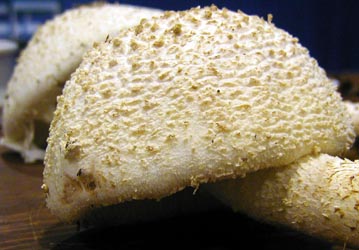
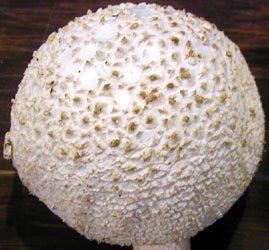
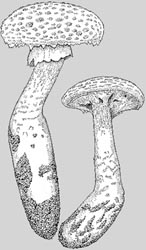
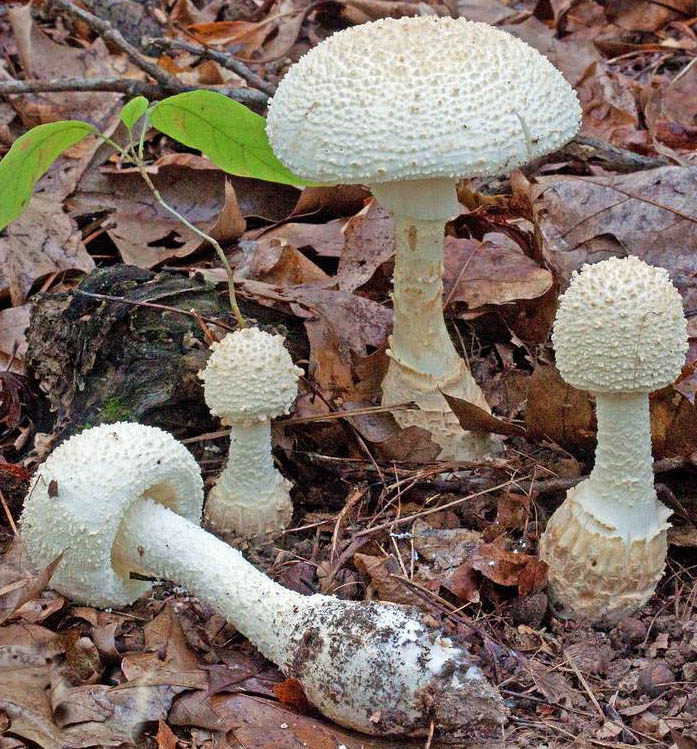
(30-) 50 - 190 mm wide, white to pale cream, hemispheric at first, then convex with disc flattened a bit or slightly umbonate, usually depressed in age, ?; context white, unchanging when cut or bruised, 11± mm thick above stipe; margin nonstriate, appendiculate, initially incurved, projecting 3± mm beyond ends of lamellae; universal veil as dense covering of floccose-felted or subfelted patches or irregularly shaped subfloccose warts or (especially over disc) subfloccose conical warts, at first concolorous with pileipellis, later browning on tips, reduced to thin layer of flocculose material toward margin. |
| lamellae |
free to narrowly adnate, subcrowded to crowded, yellowish cream in mass, cream in side view (becoming cream-yellow on maturing), 11.5± mm broad; lamellulae truncate (shorter ones) to attenuate (longer ones), of diverse lengths, plentiful, approximately alternating with lamellae. |
| stipe |
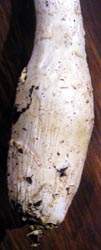
(50-) 120 - 200+ x (4-) 10 - 25 mm, whitish, subcylindrical or tapering upward, flocculent for several cm below annulus, then fibrillose, upon starting to dry having surface marked by upward pointing, overlapping, broad fibrillose regions; bulb 70 - ? × 31 - ? mm, elongate, robust, radicating to very deeply radicating, usually broader than stipe, cylindric to subclavate to fusiform, often doglegged with respect to stipe, with distinct pseudorhizzae at base (but often not collected because of depth in substrate); context off-white to pale cream, unchanging, solid, with larvae tunnels concolorous, solid; partial veil apical, white to off-white, weakly submembranous-felted, easily breaking up and deciduous, faintly striate above (lens), densely set with floccose warts below; universal veil as inconspicuous to rather distinct subfloccose-felted warts scattered or in circles at the base of the stem or as 3 - 7 rings of block-like warts on the upper half to two-thirds of the bulb. |
| odor/taste |
Odor strong and pungent, of decaying protein. Taste not recorded. |
macrochemical
tests |
none recorded. |
| pileus context |
not described. |
| universal veil |
On pileus: elements vertically oriented (seen best in young material or in warts over disc), but easily disoriented; filamentous, undifferentiated hyphae ? µm wide, frequently branching, often with yellowish subrefractive walls; inflated cells elongate to ellipsoid to subglobose to pyriform, to ? × ? µm, in rather long chains; vascular hyphae ? µm wide, rather common, branching; clamps common and concolorous with hyphae on which present. On stipe base: often absent; ?. |
| basidiospores |
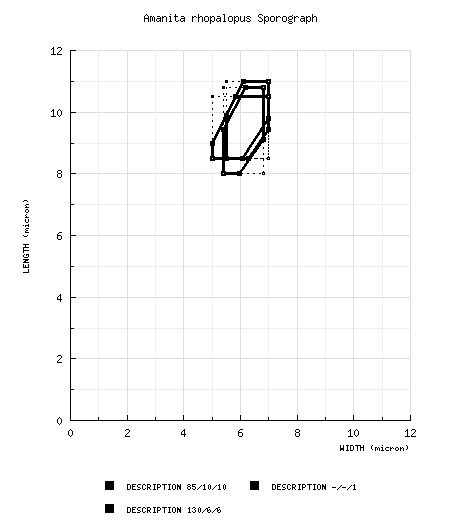
Bas (1969): [85/10/10] (8.0-) 8.5 - 11.0 (-11.5) × 5.5 - 7.0 (-7.5) μm, (Q = 1.40 - 1.80; Q = 1.50 - 1.60), colorless to slightly yellowish, thin-walled, amyloid, ellipsoid to elongate, sometimes obovoid; apiculus not described; contents subgranular, slightly refractive; color in deposit not recorded.
from type study of Jenkins (1978a): [-/-/1]
8.5 - 10.5 × 5.0 - 7.0 μm, (Q = 1.35 - 1.80; Q' = 1.55),
hyaline, thin-walled, amyloid, ellipsoid to elongate, often adaxially flattened; apiculus sublateral, cylindric, truncate-conic; contents guttulate;
color in deposit not recorded.
composite of data from all material revised by RET: [130/6/6] (7.3-) 8.0 - 10.8 (-12.5) × (4.8-) 5.4 - 6.8 (-8.1) µm, (L = 8.6 - 10.0 µm; L’ = 9.2 µm; W = 5.8 - 6.4 µm; W’= 6.1 µm; Q = (1.19-) 1.34 - 1.75 (-1.88); Q = 1.46 - 1.61; Q’ = 1.52), hyaline, colorless, smooth, thin-walled, amyloid, ellipsoid, infrequently elongate, rarely broadly ellipsoid or elongate, sometimes reniform; apiculus sublateral, cylindric, variable in size; contents granular to monoguttulate; white in deposit. |
| ecology |
Solitary or in small groups or scattered. Indiana: At ca. 175 m elev. Maryland: In broadleaf forest with Fagus, Liriodendron, Quercus, etc. Pennsylvania: At ca. 265 m elev. On acid soil in forest with Pinus strobus, Quercus alba, Q. prinus, and Q. coccinea, Mountain Laurel, and Vaccinium or in Fagus-Quercus upland forest. South Carolina: At 545 m elev. West Virginia: At ca. 710 m elev. In forest of Quercus and other broadleaf trees or with Pinus. |
| material examined |
from type study of Jenkins (1978a): U. S. A.: NEW JERSEY— Unkn. Co. - unkn. loc., 29.vii.1899 E. B. Sterling 138 (lectotype, NYS).
Bas (1969): U.S.A.: NEW JERSEY—Unkn. Co. - unkn. loc., 26.vii.1899 E. B. Sterling 114 (NYS), 29.vii.1899 E. B. Sterling 138 (lectotype, NYS).
NORTH CAROLINA—Unkn. Co. - ca. border of Caldwell & Watauga Cos., ca. Blowing Rock, viii-ix.1899 G. F. Atkinson 3731 (CUP), 3731bI (CUP), 3731bII (CUP).
TENNESSEE—Knox Co. - Knoxville, 11.vii.1934 J. K. Underwood 4074 p.p. (TENN; L). Sevier Co. - GSMNP, Cades Cove, 13.viii.1938 A. H. Smith s.n. (MICH), 1.ix.1940 L. R. Hesler 12852 (TENN), 1.x.1955 L. R. Hesler 22132 p.p. (TENN: L), 26.ix.1963 C. Bas 3930 (L).
from protolog of f. turbinata: U.S.A.: NORTH CAROLINA—Watauga Co. - Blowing Rock, viii-ix.1899 G. F. Atkinson 3731bIII (holotype of A. rhopalopus f. turbinata, CUP), 3731_duplicate_A (paratype of A. rhopalopus f. turbinata, CUP).
RET: U.S.A.:
ARKANSAS—Polk Co. - Mena, 11.vii.1983 Edsel Kiser s.n. [Tulloss 7-11-83-EK1] (RET 207-10).
CONNECTICUT—Middlesex Co. - Middletown Twp., Connecticut For. & Parks Assoc., 25.vii.1992 Schindler s.n. [Tulloss 7-25-92-C] (RET 064-4).
INDIANA—Monroe Co. - SE of Bloomington, Lake Monroe, Paynetown St. Recreation Area [39.0941° N/ 86.4476° W, 174 m], 1.ix.2012 Stephen Russell 3848 [mushroomobserver.org #108034] (RET 534-1).
MARYLAND—Cecil Co. - Port Deposit, 6.ix.1986 Lynn Sherman s.n. [Tulloss 9-6-86-A] (RET 117-1).
NEW JERSEY—Morris Co. - Hackettstown Reservoir, 25.vii.1984 J. Richards s.n. [Tulloss 7-25-85-A] (RET 243-5). Warren Co. - Stephens St. Pk., 11.ix.1983 NJMA foray participant s.n. [Tulloss 9-11-83-RF1] (RET 470-2). Unkn. Co. - unkn. loc., 26.vii.1899 E. B. Sterling 114 (NYS); 29.vii.1899 E. B. Sterling 138 (lectotype, NYS).
PENNSYLVANIA—Bucks Co. - Honey Hollow Watershed, 24.viii.1985 M. Kyde 378 (RET 320-8). York Co. - N of Coffeetown Rd., E of Whiskey Spring Rd. [40°04'41" N/ 77°06'54" W, 264 m], 19.ix.2003 Dr. Gary Emberger s.n. (RET 372-9).
SOUTH CAROLINA—Oconee Co. - Oconee St. Pk., at entrance [34°52'01.43" N/ 83°06'27.30" W, 545 m], 10.ix.2010 Jay Justice NC-AM-34 (RET 451-10).
WEST VIRGINIA—Harrison Co. - Shinnston, 5.ix.1995 student s.n. [S. L. Stephenson 95-101] (FWVA; RET 178-4). Marion Co. - Mill Fall Run, s.d. S. L Stephenson & D. Binion 93-01 (FWVA). Pendleton Co. - ca. Moyers, Serene Lea Farm [39°32'01.00" N/ 79°22'32.99" W, 706 m], 7.ix.1992 Estelle Keaner Tulloss Wagner s.n. (RET 069-8). Preston Co. - unkn. loc., 11.viii.2005 coll. unkn. s.n. [Tulloss 8-11-2005-A] (RET 386-3). |
| discussion |
This medium to large-sized mushroom is named after its dog-legged, elongate bulb. This amanita is white or whitish and has a rather easily lost submembranous, annulus. The volval material on the pileus is in floccose patches or warts. Bas (1969) distinguished a f. turbinata which differs by having a large turnip or top-shaped bulb on the stipe base; however, eastern U.S. collectors agree that the bulb shape is variable in this species; and the top-shaped bulb is just an extreme of that variation. I have not been able to distinguish the two "forms" on any other grounds and propose that their names are synonyms.
Amanita rhopalopus is sometimes confused with A. ravenelii of Bas' stirps Ravenelii. The nature of the two volvas is very distinct. In the field, a hand lens will quickly reveal the radially oriented and fibrous nature of the material of the warts of A. ravenelii that is illustrated on this site's page for that species. The warts of A. rhopalopus are more formless.
The present species can be confused with an as yet unpublished taxon (A. magniradix Tulloss nom. prov.) that has a largely overlapping distribution. The provisional entity is also white with a flocculent volva; however, its stem base is narrower and radicates so deeply that I've never known a specimen to be collected in its entirety. The annulus is distinctly less membranous from the outset; and its spores are markedly more narrow on average than in A. rhopalopus. In my experience, the undescribed species may be more common than A. rhopalopus and is often mistaken for it.
Stephenson 95-101 consists of a specimen in the “button” stage lacking spores; however, the habit and the excellently preserved anatomy of the universal veil make for decisive determination. |
| citations |
—R. E. Tulloss |
| editors |
RET |
|



 Spore data sets and their composite