
| name | Amanita magniradix |
| name status | nomen provisorum |
| author | Tulloss |
| english name | Great Rooting Lepidella |
| images |
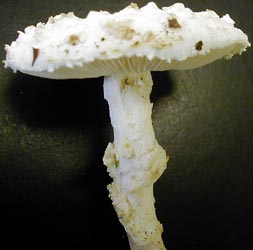 1. Amanita magniradix, GSMNP, Tennessee, U.S.A. 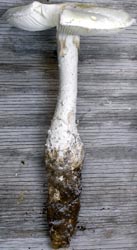 2. Amanita magniradix, ??, U.S.A. 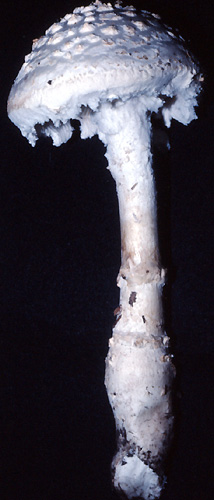 3. Amanita magniradix, ca. E. Stroudsburg, Pennsylvania, U.S.A. |
| intro |
Amanita magniradix, as indicated by the name, usually bears a deeply radicating basal bulb that is extremely difficult to excavate in its entirety. The specimen on the left, above, is an exception. The cap of this species bears a notable sterile margin extending a few mm beyond the outer ends of the lamellae—this is in addition to the material of the partial and/or universal veil that often is found hanging from the outer edge of the sterile margin. The following text is based on original research of R. E. Tulloss. |
| cap | The cap of A. magniradix is 58 - 150 mm wide, white, sometimes browning slightly near margin with age or after partially drying in the field; at first, it is hemispheric, then it becomes broadly convex to plano-convex. Occasionally, the cap becomes depressed in the center; it is shiny to subshiny and faintly tacky to dry. The cap's flesh is white, unchanging or becoming pallid yellowish tan to yellowish when cut or bruised. The flesh is 9 - 18 mm thick over the stem. The cap's margin is nonstriate, densely appendiculate in a ragged band or like a discontinuous curtain or as flocculence along the edge of an apparent membranous extension of the cap. The volval remnants on the cap are lumpy pyramidal to flattened warts that are irregularly floccose (fluffy near the cap's margin, more compact near the cap's center). Sometimes adjacent pyramidal warts are joined by their tips, sometimes their bases are joined by a nearly complete adnate volval layer. The volval remnants are white at first, then grayish or brownish especially at the wart's top's. Warts are up to 2 mm high, up to 4 mm wide, easily crushed, and leave a thin patch when removed. |
| gills | The gills of this mushroom are adnate to minutely adnate to free, with or without a decurrent tooth or decurrent line on the top of the stem. They are subclose to subcrowded to crowded, white to off-white to cream to yellowish cream in mass, pale off-white to off-white to cream in side view. They are 6 - 16 mm broad, with white minutely flocculose to flocculose edge, and infrequently are connected to a neighboring gill or short gill. The short gills are truncate to subtruncate to subattenuate to stepwise attenuate to attenuate, plentiful, of diverse lengths, and unevenly distributed. |
| stem | The stem is 61 - 158 × 7.5 - 18 mm, dry, white to off-white, occasionally bruising yellow to yellow brown to brownish orange and later brown from handling—most of stipe may get brown tints in age. The stem is subcylindric or narrows slightly upward or downward, it flares outward near its top (sometimes slightly at first). The stem is pulverulent-flocculent above its ring or ring-zone, and below the ring the stem is smooth to densely lacerate-floccose or may develop squamules in a number forms (see technical tab). Sometimes the stem surface is decorated by drooping, rather thick, garlands of volval tissue from the internal limb. If no decorations are present, the stem becomes satiny and longitudinally striatulate (decorated with very fine striations). The stem's basal bulb is up to 135 mm or more in length (not yet collected without being broken), 12.5 - 32 mm wide, subsinuous to sinuous, with its surface having appearance of the skin of a new potato. Usually the bulb narrows into a very deeply penetrating radical (often impossible to collect in its entirety). The solid flesh of the stem is the same color as the stem's surface, yellowing or (more often) unchanging when cut or bruised, but with some brownish stains occasionally in the bulb. At first, the stem may bear ring—white, sometimes yellowing then browning with age, staining yellow when bruised in some collections. The ring is floccose to very weakly membranous; when it is floccose, it leaves a dense deposit of material on the upper stem—up to 4 mm thick at the bottom of the deposit. When the ring is weakly membranous at first, it is striate on its upper surface and sometimes bears a thick marginal load of material derived from the internal limb of the volva. In either case, the ring easily breaks up when touched; and fragments come off on one's fingers. In brief, the ring is ephemeral to somewhat persistent. Parts of the volva may be found on the lower stem and the upper part of the bulb in warts like those on pileus (removal leaving a thin basal patch) or in floccose-felted patches or in broken (sometimes rather distant) rings (up to 6 or more) as one sees in A. muscaria and some related taxa. Such volval material is white or whitish or pale grayish white at first and becomes brown with age. |
| odor/taste |
The odor is pleasant, but rather strong when young; later, the odor is pungent on sectioning—like chlorine or as in the "CaCl" group of odors (decaying protein) or like fresh green beans or lima bean pod. The taste has not been recorded. The species should be considered POISONOUS because of its apparently close phenetic relationship with the toxic A. smithiana. |
| spores | The spores of A. magniradix measure (6.5-) 8.4 - 11.8 (-14.7) × (4.3-) 4.5 - 6.5 (-7.8) µm and are ellipsoid to elongate to cylindric and amyloid. Although microscopic study is not complete, clamps will probably be found at the bases of some basidia. |
| discussion |
At present, this species is know to occur in the U.S.A. from the southern New England states to Tennessee. At least one photograph posted on mushroomobserver.com in 2010 suggests that this species' range may extend westward to the Missippi River south of the Great Lakes. Amanita magniradix appears in hardwood or mixed forests in which oak (Quercus) is present. This large, white mushroom has a sometimes yellowing, flocculent partial veil and a deeply rooting bulb reminiscent of the bulb of A. smithiana Bas—so deeply rooting that large specimens probably are never collected in their entirety. Amanita magniradix is also somewhat similar to A. rhopalopus Bas; but, among other differences, has consistently narrower spores.—R. E. Tulloss |
| brief editors | RET |

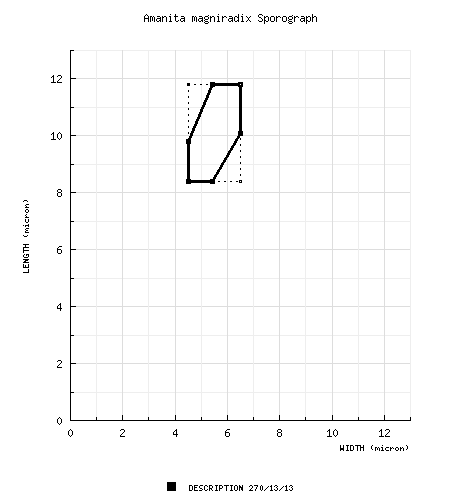
 Spore data sets and their composite