| name |
Amanita
sp-10 |
| author |
Tulloss et al. |
| name status |
cryptonomen temporarium |
| english name |
"Brown-Haired Yellow Dust Amanita" |
| GenBank nos. |
Due to delays in data processing at GenBank, some accession numbers may lead to unreleased (pending) pages.
These pages will eventually be made live, so try again later.
|
| intro |
Olive text indicates a specimen that has not been
thoroughly examined (for example, for microscopic details) and marks other places in the text
where data is missing or uncertain.
The following material not directly from the protolog of the present taxon is based upon
original research by R. E. Tulloss. |
| pileus |
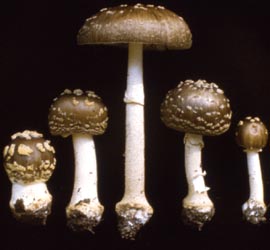
40–105 mm wide, at first solidly pigmented dark brown to fuliginous (e.g., 5E5–6), becoming densely virgate with brown (ca. 10YR 6–7/3) streaks on gray-tan (ca. 10YR 4/4) ground color, darkest over disc, sometimes with yellow tint at first that disappears in situ, sometimes with slight reddish tint near margin, hemispheric at first with or without incurved margin, then broadly convex to planar, sometimes depressed in age and with recurved margin, dull to subshiny and tacky when moist, subshiny to subsilky when dry; context white, not changing when cut or bruised, in particular no yellow reaction when pileipellis is scraped away over disc, 3–5 mm thick at stipe, thinning evenly to margin; margin nonstriate or short striate (sometimes even before partial veil separation), nonappendiculate; universal veil as yellow warts (occasionally confluent) or crumbs or small patches, < 2 mm thick, occasionally subpyramidal, minutely verruculose, flocculose, friable, detersile, fading to pale yellow then tan or grayish and finally brownish in age. |
| lamellae |
free to narrowly adnate, without decurrent line on stipe, crowded, off-white to pale cream in mass, white in side view, unchanging when cut or bruised or infrequently with brown spots, thin, 2–9 mm broad; lamellulae truncate to rounded truncate to attenuate in steps to (predominantly) attenuate, plentiful, unevenly distributed, of diverse lengths. |
| stipe |
33–93 × 8–16 mm, whitish, sometimes pale yellow in some parts, becoming sordid or brownish from age and handling, cylindric to subcylindric or narrowing slightly upward, flaring at apex, sometimes slightly flattened, above annulus finely pulverulent-flocculose or sometimes finely punctate, below annulus finely longitudinally striatulate and with scattered (sometimes minute) raised fibrils (lens); bulb 10+–29 × 9–25 mm, as white or whiter than palest part of stipe, ovoid to subnapiform to narrowly fusiform, sometimes subradicating, with cluster of white mycelial threads on very base tending to hold clump of soil at that point; context off-white, usually solid to firmly stuffed at first, occasionally with some lacunae, sometimes mostly hollow, with central cylinder whiter than remainder, with central cylinder 1–4 mm wide, with larva tunnels usually concolorous with surrounding tissues, sometimes becoming pinkish brown to slightly orangish brown or brown where damaged by insects; partial veil pale yellow to white, superior, membranous, skirt-like, thin, smooth above and below, with edge thickened by yellow universal veil material and darkening in age, collapsing on stipe; universal veil as yellow (ca. 3A5) warts on lower stipe and upper part of bulb, can easily be lost during collecting, occasionally with thin partial ring of yellow limbus internus on stipe close to top of bulb, sometimes becoming red-brown on exposure or from handling. |
| odor/taste |
Odor indistinct to faintly earthy. Taste not recorded. |
macrochemical
tests |
Spot test for laccase (syringaldazine) - negative throughout basidiome. Spot test for tyrosinase (paracresol) - positive only in the lower part of the bulb in buttons; positive through most of lower stipe and (slowly) in bulb and on cut edges of lamellae in basidiomes expanded but not sporulating; positive throughout mature basidiome except for few spots on lamellae or in lower bulb. Test vouchers: Tulloss 8-1-86-I, 8-2-96-C. |
| basidiospores |
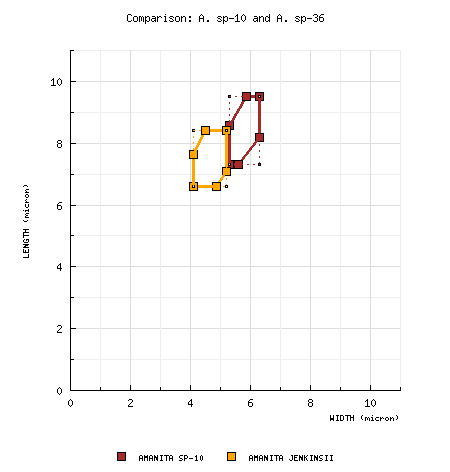
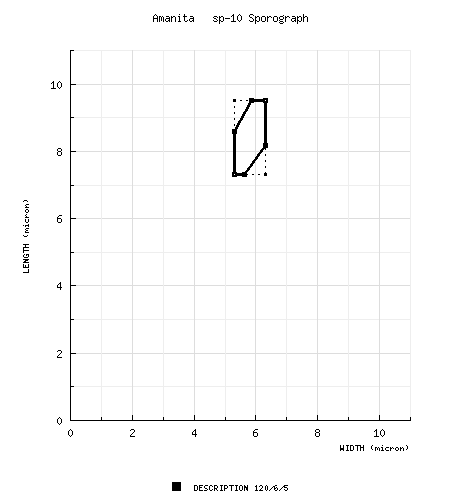
RET: [120/6/5] (6.6-) 7.3 - 9.5 (-12.5) × (4.7-) 5.3 - 6.3 (-7.8) µm, (L = 7.8 - 9.2 µm; L’ = 8.4 µm; W = 5.5 - 6.0 µm; W’ = 5.8 µm; Q = (1.18-) 1.30 - 1.62 (-1.73); Q = 1.37 - 1.55; Q’ = 1.46), hyaline, colorless, thin-walled, smooth, amyloid, predominantly ellipsoid, infrequently broadly ellipsoid, infrequently elongate, predominantly adaxially flattened; apiculus sublateral, cylindric; contents granular to mono- to multiguttulate (when monoguttulate, usually of "oil drop" form); white in deposit. |
| ecology |
Subgregarious, often after extended soaking rains. Maryland: In swampy woods. . New Jersey: In sand in deciduous forest including Quercus or in loam under Tsuga canadensis (as partial fairy ring around tree) with Betula sp., Rhododendron maximum, and Prunus serotina or in a mixed conifer planting dominated by Tsuga canadensis. |
| material examined |
U.S.A.:
MARYLAND—Worcester Co. - Nassawango Crk. Nat. Preserve, Sand Rd., 16.ix.1990 L. T. Biechele s.n. (RET 110-5).
NEW JERSEY—Mercer Co. - E. Windsor Twp., Etra Lk. Twp. Pk. [40°15’11” N/ 74°29’54” W], 2.viii.1996 M. A. & S. E. K. Tulloss s.n. [Tulloss 8-2-96-C] (RET 228-6); Hopewell Twp., 1.viii.1986 R. E. Tulloss 8-1-86-D (RET 110-8); Princeton, 30.v.1983 R. E., D. C., & M. H. Tulloss & M. A. King [Tulloss] 5-30-83-B (RET 219-1); Hopewell Twp., off Carter Rd., woods behind AT&T/Lucent research labs [40°21’39” N/ 74°43’29” W, 63 m], 1.viii.1986 R. E. Tulloss 8-1-86-C (RET 240-5); Princeton, Princeton University Graduate College campus [40°20’25” N/ 74°39’55” W], 15.vii.1982 N. Macdonald & R. E. Tulloss [Tulloss 7-15-82-A] (RET 354-2), [Tulloss 7-15-82-E] (RET 354-3); 21.vi.1983 R. E. Tulloss 6-21-83-A (RET 219-2), -B (RET 219-8), -C (RET 219-7), 1.viii.1986 R. E. Tulloss 8-1-86-I (RET 015-9). Monmouth Co. - Shark River Co. Pk. [40°12’18” N/ 74°05’44” W, 16 m], 8.vii.1984 unkn. coll.? 7-8-84-I (RET ??), -J? (RET ??), 13.ix.1998 R. E. Tulloss et al. [Tulloss] 9-13-98-F (RET 287-4).
NEW YORK—Queens Co. - Cunningham Pk. 31.vii.1982 A. Norarevian s.n. [Tulloss 7-31-82-AN1] (RET 354-4).
[Note: There is at least one possible collection in the Costa Rican Agaricales collections—(RET 325-5).] |
| discussion |
The current entity differs from
A.
jenkinsii (A. franchetii sensu
Jenkins) by having apparent innate fibrils and a
virgate pileus usually lacking shades of orange and
by having larger and slightly less elongate
spores. Sometimes, there may be shades of
yellow in the pileus of some specimens, but the
yellow tint appears to be lost as the basidiome
matures.
The species is separated from
A.
franchetii of Europe by lack of a yellowing
reaction in the pileus context when the young
pileipellis is scraped away and by its having
smaller and narrower spores. Neville and Poumarat
(2004: 744)
give 7.5–9.5 (–11.0) × (5.0–) 5.5–7.0 (–7.5) µm
(L’ = 8.6 µm; W' = 6.3 µm;
Q = 1.20–1.50 (–1.60); Q = 1.32–1.40;
Q’ = 1.36) for the European species based on
measurement of 60 spores.
Among North American Amanita taxa, the habit
of A. sp-10 is most suggestive of that of
A. flavoconia
G. F. Atk.
One collection originally labeled "Amanita
sp. 43" [Tulloss 8-9-87-G (RET 180-9)] and that
might be assigned here differs (so far as is known)
solely by having a pale brown/tan pileus and a
"fruity" odor. The collection came from the
Shark River site at which the present taxon has also
been collected.
The collection including the fruiting body with the
largerst spores measured for this taxon is Tulloss
9-13-98-F. The specimen in question bore
"giant" spores of slightly irregular shape.
To date, all measured spores of length greater than
9.8 μm and all but four have length greater than
9.1 μm come from this single basidiome.
The taxon is liable to attack by Hypomyces
hyalinus(Schwein.) Tul. & C. Tul. Infected
basidiomes of the present species have been
collected at the Princeton University site. |
| citations |
—R. E. Tulloss |
| editors |
RET |
|




 Spore data sets and their composite