| name |
Amanita flavoconia var. flavoconia |
| author |
G. F. Atk. 1902. J. Mycol 8: 110. |
| name status |
nomen acceptum |
| english name |
"American Yellow Dust Amanita" |
| synonyms |
≡ Amplariella flavoconia (G. F. Atk.) E.-J. Gilbert. 1940. Iconogr. Mycol. (Milan) 27, suppl. (1): 78.
≡Venenarius flavoconius (G. F. Atk.) Murrill. 1948. Lloydia 11(2): 101.
The editors of this site owe a great debt to Dr. Cornelis Bas
whose famous cigar box files of Amanita nomenclatural information
gathered over three or more decades were made available to RET for computerization
and make up the lion's share of the nomenclatural information presented on this site.
|
| MycoBank nos. |
206277, 284154, 291942 |
| GenBank nos. |
Due to delays in data processing at GenBank, some accession numbers may lead to unreleased (pending) pages.
These pages will eventually be made live, so try again later.
|
| lectotypes |
CUP |
| lectotypifications |
Jenkins. 1982. Mycotaxon 14: 242. |
| type studies |
Jenkins. 1982. Mycotaxon 14: 242. |
| selected illustrations |
Tulloss. 2000a. Boll. Gruppo Micol. G. Bresadola 43(2): 20, fig. 12. |
| intro |
The following text may make multiple use of each data field.
The field may contain magenta text presenting data from a type study
and/or revision of other original material cited in the protolog of the present taxon.
Macroscopic descriptions in magenta are a combination of data from the protolog and
additional observations made on the exiccata during revision of the cited original
material.
The same field may also contain black text, which is data from a revision of the present
taxon (including non-type material and/or material not cited in the protolog).
Paragraphs of black text will be labeled if further subdivision of
this text is appropriate.
Olive text indicates a specimen that has not been
thoroughly examined (for example, for microscopic details) and marks other places in the text
where data is missing or uncertain.
The following material is based on original research of R. E. Tulloss. |
| pileus |
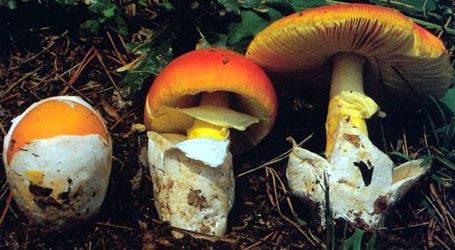
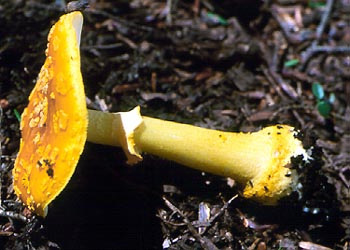
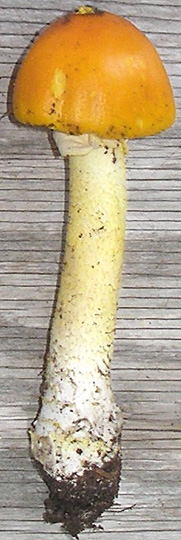
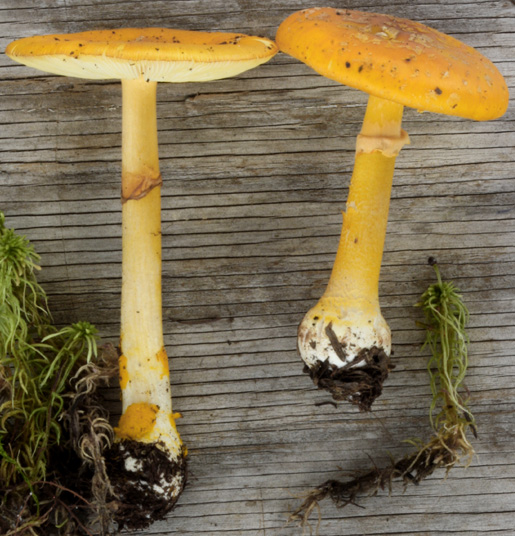
30 - 63 mm wide, yellow-orange to orange-yellow to saturated orange, most intensely orange over disc (e.g. 4A8 to 5B8 to 8A-B8), sometimes more yellowish toward margin, often distinctly appearing radially fibrillose (with such fibrils with color more saturated than in surrounding surface), unchanging when cut or bruised, campanulate with broad umbo when partial veil starting to separate, plano-convex to undulant at maturity, viscid to tacky when moist, shiny; context 2.5 - 4.5 mm thick above stipe, off-white to white except for pale yellow below pileipellis, thinning evenly to margin; margin usually nonstriate, infrequently striate (0.2R), nonappendiculate; universal veil usually orangish yellow or yellow, unchanging when bruised or cut, infrequently white (possibly due to bleaching), detersile, in rather thin small patches and warts, irregularly distributed, verruculose (10× lens), often absent or nearly so. |
| lamellae |
free or narrowly adnate, with decurrent line on upper stipe lacking or faint (10× lens), close to subcrowded, white to whitish to pale yellow to yellow in mass, white in side view, unchanging when cut or bruised, ventricose, 4 - 6 mm broad, with yellow edges; lamellulae attenuate to subattenuate to rounded truncate, of diverse lengths, plentiful. |
| stipe |
45 - 105 × 3 - 11 mm, yellow (3A5 or 3A7) from upper third to all of stipe or in separated apical and basal (above bulb) regions, otherwise cream to white, unchanging when cut or bruised, narrowing upward, flaring at apex (although often barely flaring), finely pulverulent (lens) above partial veil, minutely longitudinally striatulate and sometimes with raised fibrils below partial veil; bulb 18 - 20 × 10 - 19 mm, white, more or less subnapiform with rounded bottom, not abrupt; context hollow or stuffed; white except sometimes pale yellow below yellow area of surface especially near stipe apex, usually unchanging when cut or bruised, infrequently pale pinkish in bulb, with central cylinder 2.5 mm wide and containing white cottony material; partial veil superior, membranous, persistent, skirt-like, collapsing with age, yellow (3A4), sometimes become sordid or brown with age, at times with yellow volval fragments on underside at edge; universal veil as fragmenting friable warts and patches on lower stipe and upper bulb, detersile, yellow to orangish yellow, often left in substrate during collection of basidiome. |
| odor/taste |
Odor faint. Taste not recorded. |
macrochemical
tests |
spot test for tyrosinase (L-tyrosine) - slowly positive in pileus context and even more slowy positive on lamellae, on stipe surface, and in stipe context. Voucher collection: Tulloss 7-7-85-B. |
| basidiospores |
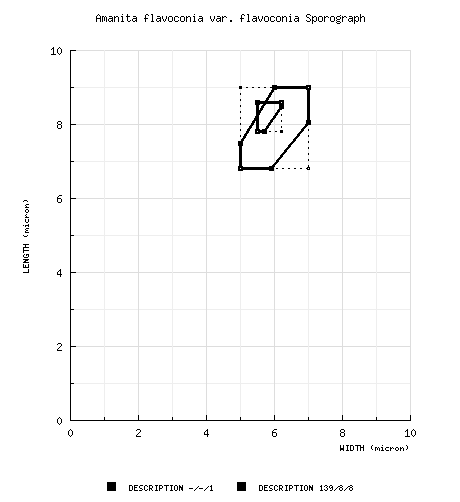
from type study of Jenkins (1982): [-/-/1] 7.8 - 8.6 × 5.5 - 6.2 μm, (Q = 1.37 - 1.57; Q' = 1,44), hyaline, thin-walled amyloid, ellipsoid; apiculus sublateral, truncate-conic; contents guttulate;
color in deposit not recorded.
Composite data from all material revised by RET:
[139/8/8] (6.5-) 6.8 - 9.0 (-10.6) × (4.8-) 5.0 -
7.0 (-8.9) µm, (L = 7.2 - 8.2 (-8.6) µm;
L’ = 7.9 µm; W = (5.3-) 5.5 - 6.9 µm;
W’ = 6.0 µm; Q = (1.08-) 1.15 - 1.50 (-1.64);
Q = 1.21 - 1.43 (-1.49); Q’ = 1.33),
hyaline, colorless, smooth, thin-walled, amyloid,
broadly ellipsoid to ellipsoid, occasionally
elongate, rarely subglobose, usually adaxially
flattened, sometimes expanded at one end;
apiculus sublateral, small, cylindric;
contents ??;
white in deposit. |
| ecology |
Solitary to gregarious. New Jersey: In Pinus-Quercus barrens or in loam of hardwood forest including Fagus grandifolia, Liriodendron tulipifera, Acer, Quercus alba, Carya ovata and Viburnum acerifolia or in Fagus-Quercus-Carya forest without any conifers present or in loamy clay of hardwood forest including Q. alba, Q. palustris and Acer or in swampy area of mixed deciduous woods near F. grandifolia and L. tulipifera or in Northern Hemlock-Hardwood forest including Tsuga canadensis and Betula allegheniensis. Ohio: Under T. canadensis. Pennsylvania:In pure grove of T. canadensis.
Tennessee: At 780 - 1760 m elev.
West Virginia: At up to 940± m elev. Under T. canadensis. |
| material examined |
from type study of Jenkins (1982): U.S.A.:
NEW YORK—Unkn. Co. - Cayuga Lk. basin, woods N of Fall Crk., 25.vii.1902, Bradfield and Thom 9963 (lectotype, CUP).
CANADA: NEWFOUNDLAND & LABRADOR—Isl. of Newfoundland - GMNP, Lomond, Lomond-Stuckless Pond Tr., 14.ix.2004 R. E. Tulloss 9-14-04-C (RET 384-1); GMNP, Killdevil Anglican Church Camp, 17.ix.2004 Noah Siegel s.n. [Tulloss 9-17-04-B] (RET 384-10), 17.ix.2004 Andrus Voitk s.n. [Tulloss 9-17-04-A] (RET 385-1).
U.S.A.:
CONNECTICUT—Middlesex
Co. - E. Haddam, Devil’s Hopyard St. Pk.
[41°28'32" N/ 72°20'25" W, 72 m], 24.viii.2007
R. E. Tulloss 8-24-07-C (RET 439-8).
New London Co. - Colchester, Day Pond St. Pk. [41°33'25" N/ 72°25'06" W, 134 m], 24.viii.2007 Rock s.n. [Tulloss 8-24-07-A] (RET 439-2), R. E. Tulloss 8-24-07-H (RET 439-10).
INDIANA—Monroe Co. - Bloomington, Griffey Lk. [39.2010° N/ 86.5188° W, 202 m], 5.vi.2012 Stephen Russell s.n. (RET 533-6); Morgan-Monroe St. For. [39.3298° N/ 86.4388° W, 248 m], 20.ix.2012 Stephen Russell s.n. [mushroomobserver.org #110651] (RET 533-10). Montgomery Co. - Waveland, Shades St. Pk. [39.9378° N/ 87.0894° W, 223 m], 28.viii.2012 S. Russell 3667 (RET 533-1).
MAINE—Cumberland Co. - Falmouth, Atherton Woods, 12.viii.1990 Dr. Samuel S. Ristich s.n. [Tulloss 8-12-90-SSR1] (RET 009-5).
MASSACHUSETTS—Hampden Co. - ca. Holyoke, Mt. Tom St. Reservation, 27.ix.1986 Ellen Greer s.n. [Tulloss 9-27-86-EG4] (RET 224-1).
MISSOURI—St. Louis Co. - Forest 44
Conservation Area [38.5318° N/ 90.5173° W, 144 m
elev.], 9.ix.2008 Jeff Cameron s.n.
(RET 423-8).
NEW JERSEY—Burlington Co. - ca.
Chatsworth, Franklin Parker Preserver, RRE sector,
28.viii.2010 Nina Burghardt & Lily Tulloss
[Tulloss 8-28-10-C] (RET 450-10);
Penn St. For.,
Oswego Lk. [39°44’02” N/ 74°29’26” W], 3.x.1997
Mary A., Sarah E. K. & R. E. Tulloss 10-3-97-A
(RET 271-4); bank of Wading R., E of Co. Rte. 563,
S of Jenkins, 11.ix.1983M. A. King & R. E.
Tulloss 9-11-83-D (RET 470-4).
Middlesex Co. - Jamesburg Twp. Pk., ca. Helmetta
[40°23’07” N/ 74°25’48” W], 24.viii.1985 R. E.
Tulloss 8-24-85-M (RET 099-2). Monmouth Co. -
Shark River Co. Pk. [40°12’18” N/ 74°05’44” W, 16
m], 19.viii.2011 L. K., M. A., O. C., & R. E.
Tulloss & C. Rodríguez Caycedo [Tulloss]
8-19-11-B] (RET 485-6).
Sussex Co. - Stokes St. For., 7.vii.1985 D. C.
Tulloss, M. A. King & R. E. Tulloss 7-7-85-B
(RET 056-1).
NEW YORK—Franklin Co. - Floodwood Mtn.
Rd. [44.3476° N/ 74.4424° W, 501 m], 12.viii.2011
L. Shirley s.n. [Tulloss 8-12-11-D]
(RET 480-5).
Oneida Co. - unkn. loc.,
29.viii.2010 Eric Smith s.n.
[www.mushroomoberver.org
#51712]
(RET 481-4), ix.2010
Eric Smith s.n. (RET 481-8).
OHIO—Butler Co. - Oxford, Miami Univ.
campus, near Formal Gardens, 28.vii.1992 M. A.
Vincent 5613 (MU; RET 121-3).
PENNSYLVANIA—Clarion Co. - Cook For. St. Pk., Corduroy Tr. [41°20’48” N/ 79°13’16” W, 400 m], 5.viii.2011 Garrett Taylor s.n. [Tulloss 8-6-11-G] (RET 478-2). Pike Co. - Dingman's Ferry, Pocono Environmental Education Ctr. [41°10'17" N/ 74°54'52" W, 235 m], 20.vi.1981 M. A. King & R. E. Tulloss 6-20-81-D (RET 175-3).
TENNESSEE—Blount Co. - GSMNP, Cades
Cove, Loop Rd., 27.ix.2006 D. J. Lodge, E. B.
Lickey & R. E. Tulloss 9-27-06-M (RET
396-5). Sevier Co. - ca. Gatlinburg, GSMNP,
Alum Cave trailhead [35°37’48” N/ 83°27’04” W],
13.vii.2004 L. L. Norvell LLN2040713-005
(RET 376-9), Dr. Joaquin Cifuentes s.n.
[Tulloss 7-13-04-B] (RET 376-10); ca.
Gatlinburg, GSMNP, Cherokee Orchard
[35.6811° N/ 83.4625° W, 945],
12.vii.2004 S. Tieken s.n.
[Tulloss 7-12-04-T] (RET 377-8); ca. Gatlinburg,
GSMNP, Fork Ridge trailhead
[35°35’24” N/ 83°28’09” W], 13.vii.2004 Dr. L. L.
Norvell & David P. Lewis [Norvell]
LLN2040713-02 (RET 376-7).
WEST VIRGINIA—Greenbrier Co. - Monongahela Nat. For., Lake Sherwood Recreation Area [38°00'24" N/ 80°06'40" W, 825 m], 2.ix.1982 Mark H. & R. E. Tulloss 9-2-82-B (RET 214-5). Tucker Co. - Blackwater Falls St. Pk. [39°06’45” N/ 79°29’02”W], 28.vi.1996 M. A. & S. E. K. Tulloss s.n. [Tulloss 6-28-96-A] (RET 181-7); Fernow Exp. For., 4.ix.1992 S. L. Stephenson, R. P. Bhatt & A. Kumar WS7-103 (FWVA), WS13-104 (FWVA), WS13-105 (FWVA), WS13-106 (FWVA) & WS13-139 (FWVA). |
| discussion |
The present name is applied to what is apparently one of the most common species of Amanita sect. Validae in eastern North America, where it appears to be associated with a relatively large number of symbionts. We use the words "apparently" and "appears" because we have reason to believe that we may be dealing with multiple species under the name flavoconia.
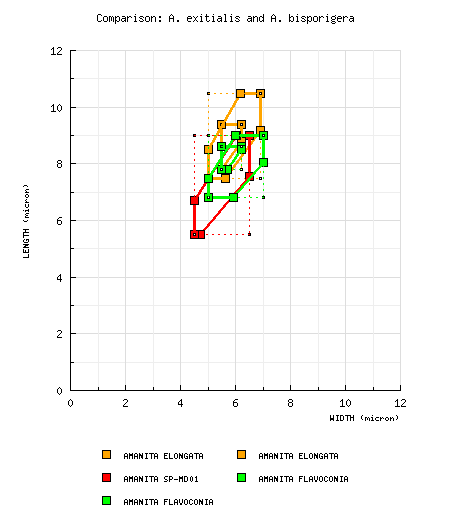
It is not clear how many taxa are in the group with brightly colored yellow to orange to reddish orange caps in eastern North America. This group of amanitas is phenologically and phylogenetically similar to the group associated with the name A. flavipes in eastern Asia; and the latter group appears to comprise a number of distinct taxa according to on-going research in ZLY's laboratory in Kunming. We probably expect that a similar situation will be found once we start sequencin a large number of collections of A. flavoconia, A. elongata, A. sp-MD01, etc. A sporograph comparison of the three taxa follows. Be aware that the sample size for spores of A. sp-MD01 is small.
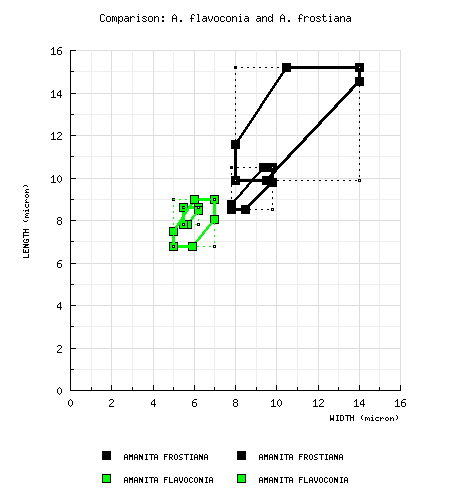
It is required (there must be a compelling Supreme Court ruling) that in any discussion of the present species one must explain how it can be segregated from A. frostiana. The latter has significantly larger, globose, inamyloid spores; often it has an ocreate "rolled sock"-type universal veil at the top of its stipe's bulb; the margin of the pileus is usually striate; and the lamellulae are predominantly truncate. A sporograph comparison of the two species is provided below:
|
| citations |
—R. E. Tulloss |
| editors |
RET |
|



 Spore data sets and their composite