| name |
Amanita brunnescens |
| author |
G. F. Atk. 1918. Proc. Amer. Philos. Soc. 57: 354. |
| name status |
nomen acceptum |
| english name |
"Brown American Star-Footed Amanita" |
| synonyms |
≡ Amanitina brunnescens (G. F. Atk.) E.-J. Gilbert. 1940. Iconogr. Mycol. (Milan) 27, suppl.1: 78, tabs. 35-27 (numerous figs.). [Based on his naming of Amanita brunnescens f. straminea, it is clear that Gilbert included Amanita citrina sensu auct. amer. in Amanita brunnescens. Hence, many of the spores depicted in the cited figures of the present work may not be from specimens of the latter species.]
=Amanita brunnescens var. pallida L. Krieg. 1927. Mycologia 19: 308.
?= Amanita viridis var. fuliginea Schwein. 1822. Schr. Nat. Ges. Leipzig 1: 79.
=Amanita phalloides var. fuliginea Ferry. 1911. Études Amanites. Amanites Mort.: 94, pl. 4 (figs. 1-4). ≡ Amanita phalloides f. fuliginea ("Peck") E.-J. Gilbert. 1918. Gen. Amanita Pers.: 49. [Superfluous name.]
The editors of this site owe a great debt to Dr. Cornelis Bas
whose famous cigar box files of Amanita nomenclatural information
gathered over three or more decades were made available to RET for computerization
and make up the lion's share of the nomenclatural information presented on this site.
|
| MycoBank nos. |
101402 |
| GenBank nos. |
Due to delays in data processing at GenBank, some accession numbers may lead to unreleased (pending) pages.
These pages will eventually be made live, so try again later.
|
| holotypes |
Amanita brunnescens—CUP-A |
| lectotypes |
Amanita brunnescens var. pallida—syntypes in MICH?. |
| type studies |
Amanita brunnescens—Jenkins. 1982. Mycotaxon 14: 238. |
| intro |
The following text may make multiple use of each data field.
The field may contain magenta text presenting data from a type study
and/or revision of other original material cited in the protolog of the present taxon.
Macroscopic descriptions in magenta are a combination of data from the protolog and
additional observations made on the exiccata during revision of the cited original
material.
The same field may also contain black text, which is data from a revision of the present
taxon (including non-type material and/or material not cited in the protolog).
Paragraphs of black text will be labeled if further subdivision of
this text is appropriate.
Olive text indicates a specimen that has not been
thoroughly examined (for example, for microscopic details) and marks other places in the text
where data is missing or uncertain.
The following material that is not otherwise attributed in the text is based on original research of R. E. Tulloss. |
| pileus |
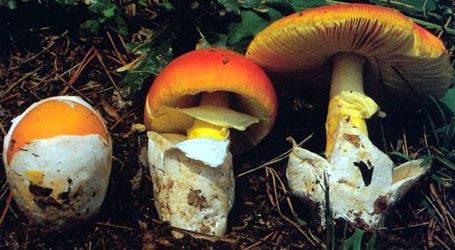
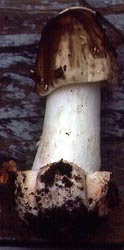
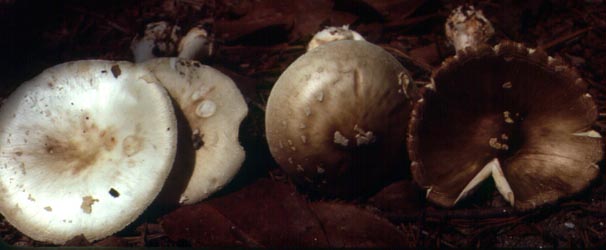
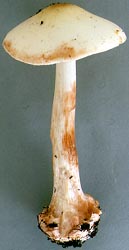
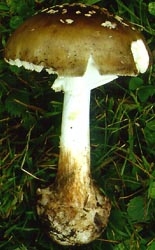
Up to 70 - 97 mm wide, pale citrin (e.g., yellower than 1A2, paler that 1A3) to olivaceous brown to dark gray-brown or dark red-brown, often distinctly virgate with pigment at least partially in radial fibrils, often darker over disc [e.g., in pallid citrin cap, pale sordid yellow (e.g., ca. 5B2 or browner than 5Y 8/3)], infrequently with ca. one-half of cap pallid and one-half of cap much darker brown, broadly rounded conic to broadly campanulate to convex to planar, viscid to tacky to dry, dull when moist, shiny when dry; context white except for pale cream in upper part of disc, staining brown, 4.5 - 9 mm thick above stipe, thinning evenly to margin; margin nonstriate, nonappendiculate, slightly incurved at first; universal veil absent or present as scattered warts and small patches, submembranous at least at first, friable, detersile, whitish of off-white at first, becoming orange-brown then dark brown on exposure. |
| lamellae |
free to very narrowly adnate with dense faint lines (10× lens) or small decurrent tooth (10× lens) on upper stipe, crowded, white to cream in mass, very pale cream to pale cream in side view, staining brown, 5.5- - 6+ mm broad, broadest at midlength; lamellulae subtruncate to subattenuate to attenuate, unevenly distributed, plentiful, of diverse lengths. |
| stipe |
90 - 108 × 12- 15 mm, entirely whitish or pale cream above partial veil and white below, with orange-brown to brown stains developing in lower half of stipe and on bulb, narrowing upward, barely flaring at apex, finely striatulate, fibrillose-squamulose in lower half; bulb 22 - 28 × 30- 34 mm, abrupt, subglobose? to hemispheric to subhemispheric, with multiple deep vertical clefts; context stuffed (often limited to upper stipe) to solid, white, staining like stipe surface, pale orange-brown to orange-brown in larva tunnels, with 2 mm wide central cylinder with densely packed white fibrillose stuffing material; partial veil superior to subapical, cream, with infrequent brown radial streaks, sometimes becoming sordid with age, brown-staining especially on edge, membranous, skirt-like, striate above, smooth below; universal veil originally pallid, becoming brown, forming incomplete very short limb on bulb rim or absent. |
| odor/taste |
Odor of freshly dug potatoes especially in stipe and bulb context when just sectioned. Taste not recorded. |
macrochemical
tests |
Spot test for tyrosinase (L-tyrosine) - negative on stipe surface and context (only areas tested). Spot test for laccase (syringaldazine) - negative thoughout basidiome or slowly positive on cut edges of lamellae, slowly positive (intensifying over 15 min.) in spots in stipe context and pileus context near top of stipe and upper center of bulb or base of bulb. Spot test with 2-furaldehyde ("furfural") - negative throughout basidiome. 10% KOH - on lamella, pale yellow; on cap of pallid specimen, pale yellow. Conc. HNO3 - on cap context, instantly orange, becoming yellow; on lamellae instantly yellow-orange, becoming yellow; on stipe context yellow; on bulb context, yellow; on pileus surface of pallid specimen, instantly pink, soon fading to pale yellow. Test vouchers: Tulloss 8-15-85-B. 11-25-85-A, 8-4-95-B, 9-22=96=F. [Note: Compare 2-furaldehye spot test with those of similar taxa A. aestivalis and A. asteropus.—ed.] |
| basidiospores |
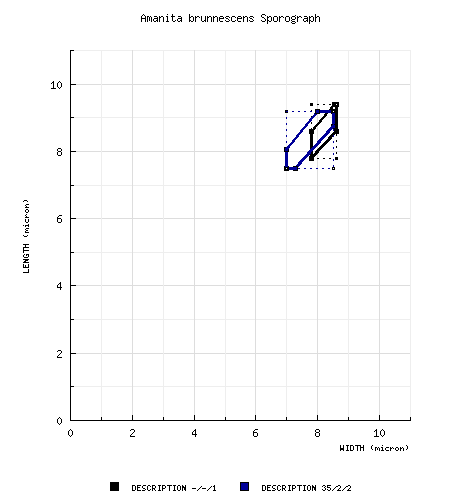
Jenkins (1982): [-/-/1] 7.8 - 9.4 × 7.8 - 8.6 μm, (Q = 1.0 - 1.10; Q' = 1.07),
hyaline, thin-walled amyloid, globose to subglobose; apiculus sublateral, cylindric; contents guttulate;
color in deposit not recorded.
Composite data from all material revised by RET:
[35/2/2] (7.0-) 7.5 - 9.2 (-9.5) × (6.5-) 7.0 - 8.5
(-9.2) µm, (L = 8.2 - 8.7 µm;
L’ = 8.4 µm; W = 7.6 - 8.0 µm;
W’ = 7.8 µm; Q = (1.0-) 1.03 - 1.15 (-1.18);
Q = 1.08; Q’ = 1.08), hyaline,
colorless, thin-walled, amyloid, globose to
subglobose, infrequently broadly ellipsoid;
apiculus sublateral,
??; contents
granular to monoguttulate; white in deposit. |
| ecology |
Solitary to subgregarious to gregarious, rarely in
"fairy rings." Ontario: in mixed forest with
Acer saccharum, Quercus rubra, Betula
papyirifera, Populus tremuloides, and
Abies balsamea. Missouri: In upland
Quercus-Carya flatwoods. New Jersey: At
12 - 214 m elev. In sandy soil of
Pinus-Quercus barrens (e.g., with P.
rigida, Q. marilandica, Sassafras
albidum, Smilax glauca, Vaccinium
spp., etc.). New York: In loamy clay or with
Tsuga canadensis in mixed woods including
Pinus, Abies, Quercus,
Liriodendron tulipifera, Betula,
Fagus grandifolia, Populus,
Acer, Fraxinus and other
hardwoods. South Carolina: In sandy-clay
under layer of loam and duff of
Pinus-Quercus upland forest.
Tennessee: At 805 m elev. West Virginia: With
Pinus, T. canadensis, and Acer
pensylvanicum. |
| material examined |
Jenkins (1982): U.S.A.: NEW YORK—Tompkins Co. - ca. Ithaca, Cayuga Lk., 30.vii.1917 Leva B. Walker 24227 (holotype, CUP).
CANADA: ONTARIO—Norfolk
Co. - Port Dover [42.7863° N/ 80.198° W, 182 m],
n.d. Eva Skific s.n. (RET 547-8, nrITS & nrLSU
seq'd.). Northumberland Co. -
Eels Lake, 18.viii.2014 Jan Thornhill s.n. (RET
637-7, nrITS & nrLSU seq'd.).
U.S.A.:
CONNECTICUT—Middlesex Co. - East Haddam,
Devil's Hopyard St. Pk., 3.ix.2011 Sandy Sheine
s.n. [Tulloss 9-3-11-N] (RET 488-6, dark pileus
variant, nrITS seq'd.);
Salmon River St. For.
(South) [41°32’58” N/ 72°27’01” W, 21 m],
22.ix.1996 Sandy Sheine s.n. [Tulloss 9-22-96-F]
(RET 251-5, pale pileus variant).
Tolland Co. - Gay City St. Pk. [41°43’23” N/ 72°26’38” W, 209 m], 31.viii.1997 R. E. Tulloss 8-31-97-C
(RET 267-8, dark pileus variant, nrITS seq'd.);
Somers, 29.ix.1986 Ellen Greer s.n. [Tulloss
9-29-86-EG9] (RET 224-2, pale pileus variant),
s.n. [Tulloss 9-29-86-EG10 (RET 224-3, pale pileus
variant), s.n. [Tulloss 9-29-86-EG11] (RET 224-4,
pale pileus variant).
INDIANA—Clark Co. - SW of Marshal, Lincoln
Trail St. Pk. [39.3526° N/ 87.7077° W, 187 m],
23.ix.2012 Patrick Harvey s.n. [mushroomobserver
#111046]
(RET 517-7, nrITS seq'd.).
Lawrence Co. - Lake Monroe,
Dean Wilderness [38.9762° N/ 86.3518° W, 210 m],
11.ix.2012 Stephen Russell s.n. [mushroomobserver
#109416]
(RET 529-10, nrITSs & nrLSU seq'd.).
LOUISIANA—Vernon Parish - Vernon Distr.,
Kisatchie Nat. For., Brady Rd. area, 16.v.2009 David
P. Lewis 8934 (RET 606-1, nrITS seq'd.).
MAINE—Penobscot Co. - Orono, Univ. of
Maine, 10.viii.1991 NEMF 1991 participant s.n.
[Tulloss 8-10-91-A] (in herb. F. Massart; RET 031-1,
pale pileus variant-nrITS seq'd.). Washington
Co. - Grand Lake Stream Region [45.1830° N/ 67.8423°
W, 100 m], 18.vii.2013 Teresa Clements TAC94
[mushroomobserver.org
#140397]
(RET 554-1, nrITS & nrLSU seq'd.); Perry
[44.97905° N, 67.10955° W, 24m], 25.vii.2013 T.
Clements TAC110 [mushroomobserver.org
#141053]
(RET 575-4, nrITS seq'd.).
MASSACHUSETTS—ca.
border of Berkshire & Franklin Cos. - Mohawk
Trail St. For., 16.viii.1981 M. A. King & R. E.
Tulloss 8-16-81-C (RET 323-1, pale pileus variant),
8-16-81-D (RET 323-2, dark pileus variant).
MISSOURI—Camden Co. - ca. Camdenton, Ha
Ha Tonka St. Pk., River Cave, 24.vi.2009 Sherry
Kaye s.n. [Tulloss 6-24-09-H] (RET 441-3, nrITS
seq'd.), ca. Camdenton, Ha Ha
Tonka St. Pk., Turkey Pen Hollows [37º58.183’ N/
092º45.263’ W], 28.vi.2009 Jay Justice s.n.
[Tulloss 6-28-09-B] (RET 441-9, nrITS seq'd.).
Ste. Genevieve Co. - W of Ste. Genevieve, Hawn St.
Pk. [37.8337° N/ 90.2416° W, 262 m], 13.viii.2011
Patrick Harvey s.n. [mushroomobserver.org
#73884]
(RET 494-10, nrITS seq'd.); W of Ste. Genevieve, Hawn St. Pk.
[37.83° N/ 90.23° W, 188 m], 5.vii.2014 P. Harvey
s.n. [mushroomobserver
#169103]
(RET 641-10, nrITS
& nrLSU seqs.).
NEW JERSEY—Burlington
Co. - W of Chatsworth, Franklin Parker Preserve,
woods by north gate [39°48.827’ N/ 74°32.857’ W,
29 m], 14.x.2012 Naomi Goldman, Cristina Rodríguez
Caycedo & R. E. Tulloss [Tulloss] 10-14-12-B
(RET 518-5, nrITS seq'd.); Penn St. For., Oswego Lk.
[39°44’02” N/ 74°29’26” W, 16 m], 2.viii.1981 M. A.
King & R. E. Tulloss 8-2-81-A (RET 161-8).
Middlesex Co. - East Brunswick, 176 Tice's Lane
[40°27'15.41" N/ 74°25'09.29" W, 12 m], 22.vi.1989
Dr. Eugene Varney s.n. [Tulloss 6-22-89-A] (RET
248-3, nrITS seq'd..); Jamesburg, ca. Helmetta,
Jamesburg Mun. Pk. [40°23’07” N/ 74°25’48” W],
9.viii.1981 M. A. King, Aaron Norarevian &
R. E. Tulloss 8-9-81-B (RET 109-5), A. Norarevian
& R. E. Tulloss 8-9-81-I (RET 172-6, dark
cap variant), 28.vii.1985 Mark H., David C. &
R. E. Tulloss 7-28-85-C (RET 204-1, pale pileus
variant), 7-28-85-D (RET 204-2, pale pileus
variant), 30.viii.1987 D. C. Tulloss s.n. [Tulloss
8-30-87-D] (RET 018-3). Monmouth Co. -
Shark River Co. Pk. [40°12’18” N/ 74°05’44” W,
16 m], 19.viii.2011 L. K., M. A., O. C. & R. E.
Tulloss & C. Rodríguez Caycedo [Tulloss]
8-19-11-A (RET 485-1); Upper Freehold, ca.
Imlaystown, Clayton Co. Pk., Bridges Tr.,
19.viii.2012 M. A. & R. E. Tulloss 8-19-12-E
(RET 508-5, pallid pileus, nrITS seq'd.); Upper Freehold Twp.,
Assunpink Wildlife Mgmt. Area, 3.viii.1981 M. A.
King & R. E. Tulloss 7-3-81-F (RET 115-1,
dark pileus variant with progressive spore prints
from single basidiome). Morris Co. -
Hackettstown Reservoir, 26.vii.1984 R. E. Tulloss,
Jim Richards, Robert Peabody, Geoffrey Kibby
[Tulloss 7-26-84-L] (RET 052-7, dark pilleus variant)
; Mendham, Meadowood Twp. Pk. [40°47'31" N/
74°38'43" W, 214 m], 22.vii.1984 S. Hopkins, G.
Kibby & R. E. Tulloss 7-22-84-K (RET
051-7).
NEW YORK—Onondaga
Co. - NW of Beaver Lk., 4.viii.1995 R. Archambault
s.n. [Tulloss 8-4-95-B] (RET 154-5, brown pileus
variant). Otsego Co. - Oneonta, 15.viii.1985
Connie Long s.n. [Tulloss 8-15-85-B]
(RET 099-8). Ulster Co. - Rochester
Twp., Minnewaska St. Pk., 19.viii.1994 Stachula
s.n. [Tulloss 8-19-94-C] (RET 129-10, pale pileus
variant - nrITS seq'd.).
OHIO—Butler Co. - Oxford Twp., Hueston
Woods St. Pk., High Banks, 3.vii.1992 Mary W. &
Michael A. Vincent 5445 (RET 069-6).
PENNSYLVANIA—
Allegheny
Co. - McCandless Twp., North Park, unkn. loc.,
21.ix.2013 unkn. coll. s.n. [WPMC 20130921-93]
(RET 568-3). Lackawanna Co. - Lackawanna St.
For., ca. Thornhurst [41.2006° N, 75.6025° W, 523m],
41.2006° N, 75.6025° W, 523m David Wasilewski s.n.
[mushroomobserver
#140436]
(RET 569-4, pallid cap variant), 19.vii.2013 D.
Wasilewski s.n. [mushroomobserver
#140438]
(RET 570-3, pallid cap variant).
Luzerne Co. - Moon Lake Pk. [41.2530° N/
76.0470° W, 240-400 m], 20.vi.2013 D. Wasilewski
s.n. [mushroomobserver #138349]
(RET 549-9, nrITS & nrLSU).
SOUTH CAROLINA—Oconee Co. - Sumter Nat.
For., Stumphouse Tunnel Pk., 16.vii.1983 M. A. King
& R. E. Tulloss 7-16-83-M (RET 220-1).
TENNESSEE—Sevier Co. - ca. Gatlingburg,
GSMNP, Cherokee Orchard
[35.6811° N/ 83.4625° W, 945 m], 12.vii.2004
Dr. R. H. Petersen s.n. [Tulloss 7-12-04-AB]
(RET 378-1).
VERMONT—Bennington Co. - ca. Bennington,
Bennington Fish Culture Stn. [42°51'10" N/ 73°10'12"
W, 288 m], 24.viii.1980 Adair, Mary A. King & R.
E. Tulloss 8-24-80-H (RET 392-9), Mary A. King
& R. E. Tulloss 8-24-80-C (RET 392-8).
WEST VIRGINIA—Greenbrier Co. - woods
above rest stop along U.S. Rte. 60 ca. 1.6 km W of
Charmco, 9.viii.1990 M. A. Vincent 4384 (MU F38505;
RET 148-5, nrITS seq'd.). Marion Co. -
Mill Fall Run, 5.x.1993 S. L. Stephenson 93-02
(FWVA). |
| discussion |
We have for a long time held with Pomerleau
(1980) that
the proposed variety pallida of the present
species was without taxonomic value—having found a
fairy ring of A. brunnescens containing brown
pilei, pale citrin pilei, and at least one pileus
that was pale citrin on one side and brown on the
other.
Recent unpublished genetic studies find that the
material with brown caps and material with pallid
caps may have no differences in their nrITS
sequences (the presently proposed "fungal barcode)
at all and have not been found differing in more
than 4 base pairs (bp).
The present species is not strongly differentiated
from A.
aestivalis by the shape and size of spores
as seen in the following sporograph
comparison:
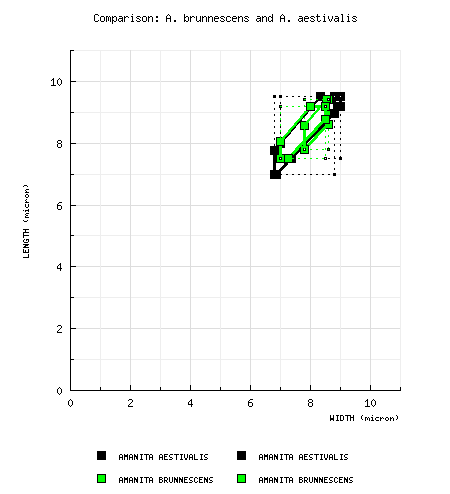
Limited DNA evidence (unpublished nrITS data)
suggests that the present taxon and A.
aestivalis may not be separable by the
currently proposed "fungal barcode." At
present they are distinguished by cap color and
difference in speed and color of their staining
reactions. |
| citations |
—R. E. Tulloss |
| editors |
RET |
|



 Spore data sets and their composite