| name |
Amanita jenkinsii |
| author |
Tulloss, K. W. Hughes, Rodrig. Cayc., S. D. Russell,
M. K. Tulloss & Naomi Goldman |
| name status |
nomen provisorum |
| english name |
"Jenkins' Amanita" |
| GenBank nos. |
Due to delays in data processing at GenBank, some accession numbers may lead to unreleased (pending) pages.
These pages will eventually be made live, so try again later.
|
| intro |
Olive text indicates a specimen that has not been
thoroughly examined (for example, for microscopic details) and marks other places in the text
where data is missing or uncertain.
The following material is based upon original research by R. E. Tulloss.
RET believes this to be Amanita franchetii sensu Dav. T. Jenkins (1986). |
| pileus |
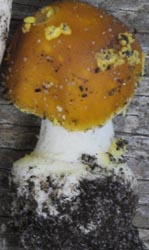
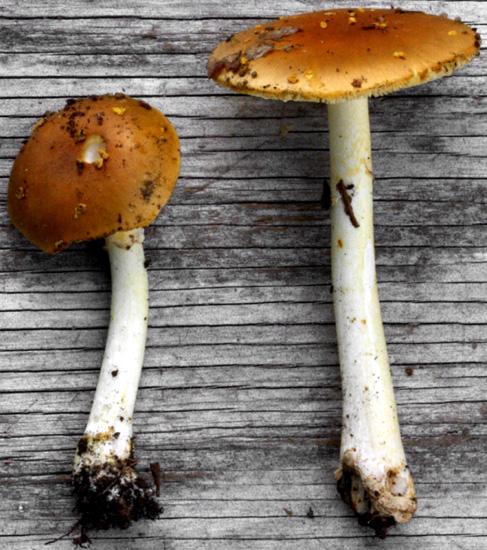
28 - 59± mm wide, orange-brown (ca. 6C8) or ranging from 6D6 near disc to 10YR6/8 to 10YR8/8 (at margin), hemispheric at first with margin straight or slightly decurved, tacky becoming dry, dull; context white, except bright yellow immediately below pileipellis, not staining when cut or bruised, 1 - 4± mm thick over stipe, thinning evenly to margin or thinning to within 2-6 mm of margin and becoming membranous from that point to margin; margin nonstriate, usually nonappendiculate, sometimes bearing fragments of partial veil; universal veil as small warts and confluent warts, orangish yellow to canary yellow to yellow, verruculose, friable, detersile, color change not observed. |
| lamellae |
very narrowly adnate (10× lens) and lacking decurrent lines on stipe apex, close to crowded, white to pale yellow in mass, color in side view not recorded, unchanging when cut or bruised, 4 - 5.5 mm broad, broadest at mid-length, with yellow edge; lamellulae truncate with attenuate tooth along underside of pileus context, unevenly distributed, of diverse lengths. |
| gleba |
double click in markup mode to edit. |
| stipe |
47 - 84± × 4 - 9.5± mm, white to pale yellow to yellow (variation seen within single collection of three basidiomes), with yellow pigment extensively and evenly distributed or limited to apical or basal portions or only above partial veil, unchanging after cutting or bruising, narrowing upward, flaring at apex, longitudinally striatulate; bulb subglobose, 15± × 14± mm or as clavate stipe base; context white, unchanging when cut or bruised, with central cylinder 1.5 - 3± mm wide, stuffed with white compressed cottony material, larval tunnels sometimes present and then unstaining; partial veil superior to submedian, membranous, thin, persistent, white or yellow above, yellowish below, sometimes becoming gray-brown with age, not striate above, floccose-fibrillose below; universal veil as minute yellow granules or flecks on stipe and loose detersile patches on and in soil surrounding stipe base. |
| odor/taste |
Odor faintly earthy or absent. Taste not recorded. |
macrochemical
tests |
Spot test for tyrosinase: L-tyrosine - positive in lower two-thirds of stipe and in bulb, on cut surfaces of sectioned partial veil and pileipellis, around edges of lamellae (above and below), and at point of merger of stipe and pileus contexts. Test voucher: Tulloss 8-1-86-H. |
| basidiospores |
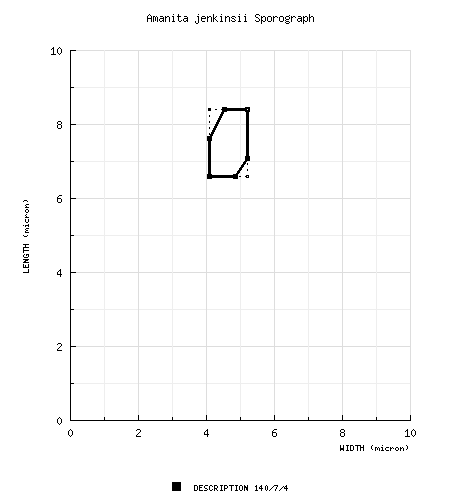
RET/CRC: [140/7/4] (5.9-) 6.6 - 8.4 (-9.8) × (3.8-) 4.1 - 5.2 (-6.3) μm, (L = 7.2 - 7.7 μm; L' = 7.5 μm; W = 4.5 - 5.0 μm; W' = 4.8 μm; Q = (1.27-) 1.36 - 1.86 (-2.04); Q = 1.49 - 1.69; Q' = 1.58), hyaline, colorless, smooth, thin-walled, amyloid, ellipsoid to elongate, infrequently broadly ellipsoid, occasionally pip-shaped, sometimes swollen at one end, adaxially flattened; apiculus sublateral, cylindric; contents multiguttulate; white in deposit. |
| ecology |
In small groups. At 60 - 75 m elev. Connecticut: In dark loam of mixed forest including Pinus, Quercus, Tsuga canadensis, etc. New Jersey: In mature oak-beech-hickory (Quercus-Fagus grandifolia-Carya ovata) forest also including Acer. |
| material examined |
U.S.A.: CONNECTICUT—Middlesex Co. - E. Haddam, Devil's Hopyard St. Pk. [41°28’32” N/ 72°20’25” W, 72 m], 4.ix.2011 Josh Hutchins s.n. (RET 489-3, nrITS & nrLSU seq'd.); Salmon River St. For. (South) [41°32’58” N/ 72°27’01” W, 21 m], 3.ix.2011 Paula DeSanto s.n. [Tulloss 9-3-11-K] (RET 490-7, nrITS & nrLSU seq'd.). Unkn. Co. - unkn. loc. 24.viii.2007 COMA2007 foray participant s.n. [Tulloss 8-24-07-T] (RET 438-9, nrITS & nrLSU seq'd.).
NEW JERSEY—Burlington Co. - Brendan T. Byrne (formerly Lebanon) St. For., 7.ix.1986 Janice VanSant, L. Baade et al. [Tulloss] 9-7-86-H (RET 117-4). Mercer Co. - Hopewell Twp., off Carter Rd., woods behind AT&T/Lucent research labs [40°21’39” N/ 74°43’29” W, 63 m], 30.vii.1982 R. E. Tulloss 7-30-82-A (RET 217-6), 1.viii.1986 R. E. Tulloss 8-1-86-H (RET 138-4). Monmouth Co. - Shark River Co. Pk. [40°12’18” N/ 74°05’44” W, 16 m], 19.viii.2011 Lilian K., Mary A., Owen C. & R. E. Tulloss & Cristina Rodríguez Caycedo [Tulloss 8-19-11-C] (RET 485-2, nrITS & nrLSU seq'd.). |
| discussion |
This is apparently the species to which the name
A. franchetii was applied by David T. Jenkins
(1986).
However, A. franchetii is a European taxon,
while the present species appears to be endemic to
eastern North America.
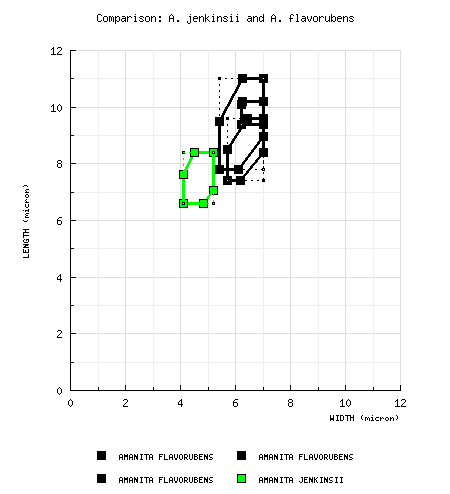
Occasionally this species is mis-identified as
A.
flavorubens; however the present species
generally smaller has different spores
size/shape. The following sporograph
illustrates the latter observation:
Preliminary morphological and genetic data
(nrITS and nrLSU) indicate that the species called
"sp-F14" in
these pages may be very closely related to the
present species. RET retains the two
temporarily coded entities as separate for the
moment on the grounds of difference in spore size
and shape. Also, it is possible that A.
sp-F14 may be identical to the poorly known
A. fraterna. As more information
develops, you'll read it here.
RET has misidentified older specimens of this
species as belonging in A. sp-N47. The present taxon
has been called "A. sp-36" in these pages.
It has also been called "A. sp. IN36" by
S. D. Russell. |
| citations |
—R. E. Tulloss |
| editors |
RET |
|




 Spore data sets and their composite