
| name | Amanita franchetii |
| name status | nomen acceptum |
| author | (Boud.) Fayod |
| english name | "Franchet's Amanita" |
| images |
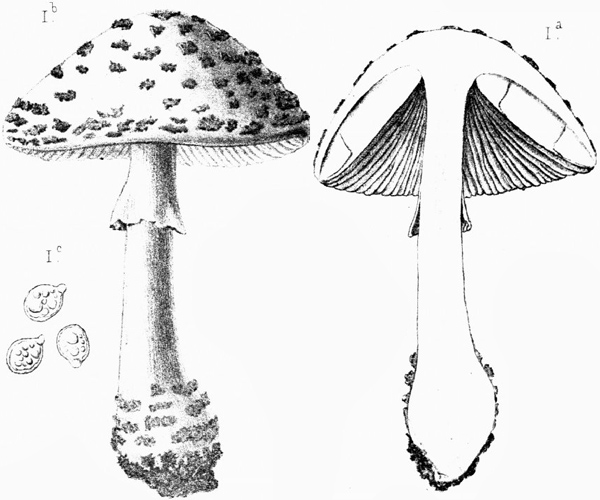  1. Amanita franchetii, syntype, protolog plate II (fig. 1a-c), France. |
| intro | The following is largely based on the description by Neville and Poumarat (2004). |
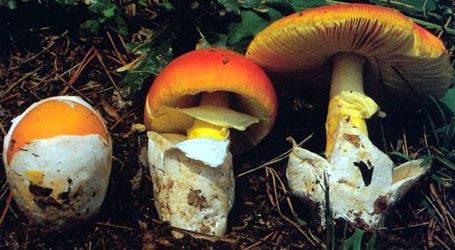
| cap | The cap of Amanita franchetii is 65 - 80 mm wide, citrine yellow to yellow, often palest towards the margin, sometimes whitish, hemispheric then convex, finally planar, often rather irregular, sometimes depressed in the center in age, shiny, viscid then silky, not virgate, with an appendiculate margin, sometimes striate in age. The volva is present as small, generally pyramidal warts, sulfur-yellow becoming paler and sordid (for example, pale grayish ochre), easily removable, densely placed. The flesh is 5 mm thick above the stem, white, with a thin yellow region just below the cap skin, tending to turn brown when wounded. |
| gills | The gills are free at maturity, distant, white, up to 7 mm broad, not or only finely floccose. The short gills are truncate, rounded truncate, or attenuate. |
| stem | The stem is 65 - 80 × 18 - 20 mm, white, solid, firm, striate above the ring, smooth or slightly flocculose below the ring, with a napiform bulb up to 33 mm wide. The ring is membranous, white, striate on the upper surface, with yellow volval warts on the edge. The volva is present as 2 or 3 incomplete rings of warts at the top of the bulb, at first yellow becoming yellowish to pale grayish-beige with age. The flesh is white, tending to turn brown when wounded especially at the base of the stem and the bulb. |
| spores | The spores measure 7.5 - 9.5 (-11) × (5-) 5.5 - 7 (-7.5) µm and are broadly ellipsoid to ellipsoid and amyloid. Clamps are absent at bases of basidia. |
| discussion |
This species was originally described from France but has been reported from much of Europe and northern Africa. This species occurs in the same environments with its form queletii. It is associated with woody plants: oaks (Quercus pubescens, Q. suber), chestnut (Castanea sativa), and pine (Pinus). Neville and Poumarat accept two forms of the present species in addition to the type form: f. lactella (white) and f. queletii (brown). In the name "A. franchetii" was mistakenly applied to A. augusta that is commonly found in California. The name "Amanita aspera" [for example, see H. D. Thiers (1982)] has also been applied to both the European and North American taxa; however, the latter epithet applies to a lepiotaceous fungus.—R. E. Tulloss and L. Possiel |
| brief editors | RET |

