

| name | Amanita sinocitrina |
| name status | nomen acceptum |
| author | Zhu L. Yang, Z. H. Chen & Z. G. Zhang |
| english name | "Chinese Citrin Bulbous Amanita" |
| intro | The information below is based on the original description of this species. |
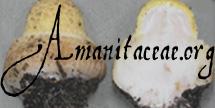
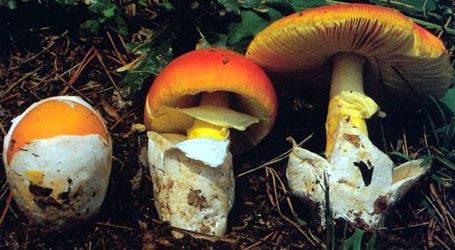
| cap | The fruiting bodies of A. sinocitrina are small to medium-sized. The cap is 40-60 mm wide, convex to applanate, gray-yellow, sometimes brownish, with indistinct, innate, radial fibrils. It is covered with grey to brownish, verrucose to floccose, felty, volval patches; its flesh is white, but turns brownish when exposed, especially in the bulb. |
| gills | The gills of this species are free to subfree, crowded, white to cream-colored; and the short gills are attenuate and of diverse lengths. |
| stem | The stipe is 60 - 90 × 5 - 10 mm, subcylindric to attenuate upwards; its surface is white to dirty white, covered with yellowish to yellow squamules above the annulus, and with whitish to grayish squamules or fibrils below the annulus; the stipe's basal bulb is 15 - 25 mm wide, subabrupt to abrupt, marginate, with the upper margin covered with grayish to brownish, verrucose to floccose volval remnants.. The annulus is membranous and superior to nearly medium, with its upper surface cream-colored to yellowish and lower surface whitish to grayish or brownish. |
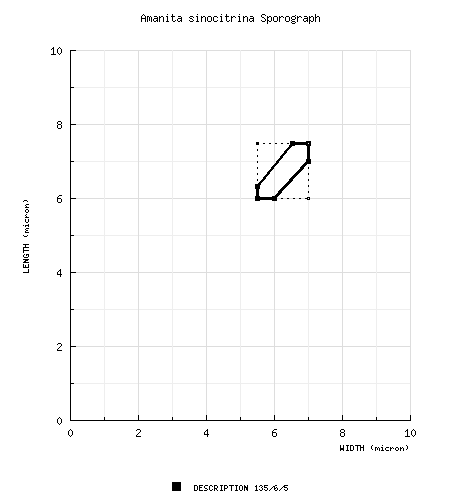
| spores | Spores of A. sinocitrina measure (5.5-) 6.0 - 7.5 (-8.0) × (5.0-) 5.5 - 7.0 (-7.5) µm and are globose to subglobose, and amyloid. Clamps are not present on the bases of basidia. |
| discussion |
Amanita sinocitrina was originally described
from central China. It occurs in mixed
forests ith broad-leaved trees and conifers.
Its distribution range is still unknown. Amanita sinocitrina is characterised by its small to medium-sized basidiome with a gray-yellow pileus, grey to brownish volval remnants, a whitish to yellowish annulus, a subabrupt to abrupt, marginate bulb on the base of the stipe, and small basidia and spores. It is related to taxa such as A. mappa (Batsch) Fr. However, A. sinocitrina differs from the European A. mappa by its differently colored pileus with somewhat darker colored volval remnants, smaller basidia and significantly smaller spores. Amanita sinocitrina is also similar to A. citrina var. grisea (Hongo) Hongo, A. lavendula (Coker) Tulloss et al., A. brunnescens G. F. Atk., A. brunnescens f. straminea E.-J. Gilbert, A. aestivalis Singer ex Singer and A. asteropus Sabo ex Romagn. However, A. citrina var. grisea, described from Japan, has a darker colored pileus, pallid yellow annulus, larger basidia and larger spores. Amanita lavendula, originally described from the U.S. and other similar taxa in North America are distinguished from A. sinocitrina by, among other features, its lavender staining fruiting body and (in the case of A. lavendula) somewhat smaller spores. Amanita brunnescens from eastern North America usually has larger basidiomes with brown, innate radial lines on the pileus covered with whitish to pallid volval remnants, a white stipe with a usually longitudinally cleft bulb, longer basidia, and larger spores. Amanita brunnescens f. straminea has a differently colored pileus and stipe, and larger spores. Amanita brunnescens var. pallida and A. aestivalis, both described from eastern North America, have a paler colored pileus, a longitudinally splitting bulb, larger basidia and larger spores. Amanita asteropus, described from Europe, has a differently colored pileus with differently colored volval remnants, and without innate, radial fibrils, a longitudinally splitting bulb, trama or surface of stipe turning rapidly brown-orange when injured, and larger spores.—Zhu L. Yang and R. E. Tulloss |
| brief editors | RET |
| name | Amanita sinocitrina | ||||||||||||||||||||
| author | Zhu L. Yang, Z. H. Chen & Z. G. Zhang in Chen, Z. H., Zhu L. Yang & Z. G. Zhang. 2001. Mycotaxon 79: 275, figs. 1-4. | ||||||||||||||||||||
| name status | nomen acceptum | ||||||||||||||||||||
| english name | "Chinese Citrin Bulbous Amanita" | ||||||||||||||||||||
| MycoBank nos. | 474286 | ||||||||||||||||||||
| GenBank nos. |
Due to delays in data processing at GenBank, some accession numbers may lead to unreleased (pending) pages.
These pages will eventually be made live, so try again later. Search:
Showing 0 to 0 of 0 entries | ||||||||||||||||||||
| holotypes | HKAS 36983 | ||||||||||||||||||||
| intro |
The following text may make multiple use of each data field. The field may contain magenta text presenting data from a type study and/or revision of other original material cited in the protolog of the present taxon. Macroscopic descriptions in magenta are a combination of data from the protolog and additional observations made on the exiccata during revision of the cited original material. The same field may also contain black text, which is data from a revision of the present taxon (including non-type material and/or material not cited in the protolog). Paragraphs of black text will be labeled if further subdivision of this text is appropriate. Olive text indicates a specimen that has not been thoroughly examined (for example, for microscopic details) and marks other places in the text where data is missing or uncertain. The following description is derived entirely from the protolog. NOTE: Spore data from papers by Z. L. Yang are presented following his use of the "Times New Roman" face for "Q" and "Q'"—respectively, " protolog: Basidiomes small to medium-sized. | ||||||||||||||||||||
| pileus | protolog: (30-) 40 - 60 mm wide, gray-yellow [3B3-6, 3C4-5, Deep Olive-Buff, Dark Olive-Buff], sometimes brownish [5C4-6], with indistinct innate, radial fibrils; contents white, sometimes very slowly brownish when cut or bruised; margin nonstriate, nonappendiculate; universal veil as felty patches, verrucose to floccose, 2 - 5 mm wide, 1± mm thick, gray to brownish, randomly arranged, often detersile in wet weather. | ||||||||||||||||||||
| lamellae | protolog: free, crowded, white to pale cream; lamellulae attenuate, evenly distributed. | ||||||||||||||||||||
| stipe | protolog: 60 - 90 × 5 - 10 mm [length includes length of bulb], white to sordid white, subcylindric or slightly narrowing upward, with slight flaring at apex, covered with yellowish squamules above partial veil, with whitish to gray sqamules below partial veil; bulb abrupt to subabrupt, marginate, 15 - 25 mm wide; context white, very slowly turning brownish when exposed especially in stipe's bulb; partial veil persistent, superior to submedian, membranous, above whitish, to cream or pale yellowish, whitish to grayish or brownish below; universal veil covering bulb margin, grayish to brownish, sometimes submembranous and then forming brief limb on bulb margin. | ||||||||||||||||||||
| odor/taste | Odor and taste not recorded. | ||||||||||||||||||||
| macrochemical tests |
none recorded. | ||||||||||||||||||||
| pileipellis | protolog: 40 - 90 μm thick; suprapellis 20 - 50 (-70) μm thick, strongly gelatinized, colorless, hyaline, with filamentous hyphae 1.0 - 5.0 μm wide; subpellis 20 - 40 μm thick, with filamentous hyphae 3.0 - 10.0 (-12.0) μm wide; ungelatinized filamentous hyphae subradially and compactly arranged, subhyaline, colorless or with brownish vacuolar pigment, with terminal segments not distinctly inflated; vascular hyphae rare. | ||||||||||||||||||||
| pileus context | not described. | ||||||||||||||||||||
| lamella trama | protolog: bilateral, divergent; wcs = 30 - 40 μm; central stratum with filamentous hyphae 2.0 - 7.0 μm wide fairly abundant to abundant, with inflated cells [probably intercalary—ed.] 60 - 90 × 20 - 25 μm, with vascular hyphae rare; lateral stratum with elements diverging at angle of ca. 30° to 45°, with filamentous hyphae 3 - 8 μm wide fairly abundant to abundant, with inflated cells fairly abundant to abundant fusiform to long ellipsoid (55 - 100 × 15 - 20 μm); clamps absent. | ||||||||||||||||||||
| subhymenium | protolog: 20 - 40 (-50) μm thick, with inflated cells subglobose to ovoid to short ellipsoid [8 - 25 (-30) × 7 - 20 (-25) μm] in 2 - 3 (-4) layers, with barely inflated hyphal segments occasional [3 - 7 μm wide]. | ||||||||||||||||||||
| basidia | protolog: [135/6/5] (10-) 25 - 35 (-40) × (8.0-) 8.5 - 10.5 (-11.5) μm, 4-, and rarely 1- or 2-sterigmate, with sterigmata 3.0 - 5.0 μm long; clamps lacking. | ||||||||||||||||||||
| universal veil | protolog: On pileus: with elements irregularly arranged; filamentous hyphae 2 - 7 μm wide, fairly abundant, frequently septate, thin-walled, hyaline, colorles or occasionally with brownish to brown vacuolar pigment; inflated cells globose to subglobose or ovoid (20 - 80 × 20 - 60 μm) or ellipsoid (40 - 60 × 25 - 30 μm), terminal singly or in chains of 2 - 3, with walls thin or up to 0.5 μm thick, hyaline, colorless or with brownish to grayish vacuolar pigment; vascular hyphae rare. On bulb margin: similar to that on pileus, but with greater proportion of filamentous hyphae. | ||||||||||||||||||||
| stipe context | protolog: longitudinally acrophysalidic; filamentous hyphae 2 - 8 (-12) μm wide, scattered in interior, plentiful near surface; acrophysalides 250 - 400 × 25 - 40 μm; vascular hyphae rare. | ||||||||||||||||||||
| partial veil | protolog: filamentous hyphae 2 - 5 (-8) μm wide, frequently branching, anastomosing, thin-walled, colorless, hyaline to subhyaline, subradially arranged; inflated cells rare, clavate to fusiform (25 - 45 × 9 - 12 μm), thin-walled, hyaline to subhyaline, almost colorless, terminal, usually singly; vascular hyphae rare. | ||||||||||||||||||||
| lamella edge tissue | protolog: sterile; as somewhat gelatinized, incomplete strip 20 - 70 μm wide in side view; filamentous hyphae 2 - 6 μm wide scattered to fairly abundant, thin-walled, gelatinized; inflated cells globose to subglobose to ovoid (20 - 40 × 15 - 30 μm) or ellipsoid (35 - 50 × 20 - 30 μm) or sometimes sphaeropedunculate (30 - 50 × 15 - 30 μm), terminal singly or in chains of 2 - 3. | ||||||||||||||||||||
| basidiospores |
protolog: [135/6/5] (5.5-)
6.0 - 7.5 (-8.0) × (5.0-) 5.5 - 7.0 (-7.5) μm,
( | ||||||||||||||||||||
| ecology | protolog: At 900 - 1200 m elev. In mixed forests of central China. | ||||||||||||||||||||
| material examined | protolog: CHINA: HUNAN—Chenzhou (prefecture level) City - Yizhang Co., Mangshan, 900 m. elev., 24.vi.1997 Z. H. Chen 3691 (holotype, HKAS 36983), 29.ix.1981 Y. C. Zong & Z. L. Mao 65 (paratype, HMAS 42248, as A. porphyria in [Mao et al. 1986]), 27.ix.1981 X. L. Mao & Y. C. Zong 20 (paratype, HMAS 52613, as A. porphyria in [Mao et al. 1986]); Yizhang Co., Mangshan, 1200 m elev., 27.vii.1997 Z. H. Chen 3712 (paratype, HKAS 36982). | ||||||||||||||||||||
| discussion | The dark cap of the present species, the color of its partial veil, the color of its volval fragments, and the small size of its spores combine to segregate this taxon from other taxa in stirps Citrina. | ||||||||||||||||||||
| citations | —R. E. Tulloss | ||||||||||||||||||||
| editors | RET | ||||||||||||||||||||
Information to support the viewer in reading the content of "technical" tabs can be found here.
 Spore data sets and their composite
Each spore data set is intended to comprise a set of measurements from a single specimen made by a single observer; and explanations prepared for this site talk about specimen-observer pairs associated with each data set. Combining more data into a single data set is non-optimal because it obscures observer differences (which may be valuable for instructional purposes, for example) and may obscure instances in which a single collection inadvertently contains a mixture of taxa.

Text and User-Generated Sporographs are published under the Creative Commons License.

In the case of a taxon page, image credits are on the 'image' tab.