| name |
Amanita aestivalis |
| author |
Singer ex Singer. 1959b. Mycologia 51: 390. |
| name status |
nomen acceptum |
| english name |
"White American Star-Footed Amanita" |
| synonyms |
≡ Amanita aestivalis Singer nom. inval. 1951 ["1949"]. Lilloa 22: 387. [Lacking Latin diagnosis and specification of holotype. ICNB §36.1, §37.1]
= Amanita [or Amanitina?] brunnescens f. albida E.-J. Gilbert nom. nud. 1940. Iconogr. Mycol. (Milan) 27, suppl. (1): 32, 154, tab. 37 (fig. 3). [Lacking Latin diagnosis, specification of holotype, etc. ICBN §36.1, §37.1, etc.] ≡ Amanita brunnescens f. pallida E.-J. Gilbert nom. nud. 1941. Iconogr. Mycol. (Milan) 27, suppl. (1): 317, 318.
The editors of this site owe a great debt to Dr. Cornelis Bas
whose famous cigar box files of Amanita nomenclatural information
gathered over three or more decades were made available to RET for computerization
and make up the lion's share of the nomenclatural information presented on this site.
|
| etymology |
aestivalis "summer" [as adjective] |
| MycoBank nos. |
292434 |
| GenBank nos. |
Due to delays in data processing at GenBank, some accession numbers may lead to unreleased (pending) pages.
These pages will eventually be made live, so try again later.
|
| holotypes |
MICH |
| revisions |
Tulloss and F. Massart. 1998. Doc. Mycol. 28(109-110): 73-76. [partial] |
| intro |
The following text may make multiple use of each data field.
The field may contain magenta text presenting data from a type study
and/or revision of other original material cited in the protolog of the present taxon.
Macroscopic descriptions in magenta are a combination of data from the protolog and
additional observations made on the exiccata during revision of the cited original material.
The same field may also contain black text, which is data from a revision of the present
taxon (including non-type material and/or material not cited in the protolog).
Paragraphs of black text will be labeled if further subdivision of
this text is appropriate.
Olive text indicates a specimen that has not been
thoroughly examined (for example, for microscopic details) and marks other places in the text
where data is missing or uncertain.
The following material not directly from the protolog of the present taxon and not cited as the work of another researcher is based on original research of R. E. Tulloss. |
| basidiospores |
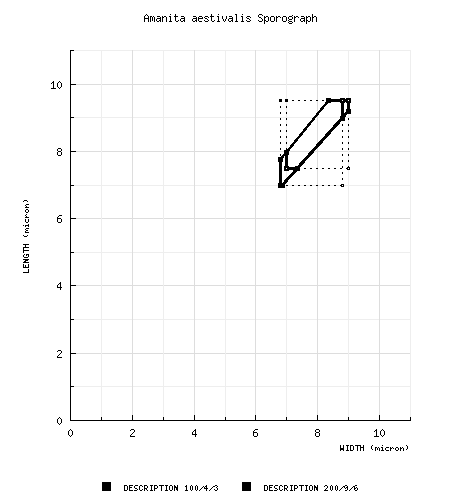
from type study of RET: [100/4/3] (6.5-) 7.5 - 9.5 (-10.8) × (6.0-) 7.0 - 9.0 (-10.0) μm, (L = 8.3 - 8.6 μm; L' = 8.4 μm; W = 7.8 - 8.0 μm; W' = 7.9 μm; Q = (1.0-) 1.02 - 1.14 (-1.18); Q = 1.07; Q' = 1.07), hyaline, colorless, smooth, thin-walled, amyloid, globose to subglobose, infrequently broadly ellipsoid, rarely lachrimoid, usually at least somewhat adaxially flattened; apiculus ??; contents ??; ?? in deposit.
composite data from all materail revised by RET: [200/9/6] (5.8-) 7.0 - 9.5 (-10.9) × (5.0-) 6.8 - 8.8 (-10.5) µm, (L = (7.6-) 7.9 - 8.6 µm; L’ = 8.4 µm; W = (7.2-) 7.5 - 8.0 µm; W’ = 7.8 µm; Q = (1.0-) 1.02 - 1.14 (-1.20); Q = 106 - 1.08 (-1.09); Q’ = 1.07), hyaline, colorless, smooth, thin-walled, amyloid, globose to subglobose, infrequently broadly ellipsoid, rarely lachrimoid, usually at least somewhat adaxially flattened; apiculus sublateral, truncate-conic; contents ??; ?? in deposit. |
| ecology |
Solitary or in small groups. Michigan: Under Quercus or in hardwood forest. New Hampshire: In litter of deciduous forest. New Jersey: At 18 m elev. In sandy soil of typical Pinus rigida-Quercus barrens. Pennsylvania: At 417 m elev. In dark loam amid rocks with Acer, Pinus, Picea pungens (alien), Q. prinus and Q. sp. Tennessee: At 795 m elev. West Virginia: With Pinus, Tsuga canadensis, and Acer pensylvanicum. |
| material examined |
U.S.A.: MAINE— Penobscot Co. - Orono, Univ. of Maine, campus, 10.viii.1991 anon.
s.n. [Tulloss 8-10-91-A] (RET 105-1).
MASSACHUSETTS—Worcester Co. - Upton,
Upton St. For., 14.viii.1993 NEMF1993 participant
s.n. [Tulloss 8-14-93-G] (RET 096-2).
MICHIGAN—Cheboygan
Co. - E shore of Burt Lk., 18.vii.1953 Rolf Singer
N667 (paratype, F 1099362); Douglas Lk., 22.vii.1953
R. Singer N735 (paratype, F).
NEW HAMPSHIRE—Hillsborough Co. - Fox St.
For., 18.viii.1989 Diane Pruden s.n. [Tulloss
8-18-89-H] (RET 245-5).
NEW JERSEY—Middlesex Co. - Jamesburg
Twp., Jamesburg Twp. Pk., ca. Helmetta [40°23’07” N/
74°25’48” W, 18 m], 24.vii.1996 Britt Carlson &
R. E. Tulloss 7-24-96-A (RET 200-5).
Monmouth Co. - Roosevelt, North
Valley Rd. bicycle path [40°12’49” N/ 74°28’19” W],
7.ix.1999 M. A. & R. E. Tulloss 9-7-99-A
(RET 295-7); Upper Freehold, Assunpink Wildlife
Management Area [40°12’36” N/ 74°28’42” W],
8.ix.1999 M. A. & R. E. Tulloss 9-8-99-E (RET
296-5).
NEW YORK—Otsego Co. -
Oneonta, College Camp, 16.viii.1985 George Waitkins
s.n. [Tulloss 8-16-85-D] (RET 101-1).
PENNSYLVANIA: Pike Co. - Lord's Valley,
800 Peyton Place [41.3398° N/ 75.0646° W, 417 m],
15.vii.2014 R. E. Tulloss 7-15-14-A (RET
625-8).
TENNESSEE—Sevier Co.
- ca. Gatlinburg, GSMNP, Cherokee Orchard
[35.6811° N/ 83.4625° W, 945 m], 12.vii.2004
R. E. Tulloss 7-12-04-B (RET 375-8).
WEST VIRGINIA—Greenbrier Co. - ca. 1.6
km W of Charmco, U.S. Rte. 60 rest stop,
9.viii.1990 Dr. M. A. Vincent 4383 (MU; RET 146-9). |
| discussion |
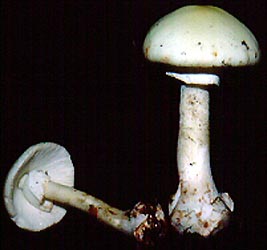
Singer distinguished the present species from A. brunnescens by its reportedly slower staining reaction, by the pileus being pure white except for a yellowish disc, and by the lack of brown radial lines on the pileus.
All these characteristics may be due to the weakness or absence of a single chemical reaction in the fruiting body—perhaps something akin the tyrosinase-triggered melanin cycle common in most pigmented agarics. The presence of tyrosinase in brunnescens (of all cap colors) and A. aestivalis is insufficient to produce a visible spot test response to (e.g.) paracresol, a reagent specific for the presence of tyrosinase among all known phenoloxidases in fungi (RET, unpub. data). Hence, the process for producing staining and pileus pigmentation are both (if they are two separate processes) unknown in the North American species of stirps Brunnescens.
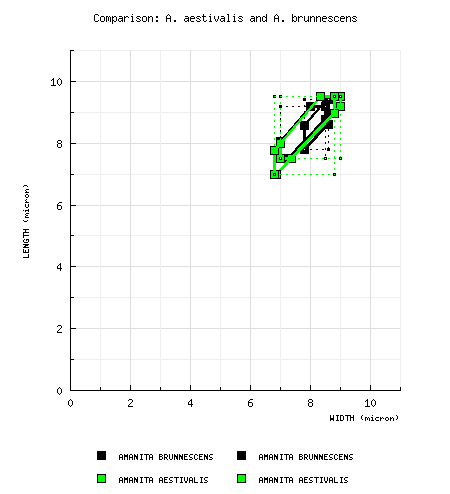
A sporograph comparison with A. brunnescens (note that the sample size for the latter species is presently rather small) follows:
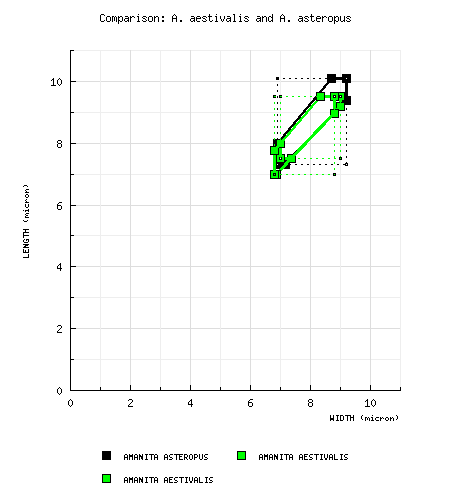
One of the distinguishing features of the European A. asteropus is that it produces an intense positive reaction for tyrosinase when paracresol is applied to the entire surface exposed by longitudinal section of a complete basidiome. The European species has a cream to butter yellow pileus and is never virgate. A sporograph comparison is shown in the following diagram:
To date no difference has been found between nrITS sequences derived from mushrooms of the present species and those derived from material of A. brunnescens. further work is on-going. |
| citations |
—R. E. Tulloss |
| editors |
RET |
|



 Spore data sets and their composite