| name |
Amanita mappa |
| author |
(Batsch) Fr. 1838.
Epicrisis Sys. Mycol.: 6. |
| name status |
nomen acceptum |
| english name |
"Citrin Bulbous Amanita" |
| synonyms |
≡ Agaricus mappa Batsch. 1783.
Elench. Fung.: col. 57, sp. 50.
≡ Agaricus citrinus Schaeff. nom. illeg.
1774.
Fung. Bavar. Palatin. Ratisbon. Nascunt.
Icones 4: 11. [Ref. pl. 20 in vol. 1
( 1762).]
[Posterior homonym. ICBN §53.1] non Agaricus
citrinus Gunnerus. 1772.
Fl. Norveg. 2: 126. [The publication
date on this name is based on the research of
Pfister et al. ( 1990.
Mycologia Mem. 17: 53). This
information was re-examined and clarified at our
request (Dr. D. H. Pfister, pers. comm.): The date
1776 appears on some copies of this work.
This is the date of a re-issue of the work with
contents identical to those of the 1772
printing.] ≡ Amanita citrina
(Schaeff.) Pers. nom. illeg. 1797.
Tentam. Disp. Meth. Fung.: 66.
[Basionym illegitimate.] ≡ Amanitina citrina
(Schaeff. ) E.-J. Gilbert nom. illeg.
1940.
Iconogr. Mycol. (Milan) 27, suppl. (1): 78,
tab. 38 (figs. 3-4, 6). [As " citrina
Fr." (sic). [Basionym illegitimate.] ≡ Amanita venenosa
var. [B] citrina (Schaeff.) Pers. 1818.
Trait. Champ. Comest.: 180, pl. 2
(fig. 1). [ A. venenosa is a nom.
dub. Selection of a type would be
arbitrary.] ≡ Amanita bulbosa
var. citrina Gillet.
1874.
Champ. (Hyménomyc.) Croiss. France:
36. [Misapplication to Amanita
phalloides.]
≡Agaricus (Amanita)
phalloides var. b albus
Duby in DC. 1830. DC. Bot. Gall.,
2e ed., 2: 850. [Misapplication.]
≡ Agaricus ( Amanita) mappa var.
minor Fr. 1874.
Hymenomyc. Eur.: 19.
≡ Amanita mappa var. minor Sacc.
1887.
Syll. Fung. 5: 11.
≡ Amanita mappa var. minor Killerm.
nom. inval. 1931.
Denkschr. Bayer. Bot. Ges. Regensburg
18(neue Folg. 12): 5. [Not definitely
accepted by author. ICBN §34.1]
= Amanita citrina var. alba (Quél.)
E.-J. Gilbert. 1918.
Gen. Amanita Pers.: 67. [Note:
Numerous authors cite the basionym as originated
by W. C. Price; however, while he mentioned a white
variety, he never named it.] ≡Amanita citrina f.
alba Quél. 1892. C. R. Assoc. Franc.
Avanc. Sci. 20(2): 467. ≡ Amanita citrina f.
alba (Quél.) E.-J. Gilbert. 1918.
Gen. Amanita Pers.: 64. [Superfluous
combination.] ≡ Amanita citrina f.
alba (Quél.) Veselý. 1933.
Ann. Mycol. 31(4): ??. [Superfluous
combination.]
= Agaricus bulbosus Schaeff. nom. illeg.
1774.
Fung. Bavar. Palatin. Ratisbon. Nascunt.
Icones 4: 61. [Posterior homonym. ICBN §53.1] [Ref. pl. 241 in vol. 3
( 1770).] non Agaricus
bulbosus Pall. 1771-1780.
Reise
Prov. Russ. Reichs 1: tab. 9, fig. 2.
[Unknown species.] ≡ Amanita bulbosa (Schaeff.) Lam. in Lam. & Poir.
1783.
Encycl. Méthod. Bot. 1(1): 112.
≡ Amanita bulbosa var. alba Pers.
nom. inval. 1818.
Trait. Champ. Comest.: 179.
[Replacement for autonym of type variety.
ICBN §11.6, §32.7] [For the same reason, the
type selected by Neville and Poumarat (2004) must
be rejected because Schaeffer's plate is required
to be the holotype of Agaricus bulbosus
Schaeff. See "holotypes" data field below.]
≡ Amanita candida Pers. 1797.
Tentam. Disp. Meth. Fung: 66.
The editors of this site owe a great debt to Dr. Cornelis Bas
whose famous cigar box files of Amanita nomenclatural information
gathered over three or more decades were made available to RET for computerization
and make up the lion's share of the nomenclatural information presented on this site.
|
| MycoBank nos. |
116594, 166106, 355583, 449971, 533644, 206334, 495405 |
| GenBank nos. |
Due to delays in data processing at GenBank, some accession numbers may lead to unreleased (pending) pages.
These pages will eventually be made live, so try again later.
|
| holotypes |
Agaricus bulbosus—Schaeff. 1770.
Fung. Bavar. Palatin. Ratisbon. Nascunt.
Icones 3: pl. 241. |
| lectotypes |
Agaricus mappa—Schaeffer. 1762. op
cit. pl. 20.
|
| lectotypifications |
Agaricus citrinus—Neville and Poumarat. 2004. Fungi Europeaei 9: 789. |
| revisions |
Neville and Poumarat. 2004. Fungi Europaei 9:
787-805. |
| intro |
This page is being
rebuilt. Please be patient.
Olive text indicates a specimen that has not been
thoroughly examined (for example, for microscopic details) and marks other places in the text
where data is missing or uncertain.
The following material not directly from the protolog of the present taxon and not cited as the work of Dr. Z. L. Yang or another researcher is based upon original research by R. E. Tulloss. |
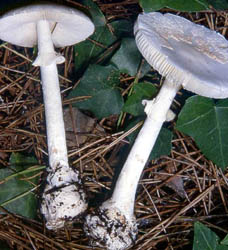
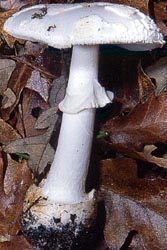
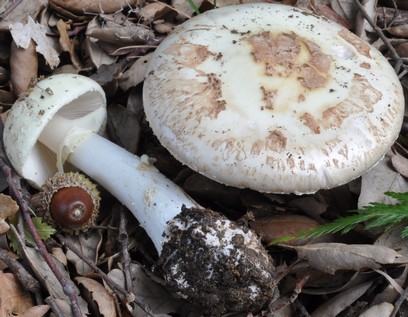
| pileus |
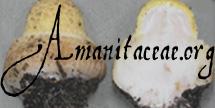
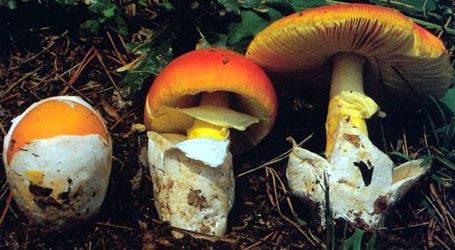
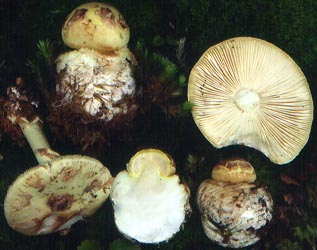
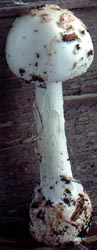
60 - 70 mm wide, very pale citron yellow (e.g., paler
and a little greener than 1A2) or entirely white,
unchanging when cut or bruised, hemispheric at
first, then planoconvex, sometimes subumbonate,
shiny to subshiny,
glistening under lens, tacky to dry; context
white, usually unchanging, sometimes with faint
brown tint under
pileipellis in old specimens, sometimes with
waterlogged spots over stipe, 4 - 7 mm thick
above stipe, thinning evenly to margin;
margin nonstriate,
nonappendiculate, incurved at first, finally
slightly decurved, with pileipellis exceeding ends
of lamellae; universal veil absent or
as cluster of minutely fibrillose warts and/or
patch(es) of varying size (up to 12.5 mm across) or
as concentrically arranged fibrillose
scales, white at first, becoming brown from edges
inward (sometimes before partial veil separates
from pileus margin), detersile. |
| lamellae |
free to narrowly adnate with slight decurrent tooth
and (occasionally) faint decurrent line
(10× lens), subcrowded, very
pale orangish white to cream to pale cream in mass,
off-white to off-white to very pale grayish white,
pale citron yellow to very pale slightly sordid
yellow in side view, unchanging when cut or bruised,
5 - 10 mm broad, ??;
lamellulae subtruncated to rounded truncate to
rounded subtruncate to subattenuate, plentiful,
??. |
| stipe |
52 - 133 × 9 - 13 mm, white, sometimes becoming
dingy or distinctly brown from handling, satiny,
narrowing upward slightly, barely to distinctly
flaring at apex, decorated with longitudinal
striation (fine or marked) and raised fibrils, with
surface sometimes splitting into fibrillose recurved
scales;
bulb subglobose to globose, subabrupt,
20 - 32 × 21 - 36 mm, soft, easily compressed;
context white, unchanging when cut or
bruised, white in larva tunnels, hollow or stuffed
in upper portion and stuffed or solid below, with
1+ - 3+ mm wide central
cylinder, with insets tunnels concolorous;
partial veil superior to subsuperior, pale
citron yellow or white (when pileus white),
sometimes browning with age (especially at edge),
membranous, skirtlike, collapsing, with edge
thickened, with upper side faintly striate,
with under side radially fibrillose;
universal veil as short limb or limbs
(sometimes of uneven height) or
slight ridge around top of bulb, white, browning. |
| odor/taste |
Odor faintly or distinctly of radishes or of
newly dug potatoes, especially in bulb context. Taste not recorded. |
macrochemical
tests |
Specimen with yellow pileus (RET): Spot test for
laccase (syringaldazine) - negative throughout
basidiome (mature specimen). Spot test for
tyrosinase (paracresol) - slowly positive in
sectioned pileipellis, small spot along juncture of
gill and pileus context, volval limb above stipe's
bulb, and small spot on lower stipe surface, in
approximately that order (mature specimen).
Test voucher: Tulloss 9-6-88-J.
Specimen with white pileus (RET): Spot test
for laccase (syringaldazine) - negative throughout
basidiome (sporulation just beginning). Spot
test for tyrosinase (paracresol) - minimal positive
reactions in warts on pileus, volval limb, and
external surface of bulb (specimen with sporulation
just
beginning). Test voucher: Tulloss
9-6-88-L.
[Add chemical information from
Massart.] |
| basidiospores |
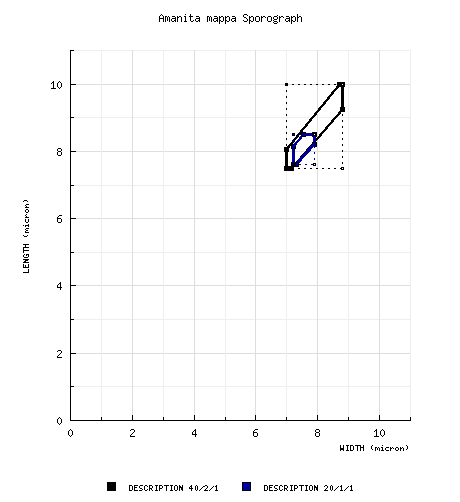
Specimens with yellow pileus (RET): [40/2/1]
(6.9-) 7.5 - 10.0 (-16.0) × (6.0-) 7.0 - 8.8 (-10.4)
μm, (L = 8.1 - 8.7 μm; L' = 8.4 μm;
W = 7.4 - 7.9 μm; W' = 7.6 μm; Q =
(1.03-) 1.05 - 1.15 (-1.54); Q = 1.10;
Q' = 1.10), hyaline, colorless, smooth,
thin-walled, amyloid, subglobose, occasionally
globose, occasionally broadly ellipsoid, rarely
ellipsoid, adaxially flattened, infrequently with
"giant" spores; apiculus sublateral,
cylindric; contents ?mono- to multiguttulate
to granular; ??
in deposit.
Specimen with white pileus (RET): [20/1/1] (7.0-)
7.6 - 8.5 (-9.0) × (6.5-) 7.2 - 7.9 (-8.0) μm,
(L = 8.1 mu;m; W = 7.6 μm; Q =
(1.03-) 1.04 - 1.13 (-1.14); Q = 1.07),
hyaline, colorless, smooth, thin-walled, amyloid,
globose to subglobose, often at least somewhat
adaxially flattened; apiculus sublateral,
cylindric; contents granular to
multiguttulate; ?? in
deposit. |
| ecology |
Solitary to subgregarious. Scotland: In sandy loam under leaf litter in ancient, pure stand of Fagus sylvaticus. |
| material examined |
Weiss et al.
(1998)
voucher for sequencing: GERMANY:
BADEN-WÜRTTEMBERG—Tübingen, s.d. unkn.
coll. s.n. (HKAS 31449).
Material with yellow pileus (RET):
GERMANY: ??—near Berlin
(location withheld), 14.ix.2013 R. K. Schumacher s.n.
(RET 573-8, nrITS).
NORWAY:
VESTFOLD—Larvik - Bøkeskjogen,
27.vii.1978 G. Gulden 76/78
(O; RET 308-8).
U.K.:
SCOTLAND—Grampian Region - Dyke & Moy,
Darnaway Estate, 6.ix.1988 G. & S. Kibby s.n.
[Tulloss 9-6-88-E] (RET 107-5), Bernice Fatto, M. A.
King & R. Tulloss 9-6-88-I (RET 107-8), R.
Roper s.n. [Tulloss 9-6-88-J] (RET 107-9), R.
Roper & Roy Watling s.n [Tulloss 9-6-88-G]
(RET 107-7).
Material with white pileus (RET):
CZECH REPUBLIC:
SOUTH BOHEMIA—Stará Řeka Nature Reserve, 2.x.2006
Dr. J. Borovička 23 (RET 406-1).
FRANCE: GIRONDE—Le Porge,
16.xi.1997 F. Massart 97067 (in herb. F. Massart;
RET 273-2).
ITALY:
UNKN. PROV.—unkn. loc., 12.xii.2011
Carmine Lavorato 111212-18 (in herb. C. Lavorato;
RET 501-5).
U.K.: SCOTLAND—Grampian
Region - Dyke & Moy, Darnaway Estate, 6.ix.1988 R.
Roper & R. Watling s.n. [Tulloss 9-6-88-G]
(RET 107-7), Bernice Fatto,
Mary A. King & R. E. Tulloss
[Tulloss 9-6-88-I] (RET 107-8), G. Kibby s.n.
[Tulloss 9-6-88-K] (RET 108-4),
R. Roper s.n. [Tulloss 9-6-88-L] (RET 108-2). |
| discussion |
??
This is as good a place as any to discuss why using the
spore data from ( Neville and Poumarat 2004) is not entirely
workable in these pages. One significant problem
occurs in their spore data for taxa (like the present
one) with globose to subglobose spores. Here is
the set of data they provide for the present taxon
(converted to RET's notation): [80/-/-] 7.0 - 9.0 (-9.5)
× 6.0 - 8.5 (-9.0) μm, (L' = 8.0 μm; W' =
7.8 μm; Q = 1.0 - 1.17 (-1.26); Q = 1.0 - 1.03;
Q' = 1.02).
Compare the spore data presented immediately above to
the spore data reported in the "basidiospores" data
field, further up the page. Focus on the range of
Q and, then, on the range of Q and the value of
Q'. If we eliminate the upper and lower
extreme values of Q in the two sets of data, we have Q
= 1.05 - 1.15 (RET) and Q = 1.0 - 1.17 (N & P).
RET's Q' (1.10) is precisely at the midpoint of
the first reduced range. In contrast, N & P's
Q' (1.02) is strikingly offset to the low end of
the N & P range. In fact, the only way this
can be true is if there were far more spores with
Q < 1.02 than there were spores with Q between 1.02
and 1.17. What can cause such a striking
difference in the two sets of data?
The most probable cause is not insisting that the
spores that are measured be in lateral view.
Without the procedure of measuring only those spores
that are found by a fixed search pattern and are
in lateral view when found and measured, the majority
of spores measured will be foreshortened (one end is
closer to the scope's objective than the other) and may
appear broader than they would in lateral view, which
is the only view in with the adaxial flattening of
Amanita spores is clearly viewed (thus reducing spore width as much as possible).&
After evaluating the Neville and Poumarat (2004) data
for the present species and other globose to subglobose
spored species, RET decided not to include it in the
basidiospore data fields for such species (and,
consequently, not to have sporographs generated for such
data). |
| citations |
—R. E. Tulloss |
| editors |
RET |
|




 Spore data sets and their composite