| name |
Amanita
maryaliceae |
| author |
Tulloss nom. prov. |
| name status |
nomen provisorum |
| english name |
"Mary Alice's Amanita" |
| etymology |
genitive of a Latinized name; hence, "of Mary Alice" or "Mary Alice's."
In honor of RET's partner and wife, Mary
[Alice] King Tulloss, who has assisted in preparing
his work for publication until she can say
"undifferentiated filamentous hyphae" and
"longitudinally acrophysalidic" in her sleep.
She has collected with him, annotated collections
with him, helped to edit the original Amanita
Studies website, reviewed DNA annotations and
metadata in Sequin files to be submitted to GenBank,
carried out filing and other
secretarial tasks for him, assisted at his lectures,
and (as a retired software developer and a teacher
of high school Mathematics) played a significant
role in developing lesson plans for
tutorials. She tolerated boxes of dried
specimens and the odor of mothballs until she
could stand it no more, and then proposed and
supported the conversion of the Tulloss garage to
a herbarium with temperature and humidity control
to house RET's mycological collections. |
| GenBank nos. |
Due to delays in data processing at GenBank, some accession numbers may lead to unreleased (pending) pages.
These pages will eventually be made live, so try again later.
|
| intro |
Olive text indicates a specimen that has not been
thoroughly examined (for example, for microscopic details) and marks other places in the text
where data is missing or uncertain.
The following text is based upon molecular data
from Stephen Russell's group (Purdue) and
??
and other original research by R. E. Tulloss. |
| pileus |
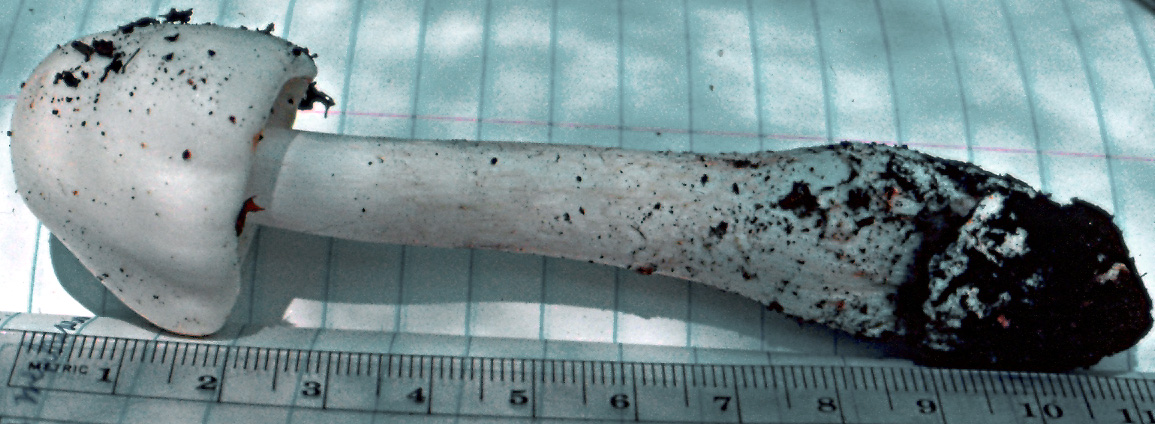
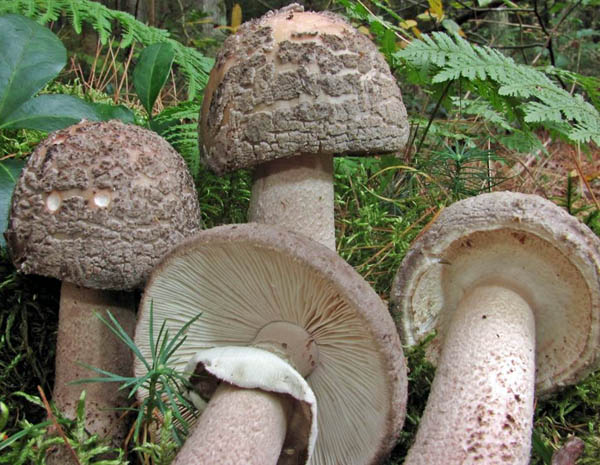
65 - 70 mm wide, white to pale grayish white to pale
gray, campanulate with incurved margin at first
becoming planoconvex with
decurved margin, somewhat translucent
prior to full expansion, subviscid; context
very firm, off-white,
with pileipellis sometimes dark gray in cross-section,
sometimes with watery line immediately above
lamellulae, thinning evenly from stipe to margin;
margin nonstriate, nonappendiculate;
universal veil often absent. |
| lamellae |
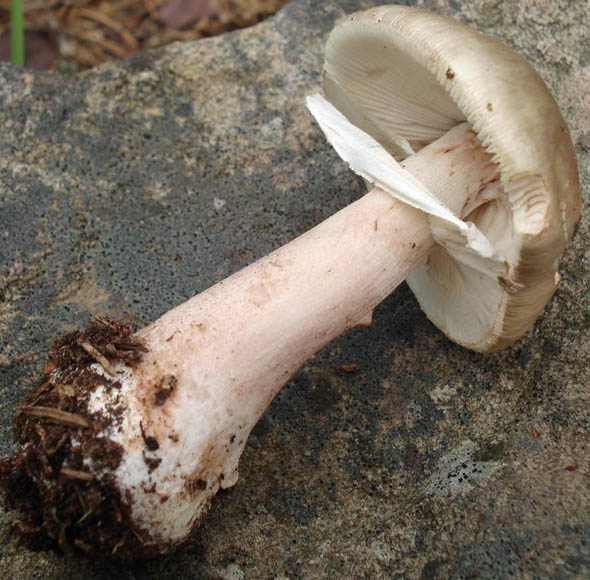
free to receding, with decurrent line on stipe,
crowded, pale
cream with pinkish tint in mass, white to pale
cream in side view (nearly concolorous with stipe
context), staining or bruising reaction not observed,
ca 5 mm broad, broadest at mid-point, narrowly
lozenge-shaped;
lamellulae subtruncate
to rounded attenulate to subattenuate to attenuate,
of diverse lengths, plentiful, with shape and length
apparently unrelated. |
| stipe |
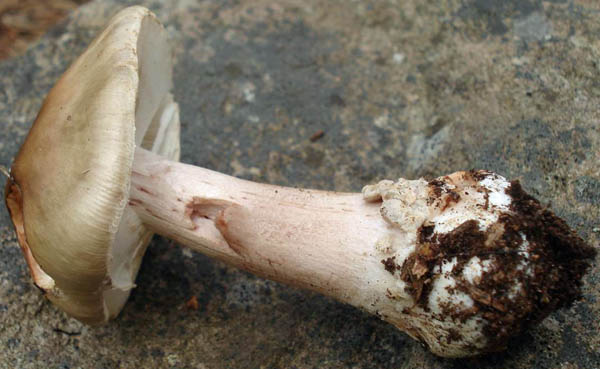
71 - 80 × 11 - 12 mm, white, subcylindric or
narrowing
upward, with surface innately fibrous, sometimes
with faint pinkish
brown stains on lower stipe: context solid,
pale cream, bruising or staining not observed,
insect damage not observed; bulb elongate
or narrowly ellipsoid, with uneven surface,
26 - 35 × 15 - 17 mm; partial veil white, membranous
persistent, exact position not
recorded (apical, subapical or superior),
striate above,
with underside bearing fine fibrils near
attachment to stipe and otherwise smooth; universal
veil white, submembranous-friable, detersile,
sometimes leaving faint margin around top of bulb
or patches in adjacent substrate or small fragments
on bulb surface. |
| odor/taste |
Odor indistinctly fungoid. Taste
not recorded. |
macrochemical
tests |
KOH - negative on pileipellis.
Paracresol (1%) - faint at first, slightly intensifying
over 15 min., center of pileus under pileipellis, bulb
and stipe base, isolated spots in stipe apex.
Sygingaldazine (0.1%) - negative throughout
basidiome.
Test vouchers: Tulloss 8-16-81-A, Tulloss 7-14-96-D.. |
| lamella trama |
bilateral, divergent; ... |
| subhymenium |
pseudoparenchymatous (cellular); ??. |
| basidia |
36± × 10.5± μm, 4-sterigmate,
with sterigmata up to 5.1 × 1.4 μm; clamps probably
not present. |
| lamella edge tissue |
sterile. |
| basidiospores |
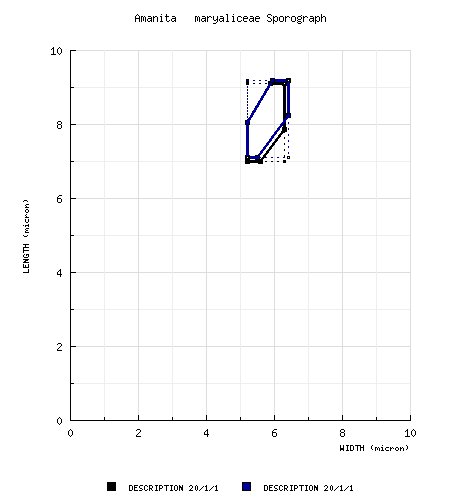
RET (material with unpigmented cap): [20/1/1] 7.0 - 9.1 (-9.4) × 5.2 - 6.3 (-6.6) µm,
(L = 8.0 µm; L’ = 8.0 µm; W =
5.7 µm; W’ = 5.7 µm; Q = (1.19-) 1.25 - 1.55;
Q = 1.40; Q’ = 1.40), hyaline, colorless,
smooth, thin-walled, amyloid, broadly ellipsoid to
ellipsoid, adaxially flattened;
apiculus sublateral, cylindric, proportionally
small; contents ??;
white in deposit.
RET (material with pigmented cap): RET: [20/1/1] 7.1 - 9.2
(-11.1) × (5.0-) 5.2 - 6.4
(-8.0) μm, (L = 8.2 μm; W = 5.7 μm;
Q = (1.25-) 1.29 - 1.55 (-1.59); Q = 1.43),
hyaline, colorless, smooth, thin-walled, amyloid,
broad ellipsoid to ellipsoid, adaxially flattened;
apiculus sublateral, cylindric;
contents ??;
?? in deposit.
[Note: Spores from the specimens with blackening
volva are not included here as they may have been
altered by environmental factors, such as a
"disease" of the fruiting body. They tended to
have greater width and, hence, lower Q values than
the spores reported above.—RET] |
| ecology |
Solitary to scattered.
Tlaxcala, Mexico: At 2775 m elev.
In dark, moist, friable loam of
Pinus-Abies-Quercus forest.
Massachusetts, U.S.A.:
In mixed forest with Amanita jacksonii.
New York, U.S.A.:
In sandy soil of mixed woods with Acer,
Fagus, Quercus, Pinus, &
Tsuga canadensis.
Pennsylvania U.S.A.: At 523 m
elev. In dark loam of woods including
Tsuga canadensis. Texas, U.S.A.: A pair in
mixed Quercus-Pinus forest. |
| material examined |
MEXICO:
TLAXCALA—Mpio. Tlaxco - El Rodeo,
Cerro El Peñon [19.7000° N/ 98.2211° W, 2775 m],
14.vii.1996 Dr. Arturo Estrada Torres s.n.
[Tulloss 7-14-96-D] (TLXM; RET 254-6, nrITS2-nrLSU seq'd.).
U.S.A.:
MASSACHUSETTS—Unkn. Co. - ca. border
Berkshire & Franklin Cos., W of Charlemont,
Mohawk Trail St. Pk., 16.viii.1981 M. A. King &
R. E. Tulloss 8-16-81-A (RET 323-3, nrLSU seq'd.);
NEMF 1986,
16.viii.1986 foray participant [Tulloss 8-16-86-J]
(RET 138-9, nrLSU seq'd.).
NEW YORK—Oneida Co. - unkn. loc., 3.x.2013 Eric
Smith s.n. [mushroomobserver #147255] (RET 598-1,
nrITS & nrLSU seq'd.).
PENNSYLVANIA—Lackawanna Co. - Lackawanna St. For.,
Thornhurst [41.2006° N/ 75.6025° W, ca. 525 m],
4.vii.2013 David Wasilewski s.n. [mushroomobserver
#138823] (RET 550-7, nrITS & nrLSU seq'd.).
Monroe Co. - Pocono Mtns. [41.1271° N/ 75.4907°
W, 514 m], 19.vii.2015 D. Wasilewski s.n.
[mushroomobserver #210821] (RET 709-6, nrITS &
nrLSU seq'd.).
TEXAS—Hardin Co. - Big Thicket Preserve,
Turkey Creek
Unit, Gore Store Rd. northbound trailhead, 4.x.2009 D. P.
Lewis 9420 (RET 461-3, nrITS-LSU seq'd.)
Newton Co. - off Forest Service Rd. 197, Mill Creek
Cemetery, 30.vi.2007 D. P. Lewis 8075 (RET 429-4,
nrITS & nrLSU seq'd.).). |
| discussion |
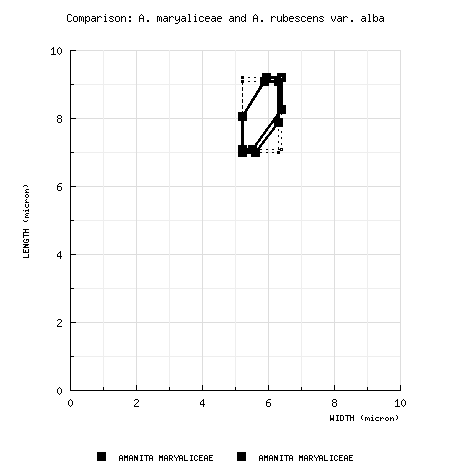
The semi-translucent appearance of the young cap,
the floral odor of the basidiome, the absence of
yellow in the universal veil in all known
specimens, and the lack of bruising reaction
suggest that this taxon is distinct from
A.
rubescens var. alba Coker and other
rubescent North American taxa.
The following figure provides a sporograph
comparison between the latter taxon and A.
maryaliceae:
The lack of bruising on the fruiting body
distinguishes the present species from other,
recently distinguished white rubescent taxa such as
A. ostendemihi
and the white-capped variant of A.
aureosubucula.
The present taxon could be the poorly known
A. spissa var. alba Coker with the
following exceptions. Coker describes his
material as
-
odorless and tasteless
-
having subcrowded lamellae
-
having a stipe that becomes brownish where
handled
-
having spores 6.3 - 7.5 × 4.2 - 5.0 µm (but his
assistant's spore measurements are notoriously
off).
In an additional collection in NCU annotated in
Coker’s hand ("North Carolina,
??, deciduous woods SE
of the Graded School, 12.vii.1920 H. R. Totten
4386," as “Amanita spissa var. alba”)
Coker wrote: “This is exactly like Hartsville no.
11—Cap 7 cm broad, smooth, white with a few light
brown stains. No volva patches. Margin faintly
striate, surface pitted. Veil ?? + staining
exactly as in my 11, even to the faint pinkish
flocculence from the volva on the good sized basal
bulb. This var. is apparently near but certainly
not the same as ?? of no. 4377 which differs in
staining much more freely + quickly (gills in var.
alba hardly stain at all; caps stain slowly and
very little), distinct warts + shorter stem +
smaller size. Stem including bulb 13 cm long.
Spores white, elliptic, smooth, 4.4 - 6.5 ×
6.3 - 9.2 µm [est. L = 7.8 µm; est.
W = 5.4 µm; est. Q = 1.42].”
[His 4377 might be
A.
salmonescens Tulloss or even
A. canescens
Dav. T. Jenkins. Remember that by 1917
he had described A. rubescens var.
alba, which can be robust.]
Molecular results regarding
Amanita maryaliceae
The following species have been mistaken for
A. maryaliceae in the field:
Amanita media,
A.
ostendemihi, and
A.
pearlriverensis. Amanita media
is distinguished by, among other things, its
narrow spores. The latter two
species have
been segregated from A. maryaliceae by
molecular means.
The two genes used for this
purpose are the commonly databased nrITS and
nrLSU. We have given some attention to whether
sequences of the two genes can both be frequently
obtained from a single sample and, when they are
obtained in large part, they can be easily connected
without insertion of ambiguities—"N's."
To date we can regularly obtain sufficient overlap
to allow joining of Sanger process sequences by
employing reads including the primers ITS4B and LR0R
(or LSU0F) in the case(s) of A. ostendemihi
and A. pearlriverensis. These two are
easily differentiated from each other by indels
(apparent gaps or insertions) in the ITS1 region of
the nrITS sequences.
more to come
Apparently there is a "darkening volva syndrome"
that attacks members of the rubescent group in
section Validae. Since the universal
veil on the stipe bulb of RET 550-7 is pallid and
the pileus has opened and separated from the
partial veil, we have an example of undarkened
universal veil in mature or near mature
material in a specimen with pigmented cap. That
the fact that the volval warts on
immature caps of RET 598-1 are dark suggests that
an alien agent may be the cause of the
pigmentation. Historically, dark-volvas on
amanitas have occasionally been attributable to
invasion of the volval tissue by a dark-walled
hyphomycete—as has been reported for Amanita
muscaria.
The blackened volva of RET 598-1 was examined at
1250× in dilute KOH without stain. While a
dark-walled hyphomycete was seen, it was seen only
in a single fragment in the section examined.
It had walls about 0.5 μm thick and frequent,
perforated septa about 0.8 μm thick. The
source of the dark appearance seems to be much more
likely to be necropigment in the collapsed,
gelatinized, and partially decayed cells of the
upper surface of the volval warts. These
cells (both filamentous hyphae and inflated cells)
contain pigment (saturated orange-brown) that is
significantly darker than the rest of the tissue
which is dominated by colorless to very pale brown,
transparent inflated cells.
In comparison to the warts of RET 550-7, the
darkened warts are much thinner and seem to have
lost material to decay; the latter's dark upper
surface is irregular and not smooth as in the
undarkened warts. Further indication that the
original surface has been lost in the darkened
warts is provided by the absence of soil particles
or other detritus on their surfaces.
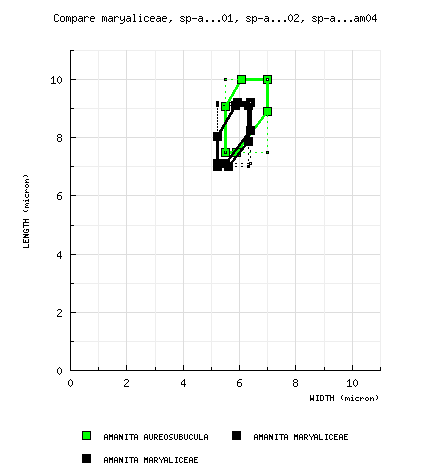
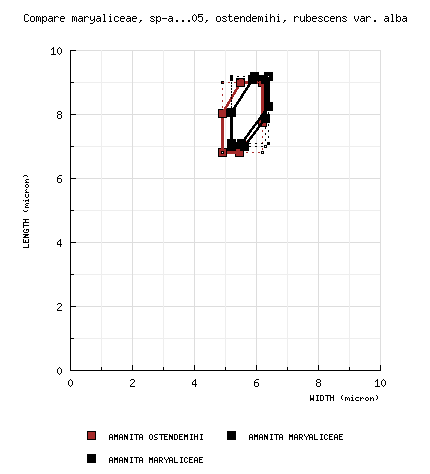
The following sporograph comparisons will change
and stabilize over time as more data is collected
from the group of rubescent Validae in
eastern North
America—Amanita rubescens var. alba,
A.
aureosubucula, Amanita
sp-amerirubescens02, Amanita
sp-amerirubescens04, Amanita
sp-amerirubescens05.
The temporary code "Amanita sp-amerirubescens07" was
used for a specimen of the present species on this
site.
|
| citations |
—R. E. Tulloss |
| editors |
RET |
|




 Spore data sets and their composite