| name |
Amanita canescens |
| author |
Dav. T. Jenkins. 1982a. Mycotaxon 14: 233. figs. 1-2. |
| name status |
nomen acceptum |
| english name |
"Golden Threads Lepidella" |
| etymology |
canus, gray + -escens, becoming;
hence, "becoming gray." |
| MycoBank nos. |
110466 |
| GenBank nos. |
Due to delays in data processing at GenBank, some accession numbers may lead to unreleased (pending) pages.
These pages will eventually be made live, so try again later.
|
| holotypes |
in herb. Dr. David T. Jenkins, Univ. of Alabama, Birmingham. |
| intro |
The following text may make multiple use of each data field.
The field may contain magenta text presenting data from a type study
and/or revision of other original material cited in the protolog of the present taxon.
Macroscopic descriptions in magenta are a combination of data from the protolog and
additional observations made on the exiccata during revision of the cited original
material.
The same field may also contain black text, which is data from a revision of the present
taxon (including non-type material and/or material not cited in the protolog).
Paragraphs of black text will be labeled if further subdivision of
this text is appropriate.
Olive text indicates a specimen that has not been
thoroughly examined (for example, for microscopic details) and marks other places in the text
where data is missing or uncertain.
The following material not directly from the protolog of the present taxon (Jenkins 1982a) is based on original research by R. E. Tulloss. |
| pileus |
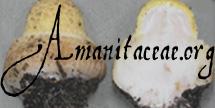
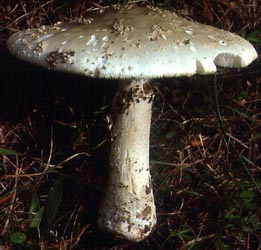
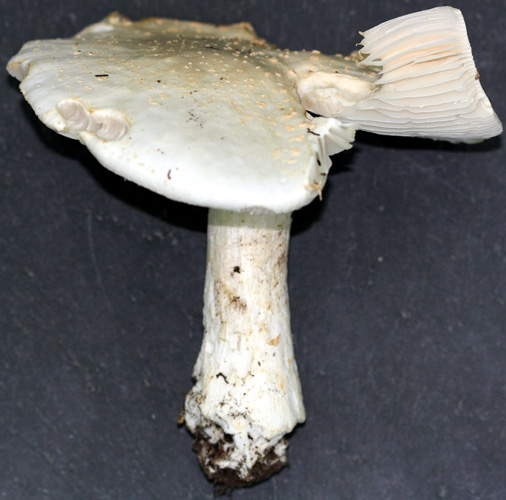
100 - 172 mm wide, pale grayish brown to grayish brown in disc, grayish-brown to pale sordid tan to white beyond disc, white or whitish near margin, plano-convex, sometimes with umbo, may become slightly depressed at full expansion, subviscid to tacky when moist, shiny or dull over disk, shiny near margin; context white, 13 - 17± mm thick at stipe, thinning evenly to margin; margin nonstriate, appendiculate, decurved throughout expansion; universal veil as plentiful warts, subpyramidal to pyramidal with eroded/striate sides, becoming flocculence near margin, white to cream to tannish cream, darkening somewhat with age, friable, detersile, randomly distributed. |
| lamellae |
adnexed to free, then seceding, with short decurrent line on stipe apex, close to crowded, pale orangish cream to cream in mass, cream or sordid cream or watersoaked white with pale orange tint in side view, not changing when bruised or cut, proportionately narrow to moderately broad (10 - 12.5 mm broad), thin and rather fragile, with minutely fimbriate edge; lamellulae subtruncate to rounded truncate to subattenuate to attenuate, plentiful, of diverse lengths, rather evenly distributed—with moderate length lamellulae alternating with lamellae, with very small lamellulae between every pair of lamella and moderate length lamellula. |
| stipe |
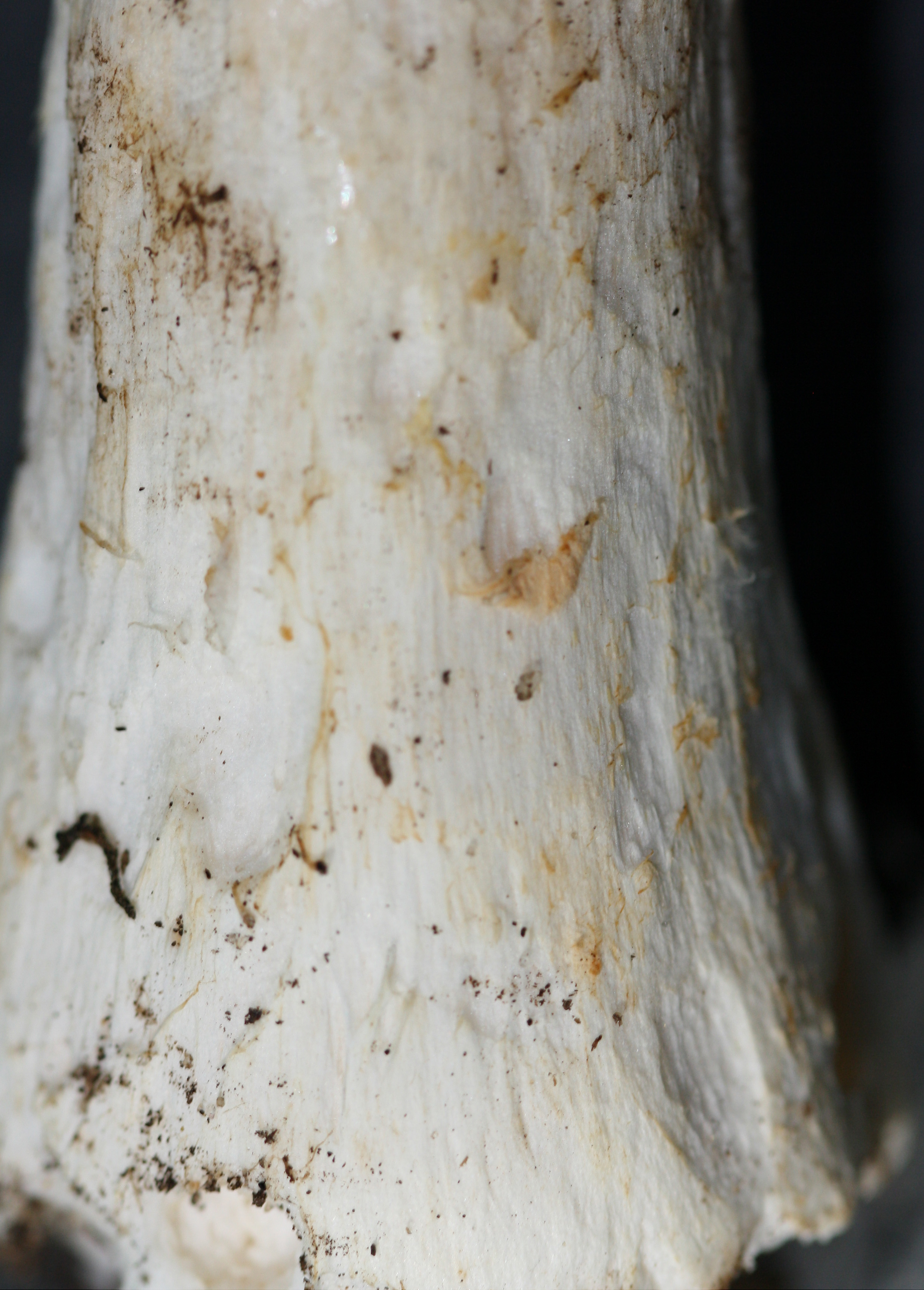
90 - 140- × 24 - 25 mm, white or near white, narrowing upward (at least slightly), flaring at apex, with abundant white fibrils above partial veil, with white to cream fibrils becoming pale pinkish orange or pale salmon or pale orangish white or pale yellowish orange below (especially in response to handling); bulb 39 - 45 × 39 - 46 mm, subnapiform to ovoid, often split longitudinally here and there; context white, solid, with concolorous larva tunnels; partial veil superior, white to off-white, large, thick, submembranous, very delicate, usually falling to lower stipe or ground after full expansion of pileus; universal veil as occasional irregular patches, randomly distributed on upper bulb or not apparent. |
| odor/taste |
Odor not distinctive or faintly fungoid or faintly of cedar wood or burnt sugar. Taste not recorded. |
macrochemical
tests |
Spot test for laccase (syringaldazine) - negative throughout basidiome. Spot test for tyrosinase (paracresol) - faintly positive in mid-stipe context after 3 min.; negative throughout remainder of basidiome. H2SO4 (conc.) - on pileipellis, quickly orangish brown, then brown; negative on context of pileus, stipe, and bulb and on surface of lamella. Test voucher: Tulloss 8-21-93-C. |
| basidiospores |
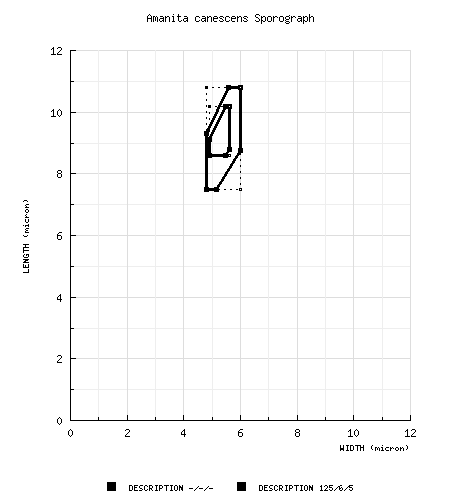
Jenkins (1982a): [-/-/-] 8.6 - 10.2 × 4.9 - 5.6 μm, (Q= 1.57 - 1.86; Q' = 1.66), hyaline, thin-walled, amyloid, ellipsoid to elongate, adaxially flattened; apiculus sublateral, short cylindric; contents guttulate to subgranular; white in deposit.
composite data from all material revised by RET: [125/6/5] (6.5-) 7.5 - 10.8 (-12.0) × (4.5-) 4.8 - 6.0 (-6.8) µm, (L = 8.3 - 9.5 µm; L’ = 8.9 µm; W = 5.0 - 5.7 µm; W’ = 5.3 µm; Q = (1.35-) 1.46 - 1.94 (-2.16); Q = 1.60 - 1.75; Q’ = 1.67), colorless, hyaline, smooth, thin-walled, amyloid to strongly amyloid, ellipsoid to elongate to (occasionally) cylindric, adaxially flattened, sometimes constricted, sometimes expanded at one end; apiculus subalteral, cylindric; contents monguttulate ("oil drop"), infrequently with additional small granules; white in deposit. |
| ecology |
Jenkins (1982a): In mixed coniferous and deciduous forest.
Solitary. Alabama: Near lake in mixed Pinus-Quercus woods. New Jersey: In mixed deciduous woods including Quercus, in moist sandy loam or by walking path in Quercus-Fagus-Carya wetland forest. New York: In sandy soil of Quercus-Pinus barrens. West Virginia: In loam in mixed hardwood forest containing high percentage of Quercus or in flood plain with Tsuga canadensis, Carya spp., Quercus spp., and Betula sp. |
| material examined |
Jenkins (1982a): U.S.A.:
ALABAMA—Jefferson Co. - Birmingham, Tyler Rd., 24.vii.1979 David, Jeannie, & Tiffan Jenkins 1528 (paratype, in herb. Dav. T. Jenkins, Univ. Alabama, Birmingham). Shelby Co. - Oak Mtn. St. Pk. [33°19'30" N/ 86°45'08" W, 210 m], 7.x.1980 Dav. T. Jenkins 1578 (holotype, in herb. Dav. T. Jenkins, Univ. Alabama, Birmingham), 7.x.1980 Milton White s.n. [Jenkins 1581] (paratype, in herb. Dav. T. Jenkins, Univ. Alabama, Birmingham).
U.S.A.:
ALABAMA—Unkn. Co. - border of Shelby
& Jefferson Cos., by lake ca. Topper Tree Lane,
22.viii.1984 C. Bas, D. T. Jenkins & R. E.
Tulloss [Bas 9083] (L n.v.; RET ??).
CONNECTICUT—Middlesex
Co. - E. Haddam, Devil’s Hopyard St. Pk.
[41°28'32" N/ 72°20'25" W, 72 m], 24.viii.2007
Noah Ratzan s.n. [Tulloss 8-24-07-D] (RET 438-10,
nrLSU seq'd.).
INDIANA—Monroe Co. - Griffey Lk. [], 19.ix.2012 Stephen Russell s.n. [mushroomobserver.org
#110439] (RET 533-4); Morgan-Monroe St. For. [39.3298° N/ 86.4388° W, 248 m], 29.ix.2012 S. Russell s.n. [mushroomobserver.org
#110652] (RET 533-8).
MASSACHUSETTS—Essex Co. - Boxford St. For., 6.ix.1990 Peter Fechko, Rob Moir & R. E. Tulloss s.n. [Tulloss 9-6-90-A] (RET 607-8).
NEW JERSEY—Burlington
Co. - ca. Chatsworth, Franklin Parker Preserve,
"airport gate area" [39°48'48" N/ 74°32'52" W,
27 m], 19.viii.2011 Nina Burghardt et al. s.n.
(RET 486-9). Middlesex Co. - Jamesburg
Twp., Jamesburg Twp. Pk., Helmetta Blvd. & Port
St. [40°23'16.19" N/ 74°25'53.97" W], 21.viii.1993
R. E. Tulloss & M. A. King 8-21-93-C
(RET 097-5).
Monmouth Co. - Upper Freehold,
ca. Imlaystown, Clayton Co. Pk., Bridges Tr.
[40°09’26” N/ 74°30’10” W, 75 m], 19.viii.2012 M. A.
& R. E. Tulloss 8-19-12-B (RET 508-8);
Roosevelt, Empty Box Brk. & Valley Rd.
[40°12'52.5054" N/ 74°28'7.0782" W], 27.vii.2010
M. A. & R. E. Tulloss 7-27-10-A
(RET 451-3, nrLSU seq'd.);
;
Roosevelt, Municipal Cemetery
[40°12'59" N/ 74°27'23" W, 67 m], 10.viii.2012 Lily,
Owen, M. A., & R. E. Tulloss & C. Rodríguez
Caycedo [Tulloss 8-10-12-B] (RET 506-2); Shark River
Co. Pk. [40°12’18” N/ 74°05’44” W, 16 m],
19.viii.2011 L. K., M. A., O. C. & R. E.
Tulloss & C. Rodríguez Caycedo [Tulloss]
8-19-11-E (RET 485-3).
NEW YORK—Dutchess
Co. - Pine Plains, Thompson Pond Preserve, base of
Stissing Mtn. [41°57’46” N/ 73°40’56” W, 148 m
elev.], 5.viii.2008 Wm. Bakaitis s.n.
(RET 421-8).
Sussex Co. (Long Isl.) - Rocky Pt. Natural Resources
Area, 15.ix.2002 J. L. Horman s.n.
(RET 327-7).
TENNESSEE—Blount
Co. - along Hwy. 12, 20.vii.2008 Jay Justice
TN-AM14 (RET 443-2, nrLSU seq'd.).
WEST VIRGINIA—Marion Co. - Fairmont, Mill
Fall Run, 21.x.1992 R. P. Bhatt, A. Kumar &
S. L. Stephenson A1 (FWVA). McDowell Co. -
Panther St. For., 10.vii.2002 W. C. Roody WRWV02-292
(DEWV 2926 as "A. excelsavar.
alba"). Pendleton Co. -
Geo. Washington Nat. For., Little Fork,
30.viii.2001 W. C. Roody WRWV01-1059
(DEWV 2103). |
| citations |
—R. E. Tulloss |
| editors |
RET |
|



 Spore data sets and their composite