

| name | Amanita media |
| name status | nomen acceptum |
| author | Dav. T. Jenkins |
| english name | "White Fence-Sitting Amanita" |
| images | |
| intro |
The following description is based on Jenkins (1983). |
| cap |
The cap of Amanita media is up to 78 mm wide, plano-convex with a slight depression in the center, shiny, smooth, silvery white, with a nonstriate margin. The volval remnants are present as a few, small, floccose patches. The flesh is white and up to 7 mm thick over the stem. |
| gills |
The gills are adnexed, crowded, creamy white; the short gills are truncate to slightly attenuate. |
| stem |
The stem is up to 50 × 14 -15 mm, solid, creamy-white, smooth, with random, white, easily removed, floccose patches of volva on the upper bulb, sometimes in rather large, easily broken patches, and sometimes forming a low rim on the base of the stem. The basal bulb is egg-shaped, with narrow end down, with the top of the bulb somewhat flattened (subabrupt) up to 30 × 25 mm. The ring is apical, white delicate, soon disappearing. |
| spores |
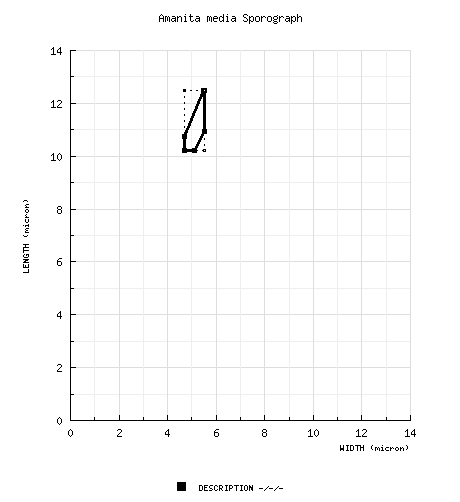
The spores measure (9.4) 10.2 - 12.5 × 4.7 - 5.5 µm and are elongate to cylindric and amyloid. Clamps are absent at bases of basidia. |
| discussion |
Amanita media was originally described from Alabama, USA, where it occurs among loblolly pine and mixed hardwoods. Jenkins notes that A. media is hard to place—"intermediate between sections Lepidella and Validae"
as in the case of A. radiata Dav. T. Jenkins. The cylindric spores and delicate partial veil
suggested section Lepidella to Jenkins but the nonappendiculate
pileus margin and the form of the volva suggested section Validae
to him. A more extensive discussion of "borderline" taxa can
be found on the page for Amanita radiata (link above). As in that case, Amanita
media has a noncellular subhymenium which could argue for its placement in section Lepidella. |
| brief editors | RET |
| name | Amanita media | ||||||||||||||||||||||||||||
| author | Dav. T. Jenkins. 1983. Mycotaxon 16: 414, fig. 1. | ||||||||||||||||||||||||||||
| name status | nomen acceptum | ||||||||||||||||||||||||||||
| english name | "White Fence-Sitting Amanita" | ||||||||||||||||||||||||||||
| MycoBank nos. | 108670 | ||||||||||||||||||||||||||||
| GenBank nos. |
Due to delays in data processing at GenBank, some accession numbers may lead to unreleased (pending) pages.
These pages will eventually be made live, so try again later. Search:
Showing 1 to 3 of 3 entries | ||||||||||||||||||||||||||||
| holotypes | In herb. David T. Jenkins, Univ. Alabama, Birmingham | ||||||||||||||||||||||||||||
| intro |
The following text may make multiple use of each data field. The field may contain magenta text presenting data from a type study and/or revision of other original material cited in the protolog of the present taxon. Macroscopic descriptions in magenta are a combination of data from the protolog and additional observations made on the exiccata during revision of the cited original material. The same field may also contain black text, which is data from a revision of the present taxon (including non-type material and/or material not cited in the protolog). Paragraphs of black text will be labeled if further subdivision of this text is appropriate. Olive text indicates a specimen that has not been thoroughly examined (for example, for microscopic details) and marks other places in the text where data is missing or uncertain. The following description is derived entirely from the protolog of the present species (Jenkins 1983). | ||||||||||||||||||||||||||||
| pileus | from protolog: up to 78 mm in diam., plano-convex with slight depression in center, shiny, smooth, silvery white, with distinct tannish tint primarily on disc; context white, up to 7 mm thick at center, tapering toward margin; margin non-striate; universal veil few, small, floccose patches. | ||||||||||||||||||||||||||||
| lamellae | from protolog: crowded, adnexed, creamy-white; lamellulae truncate to slightly attenuate./font> | ||||||||||||||||||||||||||||
| stipe | from protolog: up to 50 × 14 - 15 mm, creamy-white, smooth; partial veil apical, white, very delicate, soon disappearing; context solid; basal bulb obovate, up to 30 × 25 mm; universal veil remnants as random, floccose patches on upper bulb, white, easily removed. | ||||||||||||||||||||||||||||
| odor/taste | from protolog: Odor not distinct. Taste not recorded. | ||||||||||||||||||||||||||||
| macrochemical tests |
none recorded. | ||||||||||||||||||||||||||||
| pileipellis | from protolog: filamentous hyphae densely interwoven, considerable gelatinization, 2 - 6 µm diam, moderately abundant, oleigerous hyphae present. | ||||||||||||||||||||||||||||
| pileus context | from protolog: filamentous hyphae undifferentiated, moderately branched, no clamps, 2 - 7 µm diam; inflated cells abundant, mostly terminal, mostly elongate, up to 191 × 38 µm. | ||||||||||||||||||||||||||||
| lamella trama | from protolog: bilateral; filamentous hyphae undifferentiated, no clamps, 2- 8 µm diam; inflated cells elongate, terminal. | ||||||||||||||||||||||||||||
| subhymenium | from protolog: inflated ramose to subcellular, no clamps. | ||||||||||||||||||||||||||||
| basidia | from protolog: up to 43 × 4 - 11 µm, mostly 4-sterigmate, but with a conspicuous number of 2-sterigmate, thin-walled; no clamps. | ||||||||||||||||||||||||||||
| universal veil | from protolog: filamentous hyphae at base of stipe abundant, sparsely to moderately branched, no clamps, 3 - 7 µm diam, some gelatinization, irregularly disposed; inflated cells abundant, globose, subglobose, broadly elliptic, up to 78 × 78 µm, very few small elliptical cells, mostly short, terminal chains; tissue on pileus the same. | ||||||||||||||||||||||||||||
| stipe context | from protolog: filamentous hyphae undifferentiated, sparsely branched, no clamps, 3 - 6 µm diam; inflated cells terminal, clavate, longitudinally oriented, up to 154 × 41 µm, most smaller. | ||||||||||||||||||||||||||||
| partial veil | from protolog: almost exclusively filamentous hyphae, moderately branched, no clamps, 2 - 8 µm diam, interwoven; inflated cells sparse, small, terminal. | ||||||||||||||||||||||||||||
| lamella edge tissue | not described. | ||||||||||||||||||||||||||||
| basidiospores | from protolog: [-/-/-] (9.4-) 10.2 - 12.5 × 4.7 - 5.5 µm, (Q = 1.99 - 2.29; Q’ = 2.12), hyaline, thin-walled, amyloid, elongate to cylindric, adaxially flattened; contents guttulate; apiculus sublateral, cylindrical; white in deposit. | ||||||||||||||||||||||||||||
| ecology | from protolog: Alabama: Pinus taeda (Loblolly Pine) and mixed hardwoods. | ||||||||||||||||||||||||||||
| material examined |
protolog of A. media:
U.S.A.:
ALABAMA—Covington Co. - btwn. Florala &
Opp, U.S. Hwy. 331, rest area, 11.vi.1981 Jeannie &
Dav. T. Jenkins 1629 (holotype, in herb. Dav. T.
Jenkins, Univ. Alabama, Birmingham), 11.vi.1981
Jeannie & Dav. T. Jenkins 1657 (paratype, in herb.
Dav. T. Jenkins, Univ. Alabama,
Birmingham). RET: U.S.A.: ARKANSAS—Perry Co. - Lk. Sylvia Recreation Area, 23.viii.2008 Jay Justice AR-AM-12 (RET 436-4,, nrITS & nrLSU seq'd.), AR-AM-15 (RET 436-3, nrITS & nrLSU seq'd.). PENNSYLVANIA—Lackawanna Co. - Unkn. loc., 9.viii.2011 David Wasilewski s.n. [mushroomobserver #73731] (RET 500-1, nrIT & nrLSU seq'd.). | ||||||||||||||||||||||||||||
| discussion |
Since this taxon is apparently very similar to
A.
radiata, of which very pale specimens have
been
found, it seems that one should consider whether the
latter taxon's name might not be a taxonomic
synonym of A.
media. Both taxa were originally collected
in the same roadside rest area a year apart.
Unfortunately, Jenkins did not provide a detailed
justification of novelty in his protolog for
A. radiata. The present species is segregated from A. radiata by (1) absence of the relatively thick submembranous patches of volva on the pileus (however, apparently few volval remnants were on the pilei of the material seen by Jenkins), (2) fine radiating brown lines present on the pileus surface, and (3) a nonstriate pileus margin. This is not a very distinctive differentiation of a species within section Validae. Jenkins never gave an indication of the size of the sample of spores that he measured. Of the few specimens that we have seen that fall into the media/radiata grouping, so far all share the same nrITS and nrLSU sequences. Here is a sporograph comparing media and radiata from that point of view: New studies of the types and DNA sequencing of them (if possible) would be very useful. Comparison of the nrITS and nrLSU of media/radiata material with sequences of the same loci derived from material of Amanita canescens also suggests a high degree of similarity. In the latter case, recent research has indicated that a single gene (nrLSU) consensus tree of the cited taxa and others that are morphologically and genetically similar in section Validae includes media/radiata and canescens in a well supported clade having canescens as a well-supported subclade. Here is an extension of the previous sporograph that includes canescens: The average length/width ratio (Q) of the spores for A. canescens is distinctively smaller than the value(s) for media/radiata—1.60 - 1.75 vs. 1.90 - 2.12. | ||||||||||||||||||||||||||||
| citations | —R. E. Tulloss | ||||||||||||||||||||||||||||
| editors | RET | ||||||||||||||||||||||||||||
Information to support the viewer in reading the content of "technical" tabs can be found here.
 Spore data sets and their composite
Each spore data set is intended to comprise a set of measurements from a single specimen made by a single observer; and explanations prepared for this site talk about specimen-observer pairs associated with each data set. Combining more data into a single data set is non-optimal because it obscures observer differences (which may be valuable for instructional purposes, for example) and may obscure instances in which a single collection inadvertently contains a mixture of taxa.

Text and User-Generated Sporographs are published under the Creative Commons License.

In the case of a taxon page, image credits are on the 'image' tab.