| name |
Amanita radiata |
| author |
Dav. T. Jenkins. 1984. Mycotaxon 20: 315, fig. 1. |
| name status |
nomen acceptum |
| english name |
"Brown Fence-Sitting Amanita" |
| MycoBank nos. |
106591 |
| GenBank nos. |
Due to delays in data processing at GenBank, some accession numbers may lead to unreleased (pending) pages.
These pages will eventually be made live, so try again later.
|
| holotypes |
in herb. David T. Jenkins, Univ. Alabama, Birmingham |
| intro |
The following text may make multiple use of each data field.
The field may contain magenta text presenting data from a type study
and/or revision of other original material cited in the protolog of the present taxon.
Macroscopic descriptions in magenta are a combination of data from the protolog and
additional observations made on the exiccata during revision of the cited original
material.
The same field may also contain black text, which is data from a revision of the present
taxon (including non-type material and/or material not cited in the protolog).
Paragraphs of black text will be labeled if further subdivision of
this text is appropriate.
Olive text indicates a specimen that has not been
thoroughly examined (for example, for microscopic details) and marks other places in the text
where data is missing or uncertain.
The following is based on the protolog of the present species and on original research of R. E. Tulloss.
Basidiome medium sized. |
| pileus |
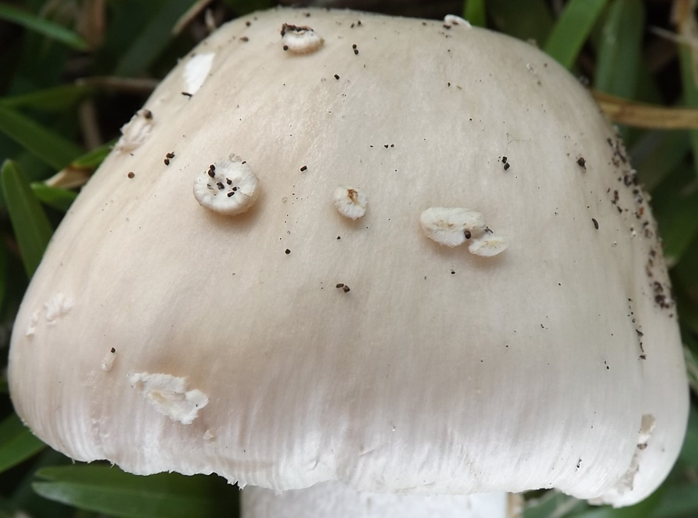
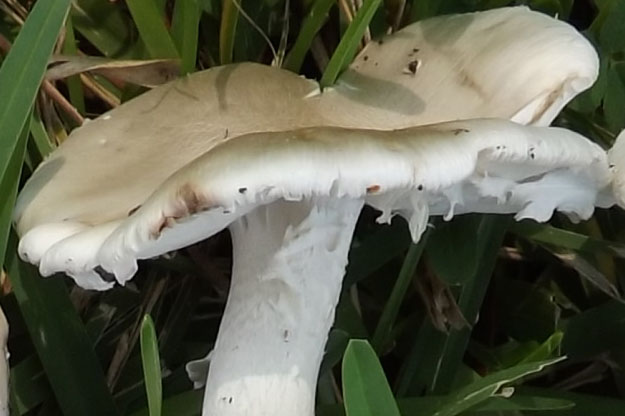
from protolog: up to 70 mm wide, brown to yellowish brown, with pigment appearing to be in imbedded radial fibrils, plano-convex to planar, smooth, shiny; context up to 7 mm thick over stipe, white; margin nonappendiculate, short-striate, very slightly incurved, with no sterile margin exceeding ends of gills; universal veil as patches over disc, relatively thick, whitish, floccose-membranous . |
| lamellae |
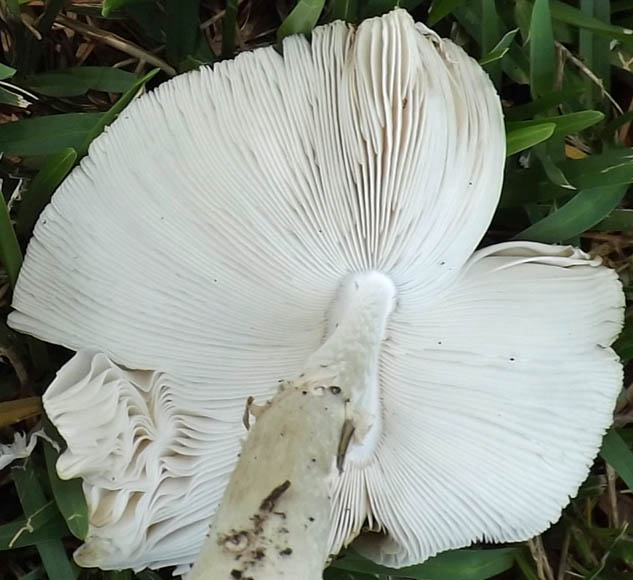
from protolog: adnexed, moderately crowded, white, narrow; lamellulae attenuate, moderately abundant. |
| stipe |
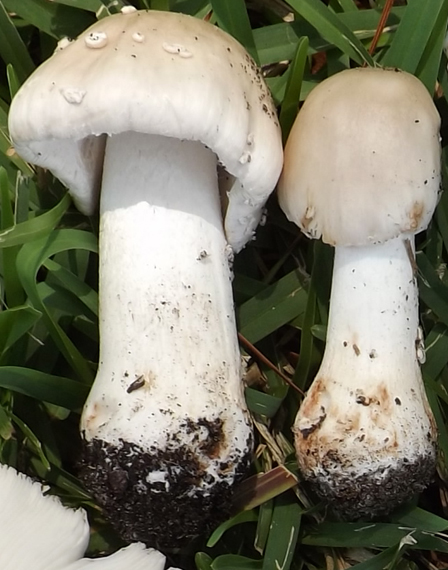
from protolog: 45 - 60 × 10 - 13 mm, white, with brownish fibrils, narrowing upward, slightly flaring at apex, fibrillose to fibrillose-scaly; bulb 40 × 25 mm, ovoid; context solid; partial veil apical, white, fugacious; universal veil as very slight floccose-membranous rim [on bulb], breaking up into patches. |
| odor/taste |
from protolog: Odor and taste indistinct. |
macrochemical
tests |
none recorded. |
| pileipellis |
from protolog: distinctly gelatinized near surface; filamentous hyphae 2.0 - 7.0 mm wide, interwoven; vascular hyphae moderately abundant. |
| pileus context |
from protolog: filamentous hyphae up to 8.0 μm wide, moderately abundant; acrophysalides numerous, elongate, terminal singly or in short chains; vascular hyphae not described. |
| lamella trama |
from protolog: bilateral; filamentous hyphae 2.0 - 7.0 μm wide, moderately branched; inflated cells mostly clavate, up to 230 μm long, terminal singly or in short chains; vascular hyphae not decribed; clamps absent.
RET: bilateral, divergent; ??. |
| subhymenium |
from protolog: inflated ramose to subcellular; filamentous hyphae up to 7.0 μm wide; vascular hyphae not described; clamps absent.
RET: pseudoparenchymatous (cellular); inflated cells ??, in 3 (-4) layers. |
| basidia |
from protolog: up to 39 × 4 - 11 μm, 4-sterigmate; clamps absent.
RET: ??; clamps not observed. |
| universal veil |
from protolog: On pileus: moderately dense tissue; filamentous hyphae up to 8.0 μm wide, abundant, irregularly disposed, moderately branched; inflated cells predominantly globose to broadly ellipsoid (up to 93 × 93 μm), occasionally ellipsoid (up to 109 × 46 μm), terminal, mostly in chains; vascular hyphae sparse; clamps absent. On stipe base: Similar, but inflated cells usually smaller. |
| stipe context |
from protolog: longitudinally acrophysalidic; filamentous hyphae 3.0 - 7.0 μm wide, sparsely branched, moderately abundant; acrophysaides up to 250 × 18 μm, mostly cylindric, terminal; vascular hyphae not described; clamps absent. |
| partial veil |
from protolog: filamentous hyphae present; inflated cells dominating variiform; vascular hyphae not described. |
| lamella edge tissue |
RET: sterile. |
| basidiospores |
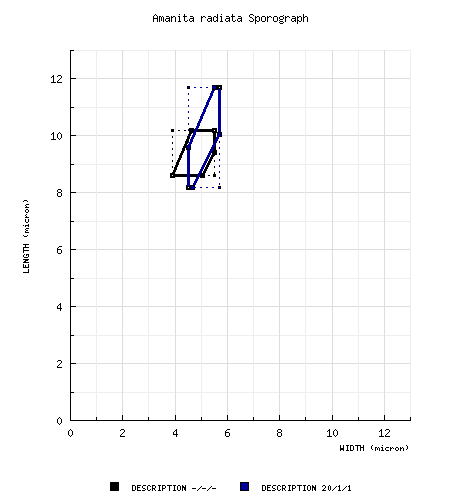
from protolog: [-/-/-] 8.6 - 10.2 × 3.9 - 5.5 μm, (Q = 1.71 - 2.20; Q' = 1.93), hyaline, thin-walled, amyloid, elongate to cylindric, adaxially flattened; apiculus sublateral, cylindric; contents guttulate; white in deposit.
RET: [20/1/1] (7.7-) 8.2 - 11.7 (-12.4) × (4.2-) 4.5 - 5.7 (-6.0) μm, (L = 9.2 μm; W = 4.9 μm; Q = (1.71-) 1.76 - 2.13 (-2.18); Q = 1.90), hyaline, colorless, smooth, thin-walled, amyloid, elongate to cyindric, sometimes expanded at one end, adaxially flattened; apiculus sublateral, cylindric; contents mono- or multiguttulate, often with additional small granules; white in deposit. |
| ecology |
from protolog: Alabama:
Solitary. Under Pinus taeda (Loblolly
Pine) and Quercus.
RET: Florida: Gregarious, in partial "fairy
ring." Under Quercus laurifolia.
New York: In sandy soil of Pinus-Quercus
barrens. |
| material examined |
from protolog:
U.S.A.:
ALABAMA—Covington Co. - btwn. Florala and
Opp, U.S. Hwy. 331 rest area, 11.vi.1981 Jeannie and
David Jenkins 1642 (holotype, in herb. Dav. T.
Jenkins, Univ. Alabama, Birmingham). Shelby
Co. - Oak Mtn. St. Pk., NE of Pelham, 9.vii.1982
David T. Jenkins 1736 (paratype, in herb. Dav. T.
Jenkins, Univ. Alabama, Birmingham).
RET: U.S.A.:
FLORIDA—Marion Co. - Ocala Nat. For.
[29.241° N/ 81.6888° W, 11 m], 19.vi.2013 Justin
Brosey s.n. [mushroomobserver.org
#136989]
(RET 548-1, nrITS & nrLSU seq'd.).
NEW YORK—Suffolk Co. - Rocky Point
Natural Resources Area, 15.ix.2002 Joel Horman s.n.
(RET 327-7, nrITS & nrLSU). |
| discussion |
from protolog [excerpt]:
"Amanita radiata is
characterized by a brownish to yellowish brown
pileus which has distinct, innate,
radial...[fibrils],
whitish floccose membranous volval patches,
a whitish
stipe with brownish fibrils, and elongate to
cylindric spores. This combination of
features makes A. radiata
distinct."
RET: In the southeastern U.S., there are three
taxa that are rarely knowingly collected and share
spores of very similar size and shape: the present
species, A.
neoneglecta, and A. media. Of the three
species, only the present one has a striate margin
of the pileus (very unusual in section
Validae except in older or drying specimens)
and a virgate pileus. Justin Brosey's
photographs illustrate these characters in young
specimens. Older specimens seem to have
bruised brownish (obscuring the virgation) or been
sunburned to the same effect.
The phrase "fence sitting" in the proposed English
name of the present species relates to Jenkins'
concern over placement of this species: Should it
be placed in sect. Validae or sect.
Lepidella? The nonappendiculate
margin appears to be sufficient to decide on the
Validae.
From the collections available to us, both
nrITS and nrLSU sequences have been derived.
When these sequences are BLASTed against GenBank
data, the most similar sequences in both cases
come from apparently early divergingspecies of
section Validae.
Similar results are obtained from the local
sequence database in the Roosevelt lab.
As samples accumulate that can be attributed to this
species or A.
media, it begins to seem more
probable that the two names were unintentionally
proposed for color variants of a single
organism. If this is the case,
A. media has priority and would be the name
to be used. |
| citations |
—R. E. Tulloss |
| editors |
RET |
|




 Spore data sets and their composite