| name |
Amanita salmonescens |
| author |
Tulloss. 1990. Mycotaxon 38: 125, figs. 1-6. |
| name status |
nomen acceptum |
| english name |
"Salmon-Staining Amanita" |
| MycoBank nos. |
127491 |
| GenBank nos. |
Due to delays in data processing at GenBank, some accession numbers may lead to unreleased (pending) pages.
These pages will eventually be made live, so try again later.
|
| holotypes |
NY |
| intro |
The following text may make multiple use of each data field.
The field may contain magenta text presenting data from a type study
and/or revision of other original material cited in the protolog of the present taxon.
Macroscopic descriptions in magenta are a combination of data from the protolog and
additional observations made on the exiccata during revision of the cited original
material.
The same field may also contain black text, which is data from a revision of the present
taxon (including non-type material and/or material not cited in the protolog).
Paragraphs of black text will be labeled if further subdivision of
this text is appropriate.
Olive text indicates a specimen that has not been
thoroughly examined (for example, for microscopic details) and marks other places in the text
where data is missing or uncertain.
The following text is derived from the protolog of the present species and additional original research of R. E. Tulloss.
The original description of Amanita salmonescens (Tulloss 1990) is available here in the form of a PDF. (open) |
| pileus |
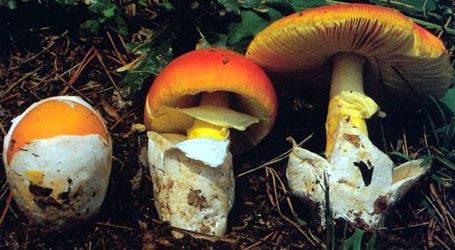
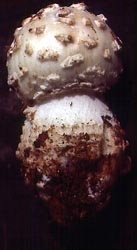
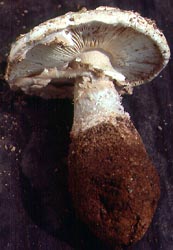
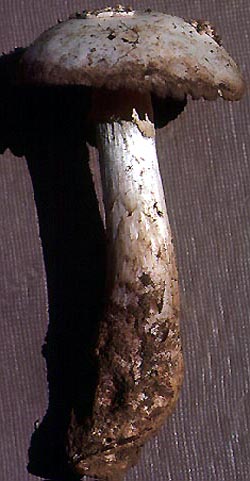
35 - 86 mm wide, at first globose, white to off-white, subviscid to dry and shiny, at maturity planar with depressed center; context white, sometimes faint pinkish in areas of insect damage and sometimes taking on a dark reddish-brown color near pileipellis, up to 5+ mm thick at stipe; margin at first inflexed, becoming rimose, nonstriate at first, sometimes becoming striate in age, finely appendiculate or not appendiculate; universal veil remnants as large, coarse, subpyramidal to truncate pyramidal warts with polygonal base, at times confluent, lifting at edges, white at first becoming gray to blackish at maturity; pileipellis slowly turning dark reddish-brown where cut, sometimes with pinkish discoloration around the darkened edges. |
| lamellae |
white to whitish, sometimes browning in spots, close to crowded, free to occasionally adnate, often with decurrent line on upper stipe, 5± mm broad; lamellulae truncate to rounded truncate to subattenuate. |
| stipe |
white becoming pinkish (close to “reddish (or pinkish) white” (7A2), but with a gray tint) or pallid orange gray, 20 - 67 × 10± mm, narrowing upward or cylindric, flaring or not at apex, surface undecorated to longitudinally striatulate, often finely fibrillose to fibrillose and sometimes with pellis recurving in thin scales, with fibrils discoloring like pileipellis, pruinose above partial veil, with stipipellis brown in section in aging specimen; bulb subnapiform to dauciform to elongate-subclavate, rooting, 25 - 35 × 15 - 22 mm; context white, solid, occasionally brownish in bulb probably due to injury; partial veil subapical, membranous, becoming lacerate and appressed to stipe, white becoming pinkish to pallid orange gray like stipe surface, with margin thickened, striate above, lacerate fibrillose below, sometimes with fibrils from stipe attached below; universal veil sometimes in up to three or four concentric circles of dash-like to rectangular warts on upper portion of bulb, white becoming grayish or pallid orange gray, sometimes detersile. |
| odor/taste |
Odor pleasant, pungent, flowery or fruit-like to faintly so. Taste not recorded. |
macrochemical
tests |
none recorded |
| pileipellis |
branching interwoven radially-arranged barely gelatinizing filamentous undifferentiated hyphae 1.2 - 16.0 µm wide; vascular hyphae present, 2.5 - 6.2 µm wide, some containing guttulate material that stains deeply in Congo Red. |
| pileus context |
scattered granules throughout tissues which stain deeply in Congo Red; branching interwoven filamentous undifferentiated hyphae 4.8 - 13.0 µm wide; abundant thin-walled inflated cells, elongate to 79 × 23 µm, subpyriform to very broadly clavate to 59 × 32 µm, ovoid to 92 × 48 µm; branching vascular hyphae present, 4.0 - 10.2 µm wide. |
| lamella trama |
bilateral; inflated cells arise at acute angles to distinct central stratum; undifferentiated filamentous branching hyphae 2.1 - 9.8 µm wide; inflated cells elongate to 75 × 24 µm, but mostly half those dimensions or less; vascular hyphae common to plentiful, 4.0 - 10.5 µm wide. |
| subhymenium |
cellular (pseudoparenchymatous); basidia arise from globose to subglobose to pyriform cells of varying size (to about 15 µm major wide) in ramifying chains, forming a layer 30 - 45 µm deep. |
| basidia |
4-sterigmate, thin-walled, 30 - 42 × 7.7 - 11.0 µm; no clamps seen. |
| universal veil |
On pileus adjacent to pileipellis: gelatinizing undifferentiated filamentous branching interwoven hyphae plentiful. On pileus other than near pileipellis: without clear arrangement of structures; filamentous undifferentiated branching hyphae plentiful, 1.8 - 10.5 µm wide, rather frequently septate—especially near terminal inflated cells; inflated cells terminal, dominating, globose to subglobose to broadly pyriform to 66 × 63 µm, clavate to ellipsoid to 75 × 56 µm, with walls 0.5 - 1.0 µm thick; vascular hyphae plentiful, 2.8 - 12.6 µm wide. On stipe base: undifferentiated filamentous branching hyphae 1.7 - 6.3 µm wide, about equally plentiful to inflated cells; inflated cells globose, subglobose, broadly ellipsoid, cylindrical, clavate, up to 70 × 60 µm, terminal or in short chains; no clamps seen. |
| stipe context |
longitudinally acrophysalidic; undifferentiated filamentous branching hyphae 1.0 - 11.5 µm wide; acrophysalides narrow, subcylindric to subfusiform to clavate, up to 156 × 47 µm, many less than half this diameter, some with thin-walls, many with walls 0.8 - 1.0 µm thick, some with basal septa to 14 µm wide because of slightly inflated subterminal cells; vascular hyphae common, but sometimes difficult to discern because they are rather narrow (4.2 - 7.0 µm wide) and mostly longitudinally arranged and infrequently branching, no coiling or curving segments seen; no clamps seen. |
| partial veil |
Below upper surface, branching filamentous undifferentiated hyphae predominant, 1.4 - 5.2 µm wide, interwoven; inflated cells terminal, clavate to broadly clavate, up to 119 × 35 µm, thin-walled; vascular hyphae common, irregularly arranged, locally dense and coiled in loose knots, occasionally branching, 2.0 - 11.0 (-18.0) µm wide; many filamentous hyphae and inflated cells have a common, subradial orientation, with upper surface bearing predominance of rounder smaller dissociated cells, pyriform to broadly clavate as well as narrower clavate cells to 44 × 31 µm mixed with plentiful dissociated partially gelatinizing fragments of undifferentiated filamentous branching hyphae and plentiful vascular hyphae. |
| basidiospores |
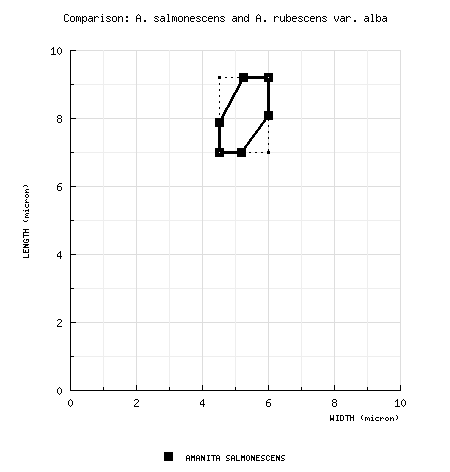
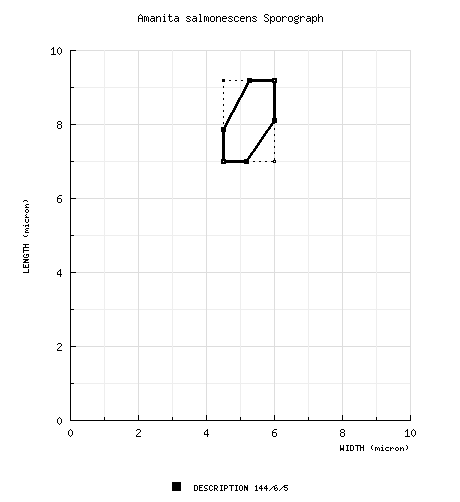
[144/6/5] (5.9-) 7.0 - 9.2 (-10.5) × (4.2-) 4.5 - 6.0 (-6.5) µm, (L = (7.7-) 7.8 - 8.4 µm; L’ = 8.1 µm; W = (4.9-) 5.2 - 5.6 µm; W’ = 5.3 µm; Q = (1.18-) 1.35 - 1.75 (-1.88); Q = 1.45 - 1.57 (-1.62); Q’ = 1.54), colorless, hyaline, thin-walled, smooth, amyloid, broadly ellipsoid to ellipsoid to elongate, occasionally expanded at one end; apiculus sublateral, cylindric, small; contents guttulate; white in deposit. |
| ecology |
Solitary to subgregarious. In red clay or in loam under deciduous trees including Quercus spp., Liriodendron tulipifera, Acer sp., Cornus florida, Fraxinus sp., etc. or in mixed woods with similar trees and Pinus spp. or under hardwoods. |
| material examined |
U.S.A.:
ILLINOIS—Coles Co. - unkn. loc., 28.vii.2003 M. Kuo 07280304 (in herb. M. Kuo, RET 372-6).
NEW JERSEY—Mercer Co. - Princeton, Herrontown Woods Co. Pk., 18.ix.1983 New Jersey Mycol. Assoc. foray participant s.n. [Tulloss 9-18-83-B] (paratype, RET 059-1).
SOUTH CAROLINA—Oconee Co. - Sumter Nat. For., Stumphouse Tunnel Pk., 16.vii.1983 M. A. King & R. E. Tulloss 7-16-83-A (holotype, NY), -D (paratype, RET 058-7), -E (paratype, RET 058-8). |
| discussion |
A comparison of sporographs for the present species and Amanita rubescens var. alba Coker is provided below.
|
| citations |
The original description of Amanita salmonescens (Tulloss 1990) is available here in the form of a PDF. (open)—R. E. Tulloss |
| editors |
RET |
|



 Spore data sets and their composite