| name |
Amanita ceciliae |
| author |
(Berk. & Broome) Bas. 1984. Persoonia 12: 192. |
| name status |
nomen acceptum |
| english name |
"Cecilia's Ringless Amanita" |
| synonyms |
≡ Agaricus ceciliae Berk. & Broome. 1854. Ann. Mag. Nat. Hist., Ser. 2 13: 396.
≡ Amanitopsis ceciliae (Berk. & Broome) Peck. nom. inval 1899. Rep. (Annual) Regents Univ. State New York New York State Mus. 51: 301. [Not definitely accepted by author. ICBN §33.1]
≡ Amanita ceciliae (Berk. & Broome) Boud. nom. inval. 1902. Bull. Soc. Mycol. France 18: 270. [Incidental mention as synonym. ICBN §34.1c.]
= Amanita inaurata Secr. ex Gillet. 1874. Champ. (Hyménomyc.) Croiss. France: 41. ≡[ Agaricus] 'Amanita' inauratus Secr. nom. inval 1833. Mycogr. Suisse 1: 36, no. 34. [Publication in designated rank of suppressed work. ICBN §32.8, App. V] ≡Amanitopsis inaurata (Secr. ex Gillet) Fay. 1889. Ann. Sci. Nat., Bot., Sér. 7 9: 317. ≡ Amanitopsis vaginata var. inaurata (Secr. ex Gillet) Sacc. 1915. Fl. Ital. Cryptogr. 1(14): 62. ≡ Amanita vaginata f. inaurata (Secr. ex Gillet) Veselý. 1933. Ann. Mycol. 31(4): 280. =[ Amanita] " Amanitopsis" inaurata f. royeri L. Maire in E.-J. Gilbert. 1918. Gen. Amanita Pers.: 155. ≡ Amanita vaginata f. royeri (L. Maire in E.-J. Gilbert) Veselý. 1933. Ann. Mycol. 31(4): 280. ≡ Amanita strangulata var. royeri (L. Maire) Contu. 2000a. Boll. Gruppo Micol. G. Bresadola 43(2): 238. [Misapplication.]
non Agaricus ( Amanita) var. strangulatus Fr. 1838. Epicr.: 6.
The editors of this site owe a great debt to Dr. Cornelis Bas
whose famous cigar box files of Amanita nomenclatural information
gathered over three or more decades were made available to RET for computerization
and make up the lion's share of the nomenclatural information presented on this site.
|
| etymology |
genitive of a name (Cecilia); hence "of Cecilia" or "Cecilia's". Named for Cecilia Berkeley—reportedly, one of Berkeley's daughters. |
| MycoBank nos. |
107714 |
| GenBank nos. |
Due to delays in data processing at GenBank, some accession numbers may lead to unreleased (pending) pages.
These pages will eventually be made live, so try again later.
|
| holotypes |
Agaricus ceciliae—K |
| selected illustrations |
Romagnesi. 1961. Nouv. Atl. Champ. 3: pl. 179. |
| intro |
The following text may make multiple use of each data field.
The field may contain magenta text presenting data from a type study
and/or revision of other original material cited in the protolog of the present taxon.
Macroscopic descriptions in magenta are a combination of data from the protolog and
additional observations made on the exiccata during revision of the cited original
material.
The same field may also contain black text, which is data from a revision of the present
taxon (including non-type material and/or material not cited in the protolog).
Paragraphs of black text will be labeled if further subdivision of
this text is appropriate.
Olive text indicates a specimen that has not been
thoroughly examined; for example, for microscopic details or another spot
where data is missing; for example, a place name.
The microscopic data and information derived from macroscopic review of exsiccata derives from original research of R. E. Tulloss.
The Latin diagnosis and comments from the protolog (Berkeley and Broome 1854) read as follows:
"Pileo primum semielliptico, volva murina crassiuscula rimosa, demum basi irregulariter circumscissa marginata operto, dein campanulato; margine sulcato; stipite sursum attenuato spongioso farcto; annulo nullo."
"Allied to A. vaginatus, but without a distinct sheathing volva, and with the stem merely spongy within and not filled with delicate cottony fibres. In full-grown specimens there is only a slight mark showing where the edge of the pileus rested. It is allied to the veil-less species from the Himalayas. The name is intended to record the services which have been rendered to Mycology by many excellent illustrations and in other ways by Cecilia E. Berkeley." |
| pileus |
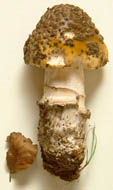
from protolog: 76 - 102 mm wide, dingy yellow [at first —ed.], at first semiellipsoid, then campanulate and obtuse; contents not recorded; margin sulcate; universal veil absent or present as thick mouse-colored flat patches or warts or as warts with an acute peak, when present more or less forming a dense covering of pileus.
RET: based on exsiccatum of Perreau 475: 110 mm wide; margin striate (0.3R - 0.35R), nonappendiculate; universal veil paler than pileus surface in exsiccata, pallid at first, darkening with exposure and age (gray-brown to dark grayish brown with high points and ridges fuligineous to nearly black), as many warts, detersile, often leaving thin layer of detritus over much of pileipellis (observed microscopically in scalp section). |
| lamellae |
from protolog: quite free, at length remote, thick, sometimes forked or anastomosing, with interstices venous; lamellulae abruptly truncate.
free, becoming remote, ??, drying tan to orangish tan to brownish tan, sometimes forking or anastomosing, intervenose; lamellae truncate to subtruncate, ??. |
| stipe |
from protolog: 102 × 19 mm, attenuated upwards, above silky, below squamulose from fragments of volva, transversely or obliquely rimose; contents spongy, with occasional cavities, "but by no means filled with floccose down"; exannulate; universal veil thick, mouse-colored, at length splitting irregularly "from slight prominence" at base of stem [i.e., leaving cupulate volva—ed.], "by no means vaginate" [i.e., not saccate—ed.].
based on exsiccatum of Perreau 475: 160± × 15± mm, narrowing upward, with fuligineous "flame" or zebroid pattern on grayish brown ground; exannulate. |
| columnella |
double click in markup mode to edit. |
| odor/taste |
from protolog: Smell none. Taste sweet. |
macrochemical
tests |
none recorded. |
| pileipellis |
In E. W. Brown collection: 155 - 220 µm thick, completely gelatinized only at surface, with suprapellis colorless and partially gelatinized (60 - 110 µm thick), with subpellis having brown intracellular pigment and ungelatinized (65 - 130 µm thick); filamentous, undifferentiated hyphae 1.1 - 7.7 µm wide, branching, closely packed, subradially arranged, commonly crossing gelatinized region into universal veil; vascular hyphae pallid yellow to orangish yellow-brown 3.2 - 13.7 µm wide, branching, rather common to locally plentiful, occasionally complexly tanged in extended masses, with darker hyphae more tightly coiled and more frequently branching and with more irregular outline.
In Perreau 475 (fully expanded specimen left on public display before thorough drying): 65 - 95 µm thick, completely gelatinized only at surface; filamentous, undifferentiated hyphae decolored for about two hyphal diameters from surface, otherwise orange to orange-brown in mass, 2.5± - 11.5 µm wide, with broader segments sometimes slightly inflated, densely packed vertically, horizontally somewhat interwoven with noticeable gaps, with common broad subradial fascicles appearing to have once been adjacent but separated (probably by expansion); vascular hyphae 4.6 - 13.3 µm wide, orange to orange-brown to pallid yellow, branching, sinuous, common to plentiful, locally densely coiled and tangled, sometimes lying just below pileipellis and penetrating it occasionally, sometimes crossing from pileipellis into universal veil. |
| lamella trama |
bilateral; wcs = ?? µm; filamentous, undifferentiated hyphae 2.8 - 5.9 µm, branching, sometimes constricted at septa, plentiful; vascular hyphae 2.8 - 23 µm wide, branching, locally rather common, locally tangled, rarely fasciculate; central stratum comprising tangled filamentous, undifferentiated hyphae with occasion slightly inflated intercalary segments up to 10.3 µm wide; subhymenial base comprising mixture of chains of elongate intercalary inflated cells (up to 74 × 16.7 µm, fusiform to broadly fusiform to subellipsoid, plentiful to dominating) and plentiful uninflated hyphae. |
| subhymenium |
wst-near = 15 - 35 µm; wst-far = 50 - 70 µm; densely branching structure comprising short uninflated hyphal segments, partially inflated cells, and occasional inflated cells, in two± layers below bases of largest basidia and with three± layers between bases of longest basidia and bases of smallest subadjacent basidioles, with outermost cells of subhymenial base giving rise to two subhymenial cells or one cell perpendicular to central stratum. |
| basidia |
65 - 89 × 13.8 - 19.1 µm, 4- and (rarely) 2-sterigmate; sterigmata up to 8.4 × 3.1 µm; clamps not observed |
| universal veil |
On pileus: all elements in upper part of wart tending to partially gelatinize, then becoming red-brown in mass; filamentous, undifferentiated hyphae 1.1 - 11.7 µm wide, with walls thin or up to 0.5 µm thick, branching, common, colorless or yellowish with subrefractive walls, sometimes with guttulate material on inside of cell wall, sometimes constricted at septa, dominantly single, infrequently in narrow fascicles, without dominant orientation; inflated cells dominating, colorless to grayish or brownish, globose to subglobose to pyriform (up to 39 × 37 µm in Perreau 475, up to 60 × 50 µm in type per notes of C. Bas in type packet) or ellipsoid to subclavate (up to 57 × 38 µm), with walls thin or up to 1.5 µm thick (most clearly seen in colorless cells), terminal singly and in chains of up to 3 cells; vascular hyphae not observed; clamps not observed. On stipe base: ??. |
| partial veil |
absent. |
| lamella edge tissue |
sterile. more...(t.b.d.) |
| basidiospores |
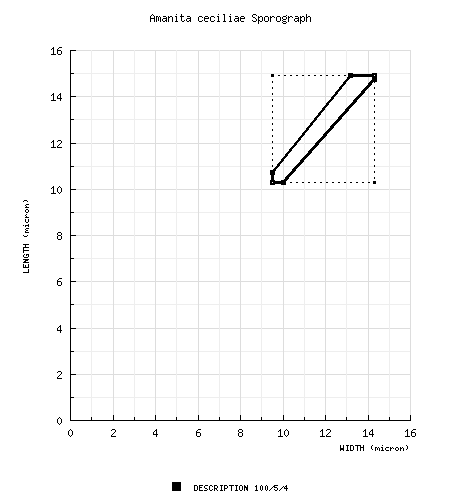
[100/5/4] (9.5-) 10.3 - 14.9 (-25) × (8.6-) 9.5 - 14.3 (-25) µm, (L = 11.6 - 12.6 µm; L’ = 12.1 µm; W = 10.9 - 11.9 µm; W’ = 11.3 µm; Q = (1.0-) 1.03 - 1.13 (-1.36); Q = 1.05 - 1.08; Q’ = 1.07), hyaline, colorless, inamyloid, thin-walled, smooth, globose to subglobose, infrequently broadly ellipsoid, adaxially flattened; apiculus sublateral, often proportionately small, cylindric; contents granular to mono- or multiguttulate, some collections dominantly monoguttulate; ?? in deposit. |
| ecology |
from protolog: "On the ground in woods."
RET: U.K.: "in woods." France: "forêt." |
| material examined |
from protolog:
U.K.:
ENGLAND—??, King's Cliffe,
"Aug.-Sept." C. Broome(?) s.n.
(holotype, K).
FRANCE: ÎLE DE FRANCE—no. loc.,
x.1975 participant in Salon du Champignon s.n.
[J. Perreau 475] (PC).
GERMANY:
BADEN-WÜRTTEMBERG—Ötisheim,
"Hurstwald" [320 m], 22.vi.1996 Andreas Gminder 96/141
(RET 305-4, nrITS seq'd.).
U.K.:
ENGLAND—Northamptonshire - unkn. loc.,
s.d. M. J. Berkeley s.n. (PC). Surrey -
Chessington, S of London,
Horton Woods, 27.viii.1997 Geoffrey Kibby s.n.
(RET 270-2).
WALES—Dyfed, Middleton, 20.ix.1994
E. W. Brown s.n. (RET 270-1). |
| discussion |
t.b.d.
Notes of C. Bas with type in K (King’s Cliffe, ix.1852 no coll. s.n.) give dimensions of spores as [10/1/1] 10.5 - 15.5 × 10.5 - 15.3 µm. In an accompanying collection from the type locality without other data (possibly an isotype per C. Bas’ notes), Bas recorded spores as follows: [11/1/1] (11-) 12.5 - 16 (-21) × (11-) 12 - 15.5 (-20) µm. I approximate the Q values for these two sets of measurements as 1.01 and 1.04. |
| citations |
—R. E. Tulloss |
| editors |
RET |
|


 Spore data sets and their composite