| name |
Amanita
sororcula |
| author |
Tulloss, Ovrebo & Halling. 1992. Mem. New York Bot. Gard. 66: 17, figs. 11-12. |
| name status |
nomen acceptum |
| english name |
"Little Sister Ringless Amanita" |
| synonyms |
= Amanita inaurata Secr. f. americana E.-J. Gilbert nom. nud. sensu Singer. 1963. Mycopathol. Mycol. Appl. 20: 241. [Gilbert ( 1940-1941) listed no type and provided no Latin diagnosis.]
The editors of this site owe a great debt to Dr. Cornelis Bas
whose famous cigar box files of Amanita nomenclatural information
gathered over three or more decades were made available to RET for computerization
and make up the lion's share of the nomenclatural information presented on this site.
|
| etymology |
sororcula "little sister"
Metaphorically intended to be the "little sister" of Amanita ceciliae, which was named for a daughter of Berkeley. Motivated by past confusion of this species and similar species from the Americas with A. ceciliae. |
| MycoBank nos. |
359390 |
| GenBank nos. |
Due to delays in data processing at GenBank, some accession numbers may lead to unreleased (pending) pages.
These pages will eventually be made live, so try again later.
|
| holotypes |
HUA |
| revisions |
Tulloss, here. |
| selected illustrations |
Tulloss. 2000a. Boll. Gruppo Micol. G. Bresadola 43(2): 15, fig. 4. |
| intro |
Olive text indicates a specimen that has not been
thoroughly examined (for example, for microscopic details) and marks other places in the text
where data is missing or uncertain.
The following material is based upon original research by R. E. Tulloss. |
| pileus |
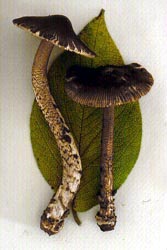
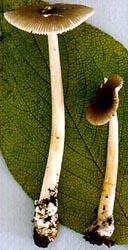
PILEUS: 35 - 85 mm wide, gray to smoky gray
(61 g Br.) to brownish gray (7E3) to grayish brown (6D-F4) or to
"soapstone" (MP) to dark brown (6F8 or 7F5) to
chocolate to fuscous to deep fuscous to dark grayish brown (7F3);
usually darkest over disc (e.g., 6F4 to 8F3), sometimes
uniformly pigmented, at first rounded subconic to convex, then
broadly convex to campanulate, subumbonate to umbonate, dry,
subpolished to shiny; context white, but blackish under
pileipellis, unchanging when cut, 4 - 5 mm thick; margin
sulcate or pectinate (0.25R - 0.5R), sometimes decurved, flaring
upward at maturity, nonappendiculate; universal veil as
scattered appressed patches or truncate conic or conic warts,
white or whitish at first, becoming orangish gray to brownish
gray (6B-C2) to grayish to tannish gray (5C3) to dark grayish
brown (6F4), sometimes paler on sides than on upper surface,
sometimesly nearly black in exsiccata. |
| lamellae |
LAMELLAE: free, close to crowded, white to
whitish buff, becoming gray from margin inward, with white to
grayish to dark gray to brownish gray (6C2) to dark brownish gray
(7E3) to dark grayish brown (8F3) to "soapstone" (MP)
fimbriate edges, drying 4A3 or slightly grayer than 4A4 to 5B4 or
dark gray to yellowish gray (5Y 7/4) and always retaining
brownish edge, rather thin to rather thick, 3 - 8 mm broad; lamellulae
truncate to subtruncate, of diverse lengths, unevenly
distributed. |
| stipe |
STIPE: 70 - 150 × 7 - 15+ mm,
subcylindric or tapering upwards, with ground color white (at
least above) to sometimes grayish toward base, with surface
decorated with fine appressed grayish to brownish gray to grayish
brown (6-7E3) fibrils often in belts; context white,
unchanging when cut or bruised, stuffed, becoming hollow; exannulate;
universal veil as complete or incomplete short limb of
membranous to submembranous tissue about 20 - 30 mm from stipe
base [white to whitish to orangish white (6A2) at first, becoming
pale ashgray to gray to brownish gray (8E2)] or in scattered
grayish patches or dark gray-brown (nearly black in exsiccata)
bands low on stipe, with color change occurring from uppermost
portion downward, sometimes with whitish rather small cupulate
portion enclosing base of stipe. |
| odor/taste |
Odor mild or lacking or fungoid or
slightly disagreeable (not strong). Taste mild. |
macrochemical
tests |
MACROCHEMICAL TESTS: Ammonia soln. -
negative on lamellae. KOH soln. - negative on pileipellis and on
lamellae. Spot test for laccase (syringaldazine) - negative throughout basidiome. Spot test for tyrosinase (paracresol) - throughout basidiome. Phenol (also tyrosinase indicator) - negative on pileipellis [obscured because of pileus color?], turning flesh directly chocolate. Test vouchers: Franco-M. 534, 905, 906; Gómez & Alfaro 24759; Mueller 4642. |
| pileipellis |
80 - 160 µm thick overall
(145 - 235 µm in material in which sporulation just beginning
when dried); suprapellis 5 - 35 µm thick (20 - 60 µm in
material in which sporulation just beginning when dried),
colorless, with hyphae gelatinized or partially gelatinized;
subpellis 75 - 125 µm thick (120 -175 µm in material in which
sporulation just beginning when dried), with hyphae partially
gelatinized or ungelatinized yellow-brown to orange-brown, with
pigment sometimes extending short distance into pileus context;
filamentous, undifferentiated hyphae 1.8 - 7.5 µm wide,
branching, interwoven, subradially arranged in part, with
intracellular pigment sometimes becoming guttulate in 2% KOH;
vascular hyphae 1.0 - 11.5 µm wide, locally tangled loosely,
common to plentiful, rarely branching, sinuous. |
| pileus context |
filamentous, undifferentitated hyphae 1.8 - 10.0 µm wide,
branching, plentiful, dominating in tissue nearest pileipellis
and nearest lamellae, with walls thin to slightly thickened,
often in fascicles, interwoven in moderately open lattice;
acrophysalides plentiful, dominating in region away from
pileipellis and lamellae, clavate to pyriform to subovoid to
ovoid to ellipsoid to elongate (subfusiform or narrowly
subfusiform), to 136 × 49 µm (mostly under 100 µm long), with
walls thin or slightly thickened, sometimes with penultimate
hyphal segment partially inflated, sometimes in chains of two;
vascular hyphae 1.0 - 15.5 µm wide, branching, infrequent to
locally common to locally plentiful, locally in coils and knots. |
| lamella trama |
obscurely bilateral; wcs = (30-) 55 -
95 (-105) µm; subhymenial base poorly or not differentiated from
subhymenium; central stratum containing plentiful intercalary
inflated cells [clavate to ellipsoid to subfusiform, up to 80 ×
34 µm (mostly under 65 × 25 µm), sometimes with wall slightly
thickened at least in apical region]; filamentous,
undifferentiated hyphae 1.5 - 10.0 µm wide, branching;
diverging, terminal inflated cells not observed; vascular hyphae
2.2 - 15.0 µm wide, sinuous, scarce to locally common. |
| subhymenium |
wst-near = (5-) 15 - 45 (-50) µm; wst-far = (25-) 35 - 70 µm; pseudoparenchymatous, occasionally locally
showing some branching of chains of cells or slightly inflated
hyphal segments, with inflated cells (to 35 × 26 µm) in one to
three (below bases of longest basidia/-oles) to four or five
(below bases of shortest basidia/-oles) layers with larger cells
nearest central stratum, with basidia arising from inflated cells
or slightly inflated short hyphal segments or occasionally
directly from a hypha of the central stratum. |
| basidia |
45 - 82 ×
9.5 - 20 µm thin-walled, but rather commonly with wall up to 0.8
µm thick in apical region, 4- or occasionally 3- or
2-sterigmate, with sterigmata up to 17.5 × 7.5 µm (largest by
far in matural in which sporulation just beginning); clamps rare
to locally common, somewhat difficult to detect because of thin
wall. |
| universal veil |
On pileus, exterior surface: often
strongly gelatinized or eroded away. On pileus, interior:
filamentous, undifferentiated hyphae 1.5 - 11.5 µm wide,
frequently branching, loosely interwoven, often in fascicles,
plentiful, partially gelatinized, more common near pileipellis;
inflated cells subglobose to ellipsoid to ovoid to clavate to
broadly fusiform to narrowly subfusiform, up to 72 × 55 µm,
terminal dominating, pale gray to gray to grayish brown to brown
to brownish gray, collapsing, with walls thin or up to 0.8 µm
thick; vascular hyphae 1.8 - 11.0 µm wide, scattered, slightly
more common than on stipe base. On pileus, adjacent to
pileipellis: filamentous, undifferentiated hyphae as in
interior, gelatinized; inflated cells smaller than in interior,
gelatinized. On stipe base, exterior surface: somewhat to
extensively gelatinized, sometimes eroded away, with inflated
cells collapsing, with orange-brown or brown intracellular
pigment in some hyphal segments and some inflated cells,
dominated (at least locally) by filamentous, undifferentiated
hyphae. On stipe base, interior: similar to interior of
pileal warts, but with hyphae somewhat more plentiful;
filamentous, undifferentiated hyphae 1.5 - 9.5 µm wide,
branching, hyaline, colorless, loosely interwoven, sometimes in
fascicles, with walls thin or slightly thickened (0.5±
µm, in those of larger diameter); inflated cells with walls thin
or up to 0.5 µm thick, sometimes colorless, otherwised colored
as on pileus, subglobose to subovoid to ovoid to ellipsoid to
subclavate to elongate, terminal or in short chains, to 70 × 52
(-62) µm, dominant away from inner surface; vascular hyphae 1.0
- 6.0 µm wide, not common; clamps absent or infrequent. On
stipe base, inner surface: filamentous, undifferentiated
hyphae dominating. |
| stipe context |
longitudinally acrophysalidic;
filamentous, undifferentiated hyphae 1.5 - 11.2 µm wide,
branching, plentiful, with walls thin or up to 0.8 µm thick;
acrophysalides to 375 × 50 µm, but most less than half that
length, of nearly cylindric, dominating, with walls thin to 1.2
µm thick, sometimes subtended by partially inflated hyphal
segment; vascular hyphae 2.5 - 14.5 µm wide, infrequent or so
plentiful as to partially obscure other structures at times,
locally in coils and knots branching, with those of largest
diameter having slightly thickened walls. |
| basidiospores |
composite of all material revised by RET: [420/18/14] (7.8-) 9.5 - 14.0 (-17.0) × (7.2-) 8.8 - 12.8 (-15.5) µm, (L = (10.2-) 10.3 - 12.1 (-13.0) µm; L' = 11.2 µm; W = (9.5-) 9.6 - 11.5 (-12.2) µm; W' = 10.5 µm; Q = (1.0-) 1.02 - 1.16 (-1.33); Q = 1.05 - 1.11 (-1.15); Q' = 1.07), hyaline, colorless, thin-walled, smooth, inamyloid, globose to subglobose, occasionally broadly ellipsoid, rarely
ellipsoid, slightly to distinctly adaxially flattened, sometimes somewhat irregularly shaped; apiculus sublateral, truncate conic to cylindric, to 3.5 µm broad at the base, sometimes appearing splintered; contents monoguttulate; white with or without yellowish cast in deposit. |
| ecology |
Colombia:
Solitary to subgregarious, 2500± - 3000 m elev. In Q.
humboldtii forest (Overbo 2426 & 2507; Franco-M. 534,
905, & 906) or under Q. colombiana Cuatrec. and Q.
humboldtii (Singer B 3596). Costa Rica: Solitary, 1800 - 2880
m. In Quercus forest (Gómez 24759, Singer B 12397) or in Quercus
dominated forest (Franco-M. 1104 & 1157; Mueller 4642) or
with Q. copeyensis (Franco-M. 1158) or with Q.
copeyensis and Q. seemannii (Franco-M. 1153) or with Q.
seemannii (Franco-M. 1161) or "in magnolietum"
(Gómez 18449). Honduras: Subgregarious, at 1800 m elev. Under Quercus
(Mueller 4127). |
| material examined |
COLOMBIA:
ANTIOQUIA—Mpio. Santa Rosa de Osos - vereda "El Chaquiro," Finca "La Española," prop. Arcángel Perez, 1.vi.1992 A. E. Franco-M. 905 (COL; NY; RET 086-1), 906 (COL; NY), 908 (COL; NY); vereda "El Chaquiro," road from Santa Rosa de Osos to Aragon, near Llanos de Cuivá, 5.xi.1986 Ovrebo 2426 (paratype, HUA), 14.xi.1986 Ovrebo 2507 (holotype, HUA; isotype, RET 042-6), 22.vi.1990, Franco-M. 534 (paratypes, HUA & NY).
BOYACÁ—Mpio. Arcabuco - 26.iv.1992 A. E. Franco-M. 781 (COL; NY), 781A (COL; NY); Tunja, 29.vii.1960 Singer B 3596 (paratype, BAFC 31.974).
COSTA RICA:
ALAJUELA—Ctn. Unkn. - Palmira,
vi.1986 L. D. Gómez & R. M. Alfaro [Gómez 24759] (F 1074476).
CARTAGO—Ctn. Unkn. - ca. Cañon, E of Interam. Hwy., at La Esperanza del Guarco [9°41’1” N/ 83°52’43” W, 2505 m], 26.xi.1993 R. E. Halling, M. Mata, L. Umaña & A. E. Franco-M. [Franco-M. 1161] (NY).
SAN JOSÉ—Ctn. Dota - La Chonta, S of Interam. Hwy. twd. Cerro Chonta [9°41’58” N/ 83°56’31” W, 2400 m], ix.1982 L. D. Gómez 18449 (F 1051896 as "A. inaurata Secr."); 200± m W of Interam. Hwy. at El Empalme, La Guaria [9°43’8” N/ 83°57’4” W, 2250 m], 23.vii.1981 R. Singer B 12397 (F 1099359); San Gerardo de Dota no. 1, 5± km SW of Cerro de la Muerte, Albergue de Montaña Savegre (Cabinas Chacón) [9°33’2” N/ 83°48’27” W], 10.xi.1993 G. M. Mueller 4642 (F 1111006), 24.xi.1993 R. E. Halling, M. Mata & A. E. Franco-M. [Franco-M. 1153] (NY), 21.vi.1995 Kris Shanks s.n. [Tulloss 6-21-95-N] (RET 334-6; USJ), R. E. Tulloss 6-21-95-D (RET 337-2; USJ), 25.vi.1995 R. E. Halling & Kris Shanks s.n. [Tulloss 6-25-95-J] (RET 335-3; USJ), s.n. [RET 6-25-95-J] (RET 335-9; USJ).
Ctn. Perez Zeledón - Villa Mills, C.A.T.I.E. Experimental For. of Villa Mills [9°33’3” N/ 83°40’55” W, 2880 m], 8.xi.1993 R. E. Halling, G. M.
Mueller, B. A. Strack, M. Mata, J. L. Mata, A. E. Franco-M. [Franco-M. 1104] (NY), 25.xi.1993 R. E. Halling, M. Mata, L.
Umaña & A. E. Franco-M. [Franco-M. 1157] (NY), [Franco-M. 1158] (NY), 22.vi.1995 R. H. Petersen s.n. [Tulloss 6-22-95-G] (RET 337-6; USJ).
HONDURAS:
FRANCISCO MORAZAN—Tegucigalpa - Parq. Nac. La Tigre, Sendero Bosque Nublado, 4.vii.1991 G. M. Mueller, B. A. Strack, R. & M. Singer & R. Andino [Mueller 4127] (F 1098652). |
| discussion |
Amanita inaurata f. americana sensu Singer and possible synonymy are mentioned in Garrido
and Bresinsky (1985). The synonymy proposed was with A.
gemmata sensu Guzmán & Varela which is clearly not a
member of section Vaginatae. RET concurs with Tulloss et
al. (1992) that the latter taxon can be identified as A. xylinivolva Tulloss et al..
There were no mature basidia on the
basidiomes of Gómez 18449; however, the anatomy of these specimens matches well with that of the present species. |
| citations |
—R. E. Tulloss |
| editors |
RET |
|


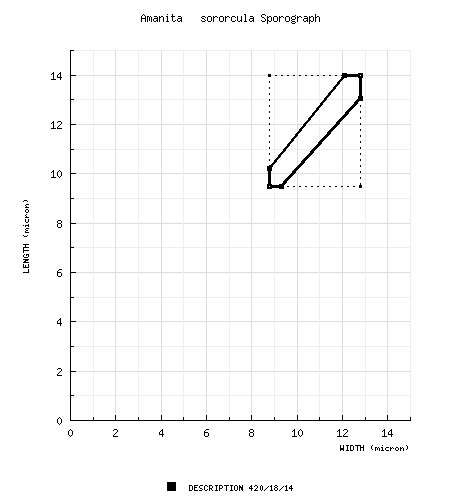
 Spore data sets and their composite