| name |
Amanita liquii |
| author |
Zhu L. Yang, M. Weiss & Oberw. 2004. Mycologia 96: 640. |
| name status |
nomen acceptum |
| english name |
"Dark-Faced Ringless Amanita" |
| etymology |
genitive of a Latinized name; hence, "of Li Qui" or "Li Qui's." Li Qui (Li Kui) is a historic Chinese hero, said to have a dark face. |
| MycoBank nos. |
488565 |
| GenBank nos. |
Due to delays in data processing at GenBank, some accession numbers may lead to unreleased (pending) pages.
These pages will eventually be made live, so try again later.
|
| holotypes |
HKAS |
| intro |
The following text may make multiple use of each data field.
The field may contain magenta text presenting data from a type study
and/or revision of other original material cited in the protolog of the present taxon.
Macroscopic descriptions in magenta are a combination of data from the protolog and
additional observations made on the exiccata during revision of the cited original
material.
The same field may also contain black text, which is data from a revision of the present
taxon (including non-type material and/or material not cited in the protolog).
Paragraphs of black text will be labeled if further subdivision of
this text is appropriate.
Olive text indicates a specimen that has not been
thoroughly examined (for example, for microscopic details) and marks other places in the text
where data is missing or uncertain.
The following material is entirely derived from the protolog of the present taxon.
NOTE: Spore data from papers by Z. L. Yang are presented following his use of the "Times New Roman" face for "Q" and "Q'"—respectively, "Q" and "Q." |
| pileus |
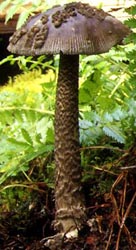
from protolog: 100 -140 mm wide, sepia to blackish (Warm Sepia, Clove Brown, Fuscous to Fuscous-Black, 6F3-7), becoming blackish brown to dark brown (Brussels Brown, Raw Umber, Medal Bronze, Cinnamon Brown, Natal Brown, 6D3-5, 6E3-7) toward margin, lacking any yellow tint at all stages of development, at first nearly hemispheric, then convex to plano-convex, often slightly umbonate; context white, but grayish to gray just beneath pileipellis, unchanging.; margin tuberculate-striate (0.15-0.25R), nonappendiculate; universal veil dark gray to sepia, sometimes gray (Warm Sepia, Medal Bronze, 6D2-3, 6E2-4, 6F3-5), as felty to irregularly formed patches or as warts, with remnants 2 -10 mm wide and 1 - 3 mm thick. |
| lamellae |
from protolog: free, crowded, white to cream-colored (Cream Color, 1A1-2) when young, grayish (much paler than Pale Smoke Gray, paler than 3B2) when mature, becoming brownish gray, dark gray to fuscous (paler than Fuscous, 5C3-5, 5D3-5, 5E3-5) when dried, with edges blackish to dark brown (Medal Bronze, Natal Brown, 6E3-5, 6F5-7); lamellulae truncate to subtruncate, plentiful, evenly distributed. |
| stipe |
from protolog: 130 - 170 × 15 - 30 mm, subcylindric or slightly tapering upward, with apex slightly expanded, whitish to brownish, densely covered with dark gray to blackish (Warm Sepia, Medal Bronze, Raw Umber, 6E3-6, 6F4-7) squamules often in belts; context white but at very base often grayish, sometimes brownish to light rusty brown, hollow in center; exannulate; universal veil remnants verrucose to subconic to granular, gray to dark gray to brownish (Smoky Gray, Drab, Mouse Gray, 5C1-4) in apical parts, becoming paler toward base of remnants, arranged in incomplete belts at stipe base. |
| odor/taste |
from protolog: Odor and taste indistinct. |
macrochemical
tests |
none recorded. |
| pileipellis |
from protolog: 100 - 180 µm thick; upper layer (20 - 70 µm thick) slightly to moderately gelatinized, composed of subradially and moderately compactly arranged, 2 - 5 µm wide, thin-walled, colorless to nearly colorless, slightly to moderately gelatinized filamentous hyphae, sometimes with intercalary segments inflated to 15 µm wide, usually, with dark yellowish brown, vacuolar pigments; terminal cells present, 5 - 12 µm wide, hardly inflated; vascular hyphae rare to locally scattered, 3 - 10 µm wide. |
| pileus context |
not described in protolog. |
| lamella trama |
from protolog: bilateral. Mediostratum 30 - 50 µm wide, composed of fairly abundant, long ellipsoid to subfusiform inflated cells (30 - 90 × 10 - 25 µm) and abundant interwoven, often anastomosing, 2 - 7 µm wide filamentous hyphae; vascular hyphae rare. Lateral stratum composed of fairly abundant, long ellipsoid to subfusiform (55 - 70 × 20 - 28 µm), sometimes to ellipsoid (55 - 70 × 20 - 28 µm) inflated cells, diverging at an angle of ca. 30° - 45° to mediostratum; filamentous hyphae abundant, 2 - 6 µm wide, frequently branching, interwoven, sometimes anastomosing; vascular hyphae rare, 3 - 7 µm wide. |
| subhymenium |
from protolog: 40 - 60 (-70) µm thick, with (2-) 3 - 4 layers of subglobose to ovoid or irregularly shaped cells 12 - 30 × 10 - 25 µm, sometimes mixed with scattered barely inflated cells 5 - 7 µm wide. |
| basidia |
from protolog: 55 - 95 × 16 - 25 µm, clavate, 4-spored, rarely 1- or 2- spored; sterigmata 6 - 10 µm long; clamps lacking. |
| universal veil |
from protolog: On pileus: with elements of warts more or less vertically aligned except in basal parts of volval remnants and there irregularly arranged; with elements of felty patches comprising more or less irregularly arranged elements. Inflated cells very abundant (to dominant), subglobose (25 - 80 × 20 - 70 µm) or ovoid to broadly clavate (30 - 50 × 25 - 38 µm), larger when nearer the pileipellis, terminal, singly or in chains of 2 - 3 (-4), thin- to slightly thick-walled (up to 1.0 µm thick), usually with brown to dark brown, vacuolar pigments, occasionally colorless and hyaline; filamentous hyphae fairly abundant, not becoming more abundant toward the pileipellis, 3 - 8 µm wide, frequently branching, often anastomosing, thin-walled, colorless, hyaline or with brownish vacuolar pigments; vascular hyphae rare, 2 - 8 µm wide. On stipe base: similar to those on pileus, but inflated cells and filamentous hyphae irregularly arranged, and vacuolar pigments locally much paler. |
| stipe context |
from protolog: longitudinally acrophysalidic; acrophysalides 70 - 400 × 16 - 50 µm; filamentous hyphae 2 - 7 µm wide, scattered (in interior) or fairly abundant to abundant (on stipe surface), colorless and hyaline (in interior), or with brown to dark brown vacuolar pigments (on stipe surface); vascular hyphae 3 - 15 µm wide, rare to locally conspicuous. |
| partial veil |
double click in markup mode to edit. |
| lamella edge tissue |
from protolog: sterile; appearing as gray-brown to dark brown strip up to 250 µm wide in side view, predominantly composed of inflated cells, ovoid to subglobose or short ellipsoid (20 - 60 × 15 - 50 µm), often in chains of 2 - 3, sometimes sphaeropendunculate to pyriform (35 - 65 × 20 - 35 µm), then single and terminal, with brownish to brown to gray-brown vacuolar pigments, occasionally nearly colorless and hyaline; filamentous hyphae fairly abundant to scattered, 2 - 7 µm wide, with brownish vacuolar pigments or nearly colorless. |
| basidiospores |
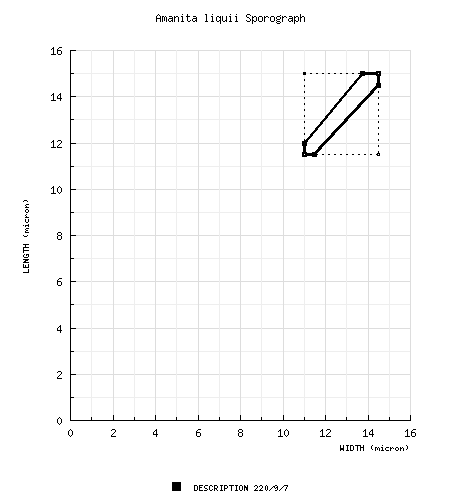
From protolog: [220/9/7] (11.0-) 11.5 - 15.0 (-24) × (9.5-) 11.0 - 14.5 (-20) μm, (Q = 1.0 - 1.09 (-1.20); Q = 1.05 ± 0.04), globose to subglobose, rarely broadly ellipsoid, imamyloid, colorless, hyaline, thin-walled, smooth; apiculus small. |
| ecology |
Scattered. At 2900-4000 m elev. On soil under Abies and/or Picea. |
| material examined |
from protolog: CHINA: SICHUAN—Liangshan Yi Autonomous Prefecture - Yanyuan Co., Beilingshan, 9.viii.1983 K. K. Chen 541 (paratype, HKAS 14096, as A. ceciliae in (Yang 1997).
YUNNAN—Dali Bai Autonomous Prefecture - Dali (county level) City, Huadianba, 10.vii.1984 J. X. Xi 569 (paratype, HKAS 378, as A. ceciliae in (Yang 1997)).
Diqing Tibetan Autonomous Prefecture - Deqen Co., Baimaxueshan, 11.vii.1981 J. W. Chen 34 (paratype, HKAS 8575, as A. ceciliae in (Yang 1997)); Zhongdiang Co. (Shangri-La Co.), Xiaozhongdian, 24.viii.1984 K. K. Chen & Y. Xuan 19 (paratype, HKAS 14242, as A. ceciliae in (Yang 1997)).
Lijiang (prefecture level) City - Yulong Nakhi Autonomous County, Laojunshan, 3900 m elev., 14.viii.2000 Zhu L. Yang 2916 (holotype, HKAS 36611); Yulong Nakhi Autonomous County, Laojunshan, 4000 m elev., 25.ix.2000 M. Zang 13712 (paratype, HKAS 37052).
XIZANG AUTONOMOUS REGION (TIBET)—Nyingchi Prefecture - Zayü Co., Ridong, 18.ix.1982 M. Zang 1005 (paratype, HKAS 11254, as A. ceciliae in (Yang 1997)). |
| discussion |
from protolog: "... Several collections cited above were regarded as A. ceciliae by Yang (1997). Amanita liquii is similar to A. ceciliae (Berk. & Broome) Bas, A. beckeri Huijsman ex Huijsman, A. cinctipes Corner & Bas, and A. sororcula Tulloss, Ovrebo & Halling. Actually, several Chinese amanitas of this group have been determined as A. ceciliae, originally described from Europe (Teng 1936 and 1996 as Amanitopsis strangulata [Fr.] Roze; Mao 1990 as A. inaurata Secr. Ex Gillet; Yang 1997). However, the European A. ceciliae differs from A. liquii by its yellow-brown, reddish brown to gray-brown or olive-brown pileus covered with lighter colored (grayish to brownish) volval remnants, white lamellae with a white edge, much paler-colored squamules on the stipe and somewhat smaller basidiospores. The basidiospores of A. ceciliae are 10.4 - 14.1 × 9.7 - 14.0 µm per Breitenbach and Kränzlin (1995). Furthermore, the volval remnants at the base of the stipe of A. ceciliae often form a ring-zone above a strangulate region and a nearly cupulate structure at the very base of the stipe (Phillips 1990, Breitenbach and Kränzlin 1995). The vacuolar pigments in the cells of the sterile strip along the lamellar edge and volval remnants on the pileus of A. liquii are much darker than those of European A. ceciliae {[material examined]: FRANCE: JURA—ca. Noga, 2.x.1992 C. Bas 9341 (L)}. Amanita beckeri, originally described from Europe, differs from A. liquii in its differently colored pileus, lighter-colored volval remnants and smaller basidiospores (Huijsman 1962a, b, Tulloss 1994). The basidiospores of A. beckeri are (8.8-) 9.8 - 11.8 (-13.0) × (7.2-) 9.0 - 11.0 (-12.2) µm (Tulloss 1994). Amanita cinctipes, originally described from Southeast Asia, is distinguished from A. liquii by its slender fruit body lacking an umbo on the pileus, smaller basidia and smaller basidiospores (Corner and Bas 1962). Basidia and the basidiospores of A. cinctipes are 40 - 50 × 15 - 15 µm and 8.2 - 11.1 × 7.8 - 10.1 µm respectively (Corner and Bas 1962). Amanita sororcula, originally described from Columbia, differs from A. liquii by its smaller and more slender fruit body with [proportionately] longer marginal striations on the pileus, volval remnants tending to darken considerably with age and smaller basidiospores (Tulloss et al 1992, Tulloss pers comm.). The basidiospores of A. sororcula are (8.8-) 9.7 - 12.8 (-16.8) × (8.0-) 8.8 - 12.0 (-15.5) µm (Tulloss et al 1992)." |
| citations |
—Zhu L. Yang, M. Weiss, & F. Oberwinkler (2004) |
| editors |
RET |
|


 Spore data sets and their composite