| name |
Amanita cinctipes |
| author |
Corner & Bas. 1962. Persoonia 2: 299, pl. 12(b-c), fig. 6. |
| name status |
nomen acceptum |
| english name |
"Belted Ringless Amanita" |
| etymology |
cinctus "girdle" + pes "foot"; referring to the dark ring of universal veil material left near the base of the stipe in nearly all specimens |
| MycoBank nos. |
326089 |
| GenBank nos. |
Due to delays in data processing at GenBank, some accession numbers may lead to unreleased (pending) pages.
These pages will eventually be made live, so try again later.
|
| holotypes |
L |
| intro |
The following text may make multiple use of each data field.
The field may contain magenta text presenting data from a type study
and/or revision of other original material cited in the protolog of the present taxon.
Macroscopic descriptions in magenta are a combination of data from the protolog and
additional observations made on the exiccata during revision of the cited original
material.
The same field may also contain black text, which is data from a revision of the present
taxon (including non-type material and/or material not cited in the protolog).
Paragraphs of black text will be labeled if further subdivision of
this text is appropriate.
Olive text indicates a specimen that has not been
thoroughly examined (for example, for microscopic details) and marks other places in the text
where data is missing or uncertain.
The following material is derived entirely from the protolog of the present taxon. |
| pileus |
from protolog: 45 - 120 mm wide, mouse gray to pale grayish brown, darker, grayish brown to fuliginous umber at center, becoming plano-convex with depressed center; context white, 3 - 4 mm thick over stipe, thinning to membrane toward margin; margin sulcate-striate (0.25 - 0.35R); universal veil gray to grayish brown, as scattered floccose patches 4 - 10 mm wide or floccose pyramidal warts 1 - 2.5 mm high. |
| lamellae |
from protolog: free, crowded, with 65 - 127 primaries, 3 - 11 mm wide, white to grayish, with or without gray-brown edge; lamellulae truncate, with 0 - 1 (-3) between each pair of otherwise adjacent lamellae. |
| stipe |
from protolog: 90 - 200 mm × 8 - 15 mm, entirely pale or dark grayish to grayish brown, paler near apex, with darker, appressed, fibrillose scales, often forming incomplete transverse zones, especially in lower part, rather fragile; context hollow; exannulate; universal veil with 2 - 4 dark grayish blown floccose rings encircling stipe near base often broken into warts or scales. |
| odor/taste |
not recorded. |
macrochemical
tests |
none reported. |
| pileipellis |
from protolog: suprapellis entirely gelatinized, about 25 µm thick; subpellis about 25 µm thick; filamentous hyphae radially oriented, thin in suprapellis, quickly increasing in diameter downward. |
| pileus context |
not described. |
| lamella trama |
from protolog: hard to analyze in dried material. |
| subhymenium |
from protolog: rather thin, densely ramose with irregular small cells, without globose cells. |
| basidia |
from protolog: 40 - 50 × 12 - 15 µm, 4-sterigmate, with sterigmata 5 µm long; no clamps observed. |
| universal veil |
from protolog: On pileus: filamentous hyphae 2 - 5 µm wide ; inflated cells globose to ellipsoid, terminal, up to 60 µm wide, with umber sap. On stipe base: as on pileus, but with more hyphae, with parts away from surface less pigmented, and inflated cells sometimes in short chains. |
| stipe context |
from protolog: longitudinally acrophysalidic; filamentous hyphae not described; acrophysalides up to 250 × 45 µm; vascular hyphae up to 18 µm wide and especially present near surface of central cylinder. |
| partial veil |
absent |
| lamella edge tissue |
from protolog; no inflated cells observed. |
| basidiospores |
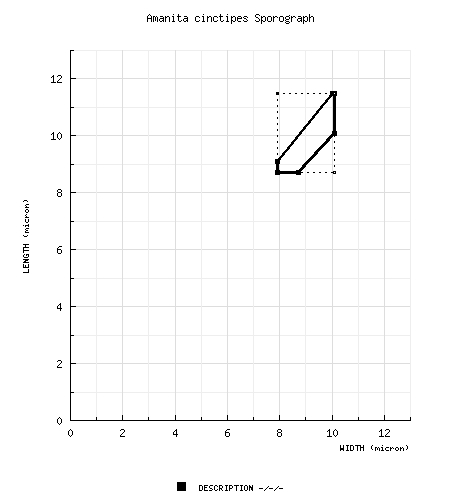
from protolog: [-/-/-] 8.7 - 11.5 × 7.9 - 10.1 μm,
(Q = 1.0 - 1.15; Q = 1.10),
hyaline, colorless, smooth, thin-walled, inamyloid, globose to subglobose;
apiculus proportionately "rather small"; contents mono- or multiguttulate; color in deposit not reported. |
| ecology |
from protolog: "Terrestrial in jungle. Probably common in lowland forest in Malaysia and Singapore." |
| material examined |
from protolog: SINGAPORE: Botanic Gardens, Gardens' Jungle, 19.iii.1931 E. J. H. Corner s.n. (holotype, L), viii.1939 E. J. H. Corner s.n. (paratype, L), 16.viii.1940 (paratype, L, watercolor drawing only); Mandai Rd. forest, 20.viii.1939 E. J. H. Corner s.n. (paratype, L); Reservoir Jungle 6.xii.1940 E. J. H. Corner s.n. (paratype, L, watercolor drawing only). |
| discussion |
from protolog: "This species is very close, perhaps too close to [A. ceciliae (Berk. & Broome) Bas] from Europe. However, at present it seems preferable to keep it apart on account of (i) the smaller spores and basidia (8 - 11 × 8 - 10 µm and 40 - 50 × 12 - 15 µm against those of [A. ceciliae] (10-) 11 - 13 (-22) × 10 - 12.5 (-21) µm and 60 -80 × 16 - 18 µm; the occurrence of very large spores of [A. ceciliae] is due to 2-spored and 1- spored basidia), (ii) the absence of an umbo on the pileus, (iii) a more delicate habit, (iv) a tendency of the volva to form small pyramidal warts on the pileus, and (v) a slightly different color of the pileus; the beautiful yellowish brown tints in older specimens of [A. ceciliae] seem to lack entirely in the more grayish A. cinctipes.
"In all of the many Dutch collections of [A. ceciliae] studied, the fruit-bodies appear to be considerably stouter than those of A. cinctipes. This cannot be said of the American specimens of [A. ceciliae] depicted by Peck (1900: pl. 44 fig. 1 - 10, as Amanitopsis strangulate) and the Japanese ones by Imazeki & Hongo (1957: pl. 18 fig. 100), but it still has to be proved that these specimens are conspecific with the European [A. ceciliae], especially those of Peck. However, all authors consulted, agree that the size of the spores of [A. ceciliae] is larger than 10 µm and usually exceeds 11 µm which is in accordance with our observations.
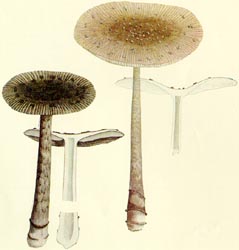
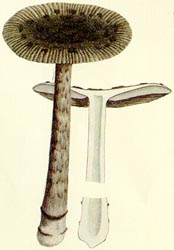
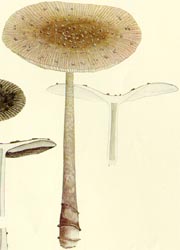
"Judging from the watercolor drawings, A. cinctipes. varies considerably. The type collection is most similar to Pl. 12c. Especially in this case it is a pity that the specimens depicted have not been preserved, so that one has to rely on the senior author’s observations in the field for the conclusion that both forms depicted are really conspecific." [Note: In RET's view the eastern North American taxon is distinct from both A. ceciliae and A. cinctipes—see A. rhacopus. See also the following text and sporograph comparisons. The name "Amanita inaurata" has been updated to "A. ceciliae," which is accepted as correct on this site.—ed.]
In addition to the exsiccatum and watercolors that comprise the original material of this species, the authors reported the records of siting this species in the Bukit Timah Forest Reserve (Singapore) and on Gunong Panti, Johor, Malaysia.
Tulloss (2005b) observed an apparent tendency in some sections for spores size to be smaller in lowland tropical forest as compared to temperate and tropical alpine forests. Since the taxa of the proposed series Ceciliae have a general tendency to be rather large, the following question is of interest: Despite the relatively large size of the present species' spores compared to the spores of many other taxa from tropical lowland forest, are these spores significantly different in size in comparison to the spores of other species in the proposed series? The following figures provides a sporograph comparison for the taxa considered to belong in the series.
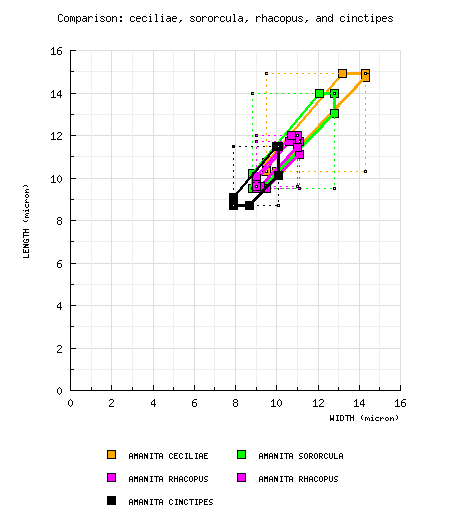
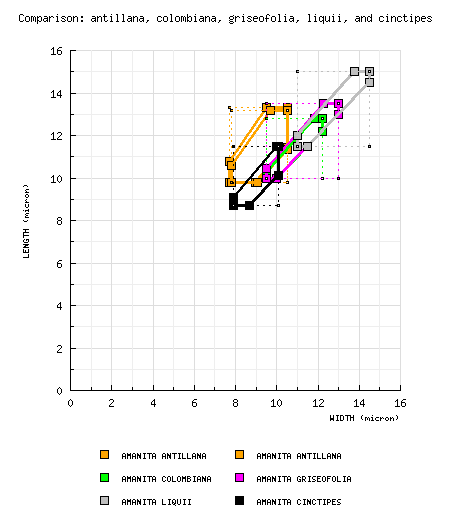
It is interesting to note that, of the group with most nearly globose spores [the series excluding the rather disimilar A. antillana (known from the Caribbean region)], the present species (the only one known from lowland tropical forest) quite clearly has the smallest spores. |
| citations |
—R. E. Tulloss |
| editors |
RET |
|



 Spore data sets and their composite