| name |
Amanita vernicoccora |
| author |
Bojantchev & R. M. Davis. 2011. Mycotaxon 117: 491, figs. 4-8. |
| name status |
nomen acceptum |
| english name |
"Ballen's Spring American Caesar" |
| etymology |
vernus, "having to do with Spring" + "coccora," a common name for this and similar species in the western United States and Italy |
| MycoBank nos. |
561705 |
| GenBank nos. |
Due to delays in data processing at GenBank, some accession numbers may lead to unreleased (pending) pages.
These pages will eventually be made live, so try again later.
|
| holotypes |
UC 1860906 |
| intro |
The following text may make multiple use of each data field.
The field may contain magenta text presenting data from a type study
and/or revision of other original material cited in the protolog of the present taxon.
Macroscopic descriptions in magenta are a combination of data from the protolog and
additional observations made on the exiccata during revision of the cited original
material.
The same field may also contain black text, which is data from a revision of the present
taxon (including non-type material and/or material not cited in the protolog).
Paragraphs of black text will be labeled if further subdivision of
this text is appropriate.
Olive text indicates a specimen that has not been thoroughly examined (for example, for microscopic details) and marks other places in the text where data is missing or uncertain.
RET is concerned that some characters of Amanita sp-M36 have not yet been edited out of his description. Viewers should be aware of this potential problem.
The following represents the descripton from the protolog of the present species and original research by R. E. Tulloss. |
| pileus |
from protolog: 60 - 180 mm wide, uniform yellow to pale yellow, hemispherical to convex, then plano-convex
to plano-concave; context white
to pale yellow; margin "straight," short striate; universal veil as "monolithic" central patch, white, cottony, thick at first, thinning with age.
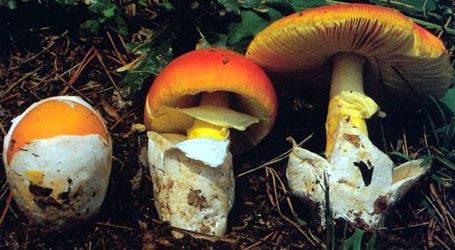
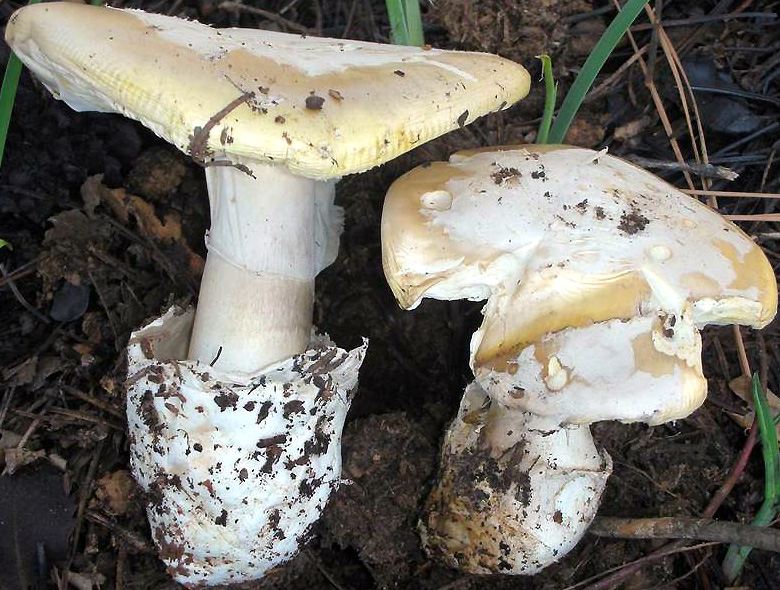
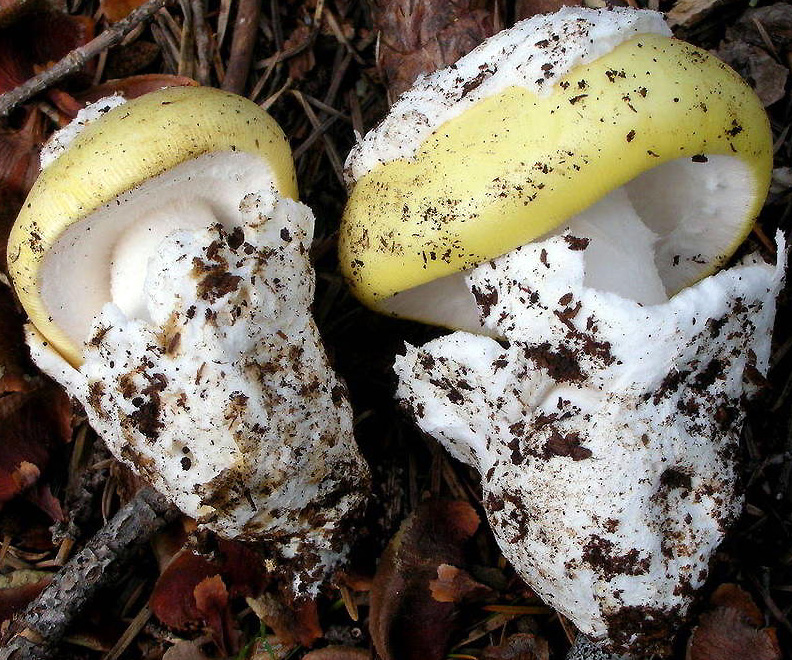
RET: 60 - 220 mm wide, pale yellow (1-2A2-3) to pale orangish yellow (slightly more orange than 2A3) to Maize Yellow to pale chrome yellow to pale straw color to Naples Yellow to off-white to white, bruising as in context when white, hemispheric to convex to planoconvex, sometimes depressed in age, shiny, viscid to subviscid to tacky; context white, sometimes sordid or watersoaked just below pileipellis, yellowish to intensely yellow in a region several mm thick just below pileipellis if pileipellis pigmented, sometimes with watersoaked regions near stipe apex and at attachment of lamellae, often becoming pale straw yellow or pale tan or very pale orangish white when cut or bruised, robust, 7.5 - 21 mm thick at stipe, thinning evenly to margin or until within a very few (e.g. 3) mm of margin and then membranous to margin; margin short striate [0.05 - 1.0 (-0.15)R], nonappendiculate; universal veil as single rather thick (e.g. 3 mm) membranous patch almost completely covering pileus, white, becoming watersoaked in rainy weather, browning somewhat in age, sometimes becoming areolate in age, detersile. |
| lamellae |
from protolog: seceding to free, crowded, white to pale cream, 10 - 18 mm broad, even; lamellulae common.
RET: free to narrowly adnate, with decurrent line on stipe apex (possibly on remnants of partial veil), subcrowded to crowded, white in mass, in side view white at first and then pale Maize Yellow to cream to very pale yellowish white to off-white to faintly off-white, sometimes more yellow farthest from the edge, not changing when cut or bruised, sometimes (at least in “button” stage) becoming pale orange to pinkish in early stages of drying and then losing this color or becoming yellowish when finally dry, 6 - 12 mm broad, with edge white and more or less (sometimes minutely) fimbriate/flocculose (lens), sometimes forking; lamellulae truncate, plentiful, of diverse lengths, occasionally free from both stipe and margin. |
| stipe |
from protolog: 50 - 140 × 15 - 30 mm, white with yellow tints at age, cylindric; context hollow or stuffed with a cottony or jelly-like substance in buttons, white or pale yellow; partial veil superior,
membranous, pendent, cottony-thick at first, thinning and collapsing with age, white, sometimes pale yellow with age, with upper surface striate; universal veil ample, thick, friable, "free," sac-like at first, thinning and collapsing with age, white.
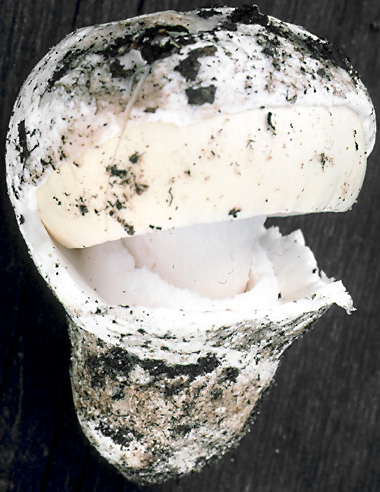
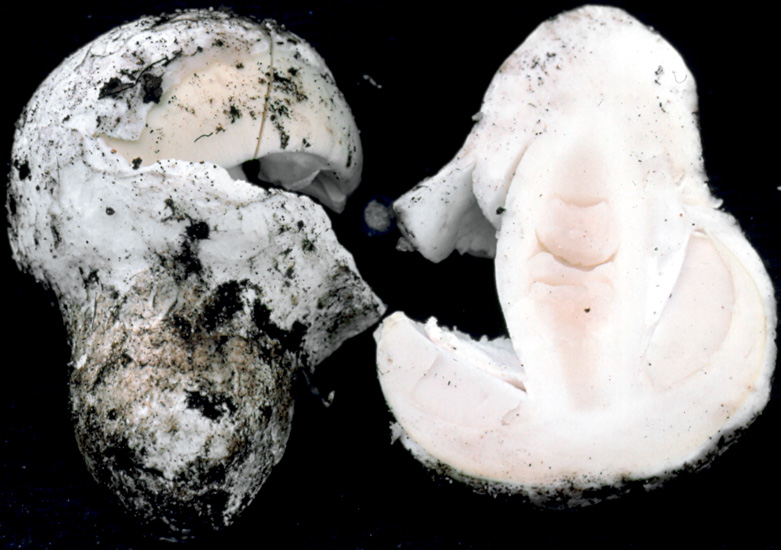
RET: 56 - 159 × 12 - 37 mm, pale Maize Yellow to cream to white, becoming pale beige or browning when damaged or from handling, cylindric or narrowing upward or broadest near the midpoint, flaring at the apex, rounded or with a rounded point at the base, surface smooth or fibrillose below partial veil; context white to off-white, sometimes becoming pale straw yellow or faintly yellowish when cut or bruised, larva tunnels concolorous, hollow to stuffed (partially or fully and firmly), with white loose cottony threads in central cylinder 5 - 13 mm in diameter; partial veil apical, pale Maize Yellow to pale straw color to cream to white, membranous, thin, striate above, cottony below (this material sometimes connecting annulus to stipe surface); universal veil as saccate volva, membranous, rather tough, soft, 1.5 - 5 mm thick at midpoint between base of limbus internus and uppermost point of limb, white, usually flaring very broadly, sometimes collapsing on stipe, sometimes with limb becoming recurved in age, circumcissile (but sometimes quite unevenly so), easily removed from stipe in older specimens (in younger specimens sometimes demarcated from the stipe context by a watery line), 25 - 81 mm from base of stipe to highest point of limb, with marked limbus internus 3 - 6 mm thick at its base. |
| odor/taste |
from protolog: Odor mild at first, pungent with age, frequently interpreted as fishy. Taste mild to pungent.
RET: Odor faintly fishy or of decay. Taste mild, then faintly peppery when raw; when cooked, distinctly of fish in the experience of RET and Mr. John Feci who sauteed this species for me to eat. EDIBLE, apparently, at least for some, an acquired taste. [NOTE: See Arora’s comments on edibility.] |
macrochemical
tests |
from protolog: 5% KOH - negative. 10% NH4OH - negative; 3% phenol - slowly pinkish lilac on all surfaces. Guaiac - negative. 10%FeSO4 - negative.
RET: Spot test for tyrosinase (paracresol) - positive in spots throughout the basidiome, with spots more strongly concentrated in the universal veil and stipe base in younger material and more concentrated in the pileus in older material. Spot test for laccase (syringaldazine) - negative throughout the basidiome in both young and mature material. Test voucher: ??. |
| pileipellis |
from protolog: as ixocutis to "ixotrichoderm," "densely interwoven within...gelatinous matrix, 200 - 300 μm thick"; filamentous hyphae 2 - 7 μm wide, branched, with intracellular pigment; clamps present. [Note: In the past, the term "trichoderm" has only been applied to the pileipellis in Amanita (e.g., in the case of A. magniverrucata) based upon misinterpretation (1) of a part of the universal veil or (2) of hyphae that, during development of the basidiome, interconnect the developing pileipellis and the developing universal veil. Because the unique ontogeny of Amanita is so significant to the mature morphology and because hundreds of amanitas have been examined microscopically, it would be quite unlikely to find a pileipellis that is properly termed a "trichoderm."—ed.] |
| pileus context |
not described. |
| lamella trama |
from protolog: [bilateral, ] divergent; filamentous to "swollen" hyphae 8 - 24 μm wide; clamps occasional. |
| subhymenium |
from protolog: comprising several layers of irregular to pyriform cells 10 - 30 × 8 - 22 μm; clamps frequent. |
| basidia |
from protolog: 42 – 64 × 11 – 14 μm, 4-sterigmate, with sterigmata 4 – 6 μm long; clamps present.
RET: 47 - 72 × 10.5 - 14.2 µm, 4-sterigmate; clamps common. |
| universal veil |
from protolog: Inner surface: filamentous hyphae 1.5 - 8 μm wide, dense; inflated cells narrowly ellipsoid to subglobose, 50 - 120 × 20 - 50 μm. Outer surface: filamentous hyphae 1.5 - 8 μm wide, dense; inflated cells broadly ellipsoid to subglobose, 60 - 180 × 40 - 150 μm, slightly gelatinized. |
| stipe context |
from protolog: [longitudinally] acrophysalidic; filamentous hyphae 2 - 8 μm wide; acrophysalides 50 - 150 × 20 - 46 μm; clamps occasional. |
| partial veil |
from protolog: filamentous hyphae 2 - 6 μm wide. [Note: The remainder of the description addresses cells from the lamella edge tissue that were found clustered on the surface of the partial veil.—ed.] |
| lamella edge tissue |
from protolog: inflated cells broadly clavate or pyriform or mucronate, 25 - 50 × 16 - 24 μm. [This is the description of clustered cells found on the upper surface of the partial veil.—ed.] |
| basidiospores |
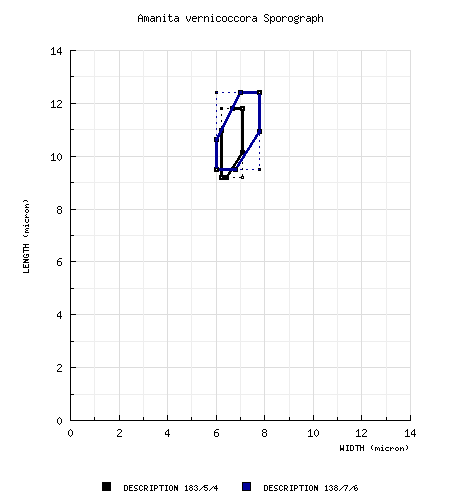
from protolog: : [183/5/4] (8.5-) 9.2 - 11.8 (-12.5) × (5.7-) 6.2 – 7.1 (-7.5) μm (L' = 10.5 μm;
W' = 6.5 μm; Q = 1.43 - 1.77; Q' = 1.61), hyaline, ellipsoid to elongate, inamyloid; apiculus "lateral," prominent; contents not described; white in deposit.
RET: [138/7/6] (9.0-) 9.5 - 12.4 (-17.2) × (5.5-) 6.0 - 7.8 (-9.8) µm, (L = 10.6 - 11.2 µm; L’ = 10.9 µm; W = 6.6 - 7.3 µm; W’ = 6.9 µm; Q = (1.35-) 1.40 - 1.77 (-2.18); Q = 1.53 - 1.67 ; Q’ = 1.57), hyaline, colorless, thin-walled, smooth, inamyloid, ellipsoid to elongate, rarely cylindric, adaxially flattened, sometimes swollen at one end; apiculus sublateral, varying in size, cylindric; contents monoguttulate; white in deposit. |
| ecology |
from protolog: California: At
245 - 1485 m elev. Material examined collected
under Quercus kelloggii or under mixed
conifers and Q. kelloggii or under Q.
agrifolia.
"Amanita vernicoccora fruits in the late
winter and spring and is apparently restricted to
California. Along the coast and in the lower
elevations of the Sierra Nevada (<2000 feet) it
fruits in February - March and is known to
associate with evergreen oaks such as live oak
(Quercus agrifolia) Né), interior live oak
(Quercus wislizenii A. DC.) and blue oak
(Quercus doglasii Hook. & Arn.).
Likely associations are also to Pacific madrone
Arbutus menziesii Pursh) and manzanita
(Arctostaphylos manzanita Parry).
Infrequently, A. vernicoccora fruits in the
northern coastal areas where it is likely
associated with tanoak (Notholithocarpus
densiflorus (Hook. & Arn.) Manos et
al. This species is far more common in the
foothills of the Sierra Nevada and Shasta Cascade
range in May-June where the primary association in
the lower elevations (2000 - 4000 feet) is with the
deciduous black oak (Quercus kelloggii
Newb.). At higher elevations A.
vernicoccora may switch association to
conifers, but we have not seen it outside of the
range of the black oak
(≤6000 feet)."
RET: Apparently fruiting only in the late winter
and spring, in contrast to (for example)
A.
calyptroderma. From near sea level up to
1132+ m elev. Santa Cruz Co.,
California: Under Quercus agrifolia.
Oregon: In second growth forest or in
Quercus/Arubuts
menziesii thicket with second growth Abies
and Cacaliposis nardosmia.
Washington: Under Quercus garryana and
Pseudotsuga menziesii. According to
the protolog of A. calyptroderma (see
discussion, below), under Pinus and
Abies in the Sierra Mtns. and often
hypogeous or nearly so in this region and
associated with Arbutus menziesii,
"chestnut," Picea, Pinus, and
Quercus along the coast. |
| material examined |
from protolog:
U.S.A.:
CALIFORNIA—Amador Co. - Indian Grinding
Rock St. Pk. [730 m], 17.v.2009 R. M. Davis
RMD07020 (paratype, in herb. D.
Bojantchev).
Calaveras Co. - Stanislaus Nat. For., off Evergreen
Rd. [1250 m], 22.v.2006 D. Bojantchev DBB00099
(paratype, in herb. D. Bojantchev);
Stanislaus Nat. For., off Hwy. 120 and Hardin Flat
Rd. exit [1100 m], 27.v.2006 Bojantchev DBB00102
(paratype, in herb. D. Bojantchev).
El Dorado Co. - Georgetown, Dru Barner Campground
[775 m], 21.v.2011 Bojantchev DBB43538 (holotype,
UC 1860906), 26.v.2011 Davis RMD110003 (paratype,
in herb. D. Bojantchev), 29.v.2011 D.
Bojantchev DBB43625 (paratype, in herb. D.
Bojantchev), El Dorado Nat. For., Crystal Basin
area, ca. Union Valley Reservoir [1485 m],
2.vi.2006 Bojantchev DBB00118 (paratype,
in herb. D. Bojantchev).
Marin Co. - Marin Watershed, off Bolinas-Fairfax
Rd. [245 m], 13.iii.2008 Bojantchev DBB07809
(paratype, in herb. D. Bojantchev).
Siskiyou Co. - Dunsmuir, off Hwy. 5, ca. Dunsmuir
airport [700 m], 31.v.2008 Bojantchev DBB00201
(paratype, in herb. D.
Bojantchev).
RET: U.S.A.:
CALIFORNIA—Butte
Co. - Forest Ranch, 11.v.2008 Beth Wallenberg s.n.
(RET 422-3 and 422-7).
El Dorado Co. - Jenkinson Lk. [38°42.694' N/
120°33.290' W, 1118 m], 23.v.2006 R. Pastorino
5-23-06-M9 (RET 392-2), 5-23-06-M10 (RET 392-1);
Sierra Springs, Cedar Pk. Tr., E of Co. Rd. E16
[38.7077° N/ 120.5936° W, 1102 m], 3.v.2011 R.
Pastorino 5-3-11A [mushroomobserver
#66942]
(RET 494-1).
Marin Co. - Alpine Lk., 30.iii.2004 Ronald
Pastorino 3/30/04/A (RET 390-10).
Merced Co. - Yosemite Nat. Pk., Wawona, 2.v.1981
R. Harvey s.n. [F. Nishida 1052] (LAM
251071).
Santa Cruz Co. - Aptos Hills, S border of Aptos,
2.iii.1989 J. Feci & R. E. Tulloss [Tulloss]
3-2-89-B (RET 041-4), [Tulloss] -C (RET 041-8);
Aptos Hills, N border of Watsonville, 3.iii.1989
J. Feci s.n. [Tulloss 3-3-89-B] (RET 040-8); ca.
Santa Cruz, ii-iii.1988 David Arora s.n.
(RET 084-7).
Sonoma Co. - Shiloh Ranch Reg.
Pk., 20.ii.1998 S. Davidson, P. Peterson, M.
Handler, David C. & R. E. Tulloss [Tulloss
2-20-98-C] (RET 274-3).
Tuolumne Co. - Stanislaus Nat. For., off Hardin
Flat Rd, S of St. Hwy. 120 [37.8135º N/ 119.979º W,
1067 m], 21.v.2010 R. Pastorino 5-21-10B
[mushroomobserver
#45852]
(RET 493-5).
Unkn. Co. - unkn. loc., 1993?
David Arora s.n. (RET 094-8).
OREGON—Linn Co. - N. Santiam R. Recr.
Area, 2.v.1993 Jack Pollard s.n. [J. E. Lindgren
93-04] (RET 385-9).
Marion Co. - Salem, Cynthia
Chase prop. (780 Madrona St. SE), 21.iv.1993 J. E.
Lindgren, Jay Lunn, & Louise Godfrey
[Lindgren] 93-03 (RET 385-6).
Riddle Co. - S of Riddle, Shoestring Ridge, J.
Stone prop., 13.iv.2001 Jack Hausotter s.n.
(RET 385-5, nrITS seq'd.).
WASHINGTON—Clark Co.
- Basket Flats Rd., 10.v.1993 J. E. Lindgren
93-07 (RET 385-2). Klickitat Co. -
ca. end of North Fork Spring Creek Rd.
[45°48.588' N/ 121°30.951' W, 309 m], 18.v.1997
Michael Beug s.n. [J. E. Lindgren 97-01](RET
281-9); Weldon Wagon Rd. Tr., 9.v.2002 J.
E. Lindgren 02-02 (RET 385-8).
[NOTE: See Ms. Hortense Lanphere coll. of
17.iv.1960 from Arcata, CA (MICH), Paul Collett
43 (MICH), Fred Lawrence 715 (MICH), A. H. Smith
80175 & 82926 (MICH).] |
| discussion |
Sporograph comparisons follow for A. calyptroderma, A. cochiseana, A. tuza, A. sp-M36, and A. sp-NM07.
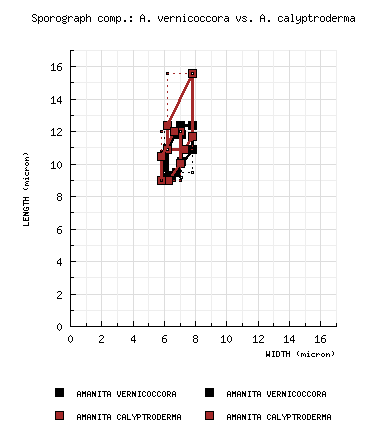
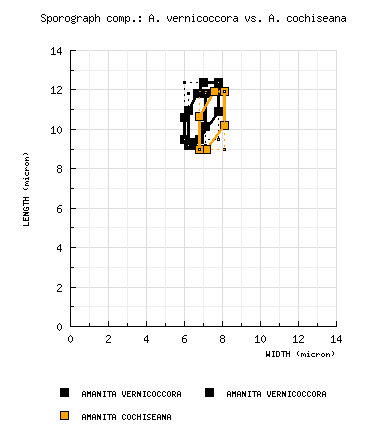
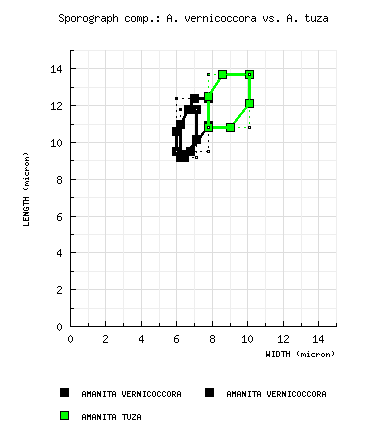
Insert comparison to A. sp-M36 when spore measurements are available.
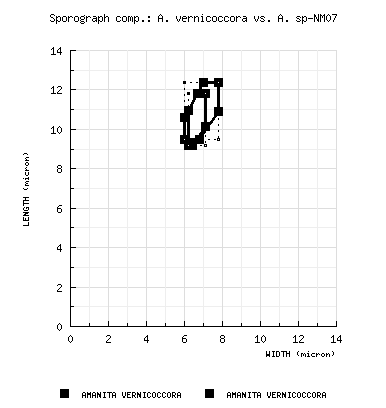
...
Data from the collection with mushroomobserver.com observation number 45852 was generously supplied by Ron Pastorino and is presented here: [10/1/1] 10.4 - 13.0 (-13.7) × 7.0 - 7.8 (-8.2) μm, (L = 11.4 μm; W = 7.4 μm; Q = 1.46 - 1.62 (-1.76); Q = 1.54).
On this site and in some web postings and correspondence, a provisional name (A. icthyeroballen) was in use for this species for several years prior to the publication of the current accepted name. |
| citations |
—R. E. Tulloss |
| editors |
RET |
|



 Spore data sets and their composite