
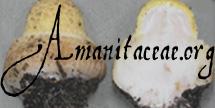
| name | Amanita tuza |
| name status | nomen acceptum |
| author | Guzmán |
| english name | "Gopher American Caesar" |
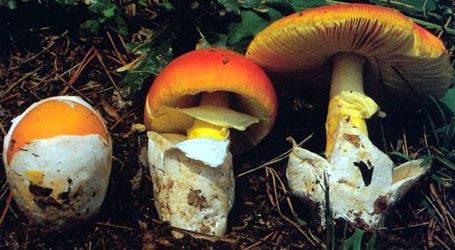
| cap | The cap of A. tuza is 70 - 120 mm wide, viscid, smooth, nonappendiculate, with a slightly sulcate margin. The cap is white to yellowish gray. The flesh is white. The volva may be present as a one or more thick, white patches. |
| gills | The gills are subadnate to free, white, with floccose edges. The short gills are truncate to subtruncate and rather sparsely(?) and unevenly distributed. |
| stem | The stem is 50 - 150 (-200) × 10 - 25 mm, with white flesh. The stem has a white, persistent, membranous, skirt-like ring. The thick, membranous, saccate volva is well-developed, and free. |
| odor/taste | The odor and taste of this species are described as indistinct or pleasant. |
| spores | The spores measure (8.4-) 10.3 - 15.7 (-25) × (6.3-) 7.5 - 10.2 (-14.0) µm and are cylindric to truncate-conic and inamyloid. Clamps are relatively common at the bases of basidia. |
| discussion |
This species occurs in Pine and Fir
forests of central Mexico and was originally described from the State of Mexico. Despite its similarity in macroscopic appearance to species of stirps Caesarea (see A. caesarea (Scop.:Fr.) Pers.) and stirps Hemibapha (see A. hemibapha (Berk. & Broome) Sacc.), A. tuza is currently regarded as somewhat distant from them because cells supporting the basidia are not inflated, or not as well-inflated, as in those groups. Subhymenial structure similar to that of A. tuza is seen in other robust taxa such as A. calyptroderma.—R. E. Tulloss |
| brief editors | RET |
| name | Amanita tuza | ||||||||||||||||||||
| author | Guzmán. 1975. Beih. Nova Hedwigia 51: 112. | ||||||||||||||||||||
| name status | nomen acceptum | ||||||||||||||||||||
| english name | "Gopher American Caesar" | ||||||||||||||||||||
| MycoBank nos. | 283356 | ||||||||||||||||||||
| GenBank nos. |
Due to delays in data processing at GenBank, some accession numbers may lead to unreleased (pending) pages.
These pages will eventually be made live, so try again later. Search:
Showing 0 to 0 of 0 entries | ||||||||||||||||||||
| holotypes | ENCB; isotypes, L & MICH | ||||||||||||||||||||
| type studies | Tulloss. 1994. Mycotaxon 52: 378, figs. 43-45. | ||||||||||||||||||||
| intro |
The following text may make multiple use of each data field. The field may contain magenta text presenting data from a type study and/or revision of other original material cited in the protolog of the present taxon. Macroscopic descriptions in magenta are a combination of data from the protolog and additional observations made on the exiccata during revision of the cited original material. The same field may also contain black text, which is data from a revision of the present taxon (including non-type material and/or material not cited in the protolog). Paragraphs of black text will be labeled if further subdivision of this text is appropriate. Olive text indicates a specimen that has not been thoroughly examined (for example, for microscopic details) and marks other places in the text where data is missing or uncertain. The following material is derived from the protolog of the present species, (Tulloss 1994), and additional original research of R. E. Tulloss. | ||||||||||||||||||||
| pileus | Tulloss (1994): 70 - 120 mm wide, white [?to yellowish gray], viscid, smooth; context white, fleshy, up to 5 mm thick at stipe; margin slightly sulcate, nonappendiculate; universal veil thick, white, calyptrate, sometimes divided into two or more pieces. | ||||||||||||||||||||
| lamellae | Tulloss (1994): subadnate to free, brownish yellow in exsiccata, with floccose edges; lamellulae truncate to subtruncate, rather sparsely(?) and unevenly distributed. | ||||||||||||||||||||
| stipe | Tulloss (1994): 50 - 150 (-200) × 10 - 25 mm; context white and fleshy; partial veil white, pendent, and apical, membranous, persistent, more or less thick, striate on upper surface, smooth below; universal veil as thick membranous saccate volva falsely giving impression of subbulbous or fusiform stipe base, well-developed, free, as in A. caesarea, with upper parts of limbs thinner than lower parts, with lower parts of limbs separating from stipe in exsiccata. | ||||||||||||||||||||
| columnella | double click in markup mode to edit. | ||||||||||||||||||||
| odor/taste | Tulloss (1994): Odor and taste both indistinct or pleasant. | ||||||||||||||||||||
| macrochemical tests |
none recorded. | ||||||||||||||||||||
| pileipellis | Tulloss (1994): 95 - 110 μm thick, gelatinizing strongly at surface, partially gelatinizing within 30 μm of surface, colorless except gelatinized surface brownish yellow heare and there; filamentous undifferentiated hyphae 1.2 - 5.2 μm wide, subradially oriented, densely interwoven; vascular hyphae not observed. [Note: Presently, RET prefers to (a) describe the gelatinized to subgelatinized region as a suprapellis and (b) give separate ranges of thickness for the supra- and subpellis.—ed.] | ||||||||||||||||||||
| pileus context | Tulloss (1994): filamentous undifferentiated hyphae 1.8 - 6.0 μm wide, branching, plentiful, in loosely interwoven fascicles; acrophysalides dominant, thin-walled, fusiform to subfusiform to clavate to ellipsoid to subpyriform, up to 91 × 40 μm; vascular hyphae not observed. | ||||||||||||||||||||
| lamella trama | Tulloss (1994): somewhat obscurely bilaterl; with wcs = ca. 25 μm; angle of divergence of hyphae and inflated elements shallow, up to about 45°; filamentous, undifferentiated hyphae 2.0 - 9.0 μm wide, inflated cell infrequent, thin-walled, clavate (e.g., 28 × 13.0 μm); vascular hyphae not observed; clamps common. [Note: Unfortunately the degree to which the type material could be rehydrated was not recorded. It is most likely that rehydration was not very good.—ed.] | ||||||||||||||||||||
| subhymenium | Tulloss (1994): wst-near = 10± μm; wst-far = 50± μm; tangled, including largely uninflated hyphal segments in branching structure with terminal one or two elements (at least) perpendicular to central stratum, with occasional segments inflated (sometimes in chains of two to four clavate to ovoid to narrowly ellipsoid to irregular elements) up to 17.5 × 11.0 μm, with basidia arising most frequently from uninflated hyphal segments, but also arising from small inflated or partially inflated cells; clamps common. [Note: Unfortunately the degree to which the type material could be rehydrated was not recorded. It is most likely that rehydration was not very good.—ed.] | ||||||||||||||||||||
| basidia | Tulloss (1994): 44 - 77 × 10.0 - 13.5 μm, thin-walled, dominantly 4-sterigmate, occasionally 2-sterigmate; clamps relatively common. | ||||||||||||||||||||
| universal veil | Tulloss (1994): On pileus, exterior surface: filamentous undifferentiated hyphae 1.0 - 3.5 μm wide, partially gelatinized, orange-brown, in disordered and widely spaced fascicles; vascular hyphae not distinguishable due to gelatinization; clamps present. On pileus, interior: filamentous undifferentiated hyphae 1.0 - 5.8 μm wide, plentiful to dominant, branching, in sometimes rather thick fascicles, with fascicles interwoven among inflated cells; inflated cells terminal singly, plentiful, thin-walled, broadly ellipsoid to ovoid to subglobose (up to 76 × 53 μm), clavate (up to 125 × 39 μm); vascular hyphae 2.0 - 4.8 μm wide, occasional, coiling here and there; clamps present. On pileus, inner surface: filamentous undifferentiated hyphae as thin layer of nearly completely gelatinized hyphae (apparently originally subradially oriented) overlaying similar thin-layer of densely interwoven hyphae. On stipe base, exterior surface: highly gelatinized, impregnated extensively with particles of soil, orange-brown, largely comprising filamentous undifferentiated hyphae. On stipe base, interior: filamentous undifferentiated hyphae 2.2 - 10.8 μm wide, plentiful, branching, sometimes partially gelatinized, in loosely interwoven fascicles; inflated cells dominating, subglobose to broadly clavate to clavate to narrowly clavate or subfusiform, up to 109 × 65 μm, terminal singly, thin-walled; vascular hyphae not observed. On stipe base, inner surface: as partially gelatinized layer 13 - 26 μm thick; filamentous undifferentiated hyphae 1.5 - 5.0 μm wide, branching, densely interwoven, sublongitudinally arranged; vascular hyphae not observed. | ||||||||||||||||||||
| stipe context | Tulloss (1994): longitudinally acrophysalidic; filamentous undifferentiated hyphae 1.0 - 8.2 (-10.8) μm wide, plentiful; acrophysalides often somewhat broad for their length (compared to usually rather narrow clavate acrophysalides in stipes of many species of Amanita), up to 151 × 50 μm, thin-walled or with very slightly thickened walls, plentiful to dominating; vascular hyphae not observed. | ||||||||||||||||||||
| partial veil | Tulloss (1994): filamentous undifferentiated hyphae 2.2 - 8.5 μm wide, frequently branching, collapsed, thin-walled, plentiful to dominant, moderately loosely interwoven, mostly in fascicles, with some fascicles subradially oriented (e.g., on upper surface); inflated cells terminal, thin-walled, plentiful to locally dominant (away from surfaces), elongate to clavate to subfusiform to broadly fusiform (up to 73 × 34 μm), infrequently subglobose (e.g., 41 × 35 μm); vascular hyphae 1.2 - 5.5 μm wide, branching, relatively common; clamps rather large, common. | ||||||||||||||||||||
| lamella edge tissue | not described, but certainly sterile—ed. | ||||||||||||||||||||
| basidiospores | Tulloss (1994): [71/3/1] (10.0-) 10.8 - 13.7 (-15.4) × (7.1-) 7.8 - 10.1 (-11.0) μm, (L = 11.6 - 14.2 μm; L' = 12.8 μm; W = 8.3 -9.4 μm; W' = 8.7 μm; Q = (1.14-) 1.20 - 1.60 (-1.74); Q = 1.32 - 1.65; Q' = 1.39), hyaline, colorless, smooth, thin-walled, inamyloid, broadly ellipsoid to ellipsoid (rarely subglobose or elongate), often adaxially flattened; apiculus sublateral, cylindric to truncate-conic, prominent; contents granular to guttulate; white in deposit. | ||||||||||||||||||||
| ecology | Tulloss (1994): In forests of Pinus and Abies. | ||||||||||||||||||||
| material examined | Tulloss (1994): MÉXICO: EDO. MÉXICO—Nevada de Toluca Region, W of Tenango del Valle, ca. San PedroTlanixco, 28.viii.1957 G. Guzmán 825-A (holotype, ENCB; isotype, L; isotype, MICH). | ||||||||||||||||||||
| discussion |
Tulloss (1994): "Guzmán explains the origin of the epithet as follows: 'The sporophore slmost completes its development under the surface of the soil, but when it is mature it suddenly emerges raising the soil with it, like the pocket gopher of the Geomydae family.' He notes that tuza is the popular Mexican name for pocket gophers (Cratogemys spp.)." It will be necessary to revise the anatomy of lamellae with new, well-dried material. | ||||||||||||||||||||
| citations | —R. E. Tulloss | ||||||||||||||||||||
| editors | RET | ||||||||||||||||||||
Information to support the viewer in reading the content of "technical" tabs can be found here.
| name | Amanita tuza |
| bottom links |
[ Keys & Checklists ] |
| name | Amanita tuza |
| bottom links |
[ Keys & Checklists ] |
 Spore data sets and their composite
Each spore data set is intended to comprise a set of measurements from a single specimen made by a single observer; and explanations prepared for this site talk about specimen-observer pairs associated with each data set. Combining more data into a single data set is non-optimal because it obscures observer differences (which may be valuable for instructional purposes, for example) and may obscure instances in which a single collection inadvertently contains a mixture of taxa.
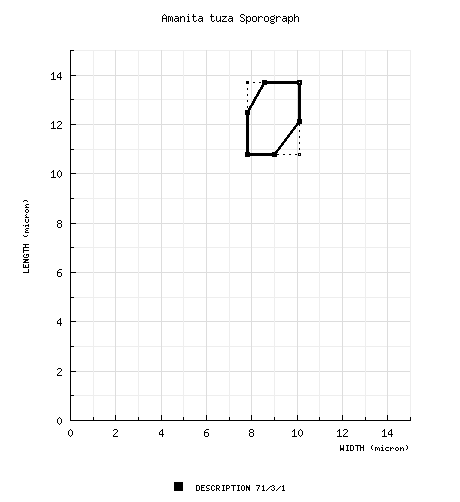

Text and User-Generated Sporographs are published under the Creative Commons License.

In the case of a taxon page, image credits are on the 'image' tab.