| name |
Amanita cochiseana |
| author |
Tulloss nom. prov. |
| name status |
nomen provisorum |
| english name |
"Cochise's American Caesar" |
| synonyms |
= Amanita caesarea sensu States. 1990. Mushr. Truff. Southw.: 56 [with unnumbered fig.].
The editors of this site owe a great debt to Dr. Cornelis Bas
whose famous cigar box files of Amanita nomenclatural information
gathered over three or more decades were made available to RET for computerization
and make up the lion's share of the nomenclatural information presented on this site.
|
| etymology |
Cochise + -ana, suffix indicating possession; hence, "of Cochise"
Named in honor of Cochise (1815?-1874), renowned military-political leader of the ? band of the Chiricahua Apache people. |
| GenBank nos. |
Due to delays in data processing at GenBank, some accession numbers may lead to unreleased (pending) pages.
These pages will eventually be made live, so try again later.
|
| selected illustrations |
Arora. 1991. All Rain Promises: 67 [as "Amanita caesarea"] |
| intro |
Olive text indicates a specimen that has not been
thoroughly examined (for example, for microscopic details) and marks other places in the text
where data is missing or uncertain.
The following is based on original research of R. E. Tulloss. |
| pileus |
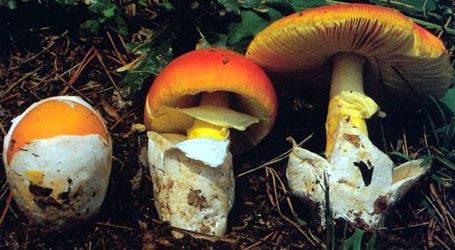
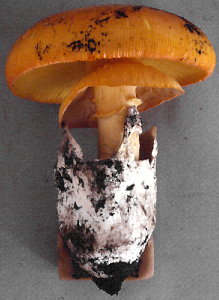
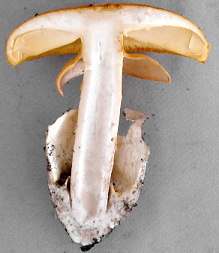
60 - 150 mm wide, egg-shaped, then convex to broadly convex with incurved margin, becoming nearly planar with decurved margin, not umbonate, sometimes entirely pale orange at first, soon pale orange-ochre to pale buff to pale orangish buff over area including disc and orange-brown outside this decolored region (except bright yellow-orange to bright yellow on margin), with orange and brown tints disappearing on exposure, then becoming entirely intense yellow except for decolored region of disc (latter remaining as above or becoming nearly white), viscid to dry, often matt (especially in decolored region), sometimes shiny; context white to pale cream, with intense yellow below pileipellis (in region 2 - 3 mm thick in disc) and pale yellow over lamellae near stipe, sometimes watery yellow over lamellae, unchanging when cut or bruised, 8 - 13 mm thick, thinning evenly to margin or to within 3 - 10 mm of margin and thence a membrane to margin; margin striate (0.1 - 0.2R), nonappendiculate; universal veil absent or, occasionally, as single white membranous patch off-center; pileipellis often bright orange red to red in cross section even in region with faded surface. |
| lamellae |
free to narrowly adnate (with or without decurrent tooth), with prominent decurrent line on stipe, crowded, yellow to bright (or brilliant) yellow to orange-yellow in mass, yellow (3A4 or a little more intense than 2A3) to pale yellowish cream in side view, close, 7.5 - 13 mm broad, with edge yellow (often brilliant) and somewhat fimbriate/flocculose or not, some forking or anastomosing; lamellulae truncate to subtruncate to rounded truncate, of diverse lengths, common, unevenly distributed. |
| stipe |
60 - 120 × 10 - 25 mm, subcylindric to cylindric or narrowing downward or upward, pointed below, cream to white to pale yellow near base becoming more intensely yellow upwards, sometimes orangish yellow or yellow-orange above midpoint (or only above partial veil), not flaring at apex, surface decorated with pale yellow and often rather thin felted/floccose scales (some with orange tint), with ground color fading with age, faintly striatulate below annuli, faintly pruinose above partial veil; context pale cream to off-white to pale yellow (between 3A2 and 3A3), sometimes more strongly yellow (especially near surface) in 20 - 30 mm nearest apex, unchanging when cut or bruised, larva tunnels concolorous to sordid to brownish gray, stuffed with white cottony material, becoming hollow, with central cylinder 7.5 - 13 mm wide; partial veil subapical to superior, copious, flaring beyond limits of volva at first, eventually collapsing, skirt-like, bright yellow to yellow orange above and pale yellow to yellowish or orangish tan below, becoming darker orange with age, membranous, usually with regular margin, sometimes tearing, strongly striate above, felted below, with apparent secondary annulus (often perpendicular to stipe, sometimes shredded, see description of limbus internus, below) having ragged edge and being much smaller and entirely concolorous with partial veil or yellow or grayish yellow and submedian to median (e.g., 20 - 30 mm below partial veil) and eventually collapsing to thickened wavy line; universal veil as copious saccate volva, ovoid at first, white, staining slightly from contact with soil, sometimes sordid in age, thick (with limb 2.5 - 4+ mm thick at mid-height), membranous, soft (even cottony), leathery, 46 - 88 × 28 - 55 mm, dividing into several (often pointed) lobes, with distinct white limbus internus at about mid-height of limb and attached (easily seen in "button" specimens) to thin yellow to orangish yellow felted sheath of stipe (with latter eventually forming inferior "secondary annulus"). |
| odor/taste |
Odor pleasant, faintly fruity/earthy. Taste not recorded. EDIBLE. |
macrochemical
tests |
Syringaldazine spot test for laccase - negative throughout both young and mature basidiomes. Paracresol spot test for tyrosinase - scattered positive reactions in interior of universal veil limb, on lower stipe surface, in material in central cylinder of stipe, in small spots in pileus context, in spots on pileipellis surface (only in mature specimen). Test vouchers: CMP1301, CMP1303. |
| pileipellis |
t.b.d. |
| pileus context |
t.b.d. |
| lamella trama |
t.b.d. |
| subhymenium |
not pseudoparenchymatic (not comprising only inflated cells). |
| basidia |
33 - 62 × 8.0 - 11.6 µm, thin-walled, 4-sterigmate, with sterigmata up to ? × ? µm; clamps present, small. |
| universal veil |
t.b.d. |
| stipe context |
t.b.d. |
| partial veil |
t.b.d. |
| lamella edge tissue |
t.b.d. |
| basidiospores |
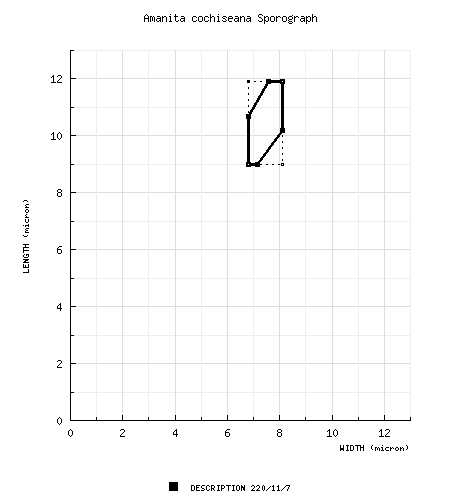
[220/11/7] (8.2-) 9.0 - 11.9 (-13.6) × (6.0-) 6.8 - 8.1 (-9.4) µm, (L = (9.5-) 9.7 - 10.8 µm; L’ = 10.2 µm; W = 6.9 - 7.5 (-7.8) µm; W’= 7.3 µm; Q = (1.09-) 1.26 - 1.57 (-1.63); Q = (1.29-) 1.34 - 1.49; Q’ = 1.40), hyaline, colorless, thin-walled, smooth, inamyloid, broadly ellipsoid to ellipsoid, infrequently subglobose, occasionally elongate, often adaxially flattened, sometimes swollen at one end; apiculus sublateral, cylindric to truncate-conic, short; contents monoguttulate with some additional granules; white in deposit. |
| ecology |
Solitary to gregarious from 1630 to 2600 m elev. Arizona: With Pinus arizonica and Pseudotsuga menziesii or under P. menziesii, P. flexilis, and P. engelmanii with P. arizonica nearby or under "mixed pines" or with Abies concolor, P. menziesii, P. arizonica, Juniperus deppeana, P. chihuahuana or with P. engelmannii or in Quercus-Pinus forest or with P. ponderosa. New Mexico: With P. ponderosa and Quercus scrub. |
| material examined |
U.S.A.: ARIZONA—Cochise
Co. - CMP site #1, 5.ix.1994 J. S. States AEF1302
(MICH as "A. caesarea"); CMP site #5,
28.viii.1991 R. Redman s.n. [CMP1606] (RET 497-10),
3.ix.1993 J. S. States AEF999 (MICH as "A.
caesarea"); CMP site #10
[31°55’59” N/ 109°16’16” W, 2134 m], 30.viii.1993
Susan B. Fleming s.n. [CMP3145] (RET 511-7); CMP site
#28, viii.1993 A. Ortiz s.n.
[CMP3701] (RET 498-1); CMP site #30
[31.9150° N/ 109.2844° W, 2492 m], 14.viii.1990
J. S. States s.n. [CMP0384] (RET 511-6, nrITS
seq'd.), Robert M. Chapman, F. H. Nishida & R. E.
Tulloss 8-18-91-E [CMP0641] (RET 426-7, nrITS
& nrLSU seq'd.), 28.viii.1991 Jerold Turney
& G. Holmes s.n. [CMP1746] (RET 511-2); CMP
site #46, 21.viii.1992 R. L. Homola s.n. [CMP1301 ;
Tulloss 8-21-92-H] (RET 426-2, nrITS seq'd.), R. E.
Tulloss 8-21-92-Z [CMP1303] (RET 426-3, nrITS &
nrLSU seq'd.), 8-21-92-AA [CMP1839] (RET 426-8,
nrITS & nrLSU seq'd.). Coconino Co. -
San Francisco Peaks, 20.viii.1988 J. S. States
AEF796 (MICH as "A. caesarea").
Santa Clara Co. - Santa Rita Mtns., Mt. Wrightson
Tr., 28.viii.1996 J. S. States AEF1456 (MICH as
"A. caesarea").
FLORIDA—Leon Co. -
Tallahassee, Hawkins prop., 14.vii.2007 J. B.
Hawkins s.n. [RET 7-14-07-A]
(RET 408-7, nrITS-LSU seq'd.).
NEW MÉXICO—Colfax Co. - NNW of Cimarron,
Carson Nat. For., Valle Vidal Unit, McCrystal Crk.
Campgr., 22.viii.1992 Margaret L. McKee & Mr.
& Mrs. J. D. Shields, Jr. s.n. [Tulloss
8-22-92-JDS1] (RET 072-5, formerly "Amanita
sp-NM07").
Grant Co. - F. R. 150 [33.1251° N/ 108.0069° W,
2420 m], 16.viii.2013 R. M. Chapman 1436
(RET 565-3).
Sandoval
Co. - Jerez Mtns. s.d. C. Barrows 1516 (in two
boxes, MICH). |
| discussion |
This entity is often determined as
A. caesarea
(Scop.:Fr.) Grev. and seems very much like that
species in a number of respects; however, its ramose
to subramose subhymenium, apparent "double annulus,"
strong color change to yellow upon exposure, and
?? differentiate it from
the European species. The same characters
serve to separate the present species from the group
phenetically very similar to
A. hemibapha
(Berk. & Broome) Sacc.
Based on current knowledge, the greatest
morphological affinity of the present taxon is with
A.
calyptroderma and
A.
vernicoccora of the U.S. western coastal
states. As A. H. Smith noted in an
unpublished manuscript (MICH), [1} neither of these
taxa has a "double annulus"; [2} nor are they like
A. cochiseana in pileus pigmentation; and
[3] a large, membranous calyptra of universal veil
is almost always present on their expanded
pilei. Smith (ibid.) also noted that
A. calyptroderma has spores that, on average,
are narrower and, hence, have a higher Q’
than those of A. cochiseana. The same
is true of A. vernnicoccora. In
addition, fruiting bodies of the latter often have
a fish-like odor and taste (for some people) that
is not removed by cooking.
The most similar speciems from a molecular point of
view is A basii.
Phylogenetic studies have indicated strong support
for the separation of the four taxa
(Sánchez-Ramírez et al.,
2014,
2015).
States AEF796 is the voucher collection
corresponding to the illustration of the present species by States (1990: 56).
RET has called the present species "Amanita
sp. AZ6," "Amanita sp. AZ20," and
"Amanita sp-NM07 in preliminary drafts of
this description, in correspondence, in checklists,
in keys, and on this site. |
| citations |
—R. E. Tulloss |
| editors |
RET |
|


 Spore data sets and their composite