| name |
Amanita solaniolens |
| author |
H. L. Stewart & Grund. 1974. Canad. J. Bot. 52: 338, figs. 14-21, 27. |
| name status |
nomen acceptum |
| english name |
"Old Potato Amanita" |
| etymology |
Solanum, "potato" + olens, "smelling" |
| MycoBank nos. |
308590 |
| GenBank nos. |
Due to delays in data processing at GenBank, some accession numbers may lead to unreleased (pending) pages.
These pages will eventually be made live, so try again later.
|
| holotypes |
ACAD 10884 |
| intro |
The following text may make multiple use of each data field.
The field may contain magenta text presenting data from a type study
and/or revision of other original material cited in the protolog of the present taxon.
Macroscopic descriptions in magenta are a combination of data from the protolog and
additional observations made on the exiccata during revision of the cited original
material.
The same field may also contain black text, which is data from a revision of the present
taxon (including non-type material and/or material not cited in the protolog).
Paragraphs of black text will be labeled if further subdivision of
this text is appropriate.
Olive text indicates a specimen that has not been
thoroughly examined (for example, for microscopic details) and marks other places in the text
where data is missing or uncertain.
The following is derived from the protolog of the
present species, from molecular research of Dr. K.
W. Hughes, and additional original research of R. E.
Tulloss. |
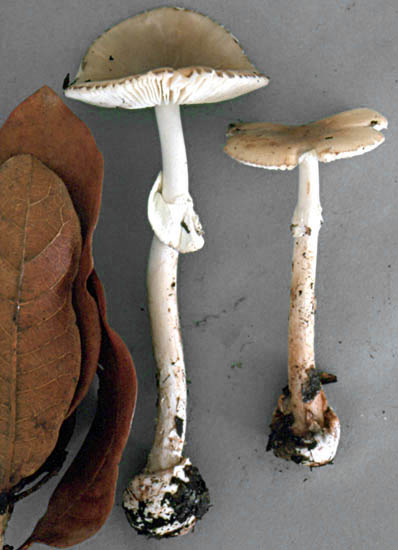
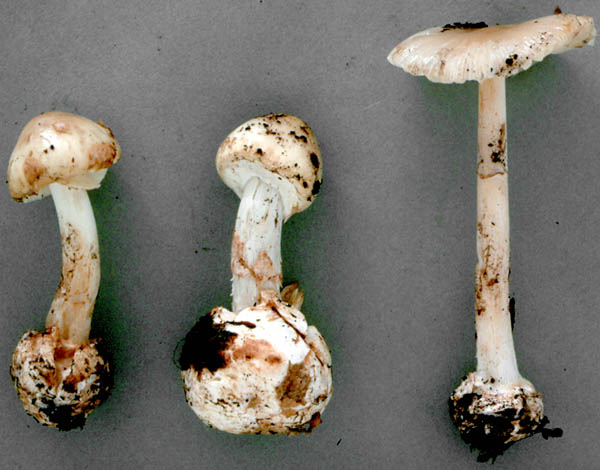
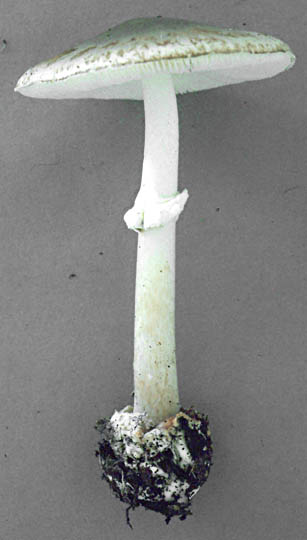
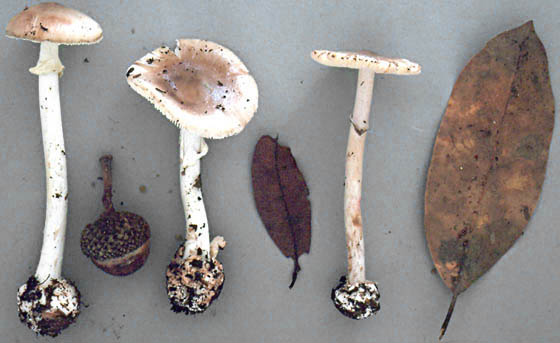
| pileus |
from protolog: 39 - 45 mm wide,
dull yellow (3B3) to light blond (4C3) at margin,
abruptly darkening to olive brown (4E5 to 4F3) over
disc, entirely with distinct greenish tinge, broadly
convex to planar, fibrillose silky, viscid when
moist; context white, creamy, "hard," 2.5 - 3
mm thick above stipe; margin nonstriate;
universal veil as one or two flat
proportionately large patches, creamy white to
yellowish white (4A2).
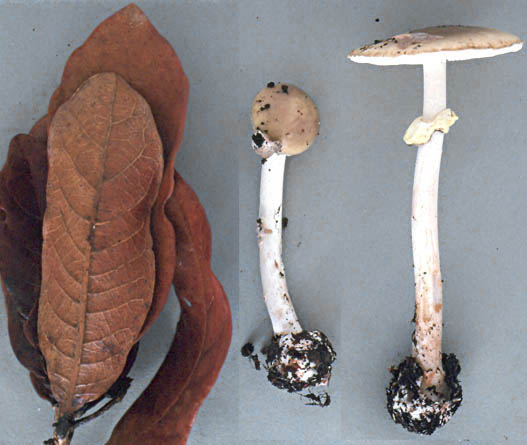
Costa Rica: 28 - 59 (-82) mm wide, brown to reddish
brown over disc and pallid in broad marginal band or
entirely very pale citrin to off-white
(occasionally with rusty stains), at first broadly
campanulate with incurved margin, finally planar,
tacky, shiny when wet, dull when dry; context
white, with watersoaked lines above stipe context
and above lamellae, 2.5 - 3 mm thick above stipe;
margin nonstriate, nonappendiculate;
universal veil as felted small patches,
scattered, white at first then tan then brown, of
uneven thickness with thickest parts minutely
verruculose (10× lens), detersile;
pileipellis
easily separating at pileus margin.
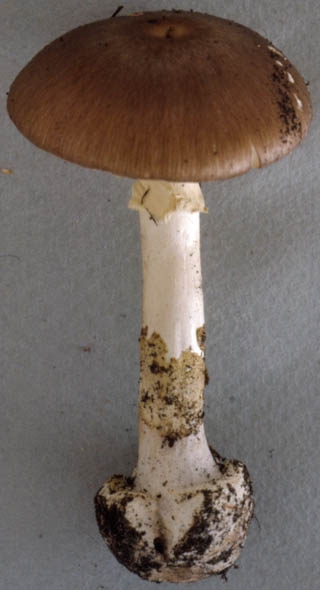
non-type, North American material: 21 - 40 mm wide,
sepiaceous or sepia in radial fibrils (darkest
above stipe, with ground
pale
yellowish to yellow tan,
virgate, sometimes with single tan spot over disk in
mature specimens, planar to broadly convex to
plano-convex to plano-depressed to rounded
subcampanulate, rimose, dry to tacky, shiny to
dull, subviscid over disk; context white to
off-white, watery below pileipellis in disc and
above contact with stipe, 1 - 2 mm thick, thinning
evenly to margin; margin nonstriate,
nonappendiculate; universal veil absent or
sometimes present as one or two buff to pale tan
small patches, thin and somewhat papery, easily
removable, membranous. |
| lamellae |
from protolog: free, moderately
close, creamy white to yellowish white (3A2), 4 - 5
mm broad, with edges sometimes slightly flocculose;
lamellulae not described.
Costa Rica: free without decurrent line on stipe,
crowded, cream in mass, off-white to pale cream in
side view, with staining or bruising not observed,
3.5 - 6.5 mm broad, broadest at about two-thirds
length from stipe, with minutely flocculose edge,
rounded at pileus margin; lamellulae truncate
to subtruncate, unevenly distributed, of diverse
lengths, plentiful.
non-type, North American material: free to narrowly
adnate with short decurrent line on stipe (10×
lens), close to subcrowded to crowded, white to
whitish to pale yellowish cream in mass, white to
cream in side view, with staining and bruising not
observed, 2 - 3.5 mm broad;
lamellulae rounded truncate to subtruncate
to truncate to attenuate, plentiful, of varying
lengths. |
| stipe |
from protolog: 76 - 92 × 4 - 5
mm, creamy white, cylindric or narrowing upward,
glabrous, slightly fibrillose-silky near bulb,
staining slightly brownish when bruised;
context thickly stuffed to hollow;
bulb proportionately small, subglobose,
subabrupt [all per figure]; partial veil
superior, pendent, creamy white to pale yellow (3A2),
membranous, collapsing; universal veil as
short limbate volva, creamy white,
membranous.
Costa Rica: 48 - 117 × 6.5 - 9.5 mm, white, narrowing
upward, barely or not flaring at apex, longitudinally
striatulate, satiny at first, developing raised
fibrils on lower part, with raised fibrils darkening
from handling; bulb 9.5 - 21 × 16-31 mm, white,
with raised rim become brick-colored, subglobose,
marginate, with some longitudinal splitting;
context stuffed with pale yellowish
watersoaked material, white, with staining or
bruising not observed, with larval tunnels
concolorous to reddish brown, with central cylinder
2 - 4 mm wide; partial veil superior, thin,
membranous, skirt-like, flaring at first, very pale
yellowish white to white, with gray to black line
around underside at edge, smooth below, finely
striate above (10× lens), becoming gray and
collapsing on stipe in oldest specimens;
universal veil as scant limb, often leaning
toward stipe, pallid, becoming rusty brown or
red-brown or brick-color.
non-type, North American material: (35-) 56 - 87 ×
2.5- 7 mm, white to whitish, brown or tan from
handling, narrowing upward or narrowing downward,
flaring at apex, longitudinally (faintly) striate,
fibrillose below with fibrils often darkening,
whitish subsatiny above; bulb 10 - 14 × 9 -
13.5 mm, subglobose to ovoid; context white,
stuffed with water soaked tissue above to hollow
below to solid; partial veil superior to
submedian, very pale yellowish white, thin,
membranous, delicate, tearing, persistent, flaring;
universal veil as continuous short white to
yellowish membranous limb appressed to stipe or as
tough smooth leathery white limb with pale yellow
limbus internus, 11± mm from base of
bulb to highest point on limb. |
| odor/taste |
from protolog: Odor of
old potatoes. Taste very
mild.
Costa Rica: Odor of freshly dug potato.
Taste not recorded.
non-type, North American material: Odor of new
potatoes. Taste not recorded. |
macrochemical
tests |
none recorded. |
| pileipellis |
from protolog: ixocutis, 85 - 100 μm thick; filamentous hyphae 3 - 6 μm wide, branching, densely packed, occasionally bearing clavate terminal segment (up to 45 × 10 μm). |
| pileus context |
not described. |
| lamella trama |
from protolog: bilateral. |
| subhymenium |
not described. |
| basidia |
from protolog: (28-) 30 - 36 × (8.4-) 9.6 - 12.0 μm, 4-sterigmate; clamps not observed. |
| universal veil |
from protolog: On pileus: filamentous hyphae (3-) 5 - 8 (-12) μm wide, hyaline, branching, loosely interwoven; inflated cells plentiful, globose to subglobose to clavate, up to 60 × 20 μm and 76 × 76 μm, terminal. On stipe base: filamentous hyphae 3.5 - 5 μm wide, branching, thin-walled, interwoven, usually constricted at septa; inflated cells scattered, up to 70 × 36 μm, terminal. |
| stipe context |
from protolog: longitudinally acrophysalidic; filamentous hyphae 3 - 9 μm wide (near exterior surface 3 - 6 μm wide), thin-walled, branching, "usually" constricted at septa in central cylinder ("pith"); acrophysalides up to 210 × 30 μm, thin-walled, scattered and smaller in central cylinder ("pith"), also sometimes subglobose (up to 74 μm long) in pith; vascular hyphae noted in central cylinder ("pith"). |
| partial veil |
from protolog: filamentous hyphae (3-) 4 - 6 (-8) μm wide, branching, loosely interwoven; inflated cells not observed. |
| lamella edge tissue |
sterile. |
| basidiospores |
from protolog: (6.6-) 7.2 -
9.0 μm long, (Q = 1.0 - 1.1, "usually 1.0"), smooth,
amyloid, globose to subglobose; apiculus not
described; contents not described; white in
deposit. [Note: Sporgraph cannot be
generated.—ed.]
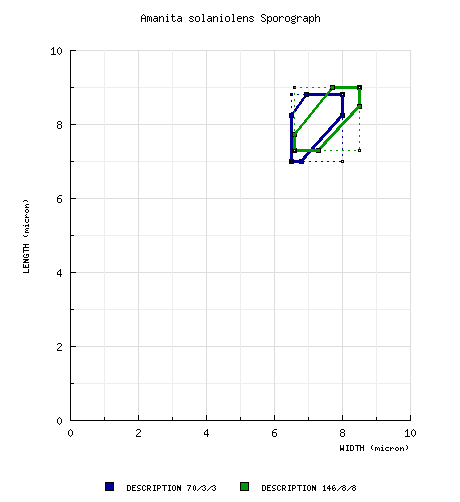
RET (from material originally defining the concept
of
A. sp-N20): [70/3/3] 7.0 - 8.8 (-10.5) ×
(5.5-) 6.5 - 8.0 (-9.5) µm, (L = 7.9 - 8.2 µm;
L’ = 8.0 µm; W = 7.1 - 7.4 µm;
W’ = 7.2 µm; Q = (1.0-) 1.03 - 1.27 (-1.35);
Q = 1.06 - 1.16; Q’ = 1.11), hyaline,
colorless, smooth, thin-walled, amyloid, globose
to subglobose to broadly ellipsoid, rarely
ellipsoid, sometimes swollen at one end, adaxially
flattened; apiculus sublateral, cylindric;
contents monoguttlate to multiguttulate,
sometimes with additional small granules; white in
deposit.
RET (from material originally defining the concept
of A. sp-O02): [146/8/8] (6.6-) 7.3 - 9.0
(-10.8) × (5.9-) 6.6 - 8.5 (-10.1) µm,
(L = 7.7 -
8.6 (-8.8) µm; L’ = 8.2 µm;
W = 7.0 - 7.8 (-7.9)
µm; W’ = 7.5 µm; Q = 1.0 - 1.17 (-1.28);
Q = 1.06 - 1.11; Q’ = 1.07),
hyaline, thin-walled,
smooth, amyloid to strongly amyloid, globose to
subglobose to broadly ellipsoid, usually at least
somewhat adaxially flattened, occasionally
expanded at one end; apiculus sublateral,
proportionately small, cylindric; contents
guttulate; white in deposit. |
| ecology |
from protolog: Solitary.
Nova Scotia: In humus under Tsuga canadensis
or Acer.
Connecticut: In litter of coniferous woods in dry
conditions. New Jersey: In mixed deciduous
woods in very dry conditions or in
Pinus rigida-Quercus (Pitch Pine-Oak)
barrens. New York:
In wet soil over sandstone bedrock, under Tsuga
canadensis and Betula
alleghaniensis.
more t.b.d.
Costa Rica: Solitary to scattered.
At 1900-2860 m elev. In dark loam of open
Quercus copeyensis grove or in similar soil in
broad-leaf forest with Q. copeyensis and
occasional Q. seemannii or in similar soil of
old remnant forest with Q. copeyensis, Q.
seemannii, and Q. rapurahuensis or in
similar soil with leaf litter of open pasture with
scattered Q. copeyensis and Q.
costaricensis with adjacent segregated patches of
mixed broad-leaf forest or in similar soil in old
mixed broad-leaf forest with Q. copeyensis
and Q. seemannii or in forest dominated by
Q. seemannii. |
| material examined |
from protolog:
CANADA:
NOVA SCOTIA—Kings Co. - Aylesford,
29.vii.1967 H. L. Stewart 200 (holotype, ACAD 10884);
Kentville Ravine, 31.vii.1967 unkn. coll. [H. L.
Stewart 215] (paratype, ACAD 10898).
COSTA RICA: PROV. ALAJUELA—Ctn.
Grecia - Bosque del Niño [10°9′4″ N/ 84°14′42″ W,
1900 m], 29.vi.1995 Juber Torres & Juan Luis Mata
s.n. [Tulloss 6-29-95-G] (RET 338-4).
PROV. SAN JOSÉ—Ctn. Dota - El Empalme [9°43′8″ N/
83°57′4″ W, 2250 m], 15.vi.1995 Kris Shanks s.n.
[Tulloss 6-15-95-A] (RET 336-1), K. Shanks s.n.
[Tulloss 6-15-95-G] (RET 336-6), K. Shanks s.n.
[Tulloss 6-15-95-O] (RET 338-2); Jardín de Dota [9°42′52″ N/
83°58′28″ W, 2220 m], 15.vi.1995 R. E. Tulloss
6-15-95-F (RET 338-5, nrITS seq'd.); La Chonta
[9°41′58″ N/ 83°56′31″ W, 2400 m], K. Shanks,
R. E. Halling & R. E. Tulloss [Tulloss
6-16-95-I] (RET 331-3), R. E. Halling s.n.
[Tulloss 6-16-95-J] (RET 335-7), R. E. Tulloss
6-16-95-O (RET 338-2); San Gerardo de Dota #1,
Albergue de Montaña Savegre [9°33′2″ N/ 83°48′27″
W], 2200 - ca. 2350 m], 25.vi.1995 K. Shanks, R. E.
Halling & R. E. Tulloss [Tulloss 6-25-95-C]
(RET 333-10);San Gerardo de Dota #3 [9°35′47″ N/
83°47′55″ W, 2860 m], 23.vi.2995 R. E. Tulloss
6-23-95-K (RET 335-2).
non-type, North American material:
CANADA:
ONTARIO—?? Co. - Port Dover
[42.7863° N/ 80.198° W, 182 m], n.d.
Eva Skific s.n. (RET 547-6).
U.S.A.:
ARKANSAS—Perry
Co., Lake Sylvia Recr. Area, ca. camping area,
14.vi.2010 Jay Justice AR-AM-27 (RET 458-4).
FLORIDA—Hillsborough Co. -
Thonotosassa [28.1789° N/ 82.2328° W, 20m],
20.iv.2013 J. Kauffman s.n. (RET 546-1).
ILLINOIS—Coles Co. - unkn. loc.,
20.vii.2007 Dr. Michael Kuo s.n. (RET 408-10).
MAINE—Penobscot
Co. - Orono, Sklar Park woods, 11.viii.2007 Alma
Homoloa sn. [Tulloss 8-11-07-A] (RET 509-4).
Waldo Co. - Searsport, Sears Isl., 10.viii.2007
Melissa Piechucki s.n. [Tulloss 8-10-07-A] (RET
409-5).
MASSACHUSETTS—Berkshire Co. -
Savoy Mountain St. For.,
14.viii.1986 Marilyn Hacker s.n.
[Tulloss 8-14-86-A] (RET 669-6). Essex Co. -
Lynn, Lynn Woods, 7.ix.1990 Martha Finta & R. E.
Tulloss [Tulloss 9-7-90-E] (RET 598-10).
MISSOURI—Camden Co. - ca.
Camdenton, Ha Ha Tonka St. Pk., River Cave,
24.vi.2009 J. Justice, Sherry Kaye, & C. Crabtree
s.n. [Tulloss 6-24-09-B] (RET 441-7).
Newton Co. - Neosho, Fort Crowder Conservation Area
[36.8167° N/ 94.3060° W, 377 m], 17.vi.2013 Jon
Shaffer s.n. (RET 547-5).
Ste. Genevieve Co. - Hawn
St. Pk. [37.820° N/ 90.2429° W, 242 m], 2.vi.2013
Patrick Harvey s.n. [mushroomobserver.org
#135461]
(RET 553-8, nrITS & nrLSU seq'd.).
NEW JERSEY—Burlington Co. -
Chatsworth, Franklin Parker Preserver entrance,
18.viii.2012 Igor Safonov, Nina & John Burghardt
1green (RET 610-9).
Mercer Co. - Hopewell, AT&T Bell Labs. prop.,
18.viii.1978 R. E. Tulloss G-B50 (RET 675-6).
Morris Co. - Mendham,
Meadowoods Twp. Pk. [40°47'31" N/ 74°38'43" W, 214 m],
19.vii.1992 Dr. Derek J. Schafer s.n. [Tulloss
7-19-92-D] (RET 064-2).
NEW YORK—Albany Co. - Alcove,
vii-ix.1892 C. L. Shear s.n. (NEB 30567).
Oneida Co. - unkn. loc. 16.vii.2013 Eric Smith s.n.
(RET 596-10), 21.vii.2013 E. Smith s.n.
(RET 597-8). Otsego Co. -
Oneonta, College Camp, 16.viii.1985 Robert Peabody
s.n. [Tulloss 8-16-85-F] (RET
??).
Otsego? Co. - Schenevus St. For., 16.viii.1985
NEMF85 participant s.n. [Tulloss 8-16-85-H]
(RET 100-1). Ulster Co. - Minnewaska St. Pk.,
Petersburg/?? Trail, 12.viii.1990 William Bakaitis
90-99 (RET 048-3). Unkn. Co. - border of
Otsego & Delaware Cos., Pine Lake Campus,
17.viii.1985 Dr. Ursula Hoffman s.n.
[Tulloss 8-17-85-A] (RET 099-7).
PENNSYLVANIA—Carbon Co. - Hickory
Run St. Pk. [41.0333° N/ 75.6920° W, 400-500 m],
13.vii.2012 David Wasilewski s.n.
(RET 528-8). Luzerne Co. - Dogtown
[41.1322° N/ 76.1538° W, 394 m], 20.ix.2014
D. Wasilewski s.n. (RET 654-3); Ricketts Glen St.
Pk. [41.3036° N/ 76.2740° W, 400-600 m],
9.iv.2012 D. Wasilewski s.n. (RET 527-8);
Seven Tubs Natural
Area [41.2334° N/ 75.8131° W, 300-350 m],
11.vii.2013 D. Wasilewski s.n. (RET 549-2),
s.n. (RET 550-6); unkn.
loc., 18.vii.2009 D. Wasilewski s.n. (RET 603-4),
24.vi.2011 D. Wasilewski s.n. (RET 499-2).
TENNESSEE—Sevier Co. - Gatlinburg,
GSMNP, Alum Cave trail head [35°37'48” N/
83°27'04” W, 1190 m], 13.vii.2004 Dr. Joaquin
Cifuentes s.n. [Tulloss 7-13-04-I] (RET 377-2); ca.
Gatlinburg, GSMNP, Cherokee Orchard [35°40?30.88” N/
83°29?09.04” W, 780 m], 12.vii.2004
G. M. Mueller s.n. [Tulloss 7-12-04-K].
WEST VIRGINIA—Colombiana Co. - Fredericktown,
20.vii.1983 W. Sturgeon s.n. [Tulloss 7-20-83-WS1]
(RET 211-6). Pendleton Co. - Onego
Quadrangle, Seneca Crk./White’s Run, 3.viii.1985
Mitchell Goldman 8-3-85-E (RET 203-6). Tucker Co. - Fernow
Exp. For., 4.ix.1992 S. L. Stephenson, R. P. Bhatt
& A. Kumar WS13-108 (FWVA) & WS7-101
(FWVA); Horseshoe Run, 3.viii.1995 M. A. King,
D. C. & R. E. Tulloss 8-3-85-G (RET 203-3). |
| discussion |
Often in North American material, the coloring of
A. solaniolens suggests a miniature
specimen of A. brunnescens.
However, the stipe's bulb is more like those of
A.
lavendula and
A. mappa.
This species is assignable to Amanita
[section Validae]—and, further, to
stirps Mappa on both morphological and
molecular grounds.
Sequencing of the holotype has, apparently, not been
performed.
Although cap pigmentation may vary geographically
or due meteorological conditions (darker pigments
may be washed away in rain), molecular
and morphological studies indicate that the present
species includes material formerly assigned to
several temporary code names as follows: A.
sp-CR15, A. sp-N20, and A.
sp-O02. Prior to development of this site,
these names were written "sp. CR15," "sp. N20,"
and "sp. O02" in correspondence, keys, and draft
descriptions.
The authors of the present taxon state that, except
for spore measurements, microscopic characters were
derived from examination only of the holotype. |
| citations |
—R. E. Tulloss and K. W. Hughes |
| editors |
RET |
|




 Spore data sets and their composite