| name |
Amanita solitaria |
| author |
(Bull. : Fr.) Fr. 28 May 1836a. Anteckningar Sverige växande ätliga Svampar 5: 33. [Per Pennycook (2003: 121).] |
| name status |
nomen acceptum |
| english name |
"European Solitary Lepidella" |
| synonyms |
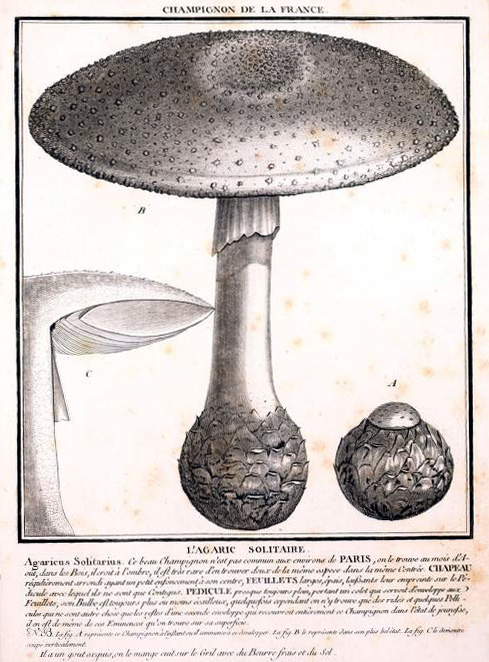
≡ Agaricus solitarius Bull. 1780-1781. Herb. France 1: pl. 48.
≡ Agaricus solitarius Bull. : Fr. 1821. Syst. Mycol. 1: 17.
≡[ Agaricus] " Amanita" solitaria (Bull. : Fr.) Secr. comb. inval. 1833. Mycogr. Suisse 1: 14, no. 12. [Publication in designated rank of suppressed work. ICBN §32.8, App. V]
≡Amanita solitaria Mérat nom. illeg. 25 July - 6 August 1836. Nouv. Fl. Envir. Paris, 4me ed. 1: 121. [Replacement for validly published name. ICBN §52.1]
≡ Venenarius solitarius (Bull. : Fr.) Murrill. 1912. Mycologia 4: 240.
≡ Aspidella solitaria (Bull. : Fr.) E.-J. Gilbert. 1940. Iconogr. Mycol. (Milan) 27, suppl. 1 (1): 79, tab. 58 (figs. 3-5).
≡ Amanita procera Pers. nom. illeg. 1818. Trait. Champ. Comest.: 186. [Replacement for validly published name. ICBN §52.1] non Amanita procera (Scop. : Fr.) Fr. nom. inval. 1836a. Anteckningar Sverige växande ätliga Svamp.: 33. [per Pennycook ( 2003: 120.] [Posterior homonym. ICBN §53.1] ≡ Agaricus procerus Scop. 1772. Fl. Carniola 2: 418. ≡ Agaricus procerus Scop. : Fr. 1821. Syst. Mycol. 1: 20. ≡Lepiota procera (Scop. : Fr.) P. Kumm. 1871. Führer Pilzk.: 135. ≡Lepiotophyllum procerum (Scop. : Fr.) Locq. 1942. Bull. Mens. Soc. Linn. Lyon 11: 40. ≡Macrolepiota procera (Scop. : Fr.) Singer. 1946. Papers Mich. Acad. Sci. Arts Letters 32: 141.
=Agaricus aculeatus Vitt. 1832. Descr. Funghi Manger.: 62. non Agaricus aculeatus Vitt. 1835. Descr. Funghi Manger.: 348. non Amanita aculeata (Quél.) Bigeard & Guill. [See below.]
=Amanita strobiliformis var. aculeata Quél. 1886. Enchir. Fung.: 3. ≡ Amanita strobiliformis subsp. aculeata (Quél.) Sacc. 1887. Syll. Fung. 5: 15. ≡ Amanita aculeata (Quél.) Bigeard & Guill. 1913. Fl. Champ. Supér. France: 44. non Agaricus aculeatus Vitt. 1832. Descr. Funghi Manger.: 62.
= Agaricus echinocephalus Vitt. 1835. Descr. Funghi Manger.: 346. [Name change of Hypophyllum tricuspidatum.] ≡ Amanita echinocephala (Vitt.) Quél. 1872. Mém. Soc. Emul. Montbéliard 2(5): 321. ≡ Lepiota echinocephala (Vitt.) Gillet. 1874. Champ. (Hyménomyc.) Croiss. France: 69. ≡ Amanita echinocephala (Vitt.) Gillet. 1884 (February). Tabl. Anal. Hyménomyc.: 7. [Superfluous combination.] ≡ Lepidella echinocephala (Vitt.) E.-J. Gilbert. 1925. Bull. Trimestriel Soc. Mycol. France 41: 304. ≡ Aspidella echinocephala (Vitt.) E.-J. Gilbert. 1940. Iconogr. Mycol. (Milan) 27, suppl. 1 (1): 79. ≡ Armillaria echinocephala (Vitt.) Locq. 1952. Bull. Trimestriel Soc. Mycol. France 68: 167. ≡Amanita umbella var. echinocephala (Vitt.) Quél. 1886. Ench. Fung.: 4. ≡ Amanita vittadinii var. echinocephala (Vitt.) Veselý. 1933. Ann. Mycol. 31(4): 285. ≡ Fungus tricuspidatus Paulet nom. inval. 1793. Trait. Champ. Comest. 2: index [7]. ≡ Hypophyllum tricuspidatum Paulet nom. inval. 1812-1835. Iconogr. Champ.: pl. 163 (fig. 3). [Devalidated name. The name Amanita Pers. is conserved against Amanita Boehm. of which Hypophylum is an isonym. (Donk. 1962. Beih. Nova Hedwigia 5: 145.)]
=Amanita echinocephala var. bicollariata Boud. 1904. Iconogr. Mycol. 3(11): pl. 298. ≡ Amanita umbella var. echinocephala f. bicollariata (Boud.) E.-J. Gilbert. 1918. Gen. Amanita Pers.: 101. ≡Lepidella echinocephala f. bicollariata (Boud.) Konrad & Maubl. 1926. Icon. Select. Fung. 1(2): 38??. ≡ Amanita solitaria subf. bicollariata (Boud.) Neville & Poumarat. 1996. Doc. Mycol. 26(101): 68.
??=Amanita flandinia Plée. 1844-64. Types Fam. Genres Pl. France 2:(57): [93], pl. 12.
The editors of this site owe a great debt to Dr. Cornelis Bas
whose famous cigar box files of Amanita nomenclatural information
gathered over three or more decades were made available to RET for computerization
and make up the lion's share of the nomenclatural information presented on this site.
|
| MycoBank nos. |
154194, 148216, 495474, 284332, 495108, 211344, 461720, 520266, 504595, 263721, 281963, 284322, 292694, 137290, 355837, 508868 |
| GenBank nos. |
Due to delays in data processing at GenBank, some accession numbers may lead to unreleased (pending) pages.
These pages will eventually be made live, so try again later.
|
| lectotypes |
Agaricus solitarius & Amanita procera—Bulliard. 1780. Herb. France: pl. 48.
Fungus tricuspidatus & Amanita echinocephala—Paulet. 1812-1835. Iconogr. Champ.: pl. 163 (fig. 3).
Amanita strobiliformis var. aculeata—Quélet. 1872. Mém. Soc. Emul. Montbéliard II 5: pl. 1, fig. 1. |
| lectotypifications |
Agaricus solitarius, Agaricus echinocephalus, Amanita procera, Fungus tricuspidatus, & Amanita strobiliformis var. aculeata—Bas. 1969. Persoonia 5: 394. |
| revisions |
Bas. 1969. Persoonia 5: 394, figs. 102-106.
Neville and Poumarat. 1996 Doc. Mycol. 26(101): 42. |
| selected illustrations |
Neville and Poumarat. 1995. Bull. Semestriel Féd. Assoc. Mycol. Médit. 7-8: figs. 6-8. |
| intro |
The following text may make multiple use of each data field.
The field may contain magenta text presenting data from a type study
and/or revision of other original material cited in the protolog of the present taxon.
Macroscopic descriptions in magenta are a combination of data from the protolog and
additional observations made on the exiccata during revision of the cited original
material.
The same field may also contain black text, which is data from a revision of the present
taxon (including non-type material and/or material not cited in the protolog).
Paragraphs of black text will be labeled if further subdivision of
this text is appropriate.
Olive text indicates a specimen that has not been
thoroughly examined (for example, for microscopic details) and marks other places in the text
where data is missing or uncertain.
The following material is derived from the revision of Bas (1969).
Bas (1969): Basidiomes medium to very large. |
| pileus |
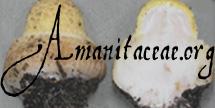
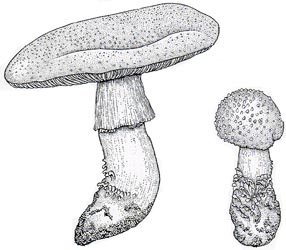
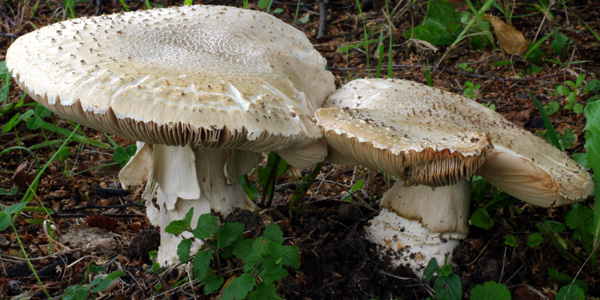
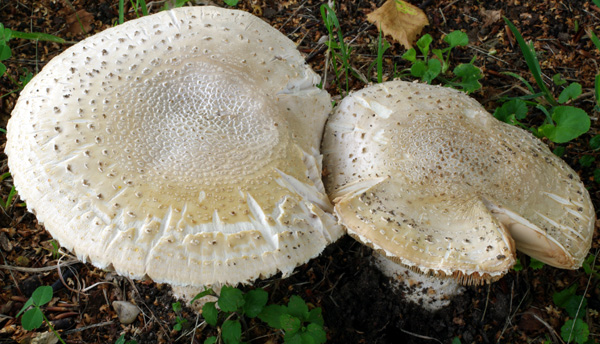
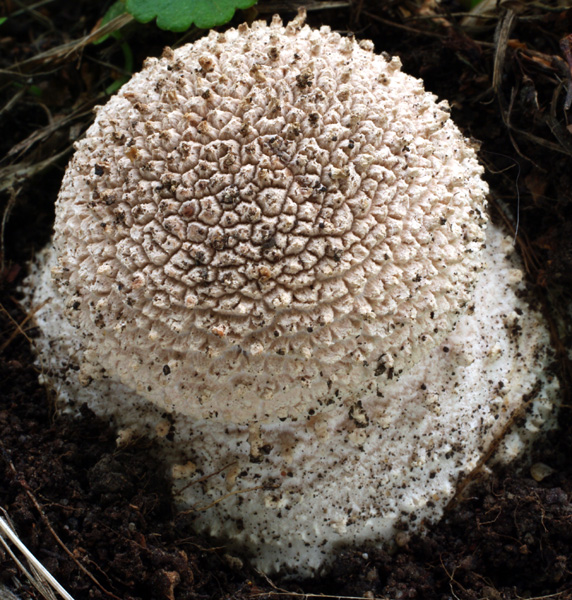
Bas (1969): (50-) 70 - 160 (-200) mm wide, sordid white to sordid cream to pale silvery gray to pale brownish gray especially toward center (sometimes with slightly greenish tinge), with age sometimes becoming pale brownish straw yellow, globose at first, convex when expanding, soon plano-convex to planar with slightly depressed disc, having subfelted appearance over disc to minutely fibrillose toward margin, becoming smooth in age, dry to subviscid; context rather firm, white except cream just below pileipellis; margin nonstriate, slightly appendiculate in young material, projecting; universal veil usually as small warts, 0.5 to 3 mm high, whitish to concolorous with pileus surface or slightly darker gray, acute-conic to low conic, subfibrillose, adnate to subdetersile, sometimes becoming small scattered flocculent fragments toward margin or completely washed away by rains. |
| lamellae |
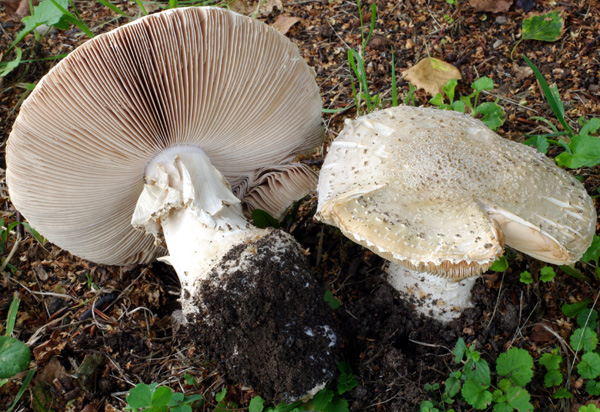
Bas (1969): narrowly adnate to barely free, sometimes with decurrent lines at top of stem, rather crowded, greenish cream-yellow (Séquy 220) in side view, with age becoming brownish straw yello, up to about 15 mm broad, ventricose, with whitish minutely granular edge; lamellulae subtruncate to more or less attenuate, often with proximal part of edge very irregular. |
| stipe |
Bas (1969): (60-) 100 - 140 (-200) × (10-) 15 - 25 (-30) mm, whitish to pale straw yellow, darker yellow spots at base, usually narrowing upward, sometimes subcylindric, longitudinally sulcate-striate above partial veil, appressed fibrillose to fibrillose-subsquamulose below; bulb clavate to clavate-fusiform to fusiform to napiform, pointed to rounded, up to 60 × 40 mm, often with more or less concentric rows of scales (ascending. appressed or recurved, rather thick, up to 3 mm wide) on upper part, sometimes simply squamulose; context solid, white, rather firm; partial veil pendent, subfelted-membranous, apical to subapical, up to 25 mm broad, white when young, straw yellow with age, striate above, fibrillose to cottony with with thick warts along the edge below; universal veil [probably to be found on tips of scales on bulb—ed.]. |
| odor/taste |
Bas (1969): Odor "moderately strong, unpleasant, subraphanoid with chemical component." Taste indistinct. |
macrochemical
tests |
none recorded. |
| pileipellis |
Bas (1969): not or slightly gelatinized near surface; filamentous hyphae 2 - 8 μm wide, interwoven to subradially arranged, colorless to pale brown. |
| pileus context |
not described. |
| lamella trama |
Bas (1969): bilateral[, divergent], without terminal inflated cells. |
| subhymenium |
Bas (1969): ramose or with irregularly inflated cells. |
| basidia |
Bas (1969): 40 - 60 × 11 - 13 μm, usually 4-sterigmate, sometimes 1-, 2-, or 3-sterigmate; clamps present. |
| universal veil |
Bas (1969): On pileus: with elements more or less anticlinally arranged, dingy yellowish to pale yellow-brown in alkaline solution, sometimes with distinct brownish intracellular pigment; filamentous hyphae parallel, rare to rather abundant, most abundant in base of warts; inflated cells abundant, in parallel chains, mainly ellipsoid to clavate (most abundant in tops of warts), also subglobose or elongate or irregular, up to 110 × 60 μm; vascular hyphae scattered to rather abundant. |
| stipe context |
Bas (1969): longitudinally acrophysalidic; filamentous hyphae 2 - 10 μm wide, yellowish to deep golden yellow in alkaline solution; acrophysalides abundant, up to 400 × 60 μm; vascular hyphae scattered to abundant. |
| partial veil |
not described. |
| lamella edge tissue |
Bas (1969): filamentous hyphae 4 - 12 μm wide; inflated cells in tufts, slenderly to broadly clavate, pyriform, or irregularly shaped.
RET: sterile. |
| basidiospores |
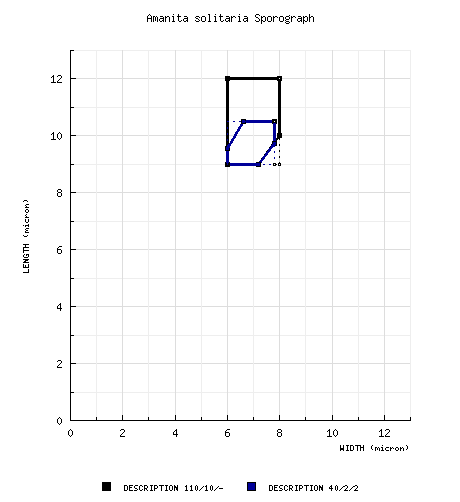
Bas (1969): [110/10/-] 9.0 - 12.0 (-14.5) × 6.0 - 8.0 (-11.5) μm, (Q = 1.25 - 2.0; Q = 1.30 - 1.75), hyaline, colorless, thin-walled, amyloid, ellipsoid to elongate, infrequently broadly ellipsoid, infrequently cylindric; apiculus not described; contents subgranular, somewhat refractive; white to cream with greenish tint in deposit when fresh, dingy cream without greenish tint when dry (slightly more cream yellow than 5Y 8/4).
composite of all material revised by CRC: [40/2/2] (8.5-) 9.0 - 10.5 (-11.0) × (5.0-) 6.0 - 7.8 (-8.0) μm, (L = 9.9 μm; L' = 9.9 μm; W = 6.7 - 7.4 μm; W' = 7.1 μm; Q = 1.25 - 1.59 (-1.73); Q = 1.33 - 1.48; Q' = 1.40), ??, amyloid, ellipsoid to elongate, infrequently broadly ellipsoid, adaxially flattened; apiculus ??; contents granular and/or mono- to (infrequently) multi-guttulate; color in deposit not recorded. |
| ecology |
Bas (1969): Solitary to gregarious. Terrestrial in woods on heavy calcareous or neutral soils in Europe, except the northern part, with preference for alluvial soils, fruiting especially in warm, dry summers.
Czech Republic: In a garden near Betula, Fagus, Picea, and Tilia. Switzerland: At 450- - 500+ m. Under Picea, Abies, and Fagus or under Fagus and Picea. |
| material examined |
Bas (1969):
AUSTRIA: Ca. Vienna, s.d. Hagenbrünn s.n. (PR).
CROATIA: Dalmatian Islands, Isl. Ugljan, 25.xi.1964 M. Tortič s.n. (fragments in L).
CZECH REPUBLIC: CENTRAL BOHEMIAN REGION—Karlštejn, 5.ix.1952 S. Indelka s.n. (PR). ÚSTÍ NAD LABEM REGION—Libochovice nad Ohři, 19.ix.1961 Z. Neubauer s.n. (PR).
FRANCE: OISE—Orry-la-Ville, viii.1949 H. Romagnesi s.n. (S). PYRÉNÉES ORIENTALES—ca. Perpignan, 11.xi.1966 A. Marchand s.n. (L).
ITALY: TRENTO—Vela, NW of Trento, vi.1901 G. Bresadola s.n. (S). TUSCANY—Isl. Elba - Porteferraio, x.1913 Gabari s.n. (S).
NETHERLANDS: UTRECHT—Utrecht, 31.viii.1953 C. Bas 150 (L), 18.ix.1953 C. Bas 206 (L); Zeist, 17.ix.1953 O. F. Uffelie et al. (in herb. Uffelie).
SLOVAKIA: Saudorf ca. Bratislava, 12.ix.1948 F. Drascla s.n. (PR).
U.K.: ENGLAND—Surrey - Horseley, 6.ix.1953 R. W. G. Dennis s.n. (L).
Zhang et al. (2004) voucher for sequencing: GERMANY: UNKN. STATE—unkn. loc., s.d. unkn. coll. s.n. (HKAS 31459).
RET: CZECH REPUBLIC: CENTRAL BOHEMIAN REGION—Čelákovice, 23.vii.2009 Josef Kadeřávek s.n. [Borovička BORE 40] (PRM 915810; RET 455-3).
FRANCE: GIRONDE—Madirac, 29.viii.1999 Francis Massart 99023 (in herb. F. Massart; RET 298-1).
SWITZERLAND: ZÜRICH—Zürich, 25.viii.1991 Carmine Lavorato 910825--- (in herb. C. Lavorato; RET 033-5), 20.x.1991 C. Lavorato 910927-23 (in herb. C. Lavorato; RET 036-5), 10.ix.1992 C. Lavorato 920910-02 (in herb. C. Lavorato; RET 079-3). |
| citations |
—R. E. Tulloss and C. Rodríguez Caycedo |
| editors |
RET |
|



 Spore data sets and their composite