| name |
Amanita rubescialba |
| author |
Coker. 1917.
J. Elisha Mitchell Scient. Soc. 33(1/2): 62, pl. 67.
[Misapplication of species name to a North American
rubescent taxon.]
≡Amanita rubescialba Tulloss, K. W. Hughes et al. nom. prov. |
| name status |
nomen provisorum |
| english name |
"Eastern American White Blusher" |
| synonyms |
≡Amanita rubescens f. alba (Coker) Sartory & L. Maire. 1922. Compend. Hymenomyc.—Amanita [citation of this work is inconsistent??] ?: 311. [Probably not applied to the North American taxon.]
≡ Amanita rubescens f. alba (Coker) A. G. Parrot sensu A. G. Parrot comb. inval. 1960. Amanites S.-O. France: 89, fig. [Lacking full and direct reference to basionym ICBN §33.2] [Probably not applied to the North American taxon. Illustration somewhat suggestive of Amanita novinupta.]
The editors of this site owe a great debt to Dr. Cornelis Bas
whose famous cigar box files of Amanita nomenclatural information
gathered over three or more decades were made available to RET for computerization
and make up the lion's share of the nomenclatural information presented on this site.
|
| MycoBank nos. |
172158, 508881 |
| GenBank nos. |
Due to delays in data processing at GenBank, some accession numbers may lead to unreleased (pending) pages.
These pages will eventually be made live, so try again later.
|
| lectotypes |
NCU |
| lectotypifications |
Tulloss. 2005a. Mycologia 92: 480 [footnote 8]. |
| revisions |
Tulloss, here |
| intro |
The following text may make multiple use of each data field.
The field may contain magenta text representing a type study
or a study of original material by Tulloss.
The same field may also contain black text, which will represent a revision of the
species by Tulloss. Paragraphs of black text will be labeled if further subdivision of
this text is appropriate.
Olive text indicates a specimen that has not been
thoroughly examined (for example, for microscopic details) and marks other places in the text
where data is missing or uncertain.
The following is based upon original research by R. E. Tulloss. |
| pileus |
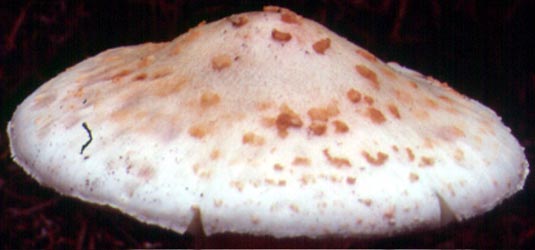
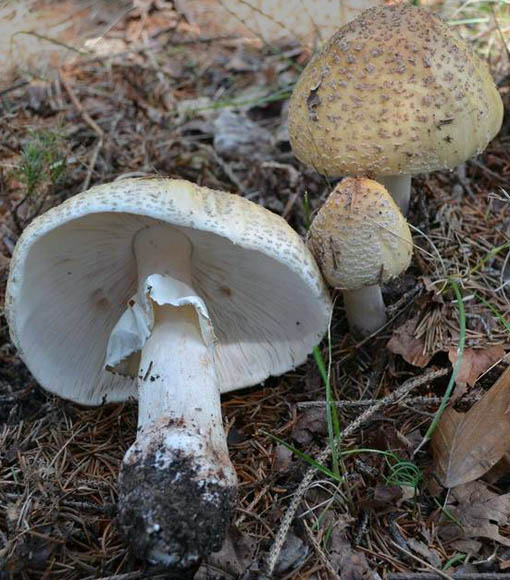
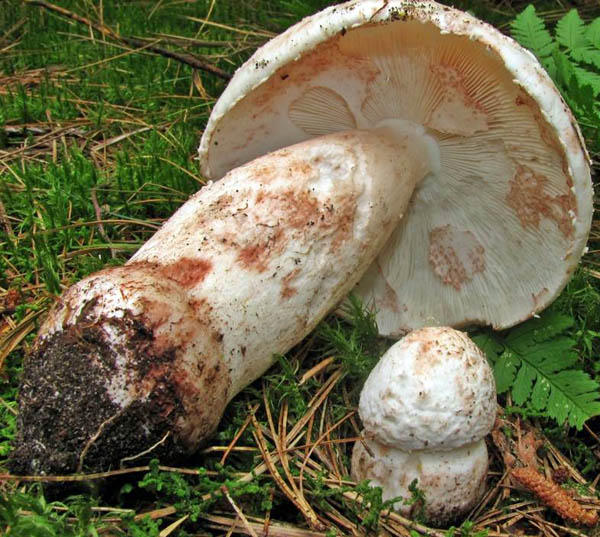
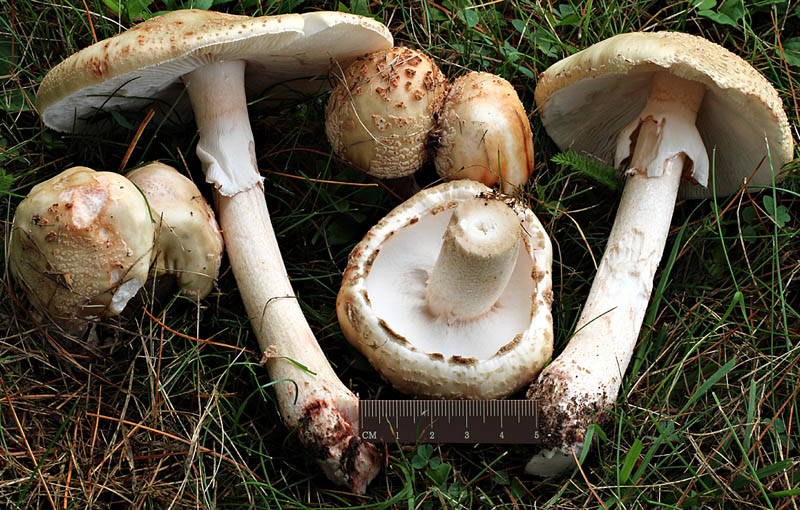
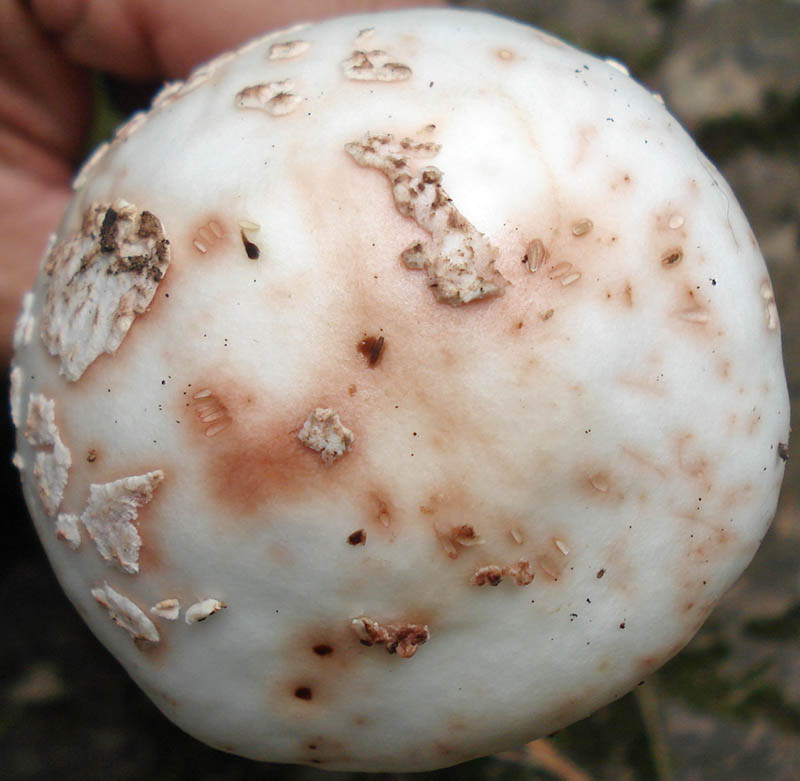
95 - 120 mm wide, entirely white (at first) to pale cream, at first taking on pale pink to pale brick to pink-ochre (e.g., ca. 6A3 or ca. 7.5 YR 6/6) tints, bruising reddish brown, broadly rounded campanulate, becoming planoconvex and umbonate with slightly decurved margin, viscid to tacky, dull to subshiny to shiny (when dry); context white, bruising as on surface or brick red, 9 - 11.5 mm thick, thinning evenly to margin; margin nonstriate to faintly striate, becoming rimose, sometimes appendiculate with fragments of partial veil; universal veil absent or as scattered cream to pale yellow-cream warts, staining reddish-brown (e.g., ca. 7B4 to ca. 7C8), flat to pyramidal, often developing raised edges, sometimes (at first) with web-like radial(?) filaments attached to pileipellis. |
| lamellae |
free to narrowly adnate, often with decurrent line on stipe apex, rather close to crowded, white to pale cream in mass, white to very pale cream in side view, staining as in remainder of basidiome or more brown, sometimes becoming light ochraceous when bruised, 3.5 - 8 mm broad, of even width for most of length, sometimes forking; lamellulae subtruncate to rounded truncate to attenuate. |
| stipe |
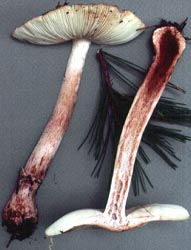
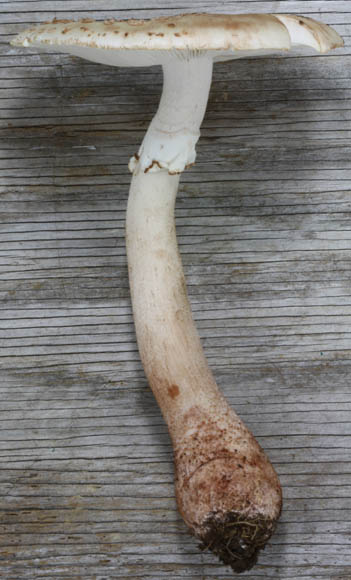
60 - 137 × 16 - 19 mm, white to cream to yellow-white, bruising pink-ocher to red to wine-colored to reddish brown, narrowing upward, flaring (sometimes only slightly) at apex, surface somewhat satiny above annulus, longitudinally striatulate below partial veil, often eventually with some raised fibrils; bulb 27 - 39 × 22 - 31 mm, subglobose to subclaviform to ovoid to broadly fusiform, with white mycelium; context fibrous, solid to firmly stuffed, sometimes with hollow spots, white, reddish to reddish brown to brick red where bruised, somewhat brownish wine-colored in larva tunnels, with central cylinder 4 mm wide; partial veil delicate, fragile, thin, membranous, apical to subapical to superior, white to pale sulfur yellow and striate above, white to sulfur yellow and floccose-fibrillose below, skirt-like, becoming shredded; universal veil absent or as small faint warts in narrow band just above bulb or as submembranous detersile patch(es) up to 22 × 16 mm easily left in substrate, whitish at first, bruising as in the remainder of the basidiome, with subfloccose to verruculose surface, not mentioned in protolog except to attribute some staining on stipe to "action" of the "volva." |
| odor/taste |
Odor none to faint to somewhat piney
(Tulloss 8-24-85-A). Taste not recorded
or lacking. |
macrochemical
tests |
Spot test for tyrosinase (L-tyrosine) - positive in stipe (only tissue tested). Test voucher: ??. POISONOUS: Causes gastrointestinal distress when ingested raw. |
| lamella trama |
bilateral; wcs = 40 µm (moderately well rehydrated); with subhymenial base largely comprising uninflated hyphal segments; filamentous, undifferentiated hyphae 2.8 - 7.5 µm wide, thin-walled; divergent, terminal, inflated cells ?; vascular hyphae ? µm wide, ?. |
| subhymenium |
wst-near = ? μm;
wst-far = ? μm; pseudoparenchymatous (cellular), with 3 to 4 cells between bases of longest basidia/-oles and subhymenial base[?], with the 2 or 3 cells closest to basidia having major axis perpendicular to central stratum, ?. |
| basidia |
29 - 40 × 7.0 - 11.2 µm, dominantly 4-, but also
2-sterigmate, thin-walled; clamps not observed. |
| partial veil |
filamentous, undifferentiated hyphae 2.0 - 11.0 µm wide, forming robust radially oriented fascicles, dominating, with walls thin or up to 0.8 µm thick, occasionally with intercalary inflated (fusiform to crescent-shaped) segment up to 32 µm wide, in many regions frequently septate, frequently branching, sometimes sinuous; inflated cells terminal, singly or in short chains, very plentiful throughout the tissue, with walls thin or up to 0.8 µm thick, clavate to narrowly clavate to subfusiform and then occasionally rostrate (up to 82 × 20 µm), ellipsoid (e.g., 36 × 16.0 µm), broadly clavate to broadly ellipsoid to subglobose (up to 48 × 32 µm); vascular hyphae 3.5 - 9.5 µm wide, uncommon to rare. |
| basidiospores |
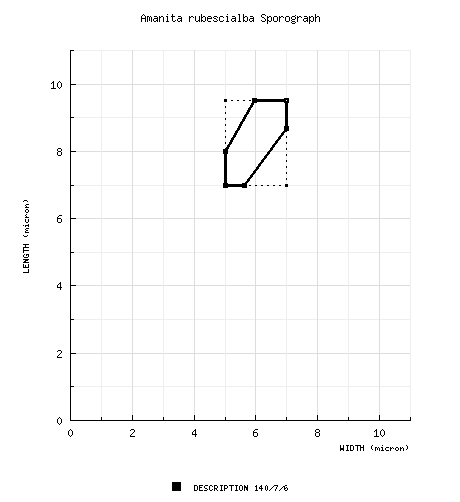
RET/CRC: [140/7/6] (6.5-) 7.0 - 9.5 (-10.2) × (4.5-)
5.0 - 7.0 (-8.5) µm, (L = 7.6 - 9.0 µm;
L’ = 8.2 µm; W = 5.5 - 6.7 µm;
W’ = 5.9 µm; Q = (1.12-) 1.24 - 1.60 (-1.69);
Q = 1.34 - 1.49; Q’ = 1.40),
hyaline, colorless, thin-walled, smooth, amyloid,
broadly ellipsoid to ellipsoid, occasionally
elongate, rarely subglobose, adaxially flattened;
apiculus sublateral, cylindric, rather small;
contents granular to monoguttulate; white in
deposit. |
| ecology |
Solitary to scattered. Québec: At ca. 80 m
elev. Under
conifers. Maine: In grass under
Quercus. New Jersey: In sand
under duff of grassy area with Pinus rigida
and having Quercus marilandica, Q.
prinus, and Smilax glauca as scrub
nearby. North Carolina: Under
Quercus. Pennsylvania: At 240-400 m
elev. In lawn with Quercus or in forest
with Tsuga canadensis, Quercus, and
Betula. |
| material examined |
CANADA:
QUÉBEC—Boisé des
Compagnons-de-Cartier [46.7576°” N/
71.3275°” W, 82 m], 17.viii.2013 Claude
Kaufholtz-Couture CKC0112 (RET 567-2, nrITS & nrLSU
seq'd.).
U.S.A.:
CONNECTICUT—Middlesex Co. - E. Haddam,
Devil's Hopyard St. Pk. [41°28’32” N/ 72°20’25” W,
72 m], 4.ix.2011 Djerba Goldfinger s.n. [Tulloss
9-4-11-O] (RET 488-4, nrITS seq'd.).
INDIANA—Henry Co. - Summit Lake St. Pk.
[40°00’53.46” N/ 85°18’50.95” W, 330 m],
22.viii.2012 Stephen Russell s.n. (RET 531-2,
nrITS & nrLSU seq'd.).
IOWA—Decatur Co. - Woodland Twp.,
Pony Farm Rd., 24.vi.2013 Sibylla Brown s.n. (RET
544-8, nrITS & nrLSU seq'd.).
MAINE—Lincoln Co. - Camden, Camden Hills
St. Pk., ix.2008 Wm. Bakaitis s.n.
(RET 559-7, nrITS & nrLSU seq'd.). York Co. -
Kennebunkport, Franciscan Monastery [43.353° N/
70.4757° W, 0m], 11.vii.2013 Linus Kudzma LVK13119
[mushroomobserver
#140547]
(RET 553-1, nrITS & nrLSU seq'd.).
MISSOURI—Lincoln Co. - Cuivre River St.
Pk. [39.035° N/ 90.9328°W, 189 m], 11.viii.2013
P. Harvey s.n. [mushroomobserver
#142353]
(RET 560-4, nrITS
& nrLSU seq'd.).
Newton Co. - Neosho, Fort Crowder Conservation Area
[36.8167° N/ 94.3061° W, 370 m], 19.viii.2013 Jon
Shaffer s.n. [mushroomobserver
#143297]
(RET 563-3, nrITS & nrLSU seq'd.).
St. Charles Co. - Welden Springs
[38.69° N/ 90.715° W, 200 m], 30.vi.2013 Patrick
Harvey s.n. [mushroomobserver
#138174]
(RET 545-2, nrITS & nrLSU seq'd.), 29.viii.2014 P.
Harvey s.n. [mushroomobserver
#175588]
(RET 637-4, nrITS & nrLSU seq'd.), 29.viii.2014 P.
Harvey s.n. [mushroomobserver
#175587]
(RET 637-5, nrITS & nrLSU seq'd.).
St. Louis Co. - La Barque Crk.
Conservation Area, 17.vi.2013 Patrick Harvey s.n.
[mushroomobserver
#136632]
(RET 539-7, nrITS & nrLSU seq'd.).
NEW JERSEY—Middlesex Co. - Jamesburg
Twp. Pk., ca. Helmetta [40°23’07” N/ 74°25’48” W],
12.viii.1981 R. E. Tulloss 8-12-81-B (RET 106-7),
22.viii.1981 Mary A. King,
D. C., M. H. & R. E. Tulloss [Tulloss
8-22-81-D] (RET 321-8), 24.viii.1985 R. E. Tulloss
8-24-85-A (RET 099-6), 26.ix.1987 D. C. Tulloss
s.n. [R. E. Tulloss 9-26-87-AD] (NYS).
Monmouth Co. - Assunpink Wildlife Mgmt. Area
[40°12’36” N/ 74°28’42” W], 6.vii.1983 M. A. King
& R. E. Tulloss 7-6-83-B (RET 218-5);
Roosevelt, lawn of public school [40°12’49” N/
74°28’19” W, 70-105 m], 2.ix.1999 R. E. Tulloss
9-2-99-D (RET 295-10; nrITS & nrLSU seq'd.),
2.vii.2013 Naomi Goldman s.n. (RET 542-10, nrITS
& nrLSU seq'd.).
Somerset Co. - Bernardsville,
23.vii.1984 R. Miller & Dorothy Smullen s.n.
[Tulloss 7-23-84-RMDS2] (RET 059-5).
NEW YORK—Madison Co. - unkn. loc.,
11.ix.2010 Eric Smith s.n. (RET 482-6, nrITS & nrLSU
seq.d.).
Oneida Co. - unkn. loc.,
4.vii.2013 Eric Smith s.n. [mushroomobserver
#138653]
(RET 597-6, nrITS seq'd.).
NORTH
CAROLINA—Orange Co. - Chapel Hill, Battle’s
Grove, 3.vii.1916 W. C. Coker 2355 (lectotype,
NCU). Unkn. Co. - "by road to Scott’s Hole,"
3.vii.1916 H. R. Totten s.n. [W. C. Coker 2346]
(paratype, NCU).
OHIO—Preble Co. - Israel Twp., Hueston
Woods St. Pk., sect. 24, Maple Grove picnic area,
27.vii.1992 M. A. Vincent 5609 (F; MU f39216;
RET 121-4, nrITS & nrLSU seq'd.; XAL).
PENNSYLVANIA—Allegheny Co. - McCandless
Twp., North Park, Devil's Elbow [40.5860° N /
79.9967° W, 357 m], 21.ix.2013 Ann
F. Berger s.n. [WPMC 20130921-62] (RET 567-8, nrITS
& nrLSU seq'd.).
Clarion Co. - Miola-Bigley,
St. Game Lands No. 72, [41.2302° N/ 79.2862° W,
368 m], 6.viii.2011 NAMA2011 participant s.n.
[Tulloss 8-6-11-H] (RET 478-1, nrITS & nrLSU
seq'd.).
Luzerne Co. - Moon Lake Pk. [41.253º N/
76.047º W, 240-400 m], 30.vi.2013 David Wasilewski
s.n. [mushroomobserver
#138348]
(RET 549-5, nrITS seq'd.);
Rickett's Glen St. Pk. [41º18’12” N/
75º35’09” W] 12.vii.2013 D. Wasilewski s.n.
[mushroomobserver
#139759]
(RET 549-6, nrITS &
nrLSU seq'd.).
Northhampton Co. - Delaware Water
Gap-Slateford Loop, Arrow Island Trail [40.94820°
N/ 75.11970° W, 177 m], 4.viii.2012 Buxton s.n.
[Tulloss 8-4-12-E] (RET 505-8, nrITS seq'd.).
Pike Co. - Dingmans Ferry, Pocono Educ. &
Environmental Ctr., Two Ponds Tr. & Scenic
Gorge Tr. [41.17090° N/ 74.91459° W, 236 m],
3.viii.2012 Owen C. Tulloss s.n. [Tulloss 8-3-12-A]
(RET 505-3, nrITS & nrLSU seq'd.).
TENNESSEE—Jackson Co. - Cummins Falls St. Pk. [36°14'51.40" N/ 85°34'16.00" W], 28.vi.2013 unkn. coll. s.n. [TFB 14261] (TENN 068119, nrITS seq'd.). Sevier Co. - ca. Gatlinburg, GSMNP, Alum Cave trailhead [35°37?48” N/ 83°27?04” W, 1190 m], 13.vii.2004 David P. Lewis s.n. [Tulloss 7-12-04-J] (RET 375-1; nrITS & nrLSU seq'd.).
TEXAS—Newton Co. - Bleakwood, Co. Rd
3062, Lewis prop. [30°42.509’ N/ 93°49.630’ W],
29.ix.2009 David P. Lewis 9332 (RET 462-2; nrLSU
seq'd.); Newton, Newton Courthouse lawn, 23.vi.2000
D. P. Lewis 6297 (RET 364-2, nrITS & nrLSU seq'd.).
|
| discussion |
Some rubescent specimens found in South Carolina
[e.g., Tulloss 7-19-86-B (RET 079-5)] have had a
yellowish underside to the partial veil—indicating
that the universal veil was originally yellow.
Although this material had a white cap margin, its
nrITS sequence does not match those of collections
presently assigned to this taxon. This
genetically distinct taxaon is listed as
A.
aureosubucula on this site.
A comparison of the sporographs of the two species
is provided below:
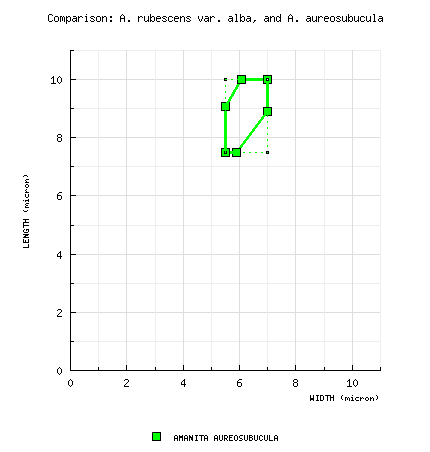
One collection of another genetically distinct species that is white and rubescent has been sent to us from Missouri. This species is called A. ostendemihi in these pages. There follows a sporograph comparison for this species and the present one:
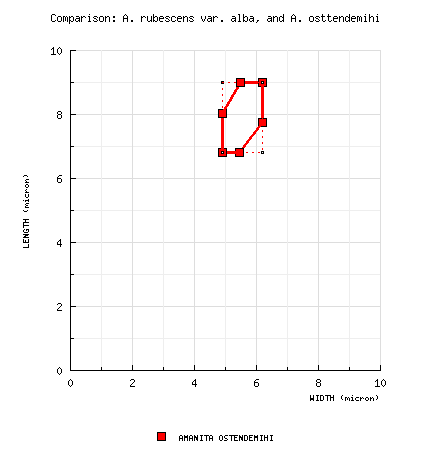
The present taxon is distinct at species rank from the following: A. rubescens of Europe, A. brunneolocularis of the Americas, and A. novinupta, which was described from North America. It should not be assumed that the present taxon is conspecific with any of the undescribed taxa of the Americas that have been called A. rubescens incorrectly in the past. Preliminary genetic studies show that there are at least four additional rubescent taxa in eastern North America which lack names. At present these are all treated under A. amerirubescens on this site.
During the molecular studies of rubescent taxa in collaboration with K. W. Hughes, this taxon was briefly called "A sp-amerirubescens03." |
| citations |
—R. E. Tulloss and C. Rodríguez Caycedo |
| editors |
RET |
|



 Spore data sets and their composite