| name |
Amanita congolensis |
| author |
Tulloss, B. E. Wolfe, K. W. Hughes, Kudzma &
D. Arora in Tulloss et al.
2015.
Amanitaceae 1(2): 2. |
| name status |
nomen acceptum |
| synonyms |
≡ Amanita rubescens var. congolensis Beeli. 1935. Fl. Champ. Congo 1: 20, pl. 3 (fig. 4).
The editors of this site owe a great debt to Dr. Cornelis Bas
whose famous cigar box files of Amanita nomenclatural information
gathered over three or more decades were made available to RET for computerization
and make up the lion's share of the nomenclatural information presented on this site.
|
| MycoBank nos. |
517344 |
| GenBank nos. |
Due to delays in data processing at GenBank, some accession numbers may lead to unreleased (pending) pages.
These pages will eventually be made live, so try again later.
|
| holotypes |
BR (implicit) |
| selected illustrations |
E.-J. Gilbert. 1940. Iconogr. Mycol. (Milan) 27, suppl.: tab. 42 (fig. 3).
Buyck. 1994. Ubwoba: figs. 56-57. |
| intro |
The following text may make multiple use of each data field.
The field may contain magenta text presenting data from a type study
and/or revision of other original material cited in the protolog of the present taxon.
Macroscopic descriptions in magenta are a combination of data from the protolog and
additional observations made on the exiccata during revision of the cited original
material.
The same field may also contain black text, which is data from a revision of the present
taxon (including non-type material and/or material not cited in the protolog).
Paragraphs of black text will be labeled if further subdivision of
this text is appropriate.
Olive text indicates a specimen that has not been
thoroughly examined (for example, for microscopic details) and marks other places in the text
where data is missing or uncertain.
The information below is derived from the protolog, from spore drawings of Gilbert (1940) and from original research of R. E. Tulloss. |
| pileus |
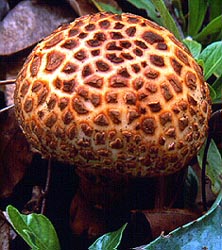
protolog: 100± mm wide, brown-red, convex to plano-concave; context thick, soft, white, reddening on exposure to air; margin smooth, nonstriate; universal veil as pyramidal warts. |
| lamellae |
protolog: free, white, acute at stipe end; lamellulae not described. |
| stipe |
protolog: 150± × 10 - 12 mm, cylindric, smooth, concolorous with pileus; bulb present; context as in pileus; partial veil superior, pendent, thin, brownish; universal veil ephemeral or not observed. |
| odor/taste |
protolog: Odor not recorded. Taste bitter. |
macrochemical
tests |
protolog: none recorded. |
| pileipellis |
protolog: filamentous hyphae "parallel" [subradial—ed.]. |
| lamella edge tissue |
sterile. |
| basidiospores |
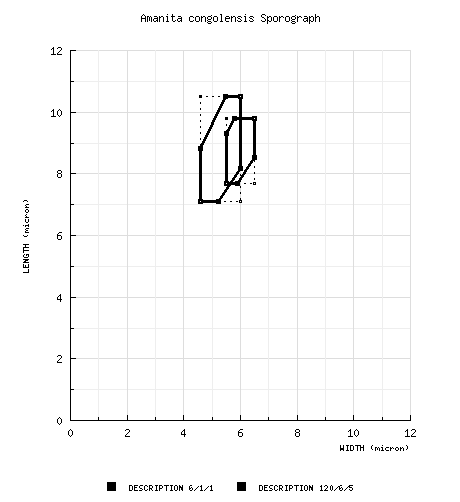
from type per Gilbert (1940): [6/1/1] 7.7 - 9.8 × 5.5 - 6.5 µm, (L = 8.6 µm; W = 5.9 µm; Q = 1.31 - 1.69; Q = 1.45).
composite of data from material revised by Tulloss: [120/6/5] (6.3-) 7.1 - 10.5 (-11.8) × (4.3-) 4.6 - 6.0 (-6.9) µm, (L = 7.5 - 9.5 µm; L’ = 8.6 µm; W = 5.0 - 5.6 µm; W’ = 5.3 µm; Q = (1.28-) 1.36 - 1.92 (-2.36); Q = 1.44 - 1.81; Q’ = 1.65), hyaline, colorless, smooth, thin-walled, amyloid, ellipsoid to elongate, infrequent broadly ellipsoid or cylindric, infrequently constricted, adaxially flattened; apiculus sublateral, cylindric; contents mono- or multiguttulate; ?? in deposit.
[Note: In the literature, the most reliable information concerning the spores of the type is derived from the text and illustrations (Tab. XXXIV, fig. 3) of Gilbert (1940 & 1941). The best size-shape information is derived from measuring the scale drawings of spores in the above cited figures. Of the six spores drawn from the holotype (fig. 3), all could be interpreted to be drawn in lateral view.—ed.] |
| ecology |
Democratic Republic of Congo: Solitary. On soil in forest.
Zimbabwe: In small groups. Under msasa (Brachystegia spiciformis). |
| material examined |
protolog: CONGO,
DEMOCRATIC REPUBLIC OF: PROV.
EQUATEUR—Territoire Lisala - Binga
[2°23'41" N/ 20°25'25" E, 361 m],
v.1927 M. Goossens-Fontana 616
(holotype, BR).
RET: TANZANIA: Iringa—Mafinga
- Mufindi Distr. [8.4026 ºS/ 35.1622º E, 1792 m],
3.iv.2016 Johann Harnisch TZ#106 [mushroomobserver
#242381]
(RET 742-7, nrITS & nrLSU seq'd.).
ZAMBIA: COPPER BELT
PROV.—off Kitwe-Ndola Rd., Greystone Farm,
14-24.xii.2000 D. Arora 00-384
(RET 346-6, nrITS seq'd.; SFSU).
NORTHERN
PROV.—Mpika Distr. - ca. Mpika, 22 km off
Great North Hwy., Mutinondo Wilderness,
31.xii.2000-7.i.2001 D. Arora
01-562 (RET 346-8; SFSU).
ZIMBABWE: HARARE
CITY—suburbs of Harare, Chisipite, 12.i.1999
David Arora 99-3 (RET 351-1, nrLSU seq'd.; SFSU); suburbs of
Harare, Chisipite, Springfield Close [17.9645° S/
31.7818° E, 1521 m],
10-13.xii.2000 D. Arora 00-302
(RET 346-4; SFSU), 26.xii.2000 D. Arora 00-443 (RET
347-6, nrITS seq'd.; SFSU). |
| discussion |
protolog: "This variety is very similar to the type from which it differs by its bitter taste."
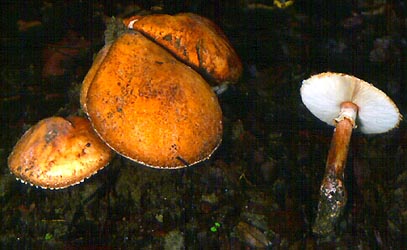
The material RET has reviewed is supplemented by photographs taken by the collector (David Arora). These show surface staining of the cap and stipe to be a brown-orange rather than a brown-red. The plate included in the protolog depicts a significantly older fruiting body with generally brown and darker coloration. The warts are shown as rather dark in age. This darkening is also viewed in Arora's photograph.
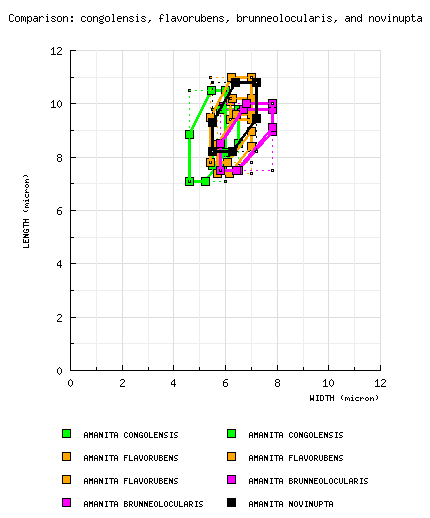
The spores of A. congolensis bear the narrowest spores among the known rubescent taxa as is illustrated by the following comparison sporographs:


|
| citations |
—R. E. Tulloss |
| editors |
RET |
|




 Spore data sets and their composite