
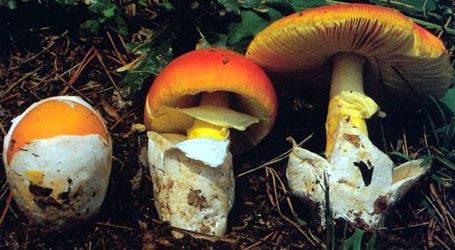

| name | Amanita novinupta |
| name status | nomen acceptum |
| author | Tulloss & J. Lindgr. |
| english name | "New Bride Blusher" |
| images |
![Amanita novinupta, Oregon or Washington [state], U.S.A.](/amanitaceae/assets/www-amanitaceae-org/novinu01-4a15a70502110d36.jpg "Amanita novinupta, Oregon or Washington [state], U.S.A.")  1. Amanita novinupta, Oregon or Washington [state], U.S.A. 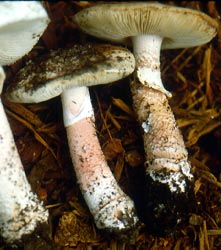 2. Amanita novinupta, holotype, Washington Co., Oregon, U.S.A. 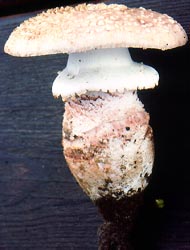 3. Amanita novinupta, Sta. Cruz Co., California, U.S.A. 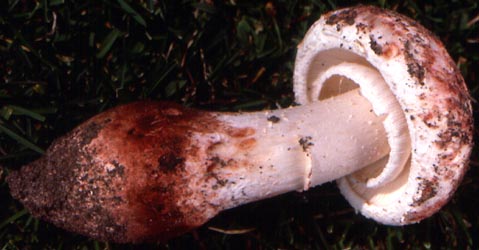 4. Amanita novinupta, Sta. Cruz Co., California, U.S.A. 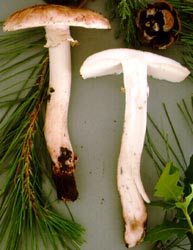 5. Amanita novinupta, Chiricahua Mtns., Cochise Co., Arizona, U.S.A. |
| intro | This species was formerly called "Amanita rubescens" in western North America's coastal states and provinces. It is distinct from the European and eastern North American taxa as well as other rubescent taxa known from the Americas north of and including Andean Colombia. |
| cap |
The blushing of the cap in this species seems to be below the surface at first, and appears to the viewer as if seen through a thin layer of frosted glass. For many years, this species was called "A. rubescens" in the western USA. This species occurs with oaks from the Pacific Northwest (see photo of holotype, above) of the USA to southeastern Arizona (image of sectioned fruiting body, above). |
| gills | The gills of this species are narrowly adnate to free, close to subcrowded to crowded, off-white to pale cream to pale grayish white in mass, more or less off-white to translucent white to pale sordid white to pale sordid cream in side view, becoming pinkish when bruised, and 3-11 mm broad. Short gills are truncate to rounded truncate, etc., of diverse lengths, and plentiful. |
| stem |
While a bulb on the stem is often apparent in young specimens, mature specimens often show little or no swelling at the base. |
| spores |
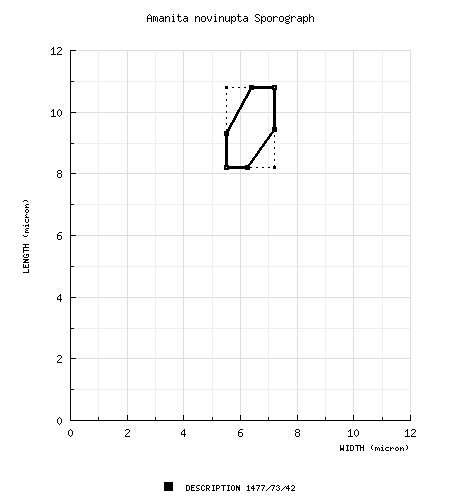
The spores measure (6.2-) 8.2 - 10.8 (-14.8) × (4.2-) 5.5 - 7.2 (-8.8) µm and are ellipsoid to elongate (rarely subglobose or cylindric) and amyloid. Clamps are rarely found at bases of basidia. |
| discussion |
There is one collection probably identifiable as this species from central Mexico. The species has been identified from the Canary Islands, Spain, growing with introduced trees. A very similar mushroom occurs with conifers in Norway, and European illustrations purporting to show A. rubescens Pers. : Fr. sometimes show a mushroom appearing to be A. novinupta. Studies on the white, rubescent European material are under way. The present species is not to be confused with A. rubescens var. alba Coker, a gracile eastern US taxon that is slower to bruise and does not have the distinctive blushing of the pileus seen in A. novinupta. For comparison with additional taxa see A. brunneolocularis; A. orsonii; and A. congolensis. For distinguishing between rubescent taxa in section Validae, refer to the Key to rubescent taxa in Amanita sect. Validae.—R. E. Tulloss & J. E. Lindgren |
| brief editors | RET |
| name | Amanita novinupta | ||||||||||||||||||||||||||||||||||||||||||||||||||||
| author | Tulloss & J. Lindgren. 1994. Mycotaxon 51: 181. | ||||||||||||||||||||||||||||||||||||||||||||||||||||
| name status | nomen acceptum | ||||||||||||||||||||||||||||||||||||||||||||||||||||
| english name | "New Bride Blusher" | ||||||||||||||||||||||||||||||||||||||||||||||||||||
| synonyms |
=Amanita rubescens sensu Thiers. 1982. Agaricales Calf. I.: 37, pl. 37A. The editors of this site owe a great debt to Dr. Cornelis Bas whose famous cigar box files of Amanita nomenclatural information gathered over three or more decades were made available to RET for computerization and make up the lion's share of the nomenclatural information presented on this site. | ||||||||||||||||||||||||||||||||||||||||||||||||||||
| etymology |
novus, "new" + nupta, "bride" [This Amanita "wears" white, has a veil, and blushes.] | ||||||||||||||||||||||||||||||||||||||||||||||||||||
| MycoBank nos. | 362224 | ||||||||||||||||||||||||||||||||||||||||||||||||||||
| GenBank nos. |
Due to delays in data processing at GenBank, some accession numbers may lead to unreleased (pending) pages.
These pages will eventually be made live, so try again later. Search:
Showing 1 to 9 of 9 entries | ||||||||||||||||||||||||||||||||||||||||||||||||||||
| holotypes | NY 00066710; isotypes, L, WTU, RET (060-2 ) | ||||||||||||||||||||||||||||||||||||||||||||||||||||
| selected illustrations |
Arora. 1979. Mushr. Demystified: 226, 240. Orr and Orr. 1979. Mushr. W. N. Amer.: pl. 66. Arora. 1986. Mushr. Demystified, 2nd ed.: 264, 266, 276. Jenkins. 1986. Amanita N. Amer.: 184, Fig. 91. Arora. 1991. All Rain Promises: 75. | ||||||||||||||||||||||||||||||||||||||||||||||||||||
| intro |
Olive text indicates a specimen that has not been
thoroughly examined (for example, for microscopic details) and marks other places in the text
where data is missing or uncertain. The following material not directly from the protolog of the present taxon is based upon original research by R. E. Tulloss and J. E. Lindgren. | ||||||||||||||||||||||||||||||||||||||||||||||||||||
| pileus | (10-) 31 - 110 (-150) mm wide, white at first, then white with a pink tint that at times seems to be located below the surface, then ivory to light tan or white with a faint tan or light tan disk, often with a pink blush (e.g., paler than Salmon-Buff), staining pale pinkish brown or Buff-Pink or Testaceous or Terra Cotta (8B5-6) or pale wine (e.g., 9B-C4-5), finally red brown (e.g., 9E6-7), occasionally flecked with gray in age, hemispheric at first, then convex to planoconvex to planar, occasionally (at any stage) with depressed disk, dry, at first with a chalky or pulverulent appearance, later dull to shiny or satiny in older specimens; context white ("chalk white"), bruising slowly red-brown to red to wine or (despite marked color changes in both pileipellis and stipe context) scarcely becoming pink or not changing, 4 - 14 mm thick at stipe, thinning evenly to margin, occasionally with a hollow spot under the pileipellis in disk; margin inflexed at first, later decurved, nonstriate, occasionally appendiculate with small white crumbs or submembranous flakes or with shreds of the partial veil (e.g., a very narrow, uneven, ring of material on the pileus margin of one of ten basidiomes in holotype); universal veil as small subpyramidal warts or as nearly confluent and rather thick patches, floccose-felted (soft and cottony) when fresh, with fibrillose to striate-eroded sides after exposure in situ, becoming fine scales toward margin in age, white at first, then pale pinkish (9A2) or pale pinkish beige, becoming more pink on bruising, brown in age, detersile when young (but not easily rubbed off as in A. smithiana Bas or A. silvicola Kauffman), becoming firmly attached in age, often leaving no mark when removed. | ||||||||||||||||||||||||||||||||||||||||||||||||||||
| lamellae | narrowly adnate to free, with short decurrent line on stipe apex, close to subcrowded to crowded, off-white to pale cream to pale grayish white in mass, more or less off-white to translucent white to pale sordid white to pale sordid cream in side view, becoming pinkish when bruised, 3 - 11 mm broad, broadest at a point three-quarters of radius from stipe, rarely forking; lamellulae (in order from shortest to longest) truncate to rounded truncate to subtruncate to rounded subtruncate to attenuate, of diverse lengths, plentiful. | ||||||||||||||||||||||||||||||||||||||||||||||||||||
| stipe | 20 - 150 (-180) × 10 - 32 (-51) mm, white, bruising/staining as on pileipellis, often pinkish to some degree when collected, narrowing upward, sometimes flaring at apex, surface with fibrillose-floccose to floccose to squamulose decoration, more or less longitudinally striatulate, often with recurved up-pointing scales, at times with circumscissile cracking near top of bulb; bulb 11 - 63 × 17 - 38 mm, ellipsoid to subnapiform to broadly napiform to napiform or rooting, often without a clear point of demarcation from the stipe at maturity, with upper portion often shrinking inward on drying so that stipe appears to arise in a depression in some exsiccata; context solid or stuffed, and then with 5 - 15 mm wide central cylinder, occasionally hollow in part, occasionally water-soaked, white to off-white, bruising as elsewhere in the basidiome or light to medium red-brown, with lower bulb occasionally showing no reaction or bruising a deeper brown than remainder of stipe context, insect tunnels white or bruising as elsewhere in the stipe or brick red (in bulb); partial veil membranous, skirt-like, persistent, white, sometimes with reddish tints, with pinkish tan or brownish particles or thickened warts at the edge, apical to superior, striate to faintly striate above, cottony fibrillose or floccose-felted below, collapsing on stipe in age; universal veil white, then staining as on pileus, at first often as a narrow and well-defined limb at the juncture of stipe and bulb, later as a few concentric rings of small warts (somewhat suggestive of A. muscaria) on lower stipe and upper part of bulb or as faint cottony material on lower stipe or not evident, almost always left in substrate (at least in part). | ||||||||||||||||||||||||||||||||||||||||||||||||||||
| odor/taste | Odor faintly fungoid or “normal agaric” (McMurphy) or odorless (holotype) or mild (Halling 7094). Taste “normal agaric” (McMurphy). | ||||||||||||||||||||||||||||||||||||||||||||||||||||
| macrochemical tests |
Spot test for laccase (syringaldazine) - negative throughout basidiome. Spot test for tyrosinase (paracresol) - in mature material, positive in lamellae, stipe (above bulb), throughout context of disk, and on surface of warts on pileus; in a specimen with the partial veil still covering the lamellae, negative or weakly positive in stipe interior (5 min.), then positive under pileus cuticle, in partial veil tissue and more strongly in stipe interior (10 min.); in a specimen in which sporulation had just recently begun, positive in pileipellis and universal veil on pileus, throughout the bulb, in a piece of limbus internus material on the underside of the margin of the partial veil, and in isolated spots on lamella surfaces and in upper stipe. 95% ethanol - negative throughout basidiome. FeSO4 - red-brown larva tunnels turn dark gray to almost black; otherwise, negative throughout basidiome. Dilute H2SO4 - negative throughout basidiome. 10% KOH - negative after 5 min. throughout basidiome. NH4OH - negative throughout basidiome after 5 min. Phenol - in mature specimen, purple-gray after 12 min. with distribution of color reaction in tissue as for paracresol. Voucher specimens tested: Tulloss 2-25-89-B, Tulloss 3-2-89-I, Lindgren 91-9, Lindgren 92-7, and Lindgren 93-06. Results according to Breckon (1968)—on exposed context of the lower stipe and bulb: FeSO4 - yellowish at first, then fading; 3% KOH - negative; Melzer’s reagent - negative; phenol - negative; phenolaniline - negative; tincture of guaiac - very slowly positive. | ||||||||||||||||||||||||||||||||||||||||||||||||||||
| pileipellis | orangish yellow in 3% KOH, completely gelatinized at surface, extensively gelatinized below, 160 - 170 µm thick over disc; filamentous, undifferentiated hyphae 2.0 - 8.2 µm wide, branching, densely interwoven, with ungelatinized elements criss-crossed when viewed from above; vascular hyphae (observable in scalp) 3.5 - 20.5 µm wide, rather common both at and below surface, sinuous, with lumpy outline, branching occasionally. | ||||||||||||||||||||||||||||||||||||||||||||||||||||
| pileus context | filamentous, undifferentiated hyphae 1.7 - 7.0 µm wide, branching, plentiful, thin-walled, often in fascicles (loosely interwoven with other fascicles and solitary hyphae); acrophysalides plentiful, thin-walled, clavate to broadly clavate to narrowly ellipsoid to subfusiform, up to 146 × 58 µm; vascular hyphae not observed. | ||||||||||||||||||||||||||||||||||||||||||||||||||||
| lamella trama | bilateral; central stratum dominantly a tangle of hyphae, with wcs = 50 - 65 µm (40 - 45 µm with sporulation just beginning), with divergence at a shallow angle, usually under 30°, with elements of subhymenial base reaching an angle of 45° or 90° to the central stratum before reaching the smaller cells of the subhymenium, with larger inflated cells of subhymenial base clavate to ovoid to ellipsoid to irregular (e.g., 22 × 14.5 µm); filamentous, undifferentiated hyphae 1.8 - 8.0 µm wide, densely interwoven, frequently branching, with occasional segments slightly inflated; divergent, terminal, inflated cells infrequent and identical in form to long partially inflated cells of subhymenial base (e.g., narrowly clavate, 83 × 17.2 µm); vascular hyphae 1.0 - 6.5 µm wide, branching, not observed in most sections, tangled and plentiful locally when seen; clamps present. | ||||||||||||||||||||||||||||||||||||||||||||||||||||
| subhymenium | wst-near = 25 - 55 µm; wst-far = 35 - 70 µm; a branching structure composed of an irregular mixture of inflated and partially inflated cells and short hyphal segments, giving the impression of being pseudoparenchymatous, with 3 to 5 inflated cells between central stratum and bases of longer basidia/-oles, with elements just below basidia usually having major axis perpendicular to central stratum, with basidia arising from elements of all types, with one to two cells between bases of longest and shortest basidia/-oles in a given region; clamps scattered, infrequent. | ||||||||||||||||||||||||||||||||||||||||||||||||||||
| basidia | 34 - 49 (-67) × 8.5 - 12.5 (-21) µm, thin-walled, 4- or (occasionally) 2-sterigmate; clamps and proliferated clamps scattered to (rarely) relatively common locally, sometimes rather small. | ||||||||||||||||||||||||||||||||||||||||||||||||||||
| universal veil | On pileus: with individual cells widely distributed over surface outside of warts or patches (even in mature material with completely gelatinized pileipellis surface); filamentous, undifferentiated hyphae 2.5 - 10.0 µm wide, branching, common, a few with slightly thickened yellow subrefractive walls, but dominantly hyaline, with walls up to 0.8 µm thick; inflated cells dominating, terminal, singly or in short chains, hyaline or (occasionally) pale brown (in Halling 7094), globose to subglobose to subpyriform to pyriform to clavate to ovoid to broadly ellipsoid to ellipsoid, up to 103 × 77 µm, with majority having major diameter less than 75 µm, often dissociated, with walls thin or up to 1.0 µm thick; vascular hyphae not observed. On stipe base: similar to that on pileus except having a significantly larger proportion of filamentous, undifferentiated hyphae. | ||||||||||||||||||||||||||||||||||||||||||||||||||||
| stipe context | longitudinally acrophysalidic; filamentous, undifferentiated hyphae 2.0 - 11.2 µm wide, branching, common to plentiful, with walls thin or slightly thickened, often constricted at septa; acrophysalides dominating, up to 310 × 49 µm, with walls thin or up to 0.8 µm thick; vascular hyphae not observed; clamps not observed. | ||||||||||||||||||||||||||||||||||||||||||||||||||||
| partial veil | filamentous, undifferentiated hyphae 1.0 - 11.9 µm wide, extensively branching, dominating, often coiling and twisting, tending to form radially oriented fascicles although often not in fascicles, very occasionally with yellow wall, with walls thin or less than 0.5 µm thick, with thicker walled hyphae having occasional partially inflated intercalary segments (up to 15.5 µm wide); inflated cells throughout tissue, elongate to clavate to subfusiform to cylindric, up to 114 × 25 µm, terminal, singly or in short chains, common, locally plentiful, with walls thin or up to 0.5 µm thick; vascular hyphae 4.9 - 12.8 µm wide, branching, scattered to locally plentiful. | ||||||||||||||||||||||||||||||||||||||||||||||||||||
| lamella edge tissue | not described. | ||||||||||||||||||||||||||||||||||||||||||||||||||||
| basidiospores | [1477/73/42] (6.2-) 8.2 - 10.8 (-14.8) × (4.2-) 5.5 - 7.2 (-8.8) µm, (L = (8.1-) 8.6 - 10.2 (-11.0) µm; L’ = 9.3 µm; W = (5.5-) 6.0 - 6.8 (-7.2) µm; W’ = 6.3 µm; Q = (1.13-) 1.31 - 1.69 (-2.47); Q = (1.34-) 1.39 - 1.58 (-1.72); Q’ = 1.48), hyaline, thin-walled, smooth, amyloid, ellipsoid, occasionally broadly ellipsoid, occasionally elongate, rarely cylindric, very rarely subglobose, adaxially flattened, occasionally expanded at one end; apiculus sublateral, cylindric; contents mono- or multiguttulate to granular; white in deposit. | ||||||||||||||||||||||||||||||||||||||||||||||||||||
| ecology | Solitary to scattered to gregarious in troops. British Columbia: under conifers in lawn. Arizona: under Pseudotsuga menziesii (Mirb.) Franco and Pinus ponderosa Dougl. ex Laws. at 2450 m elev. Amador, San Mateo, and Santa Cruz Cos., Calif.: under Quercus, including Q. agrifolia Née. Mendocino and Nevada Cos., Calif.: in mixed forest. Pt. Reyes National Seashore and Idaho sites: with P. menziesii. New Mexico: in forest of Abies, P. menziesii, Picea, and P. ponderosa, at 2700 m elev. Beaverton, Oregon (type locality): in lawn and in heavily mulched landscaped area and adjacent lawn, under mature Q. garryana Dougl. ex Hook., with clay and loam or silt (prior to landscaping the area was low and wet with nearby streams), "with a tan Amanita otherwise similar to Amanita muscaria" occurring in the same site in autumn. Lake Oswego and Tigard, Oregon, sites: in landscaped area under Quercus, (e.g., Q. garryana). Fern Ridge Reservoir, Lane Co., Oregon: under Quercus kelloggii Newb., which reaches the northern limit of its distribution in Lane Co. (Hitchcock and Cronquist, 1981). Spain (Canary Islands): Under P. radiata. | ||||||||||||||||||||||||||||||||||||||||||||||||||||
| material examined |
from protolog: CANADA: BRITISH COLUMBIA—West Vancouver, 16.x.1983 Avoca Mielke s.n. [Paul Kroeger PK710] (paratype, UBC, as “Amanita rubescens”).
U.S.A.: ARIZONA—Pima Co. - Loma Linda, Santa Catalina Mtns., 29.viii.1992 Susan B. Fleming 5 (paratype, RET 074-6; paratype, XAL).
CALIFORNIA—Amador Co. - Ione, 14.iv.1967
Harry D. Thiers 18724 (paratype, SFSU as “Amanita
rubescens”); ca. Ione, 13.iv.1965 H. D. Thiers
12349 (paratype, SFSU as “Amanita
rubescens”). Humboldt Co. - Eureka,
30.xi.1933 P. C. Richardson s.n. [Fungi of Pacific
States 287] (paratype, BPI as “Amanita
silvicola”). Marin Co. - Pt. Reyes Nat.
Seashore, Limantour Ridge, 2.ix.1981 Dennis E.
Desjardin 328 (paratype, SFSU as “Amanita
rubescens”). Mendocino Co. - Jackson St.
For., ca. Mendocino, 23.xi.1962 H. D. Thiers 9459
(paratype, SFSU as “Amanita rubescens”),
5.i.1963 H. D. Thiers 9957 (paratype, SFSU as
“Amanita rubescens”), 10.xi.1963 H. D. Thiers
10634 (paratype, SFSU as “Amanita rubescens”),
17.xi.1963 H. D. Thiers 10724 (SFSU as “Amanita
rubescens”). Nevada Co. - ca. Nevada City,
Hwy. 49, 8.vi.1964 H. D. Thiers 11220 (paratype, SFSU
as “Amanita rubescens”).
Orange Co. - Mission Viejo Ranch, 25.ii.1989 C. W.
Hendel s.n. [Tulloss 2-25-89-B] (paratype, L; paratype,
RET 042-2). Riverside Co. - Cleveland Nat. For.,
Hwy. 74 [33.6524° N/ 117.409° W, 800 m], 27.ii.2015
Kevin Lentz s.n. [mushoomobserver.org #199971]
(RET 686-6, nrITS & nrLSU seq'd.).
Santa Cruz Co. - Aptos Hills S of Aptos, 2.iii.1989
John Feci & R. E. Tulloss 3-2-89-F (paratype,
RET 041-6), -G (paratype, L; paratype, RET 041-5);
Watsonville, 2.iii.1989 J. Feci & R. E. Tulloss
3-2-89-I (paratype, RET 041-7). San Mateo Co. -
Huddart Pk., 11.xi.1962 Walter J. Sundberg 32
(paratype, SFSU as “Amanita rubescens”); Jasper
Ridge Biological Pres., 21.iii.1916 J. McMurphy 209
(paratype, BPI, as “Venenarius solitarius”),
210 (paratype, BPI, as “Amanita solitaria”);
Junipero Serra Co. Pk., San Bruno, 1.ii.1961 H. D.
Thiers 8699 (paratype, SFSU as “Amanita
rubescens”), 7.iv.1961 S. Sisk s.n. (paratype,
SFSU as “Amanita rubescens”); San Bruno St. Pk.,
iv.1966 Gary J. Breckon 311 (paratype, SFSU as
“Amanita rubescens”); San Francisco Watershed,
2.xii.1962 Esther Whited s.n. (paratype, SFSU as
“Amanita rubescens”), 22.ii.1965 H. D. Thiers
12201 (paratype, SFSU as “Amanita rubescens”),
16.iv.1966 H. D. Thiers s.n. [G. J. Breckon 358]
(paratype, SFSU as “Amanita rubescens”);
Searsville Lake, 7.i.1916 J. McMurphy 197 (paratype,
BPI as “Amanita rubescens”).
IDAHO—Kootenai Co. - E side of Coeur d’Alene
Flats, 29.vii.1993 Kit Scates Barnhart s.n. (paratype,
in herb. K. S. Barnhart; paratype, RET 110-1).
NEW MÉXICO—Taos Co. - W of Red River, Hwy. 38
btwn. Elephant Rock Campground & Molybdenum mine,
4.ix.1993 Roy E. Halling 7094 (paratype, NY).
OREGON—Clackamas Co. - Kruse Way btwn. Tigard
& Lake Oswego, 6.v.1990 Kathy & Paul Patrick
s.n. [Lindgren 906] (paratype, RET 046-5); Lake Oswego,
24.iv.1992 P. & K. Patrick s.n. [Lindgren 92-14]
(paratype, RET 060-8). Coos Co. - Tams Rd.,
30.vi.1986 Catherine Ardrey 973 (paratype, WTU as
“Amanita rubescens”), 19.ix.1986 C. Ardrey 1032
(paratype, WTU as “Amanita rubescens”).
Lane Co. - Richardson’s Park, Fern Ridge Reservoir,
15.v.1991 Freeman Rowe s.n. [Lindgren 91-10] (paratype,
RET 046-6). Washington Co. - Beaverton,
Tektronix Campus, 23.iv.1990 Lisa Volpel s.n. [Lindgren
90-4] (paratype, in herb. J. Lindgren; paratype, RET
042-4; paratype, WTU as “Amanita rubescens var.
alba”), 13.v.1991 J. E. Lindgren 91-9 (paratype,
in herb. J. Lindgren; paratype, RET 097-6), 10.iv.1992
J. E. Lindgren 92-7 (RET 093-9), 14.iv.1992 J. E.
Lindgren s.n. [Tulloss 4-14-92-JEL1] (holotype, NY
00066710, nrITS & nrLSU seq'd.; isotype, L; isotype,
RET 060-2, nrITS & nrLSU seq'd.; isotype, WTU),
12.v.1992 J. E. Lindgren 92-19 (paratype, RET 068-1),
8.v.1993 J. E. Lindgren 93-06 (paratype, RET 093-10);
Tigard, 28.iv.1988 Jim & Wanda Caruthers s.n.
[Lindgren 115] (paratype, RET 046-7).
WASHINGTON—Mason Co. - ONP, Staircase
Campground, 2.ix.1971[?], F. Van de Bogart 778
(paratype, WTU as “Amanita rubescens”).
Thurston Co. - ca. Olympia, Millersylvania St. Pk.,
s.d. collector unknown s.n. (paratype, WTU as “Amanita
rubescens”). Extralimital collections examined: SPAIN: CANARY ISLANDS—Isla La Palma, ca. Barlovento, 23.i.1997 Bill Roody s.n.[, 15.xii.1997 Bill Roody s.n.]. | ||||||||||||||||||||||||||||||||||||||||||||||||||||
| discussion |
Initial absence of pigmentation, occasionally subfelted and cottony universal veil material, and an occasionally scantily appendiculate pileus margin might suggest placement of A. novinupta in Amanita section Lepidella. However, the anatomical similarities to A. rubescens var. rubescens (see below), including plentiful inflated cells in the subhymenial tree (Tulloss, 1990: 131) are convincing reasons for placement of A. novinupta in Amanita section Validae. Taxa with which the new species should be compared are A. brunneolocularis Tulloss et al. (1992) described from Colombia; A. orsonii A. Kumar & T. N. Lakh. in A. Kumar et al. (1990) described from northern India; A. rubescens var. rubescens (European material); and A. rubescens var. alba Coker (1917) from the eastern U.S.A. Amanita novinupta differs from all four in having an universal veil that sometimes appears as soft, cottony patches on the pileus. Moreover,
Material of A. orsonii studied included an isotype (BPI 71991). Material of A. rubescens var. alba studied included both syntypes (Coker 2346, Coker 2355 in NCU) and Tulloss’ numbers 8-12-81-B, 7-6-83-B, 8-24-85-A, and 7-19-86-B (all in RET). The entity from eastern North America called A. rubescens [See Amanita amerirubescens Tulloss nom. prov.] has not been thoroughly studied to date, but it appears to be similar anatomically to A. brunneolocularis and A. rubescens var. alba and, consequently, distinct from the true A. rubescens of Europe and A. novinupta. The very few divergent, terminal, inflated cells seen in the lamella trama of A. novinupta were concentrated in the half of the lamella closest to the pileus context. One collection we examined had been determined previously as A. silvicola. The latter species of Amanita section Lepidella does not take on pinkish or reddish tones when bruised and has numerous microscopic characters differing from those in A. novinupta (Bas, 1969). In addition, Tulloss & Lindgren (1992) have reported that a paracresol spot test for tyrosinase was negative throughout the basidiome in tested collections of A. silvicola. All collections cited by Breckon (1968) as “A. rubescens” were reviewed (excepting one consisting only of a “button” specimen) and were found to be A. novinupta. For this reason, we included Breckon’s macrochemical test data. Because A. rubescens as understood in eastern North American is the North American species most often reported as liable to attack by Hypomyces hyalinus (Schwein.:Fr.) Tul. [e.g., by Krieger (1936: 59) and Arora (1986: 884, fig.)], we sought evidence for or against A. novinupta’s being a host of H. hyalinus. Drs. C. T. Rogerson, NY, and G. J. Samuels, BPI, (pers. comm.) informed us that, in a study being prepared for publication, they describe the known range of H. hyalinus as overlapping that of A. novinupta in Idaho and Washington. Although the hosts are believed to belong in Amanita, no host species has been determined for collections from the cited states. Lindgren made a point of examining all material of A. novinupta she encountered for signs of hypomycization. No indication of Hypomyces was found. The uniform pink blush that develops first in the pileus of fresh and unbruised material can be observed in nature or by refrigerating such material for 8 - 10 hours. Biek (1984) reports “A. rubescens” from Shasta Co., Calif. and indicates that the species is characteristic of “Foothill Woodland” (characterized by presence of Pinus sabiniana Dougl., Quercus douglasii Hook. & Arn., Q. wislizenii A. DC., Q. chrysolepis Liebm., and Q. lobata Née) and is frequently associated with Quercus including Q. wislizenii and Q. chrysolepis. Greg Wright, Claremont, California, (pers. comm.) reports this species from southern California where he says it occurs “with oak at low elevations in spring and less commonly winter, and occasionally with mixed oak and pine and, uncommonly, mixed pine and fir in the mountains from spring to fall, usually solitary.” He distinguishes two entities with the habit and spore size of the present species. One gives a strong, immediate, gray-green response to FeSO4; the other does not react with that reagent. He notes other differences of taste, odor, and macrochemical reactions. RET and J. E. Lindgren are interested in receiving material similar to A. novinupta, but with a gray-green reaction to FeSO4. It is apparent that this species has been exported, possibly with Pinus radiata, from its native range to the Canary Islands. | ||||||||||||||||||||||||||||||||||||||||||||||||||||
| citations | —R. E. Tulloss & J. E. Lindgren | ||||||||||||||||||||||||||||||||||||||||||||||||||||
| editors | RET | ||||||||||||||||||||||||||||||||||||||||||||||||||||
Information to support the viewer in reading the content of "technical" tabs can be found here.
| name | Amanita novinupta |
| bottom links |
[ Keys & Checklists ] |
| name | Amanita novinupta |
| bottom links |
[ Keys & Checklists ] |
 Spore data sets and their composite
Each spore data set is intended to comprise a set of measurements from a single specimen made by a single observer; and explanations prepared for this site talk about specimen-observer pairs associated with each data set. Combining more data into a single data set is non-optimal because it obscures observer differences (which may be valuable for instructional purposes, for example) and may obscure instances in which a single collection inadvertently contains a mixture of taxa.

Text and User-Generated Sporographs are published under the Creative Commons License.

In the case of a taxon page, image credits are on the 'image' tab.