

| name | Amanita brunneolocularis |
| name status | nomen acceptum |
| author | Tulloss, Ovrebo & Halling |
| english name | "Mesoamerican Dark Volva Blusher" |
| images |
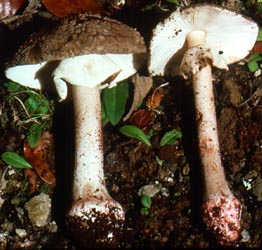  1. Amanita brunneolocularis, oak (Quercus) forest, Costa Rica. 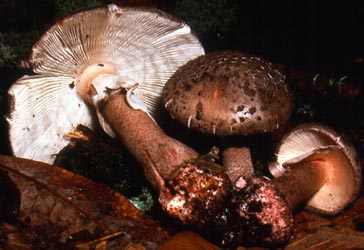 2. Amanita brunneolocularis, oak (Quercus) forest, Andean Colombia. |
| cap | The cap of Amanita brunneolocularis is 45 - 130 mm wide, dull drab tan-buff to sordid flesh-color to somewhat reddish brown, discoloring reddish where bruised, becoming broadly convex to plane, with a low broad umbo or flattened center, dry, subpolished, appearing to have embedded radial fibers when viewed under a 10x lens, cracking over the center at times, with a nonstriate margin, uplifted at maturity, sometimes appendiculate with large pieces of the ring. The volva is present as pointed or flattened squamules up to 1 mm high over the center, elsewhere as patches, whitish to grayish, becoming dark brownish or reddish brown and, finally sometimes, darker than the cap surface. The flesh is 3.5 - 8 mm thick over thestem, whitish, buff colored below the cap skin in the center, and taking on a pinkish or reddish tinge when injured that eventually becomes red-brown. |
| gills |
The gills are free but not remote from the stem, crowded, pure white to whitish buff, slowly discoloring to reddish brown where damaged, developing red-brown spots in age, 3.5 - 10 mm broad, with a fimbriate edge becoming reddish brown, maybe covered in part by the large ring. The short gills are of diverse lengths. |
| stem |
The stem is 65 - 150 × 8 - 30 mm [Note: the length of the bulb is included in these measurements], cylindric, with a fine coating of appressed fibrils that are white at first and become reddish then reddish gray or brownish and, finally, nearly black over a pallid ground. The bulb is narrow to pronounced. The ring is in the upper part of the stem, membranous to submembranous, white to buff on the upper surface, white to grayish below with darkening "dashes" or blocks of volva around the edge on the underside. It is easily torn away from the stem. The volva is absent or present as a single incomplete rounded ridge above the bulb or simply as a very thin dark ring around the bulb's "shoulder." The stem becomes partially hollow; its flesh is white to buff, and discolors red to reddish brown when cut or bruised. |
| odor/taste |
The odor is mild. |
| spores |
The spores measure (6.5-) 7.5 - 10.0 (-12.5) × (5.0-) 5.8 - 7.8 (-9.0) µm and are broadly ellipsoid to ellipsoid, rarely subglobose, infrequently elongate, and amyloid. Clamps are absent from the bases of basidia. |
| discussion |
This species is originally described from
Andean Colombia and has also been found in Costa Rica
and Honduras. In late September, 2006, A.
brunneolocularis was
found for the first time in the central Appalachians
(North Carolina, USA). This material is genetically
nearly identical to the Colombian material. Unblackened
collections of this species are occasionally collected in
the southern parts of its range and commonly collected in the northern
parts of its range. It appears that it may be the
same species as what is called
Amanita
sp-amerirubescens02 on this site. RET has seen a very dark colored species of section Validae in central Mexico, but there was no sign of red staining and a complete review of the material has not been carried out. In Colombia, this species occurs in groups in forests dominated by a single oak (Quercus humboldtii). In Costa Rica, this species occurs in forests including oak (for example, Q. oocarpa). In North Carolina, the species was found in clusters under a single specimen of White Pine (Pinus strobus). The species epithet of the present species means "brown-celled," which refers to the inflated
cells of the volva.
This species can appear to have a nearly black
stem due to the rather dense coating of dark fibrils on the stem. For distinguishing between rubescent taxa in section Validae, refer to the key
to rubescent taxa in Amanita section Validae. |
| brief editors | RET |

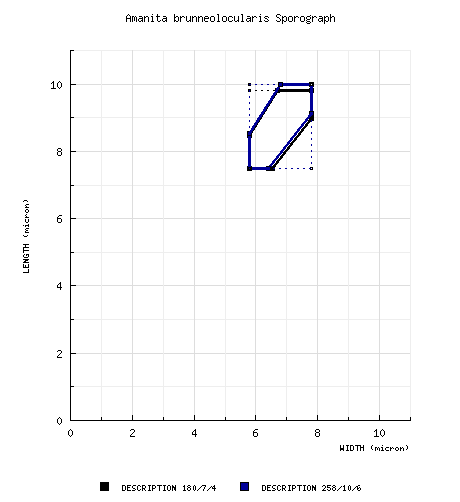
 Spore data sets and their composite