| name |
Amanita ravenelii |
| author |
(Berk. & M. A. Curtis) Sacc. 1887. Syll. Fung. 5: 15. |
| name status |
nomen acceptum |
| english name |
"Ravenel's Lepidella" |
| synonyms |
≡ Agaricus ravenelii Berk. & M. A. Curtis. 1859. Ann. Mag. Nat. Hist., Ser. 3 4: 284.
The editors of this site owe a great debt to Dr. Cornelis Bas
whose famous cigar box files of Amanita nomenclatural information
gathered over three or more decades were made available to RET for computerization
and make up the lion's share of the nomenclatural information presented on this site.
|
| etymology |
genitive of Latinized name of the collector, "Ravenel's" or "of Ravenel" |
| MycoBank nos. |
162136, 452853 |
| GenBank nos. |
Due to delays in data processing at GenBank, some accession numbers may lead to unreleased (pending) pages.
These pages will eventually be made live, so try again later.
|
| holotypes |
K |
| revisions |
Bas. 1969. Persoonia 5: 400, figs. 111-117.
Tulloss, here |
| intro |
The following text may make multiple use of each data field.
The field may contain magenta text presenting data from a type study
and/or revision of other original material cited in the protolog of the present taxon.
Macroscopic descriptions in magenta are a combination of data from the protolog and
additional observations made on the exiccata during revision of the cited original
material.
The same field may also contain black text, which is data from a revision of the present
taxon (including non-type material and/or material not cited in the protolog).
Paragraphs of black text will be labeled if further subdivision of
this text is appropriate.
Olive text indicates a specimen that has not been
thoroughly examined (for example, for microscopic details) and marks other places in the text
where data is missing or uncertain.
The following material not derived from Dr. Bas' monograph is based on original research by R. E. Tulloss. |
| pileus |
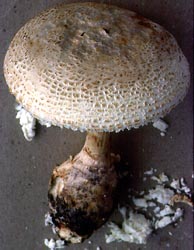
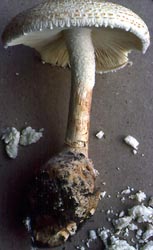
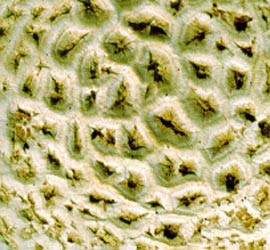
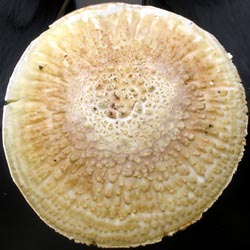
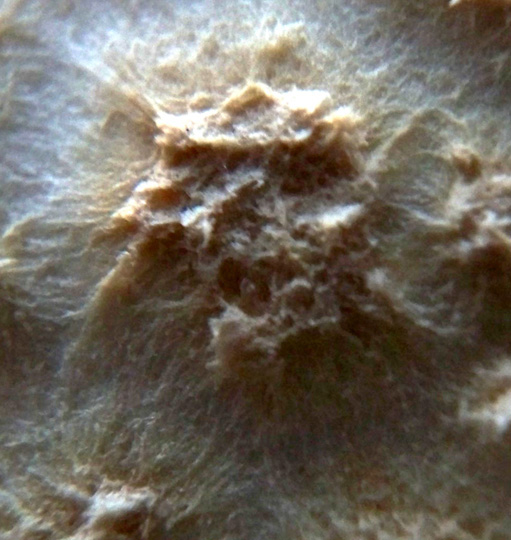
90 - 199 (-297) mm wide, white at first, dingy cream
(3-4A3) after some in situ drying, unchanging when
cut or bruised, globose at first, finally
planoconvex, tacky, shiny to subshiny; context
white, sometimes slowly pale sordid tannish when cut
or bruised, 11 - 19.5 mm thick above stipe, thinning
evenly to margin; margin nonstriate, slightly
incurved at first, appendiculate with relatively
large submembranous material in fragments up to 20 mm
long or as 2 - 3 mm rim around pileus margin;
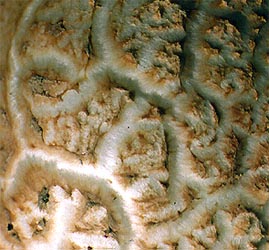
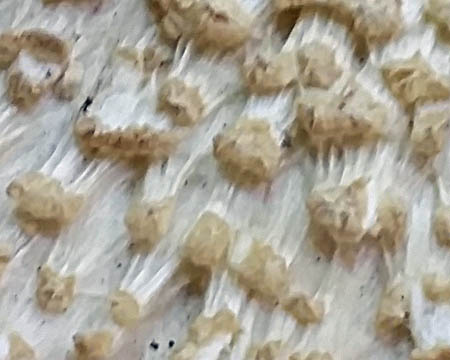
universal veil as warts, subpyramidal to
truncate-pyramidal over disc, near mid-radius as
concentric rings of floccose scales, becoming
progressively finer toward margin, concolorous at
first, becoming tan, then pale red-brown, then
red-brown, finally brown, adnate, with warts have
distinct upper portion (sometimes appearing
"felted" per Bas) resting on fibrillose base, with
upper parts of larger warts (at least) having
sides vertically grooved like hillside ravines,
with fibrils extending subradially from fibrillose
bases. |
| lamellae |
narrowly adnate without decurrent line on stipe,
crowded, pale yellowish white to yellowish cream in
mass, pale yellowish white to cream in side view,
10.5 - 18+ mm broad, infrequently forking
in some specimens, with edge finely pulverulent and
white (browning on edge with age); lamellulae
rounded truncate to subtruncate to subattenuate to
attenuate, of diverse lengths, plentiful. |
| stipe |
82 - 125 (-194) × 15 - 27 (-41) mm, whitish, becoming
yellowish with age or sometimes intensely
rusty-red-brown, becoming faint pinkish in
longitudinal split, cylindric or narrowing downward,
flaring at apex, sometimes slightly flattened,
floccose-flocculose in about upper third of stipe,
longitudinally striate below, sometimes fibrillose
below, sometimes bearing submembranous to subfelted
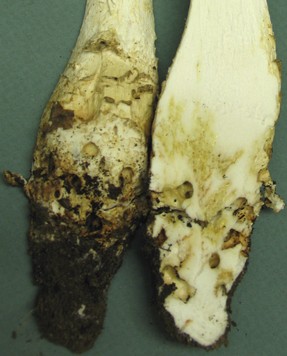
bands of greatly varying widths in lower two-thirds
(present down to top of bulb); bulb deeply
radicating, often showing longitudinal splitting,
often of irregular form, sometimes onion-shaped,
sometimes doglegged, 66 - 204 × 32 - 63 mm, often
with rusty stains; context solid, white,
becoming rusty brown very slowly on cut surfaces,
with larva tunnels pale yellowish to rusty brown;
partial veil submembranous to subfelted to
compressed-flocculose at first, with large
rectangular warts on underside at margin,
eventually falling away in large subfelted chunks;
universal veil as obscure partial rings or
completely undulating rings, widely separated on
upper half of bulb, floccose but thin at first,
reduced to thin and slightly raised firm line by
maturity, concolorous, bulb surface sometimes
splitting into recurved scales tipped with
universal veil material. |
| odor/taste |
Odor lacking at first, then of “chlorine” type (but not too unpleasant). Taste not recorded. |
macrochemical
tests |
Spot test for tyrosinase (L-tyrosine) - positive on stipe context and (immediately) on stipe surface (only portions tested). Test voucher: Tulloss 8-31-85-A. |
| pileipellis |
not distinguishable, poorly developed. [Note: The apparent pileipellis seen between warts is probably the basal, filamentous layer of the universal veil flattened by stretching.—RET] |
| basidia |
45 - 58 × 12.6 - 18.0 µm, 4-sterigmate, with sterigmata up to 4.5? × ?? µm; clamps present, ??. |
| basidiospores |
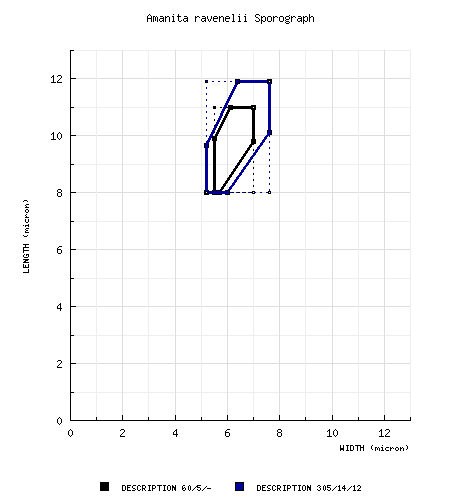
Bas (1969): [60/5/-] 8.0 - 11.0 × (5.0-) 5.5 - 7.0 (-7.5) μm, (Q = 1.40 - 1.80; Q = 1.50 - 1.60), colorless, hyaline, thin-walled, amyloid, ellipsoid to elongate, sometimes ovoid or obovoid; apiculus not described; contents subgranular, refractive; color in deposit not recorded.
composite of data from all material revised by RET: [305/14/12] (7.0-) 8.0 - 11.9 (14.0) × (4.6-) 5.2 - 7.6 (-8.5) µm, (L =
(8.3-) 8.5 - 11.1 µm; L’ = 9.8 µm; W = 5.6 - 7.0 (-7.4) µm; W’ = 6.3 µm; Q = (1.23-) 1.33 - 1.86 (-2.50); Q = 1.46 - 1.75 (-1.81); Q’ = 1.55), hyaline, colorless, smooth, thin-walled, amyloid, ellipsoid to elongate, occasionally cylindric, infrequently broadly ellipsoid, often adaxially flattened, sometimes expanded at one end, rarely langeniform; apiculus sublateral, cylindric; contents ??; white in deposit. |
| ecology |
Solitary to subgregarious. At 4 - 300+ m elev. In mixed hardwood forest including oaks or in sandy/loamy clay under Quercus alba, Q. prinus, Ilex opaca, and Juniperus virginiana (as scrub) or with Acer sp., Carya sp., Cornus florida, Q. rubra?, Q. stellata, and Pinus echinata, etc. within 40 m or in loamy soil over quarzite conglomerate under Q. alba and Fagus grandifolia or in clay. |
| material examined |
Bas (1969):
U.S.A.:
MARYLAND—Prince Georges Co. - Laurel,
13.viii.1966 A. Sánchez & E. Hacskaylo CU 48841
p.p. (CUP).
NORTH CAROLINA—Orange Co. - Chapel Hill,
Purefoy's Mill, 4.x.1913 W. C. Coker 878
(NCU).
SOUTH
CAROLINA—Unkn. Co. - unkn. loc.,
vi H. W. Ravenel s.n.
(holotype, K).
TENNESSEE—Sevier Co. - GSMNP, Cades
Cove, 5.viii.1938 A. H. Smith 9797 (MICH),
14.ix.1956 L. R. Hesler 22418 (TENN); 26.ix.1963
C. Bas 3931 (L).
material revised by RET: U.S.A.:
ARKANSAS—Unkn. Co. - unkn. loc.,
s.d. J. Justice s.n.
[Tulloss 8-84-JU5] (RET 139-8). Unkn. Co. -
unkn. loc., s.d. E. Nelson s.n.
[Tulloss 82-EN-C] (RET 399-2).
INDIANA—Monroe Co. - SE of Bloomington, Lake Monroe, Paynetown St. Recreation Area [39.0941° N/ 86.4476° W, 174 m elev.], 12.vii.2012 Stephen Russell s.n. [mushroomobserver.org #100132] (RET 535-7), 1.ix.2012 S. Russell 3870 [mushroomobserver.org #108029] (RET 535-2).
MISSOURI—Ste. Genevieve Co. - W of Ste. Genevieve, Hawn St. Pk. [37.8337° N/ 90.2416° W, 262 m], 24.viii.2009 Patrick Harvey s.n. [mushroomobserver.org #23904] (RET 442-5), 4.vii.2010 P. Harvey s.n. [mushroomobserver.org #48076] (RET 455-5).
NEW JERSEY—Mercer Co. -
Lawrence Twp., ix.1987 R.
Peabody s.n. [Tulloss 9-87-RP1] (RET
??); Hopewell
Twp., Mt. Rose [40°22’16” N/ 74°44’14” W, 91 m],
10.x.1985 B. & J. VanSant s.n.
[Tulloss 10-10-85-A] (RET 206-2). Morris Co.
- Morris Twp., Spring Brook Country Club,
viii.1985 M. A. Northrup s.n. [Tulloss 8-85-NOR]
(RET 100-10). Unkn. Co. - unkn. loc.,
1.x.1983 G. Miller s.n. [Tulloss 10-1-83-GM1]
(RET 209-4).
NORTH CAROLINA—Durham Co. - Eno River
St. Pk., Few’s Ford [36°04'45" N/ 79°00'29" W,
127 m], 29.ix.1996 Jean-Marc Moncalvo 96/45
(DUKE?). Transylvania Co. -
Dupont St. For., ca.
Hooker Falls [35°12.098’ N/ 82°37.228’ W, 696 m],
27.vi.2011 Jay Justice NC-AM-50 (RET 502-2);
Dupont St. For., ca. picnic area [35°12.058' N/
82°37.098' W, 725 m], 15.viii.2009 Jay Justice
NC-AM-20 (RET 459-10). Wake Co. - Raleigh,
Umstead St. Pk. [35.8725° N/ 78.762° W,
125 m], 27.vii.2016 Geoff Balme s.n.
[mushroomobserver
#245481]
(RET 766-6).
SOUTH CAROLINA—Edgefield Co. - unkn. loc., x.1990 Richard E. Baird s.n. [Tulloss REB6A] (RET 546-4).
TENNESSEE—Knox Co. - Knoxville, jct. Lonas Dr. & Hollywood Rd. [35°57'23" N/ 83°59'02" W, 303 m], 26.ix.2006 Karen Hughes s.n. [Tulloss 9-26-06-A] (RET 397-2; TENN).
VIRGINIA—Fauquier Co. - Warrenton, 1.ix.1965 S. Stein s.n. (NY 00047652). Lancaster Co. - Weems [37°39'41" N/ 76°26'59" W, 4 m], 31.viii.1985 D. C. & R. E. Tulloss 8-31-85-A (RET 212-6).
WEST VIRGINIA—Marion Co. - Barrackville, 5.x.1980 S. L. Stephenson 338 (FWVA). Ritchie Co. - unkn. loc., 5.x.1993 S. L. Stephenson 93-03 (FWVA). Unkn. Co. - unkn. loc., 1.viii.1985 NAMA1985 participant s.n. [Tulloss 8-1-85-C] (RET 201-4). |
| discussion |
from Bas (1969): "The type consists of four young specimens and one damaged, barely mature specimen. Characteristic are the ventricose-fusiform bulb of the short stem and the rather coarse, radially fibrillose, conical to truncate warts on the cap. The type collection of A. ravenelii is undoubtedly conspecific with what American authors usually call A. strobiliformis.
"The collection Smith 9797 cited is the one to which the photograph published by Gilbert (1941: pls. 64, 65) belongs. I have also studied one of the two specimens of Coker 856; unfortunately it was not the specimen pictured in Coker's plage (1917: p. 50); moreover it appeared to belong to another species.
"In A. ravenelii the upper part of the bulb and the lower part of the stem are often adorned with thick, fleshy, imbricate scales or sheaths. These structures come into being by splitting of the flesh of stem and bulb. The remnants of the vola are usually rather inconspicuous in this region, though initially they probably provoke the process of splitting.
"The typical form of A. ravenelii is very distinctive because of the coarse, conical to truncate, radially fibrillose warts with felted tips or central patches, towards the margin, gradually passing into broad, fibrillose scales. The pileipellis does not gelatinize, except in aging specimens, and then the outer surface of the warts may also become involved in the process. Very characteristic is usually also the broadly ventricose, sometimes even onion-shaped bulb.
"The radially fibrillose structure of the warts is not always very clear, however, and then the microscope must be used to be certain that the base of the warts consists mainly of parallel, refractive, yellowish hyphae and only scattered inflated cells.
"Specimens with clavate-subfusiform bulbs and not very conspicuously fibrillose warts resemble A. rhopalopus (see discussion p. 417 [of Bas 1969]).
"Among the clamp-bearing species A. ravenelii, together with A. crassa from S. America and A. strobilacea from Australia form a small group, chiefly characterized by the structure of the volva, which finds its counterpart among the clampless species in the group of A. perpasta.
"Peck (1880: 46) was apparently the first who applied the name 'A. strobiliformis' to the present species; as early as 1898 Lloyd (1898:6) expressed well-founded doubt about this."
The European species A. strobiliformis
is described on this site
here.
A very large specimen with cap 297 mm wide was
collected by Thea Chesney at the NAMA 2015
foray and was much photographed. The stem
plus bulb had a total length of 364 mm. |
| citations |
—R. E. Tulloss |
| editors |
RET |
|



 Spore data sets and their composite