| name |
Amanita strobiliformis |
| author |
(Paulet ex Vitt.) Bertillon in Dechambre. 1866. Dict. Encycl. Sci. Médic. 1(3): 499. |
| name status |
nomen acceptum |
| english name |
"European Pine Cone Lepidella" |
| synonyms |
See Amanita nomenclator (t.b.d.).
The editors of this site owe a great debt to Dr. Cornelis Bas
whose famous cigar box files of Amanita nomenclatural information
gathered over three or more decades were made available to RET for computerization
and make up the lion's share of the nomenclatural information presented on this site.
|
| MycoBank nos. |
153038, 374952, 461724, 124193, 292696, 129647, 50775, 414602, 202556 |
| GenBank nos. |
Due to delays in data processing at GenBank, some accession numbers may lead to unreleased (pending) pages.
These pages will eventually be made live, so try again later.
|
| lectotypes |
Amanita pellita—Paulet. 1812-1835. Iconogr. Champ: pl. 156bis.
Agaricus strobiliforme, Hypophyllum strobiliforme and Fungus strobilus—Paulet. 1812-1835. Iconogr. Champ.: pl 162 (fig. 1). |
| lectotypifications |
Amanita pellita, Agaricus strobiliforme, Hypophyllum strobiliforme and Fungus strobilus—Bas. 1969. Persoonia 5: 519. |
| revisions |
Bas. 1969. Persoonia 5: 519, figs. 303-305.
Neville and Poumarat. 1996. Doc. Mycol. 26(101): 57. |
| intro |
Olive text indicates a specimen that has not been
thoroughly examined (for example, for microscopic details) and marks other places in the text
where data is missing or uncertain.
The following text is largely derived from the revision of Bas (1969) except for some additions from observations of other authors (as noted) or based on original research of R. E. Tulloss and C. Rodríguez Caycedo (as noted). |
| odor/taste |
Bas (1969): Odor and taste "indistinct or subraphanoid"
Neville and Poumarat (2004): "...odeur subnulle ou faible de scléroderme puis désagréable; saveur insignificante." |
macrochemical
tests |
none recorded. |
| basidiospores |
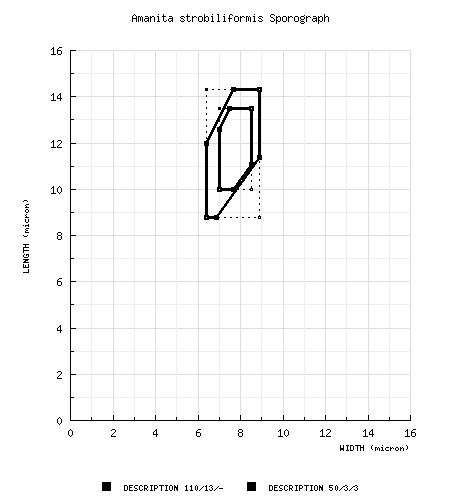
Bas (1969): [110/13/-] 10.0 - 13.5 (-14.5) × 7.0 - 8.5 (-9.5) μm, (Q = 1.30 - 1.80; Q = 1.40 - 1.60), colorless or somewhat yellowish, thin-walled, amyloid, ellipsoid to elongate, sometimes obovoid; apiculus not described; contents refractive-guttulate; color in deposit not recorded.
composite of data from all material revised by RET & CRC: [50/3/3] (8.0-) 8.8 - 14.3 (-16.0) × (4.4-) 6.4 - 8.9 (-10.8) μm, (L = 9.5 - 12.0 μm; L' = 11.4 μm; W = 7.1 - 7.9 μm; W' = 7.5 μm; Q = (1.25-) 1.28 - 1.87 (-2.07); Q = 1.34 - 1.63; Q' = 1.53), hyaline, colorless, smooth, thin-walled, amyloid, ellipsoid to (occasionally) elongate, adaxially flatted, sometimes adaxially concave, sometimes narrowed toward apex; apiculus sublateral, cyindric; contents multiguttulate to granular; color in deposit not recorded. |
| ecology |
Bas (1969): "Terrestrial in woods in Europe (except northern parts); preference for deciduous woods on heavy, calcareous soil."
RET: France: In ditch by road through deciduous forest with groves of Fagus and Quercus. Germany: Solitary. At 50 m elev. In slightly acidic loamy sand of mesotrophic Carpinus betulus forest. |
| material examined |
Bas (1969):
AUSTRIA: NIEDER ÖESTERREICH—Strassfhof-Silberwald, vi-viii.1930 Th. Cernohorsky & Wallauschek s.n. (Litsch. & Lohw., Fugi sel. exsicc. europ. 95, PR).
BELGIUM: Montagne St. Pierre, 23.vi.1950 R. de Vivell s.n. (LG; L).
CZECH REPUBLIC: PRAGUE—unkn. loc., 20.vi.1966 J. Durdil s.n. (PR).
FRANCE: HAUTES PYRÉNÉES—St-Pé, ca. 1945 anon. s.n. (L).
ITALY: TRENTINO—Trento, Gocciadoro, 23.vi.1904 G. Bresadola s.n. (S); Margone S of Trento, x.1901 J. Bresadola s.n. (S); Sopramonte W of Trento, viii.1897 Turco-Lazzari s.n. (S); Vilazzona SE of Trento, vii.1901, Turco-Lazzari s.n. (S).
NETHERLANDS: GELDERLAND—Doetinchem, Slangenburg, 29.ix.1953 C. Bas 199 (L) NOORD HOLLAND—Heemskerk, s.d. anon. s.n. (L). UTRECHT—Bunnik, ca. Rhijnauwen, ix.1862 Hartsen (in herb. Oudemans (L)); Zeist, Wulperhorst, 21.ix.1925 O. F. Uffelie (in herb. Uffelie). ZEELAND—Walcheren, Zeeduin, 3.ix.1938 H. S. C. Huijsman 30 (L), 358 (L).
SLOVAKIA: KRAJ JIHOMORAVSKÝ—Okres Hodonín - Žarošice, 22.vi.1942 V. Vacek s.n. (PR).
U.K.: ENGLAND—Surrey - Norbury Pk., 10.x.1962 R. W. G. Dennis s.n. (L).
RET: CZECH REPUBLIC: PRAGUE—Klíčova [the spelling is uncertain], 9.vii.2009 Jan Borovička BORE 42 (RET 455-4); Suchdol, Czech Republic Academy of Sciences campus, 21.vii.2009 J. Borovička BORE 41 (PRM 915787; RET 455-8).
FRANCE:
GIRONDE—La Brède,
Château La Sauque, 20.vii.1997 Rémy LeTourneau
s.n. [Francis Massart 97045] (in herb. F. Massart;
RET 273-1).
MAINE-ET-LOIRE—Ft. de Chandelais
(Est), 29.ix.1991 Thomas s.n. (in herb. J. Mornand
9123B1, as "Amanita gracilior";
RET 276-6).
VENDÉE—Forêt d’Olonne, 5.xi.1978 Lemée
s.n. (in herb. Jean Mornand; RET 276-7).
GERMANY:
UNKN. STATE—unkn. loc.
(withheld), 14.viii.2001 René K.
Schumacher s.n. (RET 522-4).
NETHERLANDS: ZUID
HOLLAND—Huys t. Donck/Ridderkerk, 9.viii.1986
Dr. M. E. Noordeloos s.n. [Dr. C. Bas 8424]
(L; RET 002-5, nrITS seq'd.). |
| discussion |
t.d.d.
The two Borevička collections (BORE 41 and BORE 42) both comprise immature material; so far as we can tell, BORE 42 lacks mature basidia. We were able to find 10 spores on a section of lamella from BORE 41; these spores produced the lowest Q observed for the specimens we have reviewed to date. |
| citations |
—R. E. Tulloss and C. Rodríguez Caycedo |
| editors |
RET |
|



 Spore data sets and their composite