

| name | Amanita sp-N47 |
| name status | cryptonomen temporarium |
| author | Tulloss, Rodríguez Caycedo & K. W. Hughes |
| images |
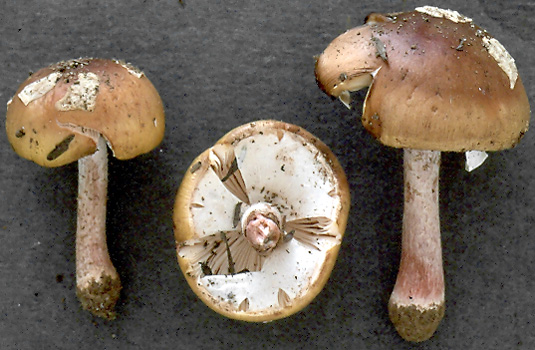  1. Amanita sp-N47, older specimens showing bruising, Tolland Co., Connecticut, U.S.A. (RET 301-5) |
| intro | This mushroom suggests small specimens of Amanita rubescens or one of the North American taxa that has gone under that name. The following material is based on original research of R. E. Tulloss and C. Rodríguez Caycedo. |
| cap | The 50-55 mm wide, hemispheric, tan cap is red-brown over its center, and is a more yellowish tan near it’s margin. The cap’s off-white flesh is 2-3.5 mm thick, a red line is present at the flesh's attachment to the gills. The cap’s flesh bruises brownish-red and thins evenly to the cap margin. There are no lines or ribs on the cap’s edge which may curved inward. The volval remnants are present as yellow to white slightly membranous felted patches or large warts that are easily removed from the cap. |
| gills | The crowded off-white gills are narrowly attached and are 3.5 – 4.5 mm broad. There is a down curving line on the sheath that remains when the ring is removed from the stem. The gills may develop wine-red spots. The short gills end abruptly, are plentiful, and are of varying lengths. |
| stem | The off-white stem is 32 - 51 × 4.5 - 6 mm and stains pink to pale brick-colored. The faintly longitudinally lined stem is cylindric and narrows upward, flaring slightly at the top. The stem is decorated with fine fibers and scales. The bulb is 12 -13 × 7-8 mm tapers toward its base and is slightly doglegged in some specimens. The thin ring is near the top of the stem and tears easily. The ring is white and faintly lined on top and smooth on its bottom. The skirt can sometimes be left in large pieces on the cap’s edge. No volval remnants where seen on the stem base in the material examined. |
| odor/taste | Collections of this species have not been tasted. The odor has been reported to be like fruit or "flowery soap." |
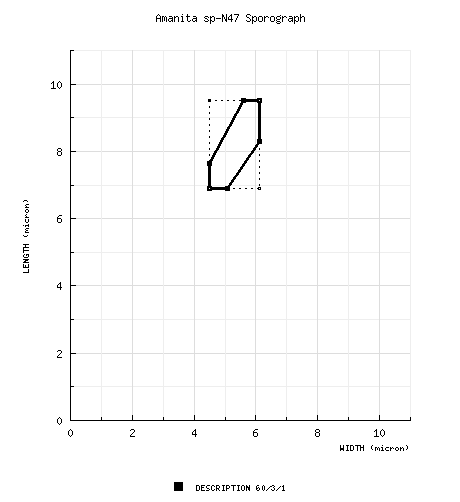
| spores | The spores of this species measure (6.5-) 6.9 - 9.5 (-10.5) × 4.5 - 6.1 (-7.0) μm, are broadly ellipsoid to ellipsoid to elongate, and amyloid. Clamps are probably not present at bases of basidia. |
| discussion |
At present we know this species from only one site in
eastern North America—in eastern Connecticut.
A small group was found in sandy soil in a mixed
forest of pine (Pinus), oak (Quercus),
and Eastern Hemlock (Tsuga
canadensis). Preliminary genetic and morphological analysis indicates this species is distinct from other rubescent taxa in section Validae known from both Europe and North America. In the same region, the non-white, more or less rubescent taxa include A. amerirubescens (presently being subdivided based on current research reported on this site), A. flavorubens, and A. jenkinsii.—R. E. Tulloss, C. Rodríguez Caycedo, and N. Goldman |
| brief editors | RET |

 Spore data sets and their composite