| name |
Amanita flavorubens |
| author |
(Berk. & Mont.) Sacc. 1887. Sylloge fungorum 5: 17.
|
| name status |
nomen acceptum |
| english name |
"Yellow American Blusher" |
| synonyms |
≡ Agaricus (Amanita) flavo-rubens Berk. & Mont. in Mont. 1856. Syll.. Gen. Spec. Crypt.: 96.
≡ Amplariella flavorubens (Berk. & Mont.) E.-J. Gilbert. 1940. Iconogr. Mycol. (Milan) 27: 78.
= Amanita flavorubescens G. F. Atk. 1902. J. Mycol. 8: 111. ≡Venenarius flavorubescens (G. F. Atk.) Murrill. 1914. N. Amer. Fl. 10: 73.
The editors of this site owe a great debt to Dr. Cornelis Bas
whose famous cigar box files of Amanita nomenclatural information
gathered over three or more decades were made available to RET for computerization
and make up the lion's share of the nomenclatural information presented on this site.
|
| etymology |
flavus (yellow) + rubescens (becoming red) |
| MycoBank nos. |
508874, 490815, 284155, 206197, 503901 |
| GenBank nos. |
Due to delays in data processing at GenBank, some accession numbers may lead to unreleased (pending) pages.
These pages will eventually be made live, so try again later.
|
| holotypes |
A. flavorubens—in herb. Montagne (PC).
A. flavorubescens—CUP. |
| type studies |
A. flavorubescens—Jenkins. 1982. Mycotaxon 14: 242. |
| revisions |
Tulloss, here |
| selected illustrations |
Kibby. 1993. Illus. Guide Mushr. Other Fung. N. Amer.: 89 (middle fig.). |
| intro |
Olive text indicates a specimen that has not been
thoroughly examined (for example, for microscopic details) and marks other places in the text
where data is missing or uncertain.
The following is based upon molecular research of
Drs. Karen Hughes and Linus Kudzma with additional
original research by R. E. Tulloss. The
microscopic data includes data from a revision of the
holotype (P) by RET. |
| pileus |
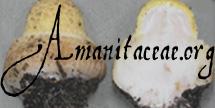
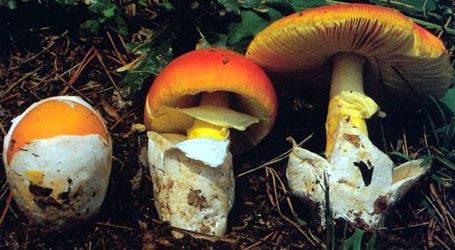
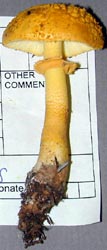
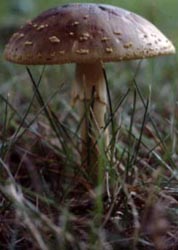
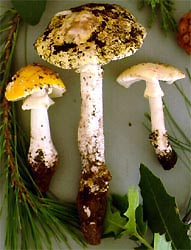
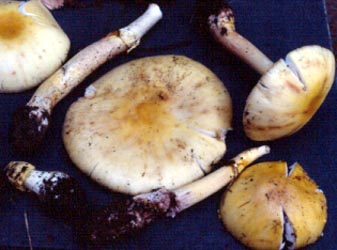
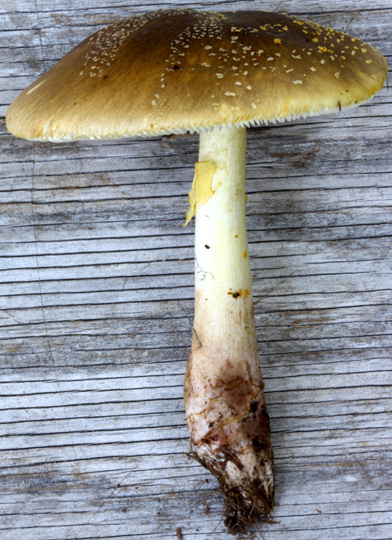
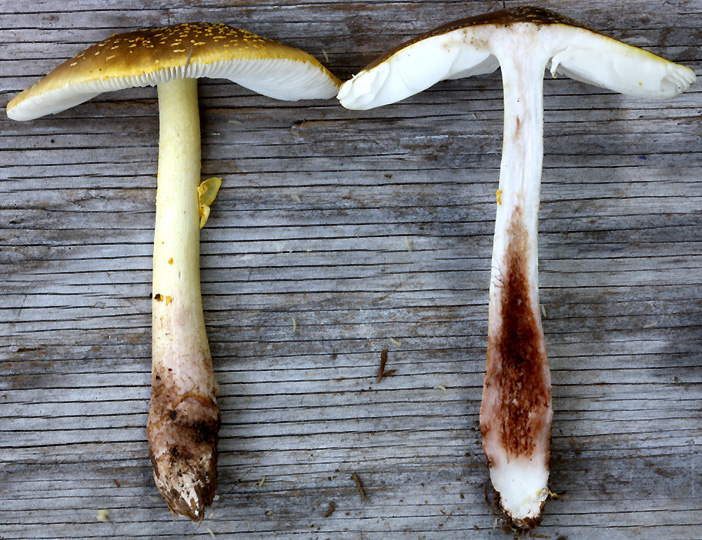
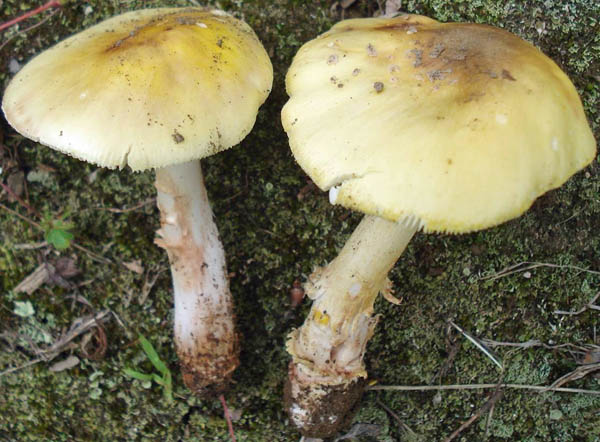
35 - 105 mm wide, brilliant yellow (e.g., 3A5) or bright lemon yellow (3-4A8) to brassy yellow, sometimes with more strongly pigmented disc and then more yellow at margin (e.g., yellower than 4B7 with 3A8 near margin or or orange-brown or with umbrinous tint), sometimes pale yellow near margin, often becoming reddish-variegate or wine stained in spots, rarely entirely wine-colored, sometimes nearly white after yellow pigment washed out by rain, at first subovoid with incurved margin, then hemispheric with incurved margin, then convex to plano-convex with decurved margin, finally concave with upward flaring margin, at times obscurely umbonate (and then sometimes flattened or slightly depressed in center of broad umbo), occasionally depressed in age, tacky to dry, subvelvety to dull; context white to yellowish, often with yellow in thin line under pileipellis, sometimes pinkish at point of separation from stipe context (when broken there), occasionally with brown tint in scattered spots, often staining wine color several hours after cutting or bruising, 3 - 7 mm thick over stipe, usually thinning evenly to margin, infrequently thinning rapidly in 25% of radius nearest stipe and then evenly to margin; margin nonstriate at first, occasionally becoming finely striate with age; universal veil as irregularly distributed warts, sometimes confluent, verruculose to subverruculose (lens), floccose to pulverulent to subpulverulent, yellow (sometimes concolorous with pileus, sometimes paler) to orange-yellow, becoming sordid yellow if not staining, sometimes becoming depigmented and then sordid in centers of warts and pale dingy cream toward edges, staining brown or brick color slowly here and there, rather thick, detersile. |
| peridium |
double click in markup mode to edit. |
| lamellae |
free to narrowly adnate, sometimes with short (at times faint) line or short decurrent tooth on stipe apex (lens), crowded to very crowded, white to off-white to creamy white to cream in mass, white to water soaked white to off-white to creamy white in side view, attenuated at both ends, 3 - 8 mm broad, up to about 0.1+ mm thick, with edges sometimes bearing white pulverulence; lamellulae sometimes dominantly subattenuate to attenuate, sometimes dominantly truncate, also subtruncate or truncate with attenuate tooth or attenuate in steps, unevenly distributed, plentiful, of diverse lengths, infrequently adjacent to stipe rather than margin. |
| stipe |
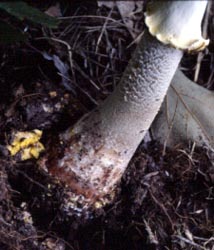
38 - 150 × 7 - 14 mm, white to pale yellowish white to concolorous with pileus, with pigmentation inconsistently distributed (sometimes strongest below partial veil, sometimes above), often becoming brown to brick color on lower part where handled, occasionally developing wine colored regions in lower half and on bulb, narrowing upward or (less frequently) downward, flaring (sometimes barely, sometimes gradually over 20± mm) at apex, pruinose-pulverulent to farinose above partial veil, silky (finely longitudinally striatulate) and sometimes finely fibrillose or with numerous raised fibrils or decorated with recurved squamules below partial veil; bulb submarginate to rounded above, rounded or with rounded point below, often napiform to subnapiform, somewhat radicating in regions with extended annual dry seasons (Arizona, central México), 15 - 26 × 12 - 21 mm; context stuffed (with or without some lacunae) to solid, infrequently hollow, white, sometimes pale yellow just below surface above partial veil, with wine to grayish wine to pale wine to vinaceous gray-brown (recorded for stuffing material) to pale pinkish brick color bruising reaction, sometimes cocoa brown in bulb, larva tunnels concolorous with surrounding tissue or more strongly wine colored or brown, when stuffed having whitish cottony material in 3 - 6 mm wide central cylinder, when hollow showing remnants of such material with pinkish staining in central cylinder; partial veil superior, membranous, flaring, skirtlike, sometimes pulled upward at first by expansion of pileus, pale yellow to pale yellowish white to cream to white above, with yellow (e.g., 3A5) universal veil remnants just under margin, striate above, smooth and orangish cream to pale yellowish to yellowish white to pale tannish yellow to white below, becoming lacerate, eventually collapsing on stipe, infrequently falling away; universal veil as thin (sometimes broken) ridge at or above broadest part of bulb or fragile detersile patches (remaining appressed on stipe base or easily lost by collectors) or in broken rings of warts on top of bulb, pulverulent-flocculose to farinose, yellow (e.g., 3A6) to yellow-orange, staining as on pileus. |
| odor/taste |
Odor absent to mild, pleasant, “slightly sweet,” faintly fragrant, or like clean laundry. Taste faintly bitter. |
macrochemical
tests |
Spot test for laccase (syringaldazine) - negative throughout basidiome. Spot test for tyrosinase (paracresol) - positive only in stipe excluding bulb or positive except for bulb context, some spots on surface of lamellae, universal veil patches, and partial veil in mature specimen. Test vouchers: Tulloss 8-24-94-H, 9-22-96-A. [Additional spot test information supplied by Dr. Currie Marr, State University of New York, Oneonta.] |
| pileipellis |
PILEIPELLIS: apparently shallow, 35 - 50 µm thick (perhaps not rehydrating well in holotype of A. flavorubens), yellow to orange-yellow, with gelatinization restricted to surface; filamentous, undifferentiated hyphae ?? µm wide, subradially arranged, often with yellowish walls; vascular hyphae absent or difficult to discern. |
| pileus context |
collapsed in holotype of A. flavorubens; filamentous, undifferentiated hyphae ?? µm wide, ??; acrophysalides ??; vascular hyphae ?? µm wide, ??. |
| lamella trama |
bilateral; wcs = 15 - 25 µm (moderate to good rehydration); central stratum not rehydrating in holotype of A. flavorubens; central stratum possibly containing somewhat inflated intercalary cells; subhymenial tree entirely composed of inflated cells, with 4 - 5 cells between the bases of longest basidia/-oles and subhymenial base, with distance from subhymenial base to nearest basidial base 15 - 20 µm, with distance from central stratum to most distant base of basidium/-ole 20 - 25 µm; subhymenial base often not strongly differentiated from subhymenium, but occasionally including broadly clavate to clavate inflated and curving cells (up to 40 × 32 µm, but probably mostly smaller than 33 × 18 µm); filamentous, undifferentiated hyphae 2.8 - 10.0 µm wide, branching, often with constrictions at septa; terminal, inflated cells ??; aseptate subrefractive yellowish branching hyphae 3.2 - 9.4 µm wide [not sure if they are vascular hyphae]; vascular hyphae ?? µm wide, ??. |
| subhymenium |
wst-near = 25 µm (good rehydration); wst-far = 35 - 40 µm (good rehydration); pseudoparenchymatous (cellular), 2 - 3 cells thick where differentiable from subhymenial base, with cells up to 15.0 × 14.5 µm or larger and thin-walled, with more elongate cells of subhymenial base some penetrating to near bases of basidia, with basidia arising from inflated cells. |
| basidia |
28 - 41 × 8.4 - 11.5 µm, predominantly 4-sterigmate, with sterigmata up to ?? × ?? µm; clamps not observed??. |
| universal veil |
On pileus: filamentous, undifferentiated hyphae 1.6 - 9.8 µm wide, branching, singly or in narrow fascicles, common, sometimes with swollen intercalary segments (e.g., 48 × 19.0 µm); inflated cells globose to subglobose, occasionally elongate, dominating, pale yellowish or with yellow walls (pigment may be bleached by sun or leached by rain), up to 74 × 73 µm, with walls thin to slightly thickened and occasionally up to 1.0 µm thick, terminal, usually singly, possibly occasionally in short chains; vascular hyphae not observed. On stipe base: similar to that on pileus, but with inflated cells smaller (up to 35 × 22 µm in holotype of A. flavorubens) and not obviously thick-walled. |
| stipe context |
longitudinally acrophysalidic; filamentous, undifferentiated hyphae 1.6 - 7.7 µm wide, branching, plentiful, occasionally with yellowish subrefractive walls; acrophysalides dominating away from exterior surface, up to 350 × 50 µm; vascular hyphae not observed; clamps not observed. |
| partial veil |
yellow; filamentous, undifferentiated hyphae ? µm wide, co-parallel, subradially? arranged, with slightly inflated intercalary segments (e.g., 39 × 8.9 µm), ??; inflated cells ??; vascular hyphae ?? µm wide, ??. |
| lamella edge tissue |
not described. |
| basidiospores |
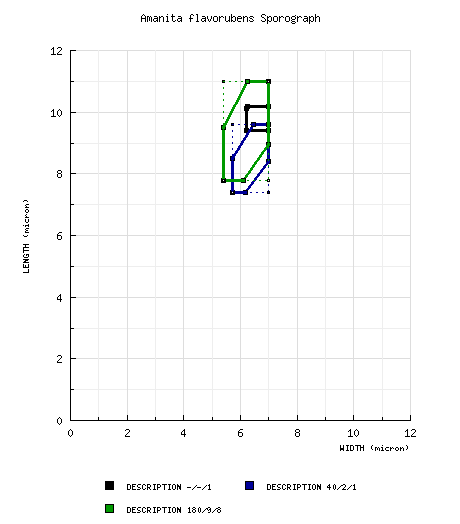
from Jenkins' type study of flavorubescens (1982): [-/-/1] 9.4 - 10.2 × 6.2 - 7.0 μm, (Q = 1.33 - 1.63; Q' = 1.42), hyaline, thin-walled ?amyloid, ellipsoid; apiculus sublateral, truncate-conic; contents guttulate; color in deposit not recorded.
RET type study of flavorubens: [40/2/1] 7.4 - 9.6 (-10.5) × (5.2-) 5.7 - 7.0 (-8.9) μm,
(L = 8.3 - 8.6 μm; L' = 8.4 μm; W = 6.2 - 6.3 μm; W' = 6.2 μm; Q = (1.17-) 1.20 - 1.49 (-1.62); Q = 1.34 - 1.37; Q' = 1.35), hyaline, colorless, smooth, thin-walled, strongly amyloid, broadly ellipsoid to ellipsoid, infrequently elongate, adaxially flattened; apiculus sublateral, cylindric; contents monoguttulate; color in deposit not recorded.
composite data from all material revised by RET: [180/9/8] (7.4-) 7.8 - 11.0 (-12.6) × (4.9-) 5.4 - 7.0 (-8.4) µm, (L = 8.3 - 9.6 (-10.7) µm; L’ = 9.2 µm; W = (5.5-) 5.7 - 6.6 µm; W’ = 6.1 µm; Q = (1.17-) 1.28 - 1.76 (-1.96); Q = (1.34-) 1.37 - 1.67; Q’ = 1.52), hyaline, colorless, smooth, thin-walled, amyloid, broadly ellipsoid to ellipsoid, infrequently elongate, usually at least somewhat adaxially flattened, often swollen at one end; apiculus sublateral, cylindric; contents mono- to multiguttulate; white in deposit. |
| ecology |
Solitary to subgregarious.
Arizona, U.S.A.: At 1600 - 2300 m
elev. In “oak woodland” or
with Quercus arizonica, Q. hypoleucoides,
Q. emoryi, Pinus leiophylla, P.
engelmannii, Juniperus deppeana,
Platanus wrightii, Pseudotsuga
menziesii, Juglans major, and P.
discolor or with J. deppeana,
Q. emoryi, J. monosperma,
Arctostaphylos pringlei, and P. discolor
or with Q. arizonica, Q. emoryi,
Q. hypoleucoides, J. deppeana,
Cupressus arizonica, P. chihuahuana,
P. discolor, Prunus serotina,
P. wrightii.
Connecticut, U.S.A.: In lawn at edge of mixed forest
including Quercus, Betula,
Fagus grandifolia, Pinus, and
Tsuga canadensis.
New Jersey, U.S.A.: At 40 - ?? m
elev. In Quercus-F.
grandifolia forest or in lawn under
Castanea or in deciduous forest
including
Quercus, F. grandifolia, and
Betula spp. nearby as well as Acer
and Liquidambar styraciflua or in wet loam
of mixed deciduous forest including Acer,
Betula, Carpinus caroliniana,
Carya ovata, F. grandifolia,
L. styraciflua, and Quercus or
between road and open pasture under pure planting
of C. caroliniana or in sand of Pinus
rigida-Quercus barrens.
New York, U.S.A.: In
sandy soil of Quercus-Pinus rigida barrens. |
| material examined |
from type study of Jenkins (1982): U.S.A.: NEW YORK—Tompkins Co. - Ithaca, Coy Glen, s.d. C. H. Kauffman 9884 (holotype of Amanita flavorubescens, CUP).
U.S.A.:
ARIZONA—Cochise Co. - CMP site #1,
24.viii.1990 J. D. States AEF692 [CMP0829] (MICH);
CMP site #4, 3.ix.1993 J. D.
States AEF996 [CMP1811b] (MICH); CMP site #12,
16.viii.1991 F. H. Nishida 4506 [CMP0929] (RET);
CMP site #13, 13.viii.1991 J. Cifuentes s.n.
[CMP0885] (RET); CMP site #23, 19.viii.1991 Robert
M. Chapman s.n. [CMP0866;Tulloss 8-19-91-D] (RET);
CMP site #28, 16.viii.1990 J. D. States s.n.
[CMP0519] (RET), 24.viii.1994 Marcia Lincoln s.n. [CMP3963;Tulloss 8-24-94-F] (RET); CMP site #37, 24.viii.1994 S. B. Fleming s.n. [CMP3964;Tulloss 8-24-94-H] (RET). Santa Cruz Co. - Santa Rita Mtns., Gardiner Cyn. 3.ix.1994 J. D. States AEF1101 (MICH).
CONNECTICUT—Middlesex
Co. - Devil's Hopyard St. Pk. [41°28’32” N/
72°20’25” W, 72 m], 4.ix.2011 COMA2011 participant
s.n. [Tulloss 9-4-11-N] (RET 491-5, nrITS &
nrLSU). Tolland Co. - Gay City St. Pk.
[41°43’23” N/ 72°26’38” W, 209 m], 31.viii.97 Mary
A. & R. E. Tulloss 8-31-97-D (RET 267-9, nrITS
& nrLSU, seq'd.); Hebron, The Hemlocks Nature
Educ. Ctr. [41°37’11” N/ 72°23’22” W, 145-160 m],
22.ix.1998 M. A. & R. E. Tulloss 9-22-96-A (RET
249-8, nrITS & nrLSU, seq'd.), 1.ix.1997 Sarah
E. K. Tulloss s.n. [Tulloss 9-1-97-A] (RET 267-1,
nrITS & nrLSU, seq'd.),
25.ix.1999 Sylvia Stein s.n.
[Tulloss 9-25-99-F] (RET 301-3, nrITS & nrLSU
seq'd.), 3.ix.2011 P. Russell s.n. [Tulloss
9-3-11-G] (RET 487-5, nrITS & nrLSU
seq'd.).
ILLINOIS—Union Co. -
K of Makanda, Giant City St. Pk. [37.5847° N/
9.2052° W, 175 m], 17.vi.2013 Patrick Harvey s.n.
[mushroomobserver.org
#136753]
(RET 538-10, nrITS & nrLSU seq'd.).
INDIANA—Monroe Co. - SE of Bloomington,
Paynetown St. Recr. Area, Lk. Monroe [39.0941° N/
86.4476° W, 174 m], 1.ix.2012 Stephen Russell s.n.
(RET 530-6, nrITS & nrLSU, seq'd.).
Montgomery Co. - Waveland, Shades St. Pk.
[39.9378° N/ 87.0894° W, 223 m], 28.viii.2012
Stephen Russell 3601 (RET 530-3, nrLSU seq'd.),
3675 (RET 530-7, nrITs & nrLSU seq'd.), 3679
(RET 530-8).
MASSACHUSETTS—Unkn. Co. - unkn. loc.,
15.viii.1986 NEMF participant s.n. [Tulloss
8-15-86-D] (RET 138-8), 17.viii.2001 John Mills
s.n. [RET 8-17-01-F] (RET 362-3).
MISSOURI—Butler Co. - Univ. For.
Conservation Area [36.9025° N/ 90.3651° W, 164 m],
7.x.2013 Patrick Harvey s.n. [mushroomobsever
#147626]
(RET 576-6, nrITS & nrLSU seq'd.).
Lincoln Co. - Cuivre River St.
Pk. [38.03° N/ 90.93°W, 330m], 29.vi.2013 P.
Harvey s.n. [www.mushroomobserver.org
#137972]
(RET 545-8, nrITS & nrLSU seq'd.).
St. Louis Co. - Babler St. Pk.
[38.6103° N/ 90.6733° W, 194 m], 1.vi.2013 P.
Harvey s.n. [mushroomobserver.org
#135480]
(RET 553-3, nrITS & nrLSU seq'd.).
NEW JERSEY—Mercer
Co. - Cranbury, W side of traffic circle on U.S.
Rte. 130, 11.viii.2003 Neal Macdonald s.n.
(RET 368-1); Hightstown
[40°15’57” N/ 74°31’04” W],
21.vi.1981 M. A. King & R. E. Tulloss
6-21-81-M1 (RET 167-6), -M2 (RET 168-3), -M3
(RET 167-4), -M4 (RET 167-7), -M5 (RET 167-10),
3.vii.1982 R. E. Tulloss 7-3-82-A (RET 340-7);
Hopewell Twp., off Carter Rd., woods behind
AT&T/Lucent Bell Labs. [40°21’39” N/
74°43’29” W, 63 m], 10.ix.1979 R. E. Tulloss
9-10-79-B (RET ??),
17.vi.1981 R. E. Tulloss 6-17-81-A
(RET ??); Lawrenceville,
on Carter Rd. btwn. Cold Soil Rd. & Rte. 206,
16.ix.1981 M. A. King & R. E. Tulloss 9-16-81-B
(RET 174-5). Middlesex Co. - Cheesequake St.
Pk., 4.viii.1990 Geoffrey G. Kibby s.n. [Tulloss
8-4-90-B](RET 147-8, nrITS &
nrLSU seq'd.). Monmouth Co. -
Roosevelt, 24.vii.1983 D. C.
& R. E. Tulloss 7-24-83-A (RET 221-1),
26.viii.1990 M. A. King & S. E. K. Tulloss
s.n. [Tulloss 8-26-90-A] (RET 009-8),
14.vii.1991 M. A. King, S. E. K. Tulloss &
R. E. Tulloss 7-14-91-A (RET 009-1),
4.viii.1991 R. E. Tulloss
8-4-91-A (in herb. C. Lavorato; RET 023-1),
28.vi.1998 Constance Herrstrom, M. A., S. E. K.,
& R. E. Tulloss 6-28-98-A (RET 280-5, nrITS
& nrLSU seq'd.), 5.ix.1998 R. E. Tulloss
9-5-98-A (RET 287-2, nrITS & nrLSU seq'd.),
2.ix.1999 R. E. Tulloss 9-2-99-C (RET 295-9,
nrITS & nrLSU seq'd.); Roosevelt, schoolyard
[40°13’05” N/ 74°28’30” W, 42 m] 17.viii.2011
M. A. & R. E. Tulloss 8-17-11-A (RET 481-2,
nrITS & nrLSU seq'd.); Roosevelt, Valley Rd.
bike path, 16.vi.2013 Naomi Goldman & Ricky
Resciniti s.n. [Tulloss 6-16-13-A] (RET 537-3,
nrITS & nrLSU seq'd.), 24.vi.2013 N. Goldman
& R. Resciniti s.n. [Tulloss 6-24-13-B]
(RET 539-9, nrITS & nrLSU seq'd.);
Shark River
Co. Pk. [40°12’18” N/ 74°05’44” W, 16 m],
3.viii.1986 Mary A. King, Janice Van Sant &
R. E. Tulloss [Tulloss 8-3-86-E] (RET 015-10);
Shark River Co. Pk. [40°12’18” N/ 74°05’44” W,
Upper Freehold Twp., Assunpink Wildlife Mgmt. Area,
Roosevelt Rd. [40°12'41" N/ 74°28'38" W, 38 m],
18.vii.1982 R. E. Tulloss 7-18-82-E (RET 472-1);
16 m]. Somerset Co. -
Bernardsville, 23.vii.1984 R. Miller & D.
Smullen s.n. [Tulloss 7-23-84-RMDS6]
(RET 060-1);
Somersville, Fatto prop., 13.vii.2001 Raymond A.
Fatto s.n. (RET 342-10, nrITS & nrLSU
seq'd.).
Warren Co. - Stephens St. Pk.,
4.viii.1996 R. E. Tulloss 8-4-96-G (RET 229-1,
nrITS & nrLSU seq'd.).
NEW MEXICO—Grant Co. - Gila Nat. For.,
SW of Silver City [32.5476° N/
108.4251° W, 1927 m], 13.ix.2012 R. M. Chapman
1399 [www.mushroomobserver.org
#109595]
(RET 516-9, nrITS & nrLSU seq'd.).
NEW YORK—Oneida Co. -
unkn. loc., sand plains,
6.ix.2010 Eric Smith s.n. [www.mushroomobserver.org
#52168]
(RET 481-9, nrITS & nrLSU seq'd.); unkn. loc.,
25.viii.2010 E. Smith S.n. [mushroomobserver.org
#51354]
(RET 483-3, nrITS & nrLSU seq'd.).
Oswego Co. - Selkirk Shores St.
Pk., E shore of Lk. Ontario, 4.viii.1995 A. Adams,
Nancy Hinman, Ray Ayers, & V. O’Neil s.n.
[Tulloss 8-4-95-E] (RET ??).
OHIO—Butler Co. -
Oxford Twp., Hueston Woods St. Pk., High Banks,
7.viii.1992 M. A. Vincent, R. J. Hickey, B. Hoppes,
R. Small [Vincent 5664] (MU; RET 069-3, nrITS &
nrLSU seq'd.); Oxford Twp., Miami Univ., 15.vii.1992
M. A. Vincent 5537 (MU; RET 064-3, nrITS &
nrLSU seq'd.).
Franklin Co. - Columbus, s.d.
Sullivant 224 (holotype of Agaricus
(Amanita) flavo-rubens,
PC).
PENNSYLVANIA—Luzerne Co. - Dallas
[41.3307° N/ 75.9712 W, 370-390 m], 3.vii.2013
David Wasilewski s.n. [www.mushroomobserver.org
#138810]
(RET 549-7, nrITS & nrLSU seq'd.);
Moon Lake Pk. [41.2530° N/
76.0470° W, 240-400 m], 30.v.2013 D. Wasilewski s.n.
[www.mushroomobserver.org
#138350]
(RET 549-8, nrITS & nrLSU seq'd.).
Pike Co. - Dingman's Ferry,
Pocono Environmental
Education Ctr. [41°10'17" N/ 74°54'52" W, 235 m],
20.vi.1981 Robert Peabody s.n. [Tulloss 6-20-81-Z]
(RET 176-4). |
| discussion |
Despite the statement in the protolog that the context of Agaricus flavorubens is not at all rubescent, the bulbs of the two specimens in Sullivant 224 have distinct reddish brown areas—after more than 140 years. In fact, the condition of the type is quite extraordinary; for example, the inflated cells of the universal veil are still as yellow as they are in one-year-old exsiccata.
Haines (1977) reported on a case in which a two-year-old child ingested several basidiomes of the present species. After ingestion, one and one-half hours passed before the child’s stomache was emptied. During this period no symptoms developed. The child remained asymptomatic. Haines suggested that if a toxin were present, it must have been present in small quantities. Identification was made based on fresh material collected at the site of the child’s ingestion. The species is frequently eaten after cooking without ill effect by peoples of the Neovolanic Axis of Mexico. It is often seen in the markets of that region where it is known as "yemita"—little yolk. In the same region the name "yema" is frequently applied to a favored edible species of Amanita sect. Caesareae—A. basiana.
Because of its apparently close phenetic relation to A. amerirubescens and A. rubescens Per. : Fr., it may be that A. flavorubens contains a hemolytic compound as has been reported for the former species (Benjamin, 1995: 362).
Ford (1909a, 1909b) reported on toxicity of A. flavorubens (called "the yellow variety" of A. rubescens by members of the Boston Mycological Club who supplied Ford with his material) stating that the species contained a hemolytic compound and was "free from heat-resistant poison." [Check literature RE rubescenlysin.] Chilton and Ott (1976: 153, tab. 1) reported on the relative concentration of six "secondary" amino acids in a number of Amanita species and found no trace of any of them in A. flavorubens. No other research on the chemistry of toxins in A. flavorubens is known to RET. |
| citations |
—R. E. Tulloss |
| editors |
RET |
|




 Spore data sets and their composite