
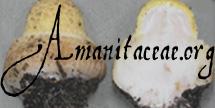
| name | Amanita hamadae |
| name status | nomen acceptum |
| author | Nagas. & Hongo |
| english name | "Hamada's Ringless Amanita" |
| intro |
The following description is based on the original description by Nagasawa and Hongo (1984). |
| cap |
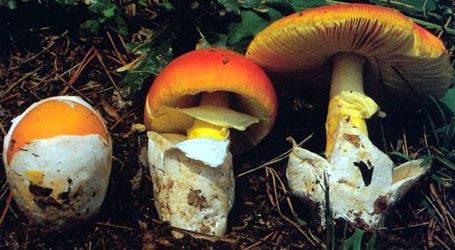
The cap of A. hamadae is 45 - 70 mm wide, yellowish-brown to brown or olive-brown over the center, grayish yellow towards the margin in maturity, light yellow to yellow around the margin when young, campanulate at first, then becoming convex to planar with a significant umbo, subviscid when moist, with a strongly sulcate-striate margin. The flesh is thin, white, yellow under the cap skin. |
| gills |
The gills are free, subcrowded, 4 - 7 mm broad, whitish, becoming somewhat pinkish with age, with a yellow subflocculose edge. The short gills are truncate. |
| stem | The stem is 100 - 130 × 4 - 10 mm, slightly tapering upward, hollow, sulfur yellow to light yellow or grayish yellow, except for the lower third which is tinged with salmon color, and fibrillose-scaly except for its bottom-most portion [Note: illustration shows decoration is in a pattern often called zebroid, flame, or snakeskin.]. A bulb and ring are absent in the original collection. The saccate volva is 20 - 40 × 15 - 20 mm, membranous, attached only at the very base of the stem, with a light yellow tint in the upper part of the limb, and with a fringed internal limb. The flesh is thin, white, yellow under the skin, pinkish at the base of the stem. |
| odor/taste |
Odor and taste are indistinct. |
| spores |
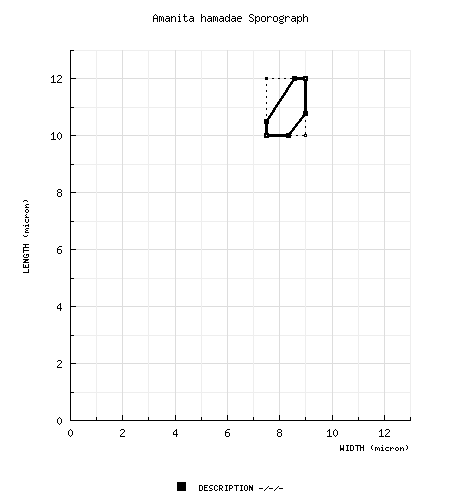
The spores measure 10 - 12 (-13) × (7-) 7.5 - 9 (-11) µm and are broadly ellipsoid to ellipsoid and inamyloid. Clamps are absent at bases of basidia. |
| discussion |
This species occurs alone or in groups in association with Abies-Castanopsis forests, especially under A. firma and was originally described from western Japan. While the colors, spore shape, and habit of the present species suggest a relationship to the Slender Caesars (stirps Hemibapha), this relationship can be questioned because this species lacks a ring and lacks clamps throughout the fruiting body including the basidia. In addition, assuming that the illustration of the basidia and subhymenium is correct, the subhymenium is not composed of layers of roughly globose cells as it is in stirps Hemibapha. Among the known taxa of stirps Hemibapha having spores approximately equally distributed between broadly ellipsoid and ellipsoid, Amanita hamadae is the only species known without bright colors. The original description of A. hamadae includes brief mention of a gelatinized suprapellis (upper layer of cap skin) including hyphae with yellow content. We are not sure how to interpret this statement; but, if this describes a gelatinized matrix through which ungelatinized colored hyphae run, then we should point to a group of taxa with a similar cap skin that has a tropical distribution and includes A. sampajensis A. V. Sathe & S. M. Kulk., A. flammeola Pegler & Pierce, and A. dunicola Guzmán. It is also possible that the hyphae observed in the suprapellis of A. hamadae are vascular hyphae [hyphae with refractive content that rarely have cross-walls (septa)] or are not part of the Amanita but of an attacking mold.—R. E. Tulloss and L. Possiel |
| brief editors | RET |
| name | Amanita hamadae | ||||||||||||||||||||
| author | Nagas. & Hongo. 1984. Trans. Mycol. Soc. Japan 25: 369, fig. 2(a-e). | ||||||||||||||||||||
| name status | nomen acceptum | ||||||||||||||||||||
| english name | "Hamada's Ringless Amanita" | ||||||||||||||||||||
| etymology | genitive of a Latinized name; hence "Hamada's" or "of Hamada" | ||||||||||||||||||||
| MycoBank nos. | 105035 | ||||||||||||||||||||
| GenBank nos. |
Due to delays in data processing at GenBank, some accession numbers may lead to unreleased (pending) pages.
These pages will eventually be made live, so try again later. Search:
Showing 0 to 0 of 0 entries | ||||||||||||||||||||
| holotypes | TMI | ||||||||||||||||||||
| intro |
The following text may make multiple use of each data field. The field may contain magenta text presenting data from a type study and/or revision of other original material cited in the protolog of the present taxon. Macroscopic descriptions in magenta are a combination of data from the protolog and additional observations made on the exiccata during revision of the cited original material. The same field may also contain black text, which is data from a revision of the present taxon (including non-type material and/or material not cited in the protolog). Paragraphs of black text will be labeled if further subdivision of this text is appropriate. Olive text indicates a specimen that has not been thoroughly examined (for example, for microscopic details) and marks other places in the text where data is missing or uncertain. The following material is derived from the protolog of the present taxon. | ||||||||||||||||||||
| pileus | from protolog: 45 - 70 mm broad, at first light yellow (2A5) to yellow (2A6-7), then grayish yellow (4C6-7, 3B6-7, 2B7), over disc yellowish brown (5D6-7) to brown (6D7, 6E7-8) to olive brown (4D8), campanulate to convex later expanding to planar, markedly umbonate, subviscid when wet, glabrous; context thin, white, yellow under pileipellis; margin conspicuously sulcate-striate:. | ||||||||||||||||||||
| lamellae | from protolog: free, subcrowded, whitish, becoming somewhat pinkish with age, 4 - 7 mm broad, with edge yellos and suflocculose; lamellulae truncate. | ||||||||||||||||||||
| stipe | from protolog: 100 - 130 × 4 - 10 mm, sulphur yellow (1A5) to light yellow (2B5) or grayish yellow (2B6), tinted with moderate salmon (4A3, 5A2-3) in lower half to one-third, with lower one-quarter to one-third glabrous (per figure), above minutely fibrillose-scaly creating snake-skin or zebroid patterning (per figure), slightly narrowing upward; context hollow, white, pinkish at base of stipe; exannulate; universal veil as saccate volva, membranous, 20 - 40 × 15 - 20 mm, with light yellow (1A4-5) tint in upper part, attached only at very base of stipe, with distinct "fringed" limbus internus. | ||||||||||||||||||||
| odor/taste | from protolog: Odor and Taste indistinct. | ||||||||||||||||||||
| macrochemical tests |
none recorded. | ||||||||||||||||||||
| pileipellis | from protolog: as cutis, up to 400 μm thick, in two layers; suprapellis gelatinized, 50 - 75 μm thick; [subpellis presumably ungelatinized;] filamentous hyphae 3 - 7.5 (-10) μm wide; vascular hyphae ca. 3 μm wide, with yellow contents, especially noted in suprapellis. | ||||||||||||||||||||
| pileus context | not described. | ||||||||||||||||||||
| lamella trama | not described. | ||||||||||||||||||||
| subhymenium | not described. | ||||||||||||||||||||
| basidia | from protolog: 50 - 65 × ca. 12.5 μm, 4-sterigmate; clamps absent. | ||||||||||||||||||||
| universal veil | from protolog: On pileus: absent. On stipe: filamentous hyphae 3 - 7.5 μm wide; inflated cells scattered, subglobose to oblong to ellipsoid, up to 100 × 30 (-50) μm. | ||||||||||||||||||||
| stipe context | not described. | ||||||||||||||||||||
| partial veil | absent. | ||||||||||||||||||||
| lamella edge tissue | from protolog: inflated cells subglobose, mostly 15 - 35 μm wide, thin-walled, hyaline, in chains. | ||||||||||||||||||||
| basidiospores | from protolog: [-/-/-] 10 - 12 (-13) × (7-) 7.5 - 9 (-11) μm, (Q = 1.20 - 1.40 (-1.60)), hyaline, smooth, thin-walled, inamyloid, broadly ellipsoid to ellipsoid, adaxially flattened (per figure); apiculus sublateral, cylindric (both per fig.); contents "with one large refractive guttule" [oil drop type (per fig.)]; color in deposit not recorded. | ||||||||||||||||||||
| ecology | from protolog: Solitary to subgregarious. Terrestrial. In Abies-Castanopsis forest, especially with Abies firma. | ||||||||||||||||||||
| material examined | from protolog: JAPAN: HONSHU—Tottori-ken, Tottori-shi, Ochidani, 31.viii.1977 E. Nagasawa s.n. (paratype, TMI 7781), 15.ix.1977 E. Nagasawa & M. Miyauchi s.n. (paratype, TMI 7782), 7.ix.1979 E. Nagasawa s.n. (holotype, TMI 7783). | ||||||||||||||||||||
| citations | —R. E. Tulloss | ||||||||||||||||||||
| editors | RET | ||||||||||||||||||||
Information to support the viewer in reading the content of "technical" tabs can be found here.
| name | Amanita hamadae |
| bottom links |
[ Keys & Checklists ] |
| name | Amanita hamadae |
| bottom links |
[ Keys & Checklists ] |
 Spore data sets and their composite
Each spore data set is intended to comprise a set of measurements from a single specimen made by a single observer; and explanations prepared for this site talk about specimen-observer pairs associated with each data set. Combining more data into a single data set is non-optimal because it obscures observer differences (which may be valuable for instructional purposes, for example) and may obscure instances in which a single collection inadvertently contains a mixture of taxa.

Text and User-Generated Sporographs are published under the Creative Commons License.

In the case of a taxon page, image credits are on the 'image' tab.