| name |
Amanita flavipes |
| author |
S. Imai. 1933. Bot. Mag. (Tokyo) 47: 428. |
| name status |
nomen acceptum |
| english name |
"Asian Yellow Dust Amanita" |
| synonyms |
≡ Amplariella flavipes (S. Imai) E.-J. Gilbert. 1940. Iconogr. Mycol. (Milan) 27, suppl. (1): 79, tab. 47 (fig. 3).
= Amanita bella S. Imai in E.-J. Gilbert. 1940. Iconogr. Mycol. (Milan) 27, suppl. (1): 47, tab. 47(fig. 4). ≡Amplariella bella (S. Imai in E.-J. Gilbert) E.-J. Gilbert. 1940. Iconogr. Mycol. (Milan) 27, suppl. (1): 79. ≡Amanita pulchella S. Imai nom. illeg 1933. Bot. Mag. (Tokyo) 47: 427.
= Amanita watlingii A. Kumar & T. N. Lakh. in A. Kumar et al. 1990. Amanitaceae India: 92, 112, fig. 18(A-E).
= Amanita flavoconia sensu A. Kumar et al. 1990. ibid.: 63, 99, fig. 5(A-E).
=Amanita flavorubescens sensu Yuan & Sun. 1995. Sichuan Mushrooms: 495.
The editors of this site owe a great debt to Dr. Cornelis Bas
whose famous cigar box files of Amanita nomenclatural information
gathered over three or more decades were made available to RET for computerization
and make up the lion's share of the nomenclatural information presented on this site.
|
| MycoBank nos. |
265044, 284153 |
| GenBank nos. |
Due to delays in data processing at GenBank, some accession numbers may lead to unreleased (pending) pages.
These pages will eventually be made live, so try again later.
|
| holotypes |
A. bella—in herb. S. Imai (SAP); isotype (fragment) in herb. Gilbert (lost).
A. watlingii—HPUB. |
| lectotypes |
A. flavipes—in herb. S. Imai (SAP); isolectotype (fragment), in herb. Gilbert (lost). |
| lectotypifications |
E.-J. Gilbert. 1940. op. cit.: 174 (in caption to fig. 3). |
| revisions |
Z. L. Yang. 1997. Biblioth. Mycol. 170: 202, figs. 169-172.
Tulloss et al. 2001. Mycotaxon 77: 480, figs. 13-15. |
| selected illustrations |
E.-J. Gilbert. 1941. Iconogr. Mycol. (Milan) 27, suppl.: tab. 54-55.
Imazeki and Hongo. 1965. Color Illus. Fungi 2: 41, pl. 12(fig. 75).
Imazeki et al. 1988. Fungi Japan: 162. |
| intro |
The following text may make multiple use of each data field.
The field may contain magenta text presenting data from a type study
and/or revision of other original material cited in the protolog of the present taxon.
Macroscopic descriptions in magenta are a combination of data from the protolog and
additional observations made on the exiccata during revision of the cited original
material.
The same field may also contain black text, which is data from a revision of the present
taxon (including non-type material and/or material not cited in the protolog).
Paragraphs of black text will be labeled if further subdivision of
this text is appropriate.
Olive text indicates a specimen that has not been
thoroughly examined (for example, for microscopic details) and marks other places in the text
where data is missing or uncertain.
Any of the following material not directly from the protolog of the present taxon and not cited as the published work of Dr. Z. L. Yang or another researcher is based upon original research by R. E. Tulloss.
NOTE: Spore measurements from papers by Z. L. Yang use his "Times New Roman" face for "Q"
and "Q'"—respectively, "Q" and "Q." |
| basidiospores |
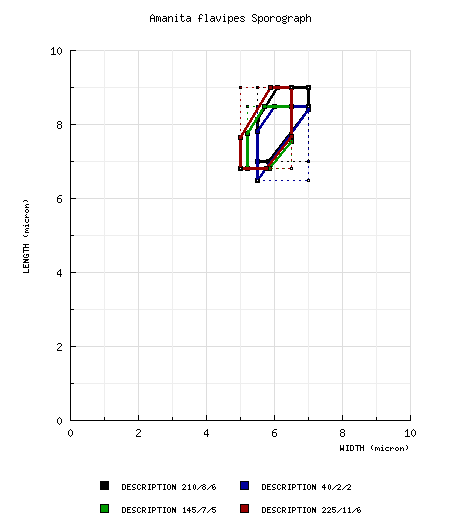
from Yang (1997): [210/8/6] (6.5-) 7.0 - 9.0 (-10.0) × (5.0-) 5.5 - 7.0 (-8.5) μm, (Q = (1.06-) 1.20 - 1.48 (-1.56); Q = 1.31 ± 0.07), broadly ellipsoid to ellipsoid, sometimes subglobose, amyloid, colorless, hyaline, smooth, thin-walled; apiculus small.
from Yang (2002a): [40/2/2] 6.5 - 8.5 (-9.0) × (5.0-) 5.5 - 7.0 μm, (Q = (1.14-) 1.20 - 1.42 (-1.50); Q' = 1.28 ± 0.08), hyaline, colorless, smooth, thin-walled, amyloid, broadly ellipsoid to ellipsoid; apiculus proportionately small; contents ?not recorded; color in deposit not recorded.
from Tulloss et al. (2001): [145/7/5] (6.0-) 6.8 - 8.5 (-11.0) × (5.0-) 5.2 - 6.5 (-8.8) µm, (L = 7.3 - 7.7 (-7.8) µm; L’ = 7.5 µm; W = 5.7 - 5.9 µm; W’ = 5.8 µm; Q = (1.12-) 1.16 - 1.49 (-1.69); Q = 1.27 - 1.34 (-1.38); Q’ = 1.30), hyaline, colorless, thin-walled, smooth, amyloid, broadly ellipsoid to ellipsoid, occasionally subglobose or elongate, often adaxially flattened, sometimes swollen at one end; apiculus sublateral, cylindric, narrow, sometimes prominent; contents mono- or multiguttulate, with or without additional small granules; white in deposit.
Composite of data from India and Pakistan (RET): [225/11/6] (5.8-) 6.8 - 9.0 (-11.0) × (4.2-) 5.0 - 6.5 (-8.8) μm, (L = 7.3 - 7.9 (-8.2) μm; L' = 7.6 μm; W = (5.4-) 5.6 - 5.9 μm; W' = 5.7 μm; Q = (1.12-) 1.18 - 1.53 (-1.73); Q = 1.27 - 1.40; Q' = 1.33), colorless, hyaline, smooth, thin-walled, amyloid, broadly ellipsoid to ellipsoid, infrequently subglobose or elongate, infrequently reniform, usually at least somewhat adaxially flattened; apiculus sublateral, cylindric, proportionately small, infrequently rather prominent; contents mono- to multiguttulate; color in deposit not recorded. |
| ecology |
from Yang (1997): Solitary or in small groups. China: At 1800 - 3300 m elev. In coniferous and mixed forest wtih Pinus and Picea speciesand representatives of the Fagaceae.
from Tulloss et al. (2001): Solitary to gregarious, in mixed woods, mostly under conifers. Himachal Pradesh, India [Kumar et al. (1990a)]: At 2000 - 3200 m elev. In woods of Cedrus deodara, Picea smithiana and Abies pindrow or woods of C. deodara and Pinus wallichiana or under C. deodara or in dominantly coniferous forest of C. deodara and P. wallichiana with scattered Quercus incana. Pakistan: With A. pindrow. |
| material examined |
from Yang (1997): CHINA: XIZANG AUTONOMOUS REGION (TIBET)—Linzhi Prefecture (also Nyingchi Prefecture) - Unkn. Co., unkn. loc., 3100 m elev., 19.viii.1983 Y. G. Su s.n. (HKAS 16414).
SICHUAN—Liangshan Yi Autonomous Prefecture - Xichang (county level) City, Luojishan, 2000 m elev., 16.vii.1992 M. S. Yuan 1787 (HKAS 25764, as "Amanita flavorubens" in Yuan & Sun (1995: 495)).
YUNNAN—Chuxiong Yi Autonomous Prefecture - Lufeng Co., Yipinglang, 1820 m elev., 26.vi.1978 Shengweizhan 786033 (HKAS 4530, as "A. aspera" in Zheng (1988: 120)). Dali Bai Autonomous Prefecture - Binchuan County, Jizushan, 3100 m elev. 17.viii.1985 G. P. Xiao 773 (HKAS 15417). Diqing Tibetan Autonomous Prefecture - Shangri La Co.(formerly Zhongdian Co.), Dabaosi, 3300 m elev., 20.ix.1993 M. Zang 12001 (HKAS 26990). Kunming (prefecture level) City - Unkn. District, unkn. loc., 3.viii.1995 M. Wang 1 (HKAS 32505).
from Yang (2002a): CHINA: JILIN—Yanbian Korean Autonomous Prefecture - Antu Co., Mt. Changbai, s.d. Y. Wang 811325 (IFP), 811038 (IFP).
from Tulloss et al. (2001):
INDIA:
HIMACHAL PRADESH—Chamba District - Kala Top, 16.viii.1985 T. N. Lakhanpal & A. Kumar s.n. (HPUB 3324 as “A. flavoconia”). Kullu District - Manali, 11.viii.1985 T. N. Lakhanpal & A. Kumar s.n. (HPUB 3176, n.v. as “A. flavoconia”; BPI 71985 as “A. flavoconia”). Shimla District - Chopal, 29.ix.1985 T. N. Lakhanpal & A. Kumar s.n. (paratype of A. watlingii, HPUB 3619, n.v.; paratype of A. watlingii, BPI 71992).
UTTARAKHAND—Pauri District - Garhwal, Nagdeva-Jhandidhar, 23.viii.1993 V. K. Bhatt & R. P. Bhatt s.n. (GUH M-20069 as “A. flavoconia”; RET 300-3).
PAKISTAN: NORTHWEST FRONTIER PROV.—Hazara District - Nathiagali, Kuzagali, 7.viii.1994 A. N. Khalid 781994 (LAH; RET 140-8). |
| citations |
—R. E. Tulloss |
| editors |
RET |
|




 Spore data sets and their composite