| name |
Amanita eijii |
| author |
Zhu L. Yang. 2002. J. Jilin Agric. Univ. 24(2): 32-34, fig. 1(1-3). |
| name status |
nomen acceptum |
| english name |
"Nagasawa's Lepidella" |
| synonyms |
≡ Amanita cokeri f. roseitincta Nagas. & Hongo. 1984. Trans. Mycol. Soc. Jap. 25: 373, fig. 4(a-e).
The editors of this site owe a great debt to Dr. Cornelis Bas
whose famous cigar box files of Amanita nomenclatural information
gathered over three or more decades were made available to RET for computerization
and make up the lion's share of the nomenclatural information presented on this site.
|
| MycoBank nos. |
505513, 117872 |
| GenBank nos. |
Due to delays in data processing at GenBank, some accession numbers may lead to unreleased (pending) pages.
These pages will eventually be made live, so try again later.
|
| holotypes |
TMI 7779 |
| selected illustrations |
Imazeki and Hongo. 1987. Color. Illus. Mushr. Japan 1: 135, pl. 34 (fig. 234). |
| intro |
The following text may make multiple use of each data field.
The field may contain magenta text presenting data from a type study
and/or revision of other original material cited in the protolog of the present taxon.
Macroscopic descriptions in magenta are a combination of data from the protolog and
additional observations made on the exiccata during revision of the cited original
material.
The same field may also contain black text, which is data from a revision of the present
taxon (including non-type material and/or material not cited in the protolog).
Paragraphs of black text will be labeled if further subdivision of
this text is appropriate.
Olive text indicates a specimen that has not been
thoroughly examined (for example, for microscopic details) and marks other places in the text
where data is missing or uncertain.
The following material is drawn from the protolog of the present species and from (Yang 2002), with some additions from others as noted. |
| basidiospores |
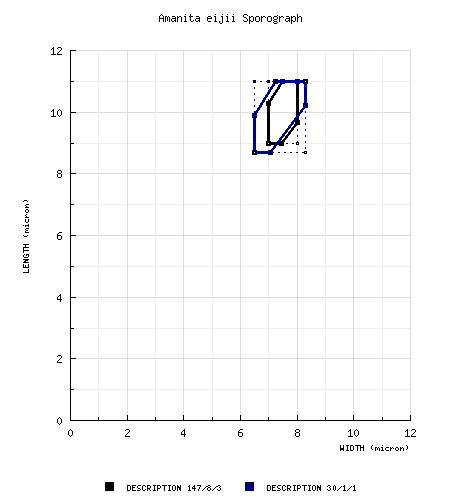
from Yang (2002): [147/8/3] (8.5-) 9.0 - 11.0 (-13.0) × (6.5-) 7.0 - 8.0 (-8.5) μm,
(Q = (1.15-) 1.21 - 1.47 (-1.73); Q' = 1.36 ± 0.08), hyaline, colorless, smooth, thin-walled, amyloid, broadly ellipsoid to ellipsoid, rarely elongate;
apiculus proportionately small; contents not described; color in deposit not described.
composite data from material revised by RET: [30/1/1] (8.6-) 8.7 - 11.0 (-12.0) × 6.5 - 8.3 (-8.5) μm, (L = 9.6 μm; W = 7.2 μm; Q = (1.10-) 1.23 - 1.52 (-1.53); Q = 1.33), subhyaline to hyaline, colorless, smooth, thin-walled, amyloid, broadly ellipsoid to ellipsoid, rarely subglobose, often adaxially flattened; apiculus sublateral, cylindric; contents mono- or multiguttulate or granular; color in deposit not recorded. |
| ecology |
from protolog: Japan: In deciduous hardwood forest with Quercus, Carpinus, Acer, etc. or in Abies-Castanopsis forest.
Yang (2002): Hunan Prov., China: At 1,280 m elev. In broad-leaved or mixed forests. |
| material examined |
from protolog: JAPAN: HONSHU—Tottori-ken - Tottori-shi, Ochidani, 6.viii.1974 E. Nagasawa s.n. (paratype, TMI 3657), 31.viii.1977 E. Nagasawa s.n. (paratype, TIMI 4216), 10.x.1979 E. Nagasawa s.n. (paratype, TMI 7778). Yazu-gun, Funaoka-cho, Ohe, 1.x.1977 E. Nagasawa s.n. (paratype, TMI 4193), 22.vii.1980 S. Murakami s.n. (holotype, TMI 7779).
Yang (2002): CHINA: ANHUI—Huangshan (prefecture level) City - Huangshan Distr., unkn. loc., 30.viii.1957 S. C. Teng 5190 (HMAS 21105).
HUNAN—Shaoyang (prefecture level) City - Wugang City, Yunshan [1280 m], 14.viii.1918 H. Handel-Mazzetti 2618a (WU 12465).
GUIZHOU—Tongren Prefecture - Jiangkou Co., Fanjingshan, 28.viii.1982 Y. C. Zong & H. A. Wen 239 (HMAS 53957).
RET: JAPAN: UNKN. ISLAND—unkn. prefecture - unkn. loc., s.d. unkn. coll. s.n. [Borovička B 378] (PRM; RET 456-1, nrLSU seq'd.). |
| discussion |
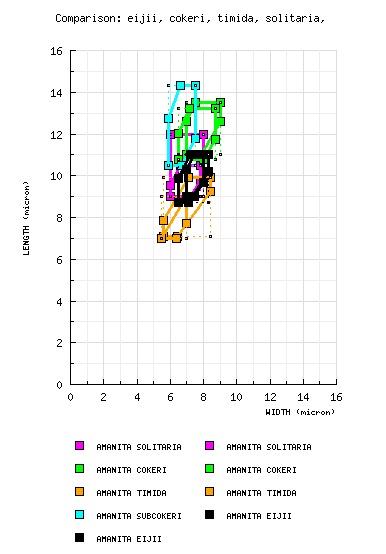
In the following figure, the spore size and shape data of the present species is compared with such data from two species mentioned by Yang (2002: 34)—A. cokeri and A. timida—as well as with the similarly staining A. subcokeri Tulloss nom. prov. from North America and the European A. solitaria. All these taxa are assignable to Amanita [sect. Lepidella subsect. Solitariae] stirps Solitaria.
|
| citations |
—R. E. Tulloss |
| editors |
RET |
|



 Spore data sets and their composite