


| name | Amanita timida |
| name status | nomen acceptum |
| author | Corner & Bas |
| english name | "Timid Lepidella" |
| images |
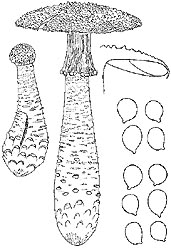 1. Amanita timida, Singapore, drawing by C. Bas from original description. 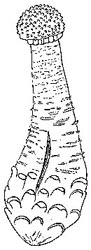 2. Amanita timida, Singapore, drawing by C. Bas from original description. 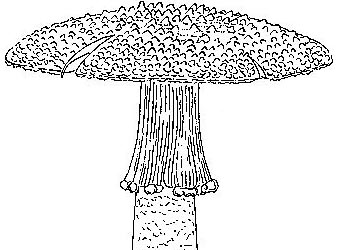  3. Amanita timida, Singapore, drawing by C. Bas from original description. |
| cap |
The cap of A. timida is 50 - 120 mm wide, globose to convex, whitish to pinkish, dry, with a nonsulcate margin. The cap is densely set with firm, adnate, pinkish to pale brown, conical warts passing into subflocculose points towards the margin. |
| gills |
The gills are rather crowded, free to narrowly adnate, white then cream, with a whitish granular edge. The short gills are attenuate. |
| stem |
The stem is 65 - 180 × 10 - 20 mm, tapering upward, with a subclavate, clavate, fusiform, or elongate-fusiform base, solid, and whitish to pinkish to brownish. Pinkish to brownish, firm, rather large scales are present below the ring, and minute scales are present in the middle. |
| spores |
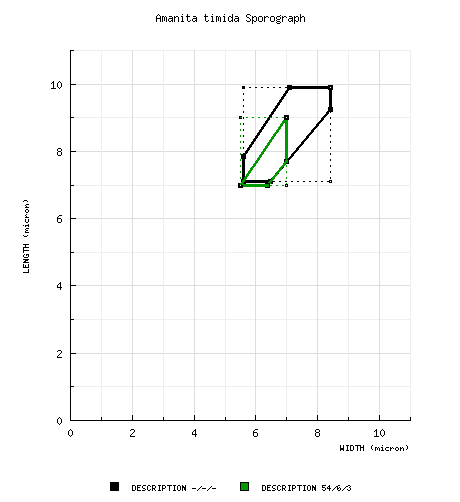
The spores measure 7.1 - 9.9 × 5.6 - 8.4 µm from fresh material and 8 - 10 × 6.5 - 8 µm from dry material (original description, 1962) [(6.5-) 7 - 9 (-10) × 5.5 - 7 (-8.5) µm (Bas, 1969)] and are subglobose to broadly ellipsoid (occasionally globose or ellipsoid) and amyloid. Clamps are abundant at the bases of basidia. |
| discussion |
This species was originally described from Singapore. Similar material was reported from Sarawak (Bas, 1969); and,in that work, Bas included in the spore measurements data taken from the Sarawak material with results shown in square brackets, above. |
| brief editors | RET |

 Spore data sets and their composite