| name |
Amanita subcokeri |
| author |
Tulloss nom. prov. |
| name status |
nomen provisorum |
| english name |
"False Coker's Lepidella" |
| GenBank nos. |
Due to delays in data processing at GenBank, some accession numbers may lead to unreleased (pending) pages.
These pages will eventually be made live, so try again later.
|
| intro |
Olive text indicates a specimen that has not been
thoroughly examined (for example, for microscopic details) and marks other places in the text
where data is missing or uncertain.
The following material is based on original research by R. E. Tulloss. |
| pileus |
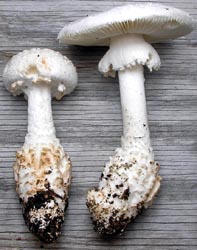
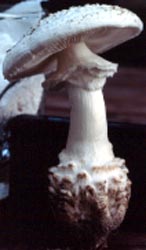
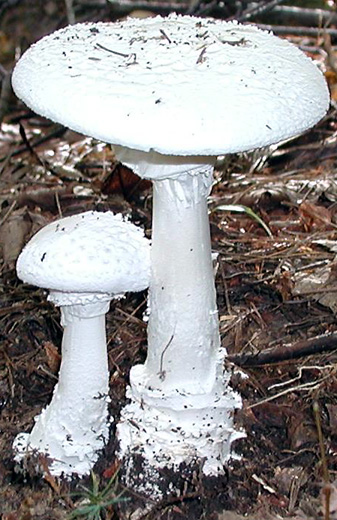
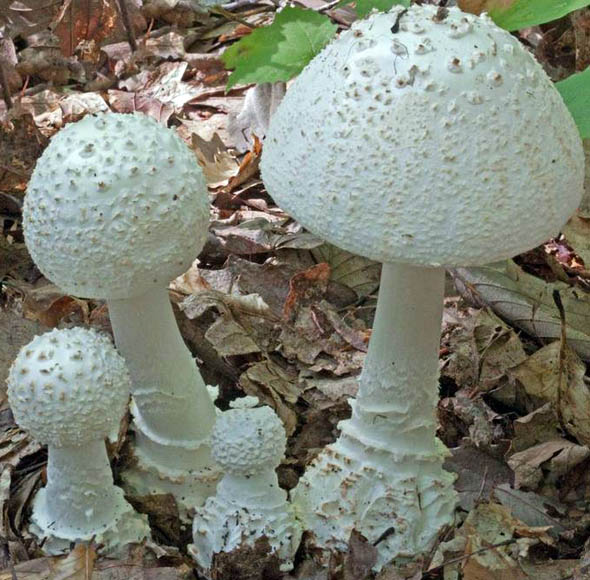
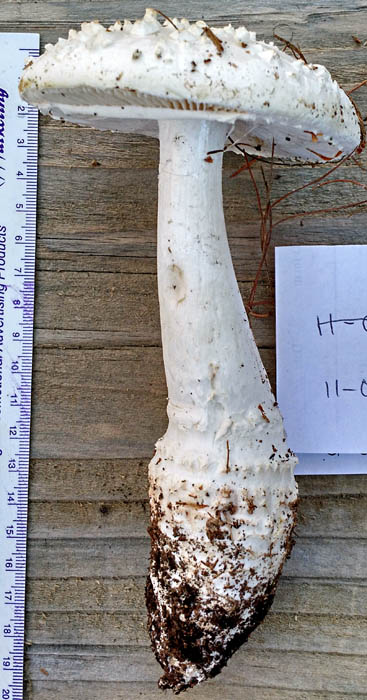
71 - 137 mm wide, white to cream, plano-convex,
occasionally with undulate margin, shiny to subshiny,
dry; context white, unchanging or becoming
watery tan when cut or bruised, 7 - 15 mm thick at
stipe, thinning evenly to margin; margin
nonstriate, decurved to incurved, sometimes with very
short sterile extension of pileipellis beyond context
and lamellae, appendiculate with ragged,
submembranous, broken curtain; universal veil
as pyramidal warts (over disk) to pulverulent coating
or minute scales (at margin), grayish to white to
cream, darkening to brick or brown at tips,
detersile in wet weather, sometimes sliding off of
pileipellis as confluent group, quite difficult to
remove from dry pileipellis. |
| peridium |
double click in markup mode to edit. |
| lamellae |
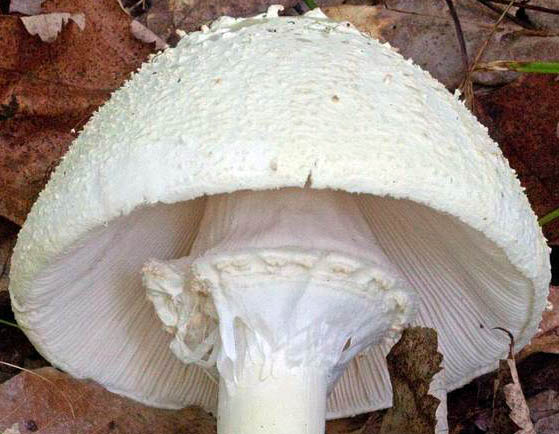
free to very narrowly adnate, with or without decurrent line on stipe apex, close to subcrowded to crowded, cream to pale cream to off-white in mass, pale cream to slightly sordid yellowish cream to cream to off-white in side view, edge browning in age, otherwise unchanging, rounded at stipe, 9 - 12 mm broad, sometimes extending below pileus margin (side view of basidiome); lamellulae rounded truncate to subtruncate with attenuate tooth to subattenuate to attenuate to stepwise attenuate, almost always alternating with lamellae, but irregularly distributed, of diverse lengths, plentiful. |
| stipe |
56 - 80 (-130) × 11 - 17.5 (-25) mm, white, pale buff with age, occasionally with brick stains or spots (especially in wounds), narrowing upward, flaring at apex, faintly longitudinally striate (lens), minutely fibrillose (lens), often becoming satiny in age; bulb 42 - 84 × 22.5 - 43 mm, carrot-shaped to fusiform to subfusiform to subnapiform, radicating, sometimes doglegged, particularly liable to red-brown or brick stains and spots on large scales, upper portion (about one-third) coarsely squamulose with several rows (up to 8 or more) of coarse squared-off recurving scales; context white, solid, occasionally with lacunae up to 30 × 6 mm, changing as in pileus context when cut or bruised, sometimes faintly brick tinted in few minutes after sectioning, larva tunnels in bulb concolorous to brick-red; partial veil white, subapical to superior, membranous, persistent, faintly to strongly striate above, with duplex margin thickened with universal veil material, with fibrils connecting underside and margin to stipe surface, sometimes as true double annulus (lower one superior to submedian) joined at edges or not (when not joined, with lower annulus bearing universal veil on its edge); universal veil on tips of recurved scales on upper portion of bulb or as rings at top of bulb and as smears and flattened incomplete rings on lower stipe. |
| odor/taste |
Odor like a combination of burnt sugar and cedar wood, strong in maturing material, not unpleasant when fresh, becoming unpleasant with aging. Taste not recorded. |
macrochemical
tests |
L-tyrosine spot test for tyrosinase - positive in context and on surface of stipe (no other tissues tested). Paracresol spot test for tyrosinase - quickly positive in sectioned pileipellis and center of stipe context, within 8 min. strongly positive in disk context, within 20 min. also less strongly positive throughout bulb; negative in other parts of basidiome. Spot test for laccase (syringaldazine) - positive in two small spots near surface just below broadest part of bulb (strong reaction in a wound?); negative throughout remainder of basidiome. Conc. H2SO4 - pink flash in pileus context; pink flash then dark brown on pileipellis; rapidly pink in stipe context, then slowly fading in < 1 min. to pale pink and colorless in < 4 min.; rapidly pink on lamella surface, still strongly pink after 3 min., becoming sordid pale pink after 5 min.; color only in excess reagent after 6 min. Vouchers for chemical tests: Tulloss 7-29-84-B, 7-21-85-C, 9-12-93-A. 7-24-96-L. |
| lamella trama |
bilateral, divergent; ??. |
| basidia |
50 - 73 × 10.5 - 17.5 (-20) μm, 4-sterigmate, with sterigmata up to 7.0 μm long, arising from ??; clamps at least locally common. |
| basidiospores |
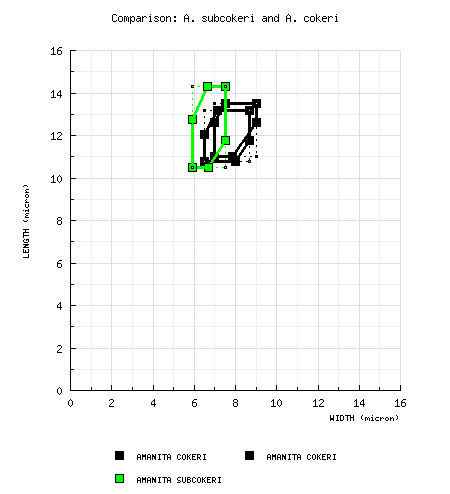
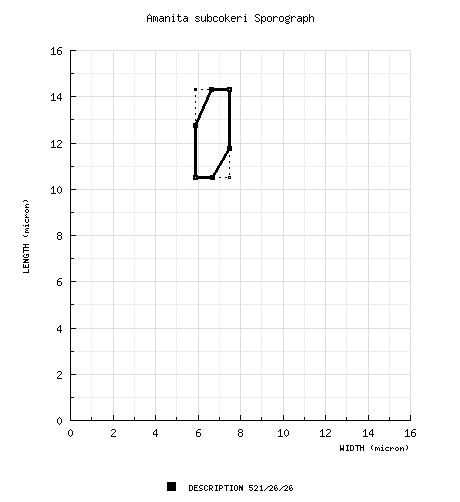
[521/26/26] (8.0-) 10.5 - 14.3 (-19.0) × (5.2-) 5.9 - 7.5 (-10.9) µm, (L = (10.7-) 10.8 - 13.6 (-13.8) µm; L’ = 12.1 µm; W = (6.0-) 6.1 - 7.0 µm; W’ = 6.6 µm; Q = (1.33-) 1.57 - 2.16 (-2.82); Q = (1.59-) 1.64 - 2.02 (-2.11); Q’ = 1.84), hyaline, colorless, smooth, thin-walled, amyloid, ellipsoid to elongate to cylindric, adaxially flattened or slightly depressed; apiculus sublateral, cylindric; contents ??; white in deposit. |
| ecology |
Solitary to subgregarious. Connecticut: In sandy loam. Massachusetts: In dark brown, unsandy soil, under Tsuga canadensis with Pinus nearby. New Jersey: In sand in pine-oak barrens including P. rigida, Q. marilandica, Q. prinus, and Q. alba. More often than any other Amanita species RET has observed in the New Jersey Pine Barrens, this species is particularly likely to be found with a blue-green Penicilium species growing on the pileus warts or in cavities which may occasionally be found in the stipe context. New York: At ca. 160 m elev. In mixed woods with plentiful Pinus strobus. Tennessee: In forest comprising Acer, Betula, Fagus grandifolia, Liriodendron tulipifera, Pinus, Quercus, Tilia, and Tsuga canadensis or in forest comprising Acer, Betula, Carya laciniosa, Quercus, and T. canadensis. |
| material examined |
U.S.A.:
CONNECTICUT—Middlesex Co. - East Haddam,
Devil’s Hopyard St. Pk. [41°28'32" N/ 72°20'25" W,
72 m], 26.viii.1985 R. Phillips 2850 (in herb. R.
Phillips; RET 212-5); Salmon River St. For. (South)
[41°32’58” N/ 72°27’01” W, 21 m], 24.viii.2007
William Bakaitis s.n. [Tulloss 8-24-07-F] (RET
439-9, nrLSU seq'd.),
3.ix.2011 Bill Yule s.n.
[Tulloss 9-3-11-C] (RET 490-10).
Tolland Co. -
Salmon River St. For. (East), 31.viii.1997 S.
Hopkins s.n. [Tulloss 8-31-97-Q] (RET 267-2).
INDIANA—Monroe Co. -
SE of Bloomington, Lake Monroe, Paynetown St.
Recreation Area [39.0941° N/ 86.4476° W, 174 m],
11.ix.2012 Stephen Russell s.n.
[mushroomobserver.org #109447]
(RET 535-3); Morgan-Monroe St. For.
[39.3298° N/ 86.4388° W, 248 m], 20.ix.2012 S.
Russell s.n.
[mushroomobserver.org #110638]
(RET 535-4). Montgomery Co. - Waveland,
Shades St. Pk. [39.9378° N/ 87.0894° W, 223 m],
28.viii.2012 S. Russell s.n.
[mushroomobserver.org #107640]
(RET 435-9). Owen Co. - Spencer, McCormick’s
Creek St. Pk. [39.2982° N/ 86.7217° W, 218 m],
15.viii.2012 S. Russell s.n.
[mushroomobserver.org #109803]
(RET 535-8).
MASSACHUSETTS—Barnstable Co. (Cape Cod) -Brewster, 2.x.2009 Erin Moriarty s.n. (RET 460-9); N. Eastham, 22.ix.1989 Walter Rode s.n. [R. E. Tulloss 9-22-89-WR1] (RET 238-8). Essex Co. - E. W. Palmer St. Pk., 6.4 km W of Ipswich, 12.viii.1985 R. Phillips 2754 (in herb. R. Phillips; RET 212-2). Middlesex Co. - Concord, Walden Pond St. Res., ca. railroad 0.5+ km S of Walden Pond, 18.x.1998 Liz Alia & Einar Rønquist s.n. (RET 289-5).
NEW JERSEY—Burlington Co. - Batsto
Village, 21.vii.1985 Bart Johnson 7-21-85-C
(RET 204-5); ca. Chatsworth, Franklin Parker
Preserve 30.x.2009 J. & N. Burghardt s.n.
(RET 449-4); north gage
("airport entrance," ca. Chatsworth, Franklin
Parker Preserve
[39°48.827' N/ 74°32.857' W, 29 m], 3.x.2010 John
Burghardt s.n. (RET 468-10), 14.x.2012 Igor
Safonov s.n. [Tulloss 10-14-12-K]
(RET 519-5).
Cape May Co. - Belleplain St. For.
[39.2477° N/ 74.8583° W, 8 m], 8.xi.2015
NJMA foray participant s.n. [Tulloss 11-8-15-D] (RET 714-9).
Middlesex Co. - Jamesburg Twp., Jamesburg Twp.
Pk., ca. Helmetta [40°23’07” N/ 74°25’48” W],
24.vii.1996 Britt Carlson & R. E. Tulloss
7-24-96-L (RET 200-1), 22.viii.1981 M. A. King,
D. C., M. H. & R. E. Tulloss 8-22-81-B
(RET 322-7), 22.ix.1982 D. C., M. H. & R. E.
Tulloss 9-22-82-H (RET 224-10), 19.viii.1981 R. E.
Tulloss 8-19-81-C (RET 322-5), -D (RET 322-6),
4.ix.1981 R. E. Tulloss 9-4-81-A (RET 171-7), -D
(RET 171-8), 11.iv.1982 R. E. Tulloss 9-11-82-C
(RET 177-7), -F (RET 177-8),
3.ix.1983 D. C. & R. E.
Tulloss 9-3-83-C (RET 469-3), -D
(RET 471-9), 27.ix.1983 R. E. Tulloss
9-27-83-A (RET 227-10), 11.viii.1985 R. E. Tulloss
8-11-85-B (RET 202-3), 21.viii.1993 R. E. Tulloss
8-21-93-H (RET 097-3), 12.ix.1993 R. E. Tulloss
9-12-93-A (RET 104-1).
Monmouth Co. - Roosevelt,
Goldstein farm prop., ca. Co. Rte. 571
[40°14'04" N/ 74°28'34" W, 41 m], 7.viii.2009 F.
Wartchow, Lily & R. E. Tulloss s.n.
(RET 457-7; URM).
Ocean Co. - Waretown [39°47’12” N/ 74°11’50” W],
1984 C. Hogenbirk 84-1
(RET 132-4). Unkn. Co. - unkn. loc.,
18.viii.1984 participant NEMF1984 s.n. [Tulloss
8-18-84-O] (RET 207-4).
NEW YORK—Sullivan Co. - Wurtsboro,
Bashakill Wildlife Mgmt. Area [41°32’21” N/
74°31’19” W, 158 m], 25.ix.2010 Steve &
Margaret Rock s.n. [Tulloss 9-25-10-A]
(RET 484-5).
NORTH CAROLINA—Buncombe Co. - Asheville,
2.viii.2010 Patrick Harvey s.n.
[mushroomoberver.org #49521]
(RET 471-10). Haywood Co. - GSMNP, Palmer
Creek Tr., 11.vii.1999 T. Rey s.n. [ATBI FU-0261]
(RET 393-9).
TENNESSEE—Blount Co. - GSMNP,
Finley Cane Tr. trailhead [35°36.7’ N/ 83°44.7’ W],
4.viii.1999 R. E. Tulloss s.n. [ATBI FU-0624]
(RET 393-10). Sevier Co. - GSMNP,
Greenbrier, 25.ix.2006 R. E. Tulloss s.n.
[Tulloss 9-25-06-A] (RET 398-2).
WEST VIRGINIA—Greenbrier Co. - woods
above rest stop along U.S. Rte. 60 ca. 1.6 km W of
Charmco, 9.viii.1990 M. A. Vincent 4381
(MU F38508; RET 146-4). |
| discussion |
The following figure compares sporographs of the present species and A. cokeri:
|
| citations |
—R. E. Tulloss |
| editors |
RET |
|



 Spore data sets and their composite