| name |
Amanita cremeosorora |
| author |
Tulloss nom. prov. |
| name status |
nomen provisorum |
| english name |
"Creamy Sister Ringless Amanita" |
| etymology |
cremeus "cream or cream-colored" + sorora "sister"; hence, maintaining the metaphoric naming of species with friable universal veils in Amanita section Vaginatae as "sisters" of Cecilia (A. ceciliae) |
| GenBank nos. |
Due to delays in data processing at GenBank, some accession numbers may lead to unreleased (pending) pages.
These pages will eventually be made live, so try again later.
|
| intro |
Olive text indicates a specimen that has not been
thoroughly examined (for example, for microscopic details) and marks other places in the text
where data is missing or uncertain.
The following is based upon original research by R. E. Tulloss. |
| pileus |
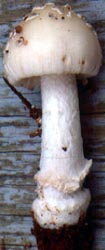
46 - 75 mm wide, white to pale cream at first, pale cream after expansion, then developing tan or brownish tint especially over disc, subhemispheric expanding to convex; context white, unchanging when cut or bruised, 5 - 5.5 mm thick over stipe, thinning evenly for 65 - 80% of radius, then less than 1 mm thick or membranous to margin; margin striate (0.25 - 0.3R), nonappendiculate; universal veil in felted to subfelted-subflocculose warts or confluent wart or patches, minutely verruculose, white at first, becoming brown with age, friable, detersile. |
| lamellae |
free to subremote, without decurrent line on stipe apex, subcrowded to crowded, pale cream or faintly orangish cream in mass, unchanging when cut or bruised, whitish pr faintly yellowish cream in side view, 4.5 - 5.5 mm broad, thickest at midpoint, with edge minutely flocculose (×10 lens); lamellulae truncate or subtruncate, unevenly distributed, of diverse lengths, plentiful. |
| stipe |
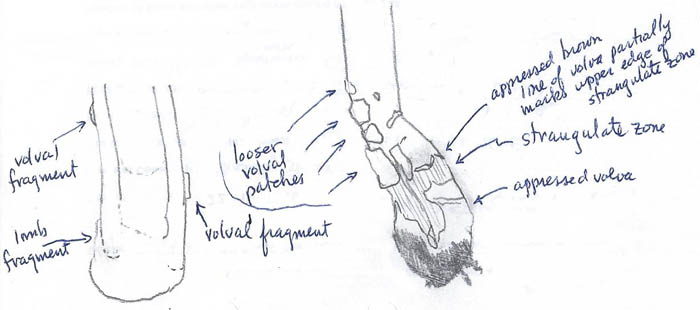
69 - 148 × 9 - 10 mm, white or concolorous with pileus, becoming pale brownish from handling, pulverulent above, decorated with dense, recurved, fine scales below (largest in lower half of stipe), narrowing upward, not flaring at apex, infrequently with very small radical; context white to pale cream, hollow, with 4 - 5 mm wide central cylinder, often with sparse interwoven white cottony fibrils in central cylinder and sometimes bridging central cylinder, sometimes with some soft grayish stuffing at base pf central cylinder, insect tunnels not observed; exannulate; universal veil as cupulate volva with additional ring or rings (perhaps comprising material of limbus internus) above it on lower stipe, also sometimes present as few or many detersile or firmly appresed fragments of volval limb, white, becoming gray or brownish gray then brown on surface and internally with age/exposure. |
| odor/taste |
Odorless. Taste not recorded. |
macrochemical
tests |
Spot test for tyrosinase (L-tyrosine) - within three min. positive throughout stipe above strangulate zone, along line dividing pileus context and lamellae, and in pileipellis; after 13 min., positive on inner half of lamellae and in entire stipe, with reactive stipe base having a very distinct dividing line between it and the L-tyrosine-negative, cupulate universal veil; negative throughout universal veil and most of pileus context. Spot test for tyrosinase (paracresol) - positive throughout stipe and pileipellis and volval remnants on pileus and lamella edge tissue and spottily on (water resistant) lamella surface; negative on cupulate volva remnant on stipe base. Spot test for laccase (syringaldazine) - negative throughout basidiome except positive in small volval fragment on lower stipe. Test vouchers: Tulloss 11-28-83-D, 9-22-96-E. |
| basidia |
50 - 71 × 12.5 - 15.8 (-16.0) µm, 4-sterigmate; clamps not observed. |
| partial veil |
absent |
| basidiospores |
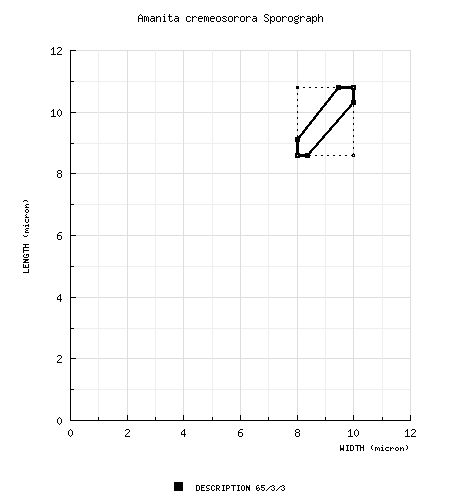
[65/3/3] (8.0-) 8.6 - 10.8 (-11.6) × (7.0-) 8.0 -
10.0 (-11.0) µm, (L = 9.6 - 10.0 µm;
L' = 9.8 μm; W = 8.9 - 9.4 µm;
W' = 9.1 μm; Q = 1.03 - 1.14 (-1.17);
Q = 1.06 - 1.08); Q' = 1.08), hyaline,
colorless, thin-walled, smooth, inamyloid, globose to
subglobose to broadly ellipsoid, often at least
somewhat adaxially flattened; apiculus
sublateral, cylindric; contents monoguttulate
often with small additional granules;
?? in deposit. |
| ecology |
Solitary. Connecticut: In duff and fluffy brown loam of mixed woods with Tsuga canadensis. New Jersey: in dense, mixed deciduous forest including plentiful Quercus. South Carolina: in sandy red clay in open forest of Quercus and Pinus. |
| material examined |
U.S.A.:
CONNECTICUT—Middlesex Co. - Salmon River St. For. (South) [41°32’58” N/ 72°27’01” W, 21 m], 22.ix.1996 Sandy Sheine s.n. [Tulloss 9-22-96-E] (RET 250-2). Tolland Co. - Hebron, The Hemlocks Nature Education Center [41°37’11” N/ 72°23’22” W, 145-160 m], 4.is.2011 M. A. & R. E. Tulloss 9-4-11-A (RET 492-3, nrITS, seq'd.).
NEW HAMPSHIRE—Unkn. Co. - Moultonborough, 20.viii.2007 R. D. Van de Poll s.n. (RET 413-7).
NEW JERSEY—Morris Co. - Mendham, Meadowood Twp. Pk. [40°47'31" N/ 74°38'43" W, 214 m], 27.vii.1986 Jo Ann McVey s.n. [RET 7-27-86-I] (RET 045-6).
NEW YORK—Dutchess Co. - Clinton Corners, 22.ix.1990 W. Bakaitis 90-188 (RET 011-5).
SOUTH CAROLINA—Oconee Co. - Seneca [34°46'09" N/ 82°57'55" W, 263 m], 28.xi.1985 R. E. Tulloss 11-28-85-D (RET 130-8).
TENNESSEE—Blount Co. - Great Smoky Mtns. Nat. Pk., Cades Cove, loop road, 27.ix.2006 D. J. Lodge, E. Lickey, R. E. Tulloss 9-27-06-C (RET 398-8; TENN). |
| discussion |
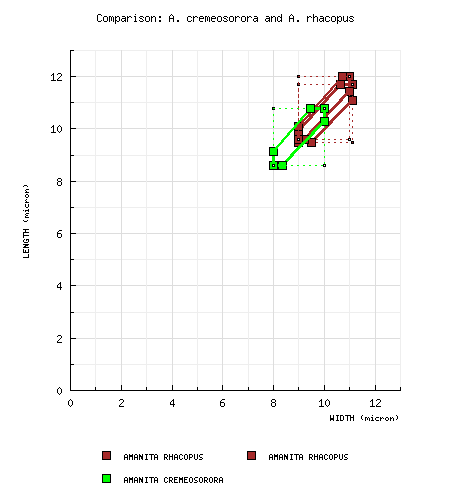
The following figure provides a comparison of the spores of the present species and those of A. rhacopus by means of sporographs:
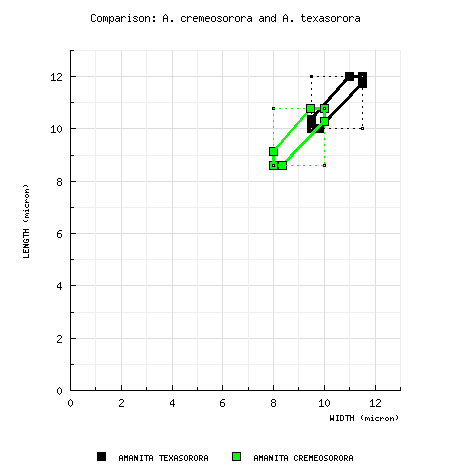
The following figure provides a comparison of the spores of the present possible species with those of A. texasorora:
(t.b.d.) |
| citations |
—R. E. Tulloss |
| editors |
RET |
|




 Spore data sets and their composite