| name |
Amanita texasorora |
| author |
Tulloss, Kudzma & D. P. Lewis |
| name status |
nomen provisorum |
| english name |
"Texan Sister Ringless Amanita" |
| GenBank nos. |
Due to delays in data processing at GenBank, some accession numbers may lead to unreleased (pending) pages.
These pages will eventually be made live, so try again later.
|
| intro |
The following text may make multiple use of each data field.
The field may contain magenta text presenting data from a type study
and/or revision of other original material cited in the protolog of the present taxon.
Macroscopic descriptions in magenta are a combination of data from the protolog and
additional observations made on the exiccata during revision of the cited original
material.
The same field may also contain black text, which is data from a revision of the present
taxon (including non-type material and/or material not cited in the protolog).
Paragraphs of black text will be labeled if further subdivision of
this text is appropriate.
Olive text indicates a specimen that has not been
thoroughly examined (for example, for microscopic details) and marks other places in the text
where data is missing or uncertain.
The following material not cited as the work of
another researcher is based on the notes and
photographs of collectors, molecular studies of
Dr. L. V. Kudzma, and other original research by
R. E. Tulloss and David P. Lewis. |
| pileus |
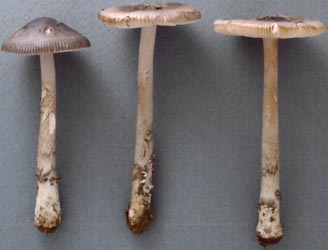
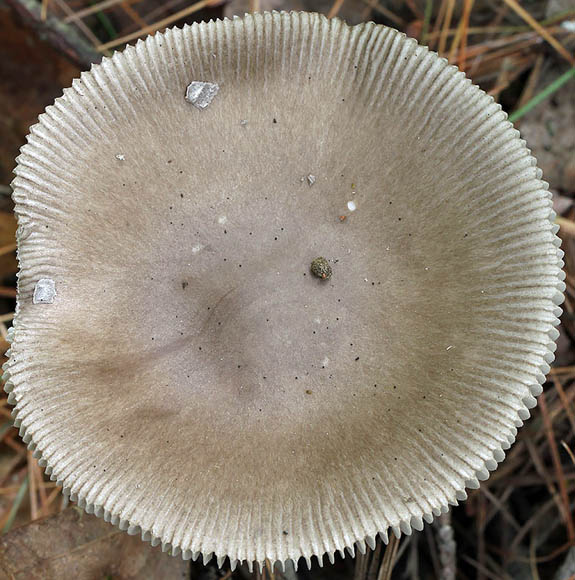
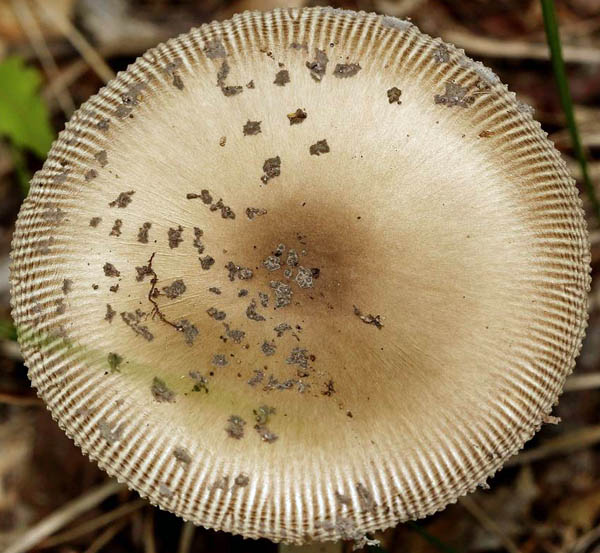
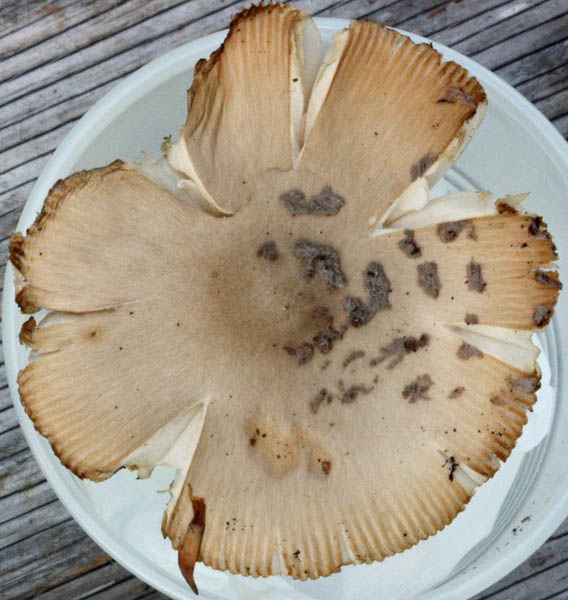
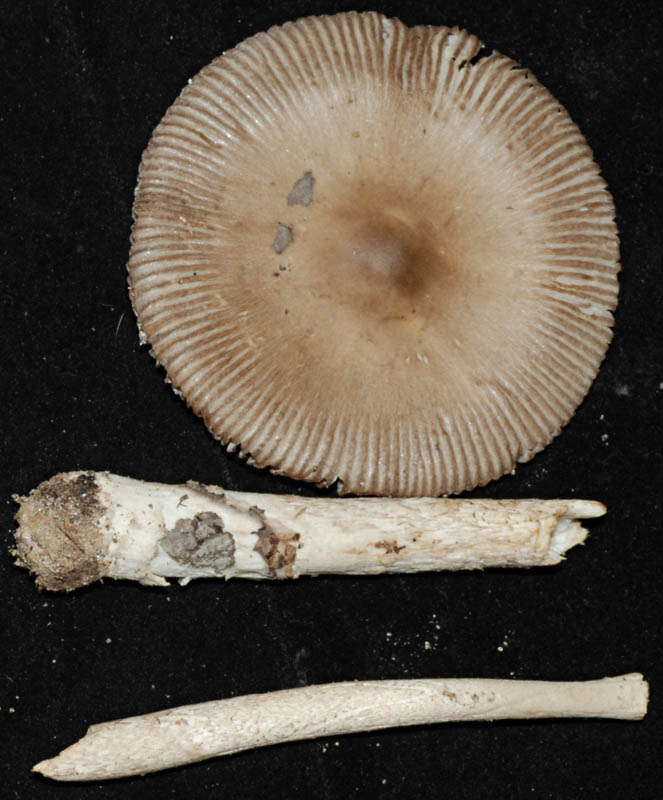
40 - 100 mm wide, brown to Dresden Brown
(e.g., 5E4) to grayish brown to
olivaceous brown (e.g., 5E5) to Dresden Brown
(10YR 4/4) to Saccardo Olive (2.5Y 4/4) to rather
dark grayish-brown
(e.g., browner than 10YR 6/2), sometimes darkening
with age, sometimes darker brown over marginal
striations (10YR 4/2), sometimes faintly virgate,
sometimes with margin pallid (cream), hemispheric to
rounded conic at first then convex to planoconvex,
eventually planar, sometimes with low broad umbo,
sometimes depressed over disc,
tacky to dry, dull to shiny, feels like like a kid glove
when matte;
context white, pale brown to gray in 1 - 2 mm
thick region below pileipellis in disc, not staining
or bruising, sometimes with watersoaked line along
upper edge lamellae, 3 - 7 mm thick over stipe,
thinning evenly for 35 - 90% of radius, then
membranous to margin; margin short-striate
to striate (0.15R - 0.4R), nonappendiculate,
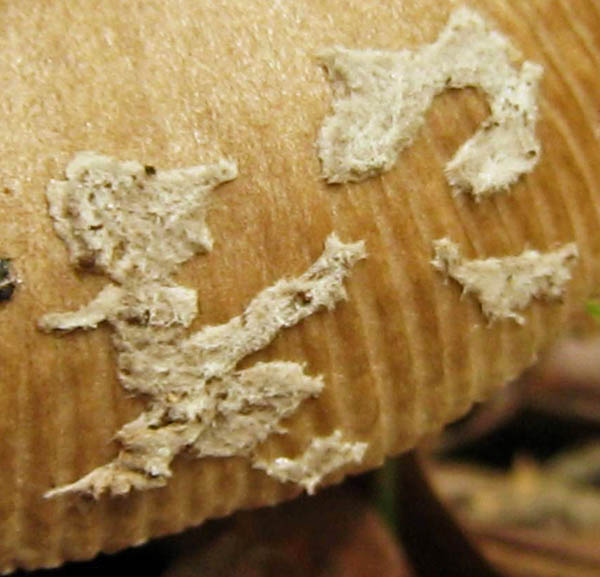
decurved; universal veil absent or as
irregular (small to large) sometimes areolate
patches sometimes with raised edges or as
concentric rings of warts, white or whitish at
first, becoming
gray to dark gray and finally black, submembranous
to subpulverulent, with uneven surface (minutely
verruculose), friable, detersile at least at first. |
| lamellae |
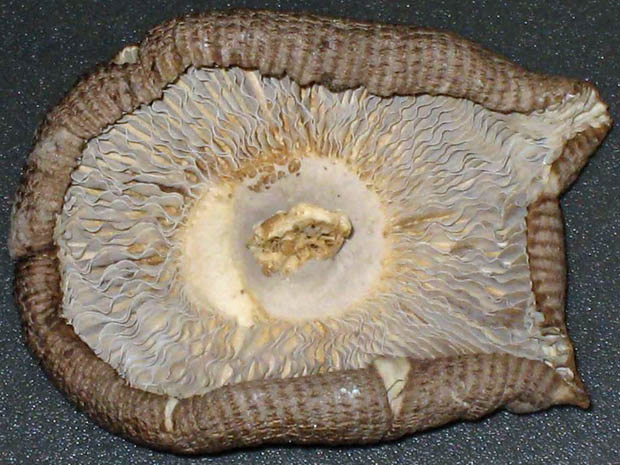
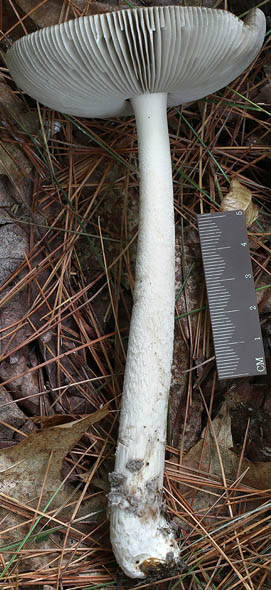
free (sometimes with faint decurrent tooth on stipe),
close to crowded, off-white to pale grayish white to
sordid cream in mass, off-white to pale cream to
cream to pale
grayish cream in side view, infrequently with
red-brown stains on free edge or near cap margin,
3 - 9 mm broad, broadest
at 65 - 75% of lamella length, with edge sometimes
white, infrequently with reverse forking;
lamellulae truncate to subtruncate,
occasionally truncate with tooth at cap context,
unevenly distributed, of diverse lengths, plentiful,
originating both at stipe and at pileus margin,
occasionally attached neither to stipe nor pileus
margin. |
| stipe |
90 - 146 × 4.0 - 15.0 mm, with white or pallid ground
color, sometimes starkly white at base, becoming pale
brown from handling, often with pale gray or brownish
gray fibrils, subcylindric or narrowing upward, often
flaring at apex, with three zones of surface
decoration, with uppermost zone originally white to
pale gray pulverulent and occupying upper half of
stipe at first and shrinking upward with age, with
middle zone decorated by longitudinally oriented and
densely placed surface fibrils becoming brown or
gray or pinkish-grayish
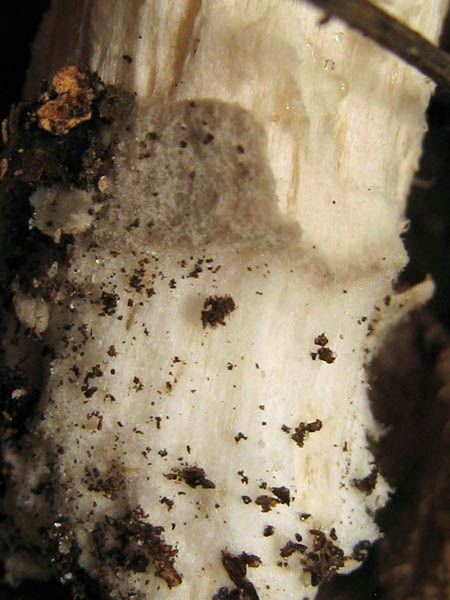
or grayish-brown with time and handling, with lowest
zone white and sometimes bearing some slightly
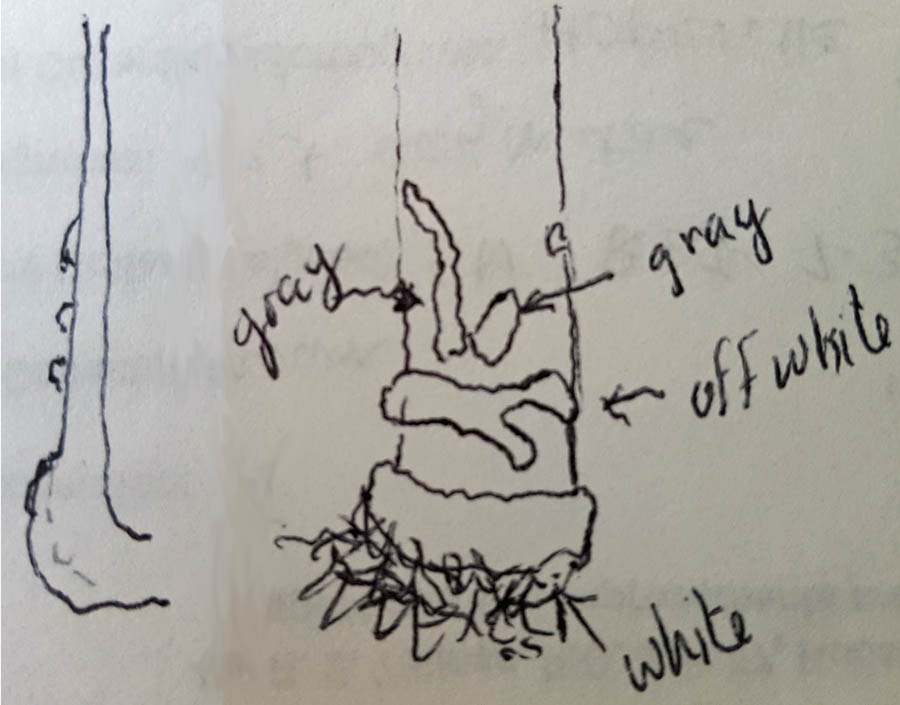
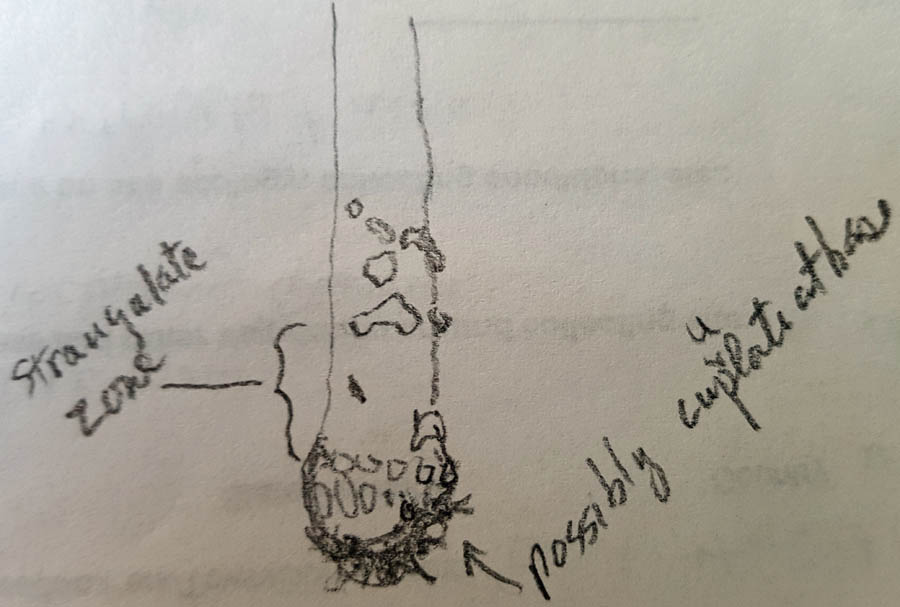
recurved scales (see pencil sketch of stipe base of
RET 319-4), eventually minutely longitudinally
striatulate; context white to off-white to
cream to very
pale tan, infrequently pale grayish white at in
stipe base, unchanging when cut, with larval
tunnels concolorous, predominantly hollow, with
exception of filamentous lining of central
cylinder and scattered loosely filamentous "cross
walls" and loosely stuffed base, with stuffing
material comprising white cottony fibrils, with
central cylinder occupying 50 - 80% of stipe
diameter (with stipes of larger diameter having
proporitonately larger cavities);
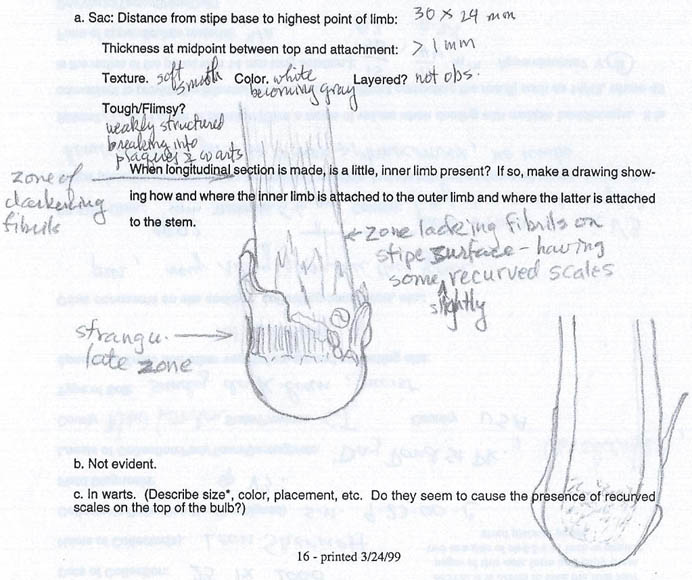
exannulate; universal veil at first
briefly as saccate submembranous volva, soon as
cupulate volval base largely (sometimes entirely)
separated from
limb fragments by strangulate zone, with limb
fragments and/or limbus internus eventually often
forming
dark gray to black ring above strangulate zone; up
to 24 mm wide at broadest point (before entire
collapse of limb), with uppermost point of limb or
limb fragment
24 - 56 mm from stipe base,soft, smooth, with
exterior white at first and becoming gray and then
black, with limb weakly structured and breaking
into plaques and warts (see sketch of stipe base
from RET 319-4) and finally remaining only as wavy
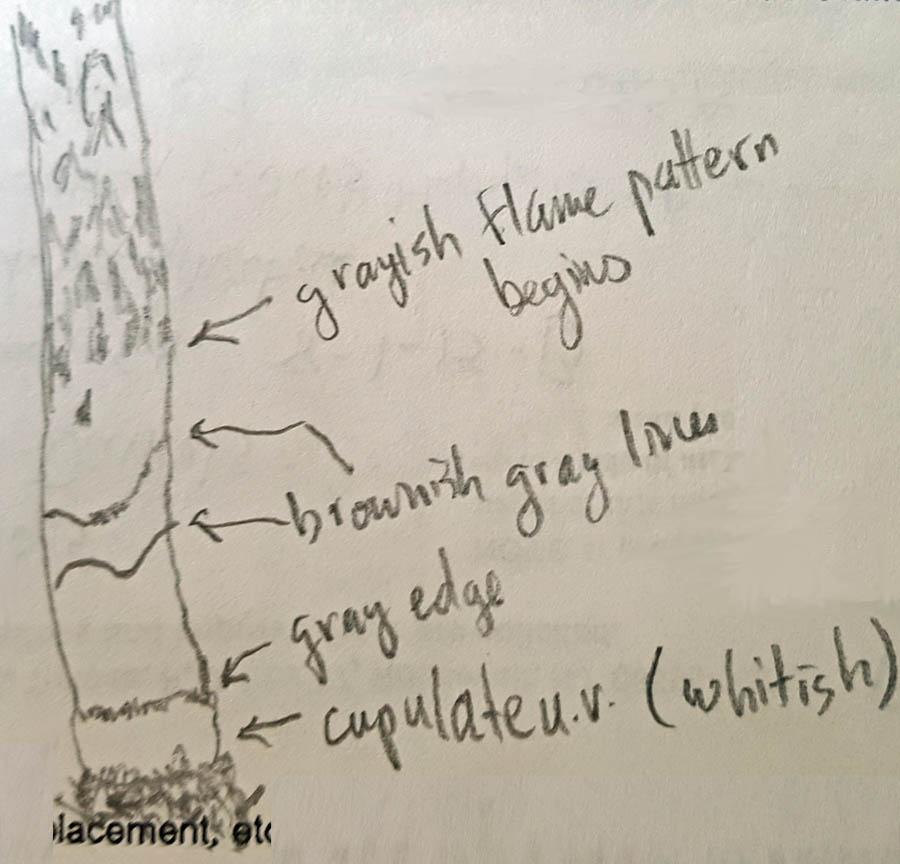
lines encircling stipe (see sketch of stipe base
from RET 704-9). |
| odor/taste |
Odor insignificant or faint or "fungoid slightly unpleasant." Taste not recorded. |
macrochemical
tests |
spot test for laccase (syringaldazine) - negative
throughout basidiome; spot test for tyrosinase
(paracresol) - immediately positive throughout all of
basidiome except immediately below pileipellis and on
part of lamellae nearest stipe, eventually positive
throughout basidiome. Test voucher: Tulloss
10-25-86-B (RET 467-5). |
| partial veil |
absent. |
| lamella edge tissue |
sterile. |
| basidiospores |
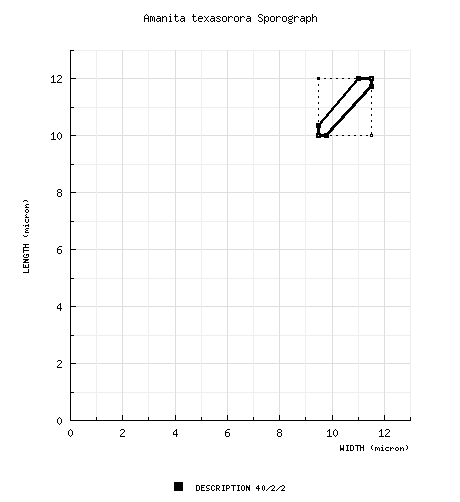
[40/2/2] (9.8-) 10.0 - 12.0 (-13.1) × (9.1-) 9.5 -
11.5 (-12.9) µm, (L = 11.2 - 11.3 µm;
L' = 11.0 µm; W = 10.2 - 10.7 µm;
W' = 10.4 µm; Q = 1.02 - 1.09 (-1.10);
Q = 1.04 - 1.07; Q' = 1.05), hyaline,
colorless, smooth, thin-walled, inamyloid, globose to
subglobose, often somewhat adaxially flattened;
apiculus sublateral, cylindric, abrupt;
contents multiguttalate to granular; white in
deposit. |
| ecology |
Solitary or in small groups. Connecticut: In
mixed deciduous forest with plentiful Quercus
spp., Fagus grandifolia, Betula,
Pinus strobus, Tsuga canadensis, etc.
and occasional conifers or in moist sandy dark loam
or in loam of coniferous forest or in loam of mixed
forest.
Georgia: Under Quercus.
Louisiana: Under Pinus with Quercus
nearby.
Massachusetts: In coniferous forest or in loam and
duff of mixed forest of northern hardwoods, T.
canadensis and Pinus spp.
North Carolina: At base of large
Quercus.
Rhode Island: In sandy soil of
Pinus-Quercus woods.
Tennessee: With T. canadensis and
Quercus in mixed forest.
Texas: In sandy soil of mixed Pinus and
hardwood forest or among native grasses in area
with Pinus, Liquidambar styraciflua,
and Juniperus or in Q. alba slope
forest or in Quercus-Pinus forest or in
upland forest dominated by Pinus with
some Quercus or in bottomland hardwoods
including Quercus.
Wisconsin: In Pinus-Quercus
sand barrens with Q. alba, Q.
velutina, Q. ellipsoidalis, P.
strobus, P. banksiana and other trees
or in Q. macrocarpa & Pinus
savannah. |
| material examined |
U.S.A.:
CONNECTICUT—Middlesex Co. - E. Haddam,
Devil’s Hopyard St. Pk. [41.4676° N/ 72.3400° W, 72
m], 24.viii.2007 R. E. Tulloss 8-24-07-I (RET
439-4, nrITS seq'd.), -L (RET 440-3, nrITS seq'd.),
4.ix.2011 COMA2011 foray participant s.n. [Tulloss
9-4-11-Q] (RET 489-9, nrITS & nrLSU seq'd.),
1.viii.2015 Megan Daniels s.n. [Tulloss
8-1-15-A] (RET 703-9, nrITS & nrLSU, seq'd.),
s.n. [Tulloss 8-1-15-B] (RET 704-9, nrITS &
nrLSU seq'd.).;
Portland Twp., Hurd St. Pk. [41.5216° N/ 72.5412°
W, 84 m], 24.vii.1992 NEMF1992 foray participant
s.n. [Tulloss 7-25-92-D] (RET 066-2, nrITS
seq'd.)
New Haven Co. - 24.vii.1992 NEMF92
foray participant s.n. [Tulloss 7-24-92-C] (RET
067-10); Woodbridge Twp., Woodbridge, ca. Tho.
Darling house, Blue Trail, 23.vii.1992 Dr. Eugene
Varney s.n. [Tulloss 7-23-92-G] (RET 065-4, nrITS
seq'd.).
New London Co. - Colchester, Day
Pond St. Pk. [41.5569° N/ 72.4333° W, 134 m],
23.ix.2000 Leon Shernoff s.n. [Tulloss 9-23-00-C]
(RET 319-4, nrITS seq'd.); Griswold, Hopeville Pond St. Pk.
[], 31.vii.2015 NEMF2015 participant s.n. [Tulloss
7-31-15-I] (RET 703-4, nrITS & nrLSU seq'd.).
Tolland Co. -
Gay City St. Pk. [41.7231° N/ 72.4439° W, 209 m],
31.viii.1997 R. E. Tulloss 8-31-97-Na (RET 268-4,
nrITS seq'd.), -Nb (RET 268-3, nrITS seq'd.);
Hebron, The Hemlocks Nature Educ. Ctr. [41.6197°
N/ 72.3894° W, 145-160 m], 25.ix.1999 R. E. Tulloss
9-25-99-A (RET 301-10, nrITS-LSU seq'd.),
9-25-99-E (RET 303-10), 21.ix.1996 Benjamin A.
Maleson s.n. [Tulloss 9-21-96-F] (RET 250-8, nrITS
seq'd.), 25.ix.1999 R. E. Tulloss 9-25-99-B
(RET 303-9; nrITS-LSU seq'd.).
GEORGIA—Clarke Co. - Tallahassee
Highlands [33.991º N/ 83.4954º W, 239 m], 14.ix.2017
Bill Sheehan s.n. [mushroomobserver
#290667]
(RET 796-7, nrITS-LSU seq'd.)
Fulton Co. - unkn. loc.,
15.iv.2012 Timothy Peden s.n. [mushroomobserver
#93338]
(RET 500-5, nrLSU seq'd.).
INDIANA—Newton Co. - De Motte, Community
Christian Reformed Church [41.1520º N/ 87.3061º W,
208 m], 24.viii.2017 Frances
Kuerbs Buckley s.n. [Mycomap #7077] (RET 818-6,
nrITS-LSU seq'd.).
Porter Co. - Indiana National
Lakeshore, Cowles Bog Unit, trail E of parking lot,
12.x.2009 Felipe Wartchow FWIN01 (RET 581-6, nrITS
& nrLSU seq'd.).
KENTUCKY—Greenup Co. - unkn. loc.,
8.ix.2019 Kevin Moore s.n. [mushroomobserver
381530]
(RET 879-5, nrITS-LSU seq'd.).
LOUISIANA—Tangipahoa Parish -
Kentwood, 20.viii.2018 Logan Weidenfeld s.n.
[mushroomobserver
#328693]
(RET 843-8, nrITS & nrLSU seq'd.).
MASSACHUSETTS—Essex Co. - Boxford,
Boxford St. For. [42.6459° N/ 71.0171° W, 39 m],
8.x.1990 Mary A. King, Estelle H. Tulloss &
Sarah E. K. Tulloss s.n. [Tulloss 9-8-90-D] (RET
598-9, nrITS seq'd.). Middlesex Co. - ca.
Sudbury, Hop Brook Marsh Conservation Area,
14.viii.1993 NEMF1993 participant s.n. [Tulloss
8-14-93-D] (RET 095-3, nrITS seq'd.).
MISSOURI—Ste. Genevieve Co. - Hawn
St. Pk. [37.8297° N/ 90.23° W, 183 m], 1.viii.2015
Patrick Harvey s.n. [mushroomobserver
#212032]
(RET 705-10, nrITS & nrLSU seq'd.).
NEW JERSEY—Monmouth Co. - Shark River
Co. Pk. [40°12’18” N/ 74°05’44” W], 30.viii.1998 Cory
Conover, Sarah E. K. & R. E. Tulloss [Tulloss
8-30-98-C] (RET 286-10, nrITS seq'd.).
NORTH CAROLINA—Buncombe Co. -
SW of Asheville, jct. of Blue Ridge Pkwy. and
Mountains-to-Sea Tr. [35.4747° N/ 82.614° W, 888 m],
14.ix.2014 Patrick Harvey s.n. [mushroomobserver
#179211]
(RET 647-10, nrITS & nrLSU seq'd.).
McDowell Co. - Blue Ridge Pkwy., milepost 320,
Chestoa View [35.9195° N, 81.9579° W, 1247 m elev.]
15.ix.2014 P. Harvey s.n. [mushroomobserver
#179152]
(RET 648-1, nrITS & nrLSU seq'd.).
Wake Co. - Raleigh, Umstead St. Pk. [35.8675° N/
78.7523° W, 118 m], 30.x.2015
Geoff Balme s.n. [mushroomobserver
#221123]
(RET 715-7, nrITS & nrLSU seq'd.), 12.vi.2018
G. Balme s.n. [mushroomobserver
#319555]
(RET 854-1, nrITS-LSU seq'd.), 28.viii.2018 G. Balme s.n.
[mushroomobserver
#329981]
(RET 876-2, nrITS & nrLSU seq'd.).
RHODE ISLAND—Washington Co. - Exeter,
Arcadia Wildlife Mgmt. Area [41.5955° N/ 71.7097°
W, 74 m], 20.vii.2014 Linas V. Kudzma 14156 (RET
665-5, nrITS seq'd.).
TENNESSEE—Sevier Co. - GSMNP, Huskey
Gap Tr. off Newfoundgap Rd. [35.6631° N/
83.5267° W, 580 m], 15.viii.2006 Ed Lickey
s.n. [TFB 13336] [TENN 061604, nrITS seq'd.].
TEXAS—Hardin Co. - BTNP, Lance Rosier
Unit, 25.x.1986 Anne B. Speers s.n. [Tulloss
10-25-86-B] (RET 467-5. nrITS seq'd.-poor); BTNP,
Lance Rosier Unit, at Kinky Branch Crk., Cotton
Rd., 14.xi.2009 David P. Lewis 9561 (RET 464-7,
nrITS seq'd.); Saratoga, Teel Rd., BTNP, Lance
Rosier Unit, 15.xi.2008 D. P. Lewis 8768 (RET
429-9, nrITS seq'd.).
Newton Co. - Bleakwood,
Co. Rd. 3062, Lewis prop. [30.7085° N/ 93.8272° W,
33 m], 2.vii.2007 D. P. Lewis 8147
(RET 416-5, nrITS & nrLSU seq'd.),
2.viii.2009 D. P. Lewis 9151 (RET 463-3,
nrITS & nrLSU seq'd.).
Orange
Co. - Big Thicket Nat. Preserve, Beaumont Unit
[30.2398° N/ 94.0925° W, 17 m], 4.vii.2014 David P.
Lewis 11327 (RET 682-4, nrITS & nrLSU), 15.vii.2014
David P. Lewis 11358 (RET 682-6, nrITS & nrLSU
seq'd.).
Tyler Co. - Big Thicket National Preserve, North
Turkey Creek Unit [30.2036° N/ 94.3487° W,
15 m], 11.vi.2014 Ronald Pastorino
6-11-14I [mushroomobserver
#168062
(RET 622-8, nrITS & nrLSU seq'd.).
Waller Co. - Hempstead [30.1022° N/ 96.0786° W,
122 m], 22.xi.2018 Logan Wiedenfeld s.n.
[mushroomobserver
#346371]
(RET 857-9, nrITS-LSU seq'd.).
WISCONSIN—Adams Co. - Quincy Bluff
[43.8829° N/ 89.86815° W, 280m], 10.vii.2013 Andrew
Khitsun s.n. [mushroomobserver.org
#146275]
(RET 575-7, nrITS seq'd.). Waushara Co. -
Mecan River Fishery Systems [43.9995° N/ 89.4621° W,
307 m], 9.vii.2018 Alden Dirks s.n. [mushroomobserver
#326682
(RET 841-2, nrITS-LSU seq'd.), [43.9972° N/ 89.4645°,
290 m], 9.viii.2018 Alden Dirks s.n. [mushroomobserver
#326684
(RET 841-3, nrITS & nrLSU seq'd.). |
| discussion |
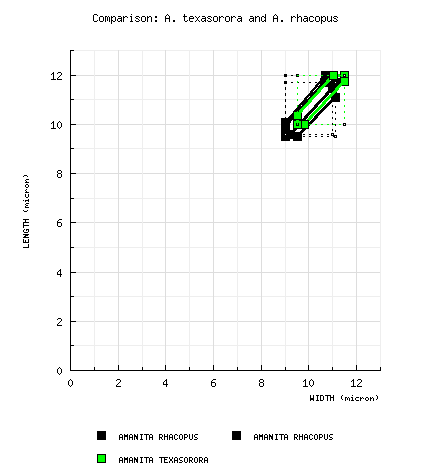
For sporograph comparisons with other
A.
rhacopus-like taxa from eastern North
America, see the techtab of
A. sp-V03.
Multiple collections originally designated as
"Amanita "sp. N34" or "sp. N45" have produced nrITS and/or
nrLSU
sequences that match sequences of the same loci
derived from Texas material of A.
texasorora.
The original morphological concepts of both the
Texas and Connecticut material involved a darker
than usual cap in comparison to similar taxa such
as A. sp-V03. However, the cap colors
present on specimens of the present species have
turned out to be quite variable—as in the
case of A.
rhacopus.
Collections on this
page are grouped by their nrITS and/or nrLSU
sequences.
This page
contains material previously assigned to
temporary code "A. sp-T01.
Despite the great similarity between the nrITS of
this
species and that of A.
sp-V03, they differ within the 5' 5.8S motif
in
one of the known variable characters. Since
this is
a rather conserved point in a nrITS sequence, this
is unusual within a single species. Hence, we
keep
the two names as indicating separate taxa for the
time being although phylogenetic separation is not
strongly supported. |
| citations |
We thank Patrick Leacock for his assistance with proper identification, geography and labeling of the Indiana collection.—R. E. Tulloss, L. V. Kudzma, and David P. Lewis |
| editors |
RET |
|



 Spore data sets and their composite