| name |
Amanita concentrica |
| author |
T. Oda, C. Tanaka and Tsuda. 2002. Mycoscience 43: 81-83. |
| name status |
nomen acceptum |
| english name |
"Devil's Apple Amanita" |
| synonyms |
= Amanita cokeri sensu R. P. Bhatt & V. K.
Bhatt [p.p.]. 1996.
Indian J. Mycol. Pl. Pathol. 26(1): 113-114.
?= Amanita albida Yadw. Singh & Munruchi Kaur.
2016.
World J. Pharmacy Pharmaceut. Sci. 5(5):
1055, figs. 1-3.
The editors of this site owe a great debt to Dr. Cornelis Bas
whose famous cigar box files of Amanita nomenclatural information
gathered over three or more decades were made available to RET for computerization
and make up the lion's share of the nomenclatural information presented on this site.
|
| MycoBank nos. |
484950 |
| GenBank nos. |
Due to delays in data processing at GenBank, some accession numbers may lead to unreleased (pending) pages.
These pages will eventually be made live, so try again later.
|
| holotypes |
CBM |
| intro |
The following text may make multiple use of each data field.
The field may contain magenta text presenting data from a type study
and/or revision of other original material cited in the protolog of the present taxon.
Macroscopic descriptions in magenta are a combination of data from the protolog and
additional observations made on the exiccata during revision of the cited original
material.
The same field may also contain black text, which is data from a revision of the present
taxon (including non-type material and/or material not cited in the protolog).
Paragraphs of black text will be labeled if further subdivision of
this text is appropriate.
Olive text indicates a specimen that has not been
thoroughly examined (for example, for microscopic details) and marks other places in the text
where data is missing or uncertain.
The following is based on the protolog of the present species and on original research by R. E. Tulloss. |
| pileus |
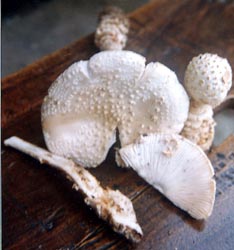
from protolog: 60 - 136 mm wide, white to yellowish white (1-3A1-2) hemispheric at first, then convex to planar; context white, 6 - 9 mm thick over stipe; margin striate (0.15 - 0.35R), often upturned in age, sometimes appendiculate with fragments of partial veil; universal veil as densely placed pyramidal warts up to 3 × 5 mm, often becoming smaller "floccose patches toward margin," white to yellowish white, "often discoloring" to brownish yellow, brownish orange, grayish orange to orange (5B-C4-8) toward wart tips.
RET: 80± mm wide, white to dingy tan (5C4) over the disc shading through ivory (4A3) to cream at the margin, convex, expanding to planar; context white to pale orangish white (4A2), hard, tough, fibrous; margin incurved to decurved, extending beyond the ends of the lamellae slightly, lightly striate, often becoming deeply rimose, often decorated with pieces of partial veil concolorous with pileus, with edge becoming tan or Pompeian yellow (5C6) with age or drying; universal veil as white or ivory pyramidal scales, often with curved tips dingy tan (5C4), radially fibrillose with sepia (4F5-6) fibrils, 2.3 - 3.0 mm wide at the base, 2.5 - 3.0 mm high, becoming more flattened toward margin and becoming ivory to dingy yellow (4A-B3) or dingy tan (5C4); pileipellis elastic, not peeling well. |
| lamellae |
from protolog: free to remote, crowded, white, 6 - 8 mm broad; lamellulae truncate to subtruncate, "in 2 - 6 ranks."
RET: free to seceding, sometimes with decurrent line on stipe, crowded to close, white in side view, creamy white to yellowish white in mass, becoming tan or Pompeian yellow (5C6) with age or drying, 8± mm broad, with minutely fibrillose edge slightly dentate to crenate; lamellulae truncate to subtruncate, of diverse lengths. |
| stipe |
from protolog: 75 - 122 × 10 - 21 mm, white to yellowish white, narrowing upward, with upper part pruinose t finely scaly, lower part with rings of recurved scales; bulb globose to subclavate (24 - 35 × 12 - 33 mm,; context stuffed to hollow; partial veil membranous, white (per figure), bearing cream to yellow universal veil material on underside near outer edge (per figure), often shredding during expansion, becoming detached from stipe; universal veil in 2 - 5 rows of distinct concentric rings, grayish yellow to grayish orange (4-5B4-6), becoming brown (per figure).
RET: ca. 80± × 7± mm, slender, narrowing upward, covered with flocculence above [creamy white at first and then Titian red (7D6) on handling]; context white, silky fibrillose, hollow, with narrow central cylinder, with reddish tan edges on holes made by larvae; bulb ventricose to subnapiform, with white mycelial threads in soil surrounding bottom third; partial veil superior, flocculent, ephemeral, pallid at first, becoming Titian red on handling; universal veil in rows of hard scales decorating much of the bulb surface, broadest at attachment to bulb, with narrower tips recurved. |
| odor/taste |
from protolog: not recorded.
RET: Odor absent or indistinct. Taste mild. POISONOUS according to local informants at Nala (Nepal). |
macrochemical
tests |
from protolog: none recorded.
RET: Aqueous KOH - Pileipellis negative; warts on pileus brownish orange (5B7); lamellae lightly yellowish orange (4A4); stipe surface negative; stipe context cream. 2% aqueous phenol - pileipellis light yellowish, stipe surfacereddish brown to light photo brown (9F5). 10% FeSO4 - pileipellis negative; stipe surface dirty olive green. 40% formalin - pileipellis very light pinkish; stipe surface same. Aniline water - pileipellis light pastel red (8A5); stipe surface deep orange (close to 6B6). Test vouchers: Bhandary s.n. [18.viii.1989], Semwal & Bhatt ??. |
| pileipellis |
from protolog: ca. 240 - 400 μm thick, colorless; suprapellis 140 - 200 μm thick, strongly gelatinized; subpellis 80 - 200 μm thick, ungelatinized; filamentous hyphae 1 - 10 μm, interwoven; vascular hyphae not described; clamps plentiful. |
| pileus context |
not described. |
| lamella trama |
from protolog: bilateral; Wcs = 50 - 70 μm wide; filamentous hyphae 2 - 6 μm wide, frequently branching; inflated cells cylindric to narrowly clavate to clavate to subfusiform, 50 - 140 × 10 - 27 μm; vascular hyphae rare or absent; clamps common. |
| subhymenium |
from protolog: inflated ramose, ca. 10 - 50 μm thick, "usually" comprising 1 - 3 layers of variform cells, 8 - 22 × 4 - 13 μm, mainly ellipsoid, also pyriform or clavate or doliiform or subfusiform or irregularly shaped. |
| basidia |
from protolog: 43 - 60 × 8 - 12 μm, predominantly 4- and sometimes 2- or 3-sterigmate, with sterigmata 1 - 5 μm long; clamps present.
RET: 30 - 38 × 9.0 - 13.0 (-16.5) µm, 4-sterigmate, with sterigmata up to 4.5 × 2.0 µm; clamps common. |
| universal veil |
from protolog: On pileus: elements "irregularly mixed"; filamentous hyphae 2 - 7 μm wide, frequently branching, interwoven; inflated cells dominating, 17 - 80 × 7 - 45 μm; vascular hyphae rare; clamps common. On stipe base: with tissue similar to that on pileus, except with filamentous hyphae more frequent. |
| stipe context |
from protolog: longitudinally acrophysalidic; filamentous hyphae 2 - 6 μm wide; acrophysalides 110 - 300 × 26 - 45 μm; vascular hyphae rare or absent; clamp presence/plenitude not described. Tissue in central cylinder: with elements irregularly mixed; filamentous hyphae 3 - 10 μm, frequently branching, interwoven; inflated cells abundant 25 - 90 × 18 - 35 μm, mainly ovate, also clavate to pyriform to fusiform; clamps present. |
| partial veil |
from protolog: with elements "irregularly" mixed; filamentous hyphae 2 - 10 μm wide, frequently branching, interwoven; inflated cells 24 - 90 × 12 - 50 μm, of various forms; clamps present. |
| lamella edge tissue |
not described. |
| basidiospores |
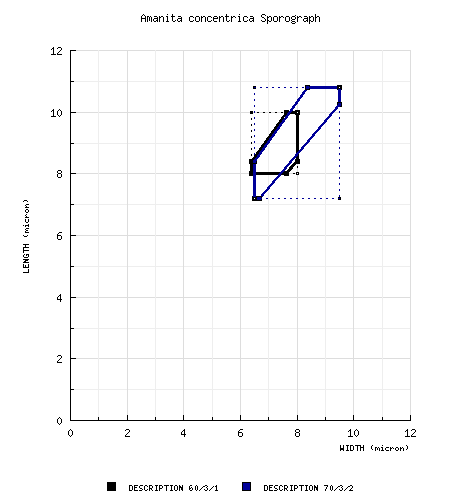
from protolog: [60/3/1] (7.6-) 8.0 - 10.0 (-11.2) × 6.4 - 8.0 (-8.4) μm, (Q = (1.0-) 1.05 - 1.31 (-1.33); Q' = 1.19 ± 0.08), hyaline, smooth, inamyloid, subglobose to broadly ellipsoid, sometimes globose or ellipsoid, often adaxially flattened (per figure); apiculus sublateral and truncate-conic (both per figure); contents not described; color in deposit not recorded.
RET: [70/3/2] (7.0-) 7.2 - 10.8 (-15.5) × (5.8-) 6.5 - 9.5 (-11.0) µm, (L = 8.2 - 9.2 µm; L’ = 8.8 µm; W = 7.1 - 8.1 µm; W’ = 7.6 µm; Q = (1.07-) 1.08 - 1.29 (-1.35); Q = 1.14 - 1.20; Q’ = 1.16), hyaline, smooth, thin-walled, inamyloid, subglobose to broadly ellipsoid, infrequently ellipsoid, rarely flask-shaped, often adaxially flattened, often expanded at one end; apiculus sublateral, cylindric, rather to very prominent, 1.5 - 2.0 µm wide at base, up to 2.0 µm long; contents guttulate; white in deposit. |
| ecology |
from protolog: Japan: At ca. 300 m elev. In mixed conifer-broadleaved forest with Castanopsis cuspidata var. sieboldii (Makino) Nakai and Quercus glauca Thunb. ex Murray.
RET: Solitary to scattered to gregarious. India: At 1900 m elev. In forest of Myrica esculenta, Quercus lanata, Rhododendron arboreum, and Lyonia ovalifolia or in humicolous soil under Cedrus deodara, M. nagi, Q. glauca, Q. leucotrichophora, and R. arboreum. Nepal: In forest of Q. glauca, Castanopsis tribuloides, and Schima wallichii. |
| material examined |
from protolog: JAPAN: HONSHU—Chiba-ken - Awa-gun, Amatsu-kominato-cho, Kyosumi-yama, Arakashi-zawa [ca. 300 m], 2.x.2000 T. Fukijaru s.n. (holotype, CBM FB-24901; isotype TNS F-101526).
RET: INDIA: UTTARAKHAND—Garhwal - Pauri District, Adwani, 19.ix.1992 V. K. Bhatt & R. P. Bhatt s.n. (GUH M-19943; RET 304-4); Pauri District, Teka 11.viii.2001 K. C. Semwal & R. P. Bhatt 381 (GUH; RET 407-6), 23.ix.2002 K. C. Semwal & R. P. Bhatt 549 (GUH; RET 407-1).
NEPAL: CENTRAL REGION—Bagmati Zone - Bhaktapur District, Nala (10 km NE of Bhaktapur city, E of Kathmandu), 18.viii.1989 H. R. Bhandary s.n. [Tulloss NHMTU-box2-6] (NHMTU n.v.; RET 355-1). UNKN. REGION—Zone 4 - Lumle, Mulabari [1830 m], 14.vi.2004 Shiva Devkota 001205D (NHTMU; RET 391-8). |
| discussion |
The authors of this species as well as mycologists working on northern India material have noted the similarity of the basidiome of the present species to basidiomes of taxa in (for example and primarily) in Bas' stirps Solitaria of Amanita sect. Lepidella—especially the eastern North American A. cokeri and the eastern Asian A. eijii.
Since the species is clearly a clamp-bearing taxon of sect. Amanita with universal veil distributed on its basal bulb in the manner typical of the muscarioid taxa of sect. Amanita, a taxonomically interesting question is, "How does this species relate to other known "muscarioid" taxa?
It was clear to the authors that they were not dealing with A. muscaria var. alba Peck (presently thought to be a pigmentless variant of A. muscaria subsp. flavivolvata per Geml et al. (2008)) based on size and shape of spores, not to mention the pyramidal form of the pileal warts.
In the paper of Oda et al. (2002) that includes the protolog of A. ibotengutake, a phylogeny was proposed that largely addresses the position of A. ibotengutake among the muscarioid rather than the pantherinoid taxa of sect. Amanita. Interestingly, A. concentrica is shown as basal to a pair of sister clades—one consisting only of "muscarioid" taxa and the other of clades or individual specimens representing pantherinoid taxa, other clampless taxa of section Amanita, and the clamp-bearing A. sinensis (Oda et al. 2002: Fig. 1).
The cited collections of A. concentrica from India and Nepal are the first identified for the two countries.
This species is reportedly very abundant and well-known in the area around Nala, Nepal. It suggests to the local people the spiny fruit of the devil’s apple (in the Newari language, dhatur muka:), and they apply the same name to A. concentrica. [The ":" stands for a nasal sound similar to the final sound in French words ending in "-ment."] |
| citations |
—R. E. Tulloss |
| editors |
RET |
|


 Spore data sets and their composite