| name |
Amanita cinereopannosa |
| author |
Bas. 1969.
Persoonia 5: 522, figs. 306-310. |
| name status |
nomen acceptum |
| english name |
"Gray Rags Lepidella" |
| MycoBank nos. |
308545 |
| GenBank nos. |
Due to delays in data processing at GenBank, some accession numbers may lead to unreleased (pending) pages.
These pages will eventually be made live, so try again later.
|
| holotypes |
MICH |
| intro |
The following text may make multiple use of each data field.
The field may contain magenta text presenting data from a type study
and/or revision of other original material cited in the protolog of the present taxon.
Macroscopic descriptions in magenta are a combination of data from the protolog and
additional observations made on the exiccata during revision of the cited original
material.
The same field may also contain black text, which is data from a revision of the present
taxon (including non-type material and/or material not cited in the protolog).
Paragraphs of black text will be labeled if further subdivision of
this text is appropriate.
Olive text indicates a specimen that has not been
thoroughly examined (for example, for microscopic details) and marks other places in the text
where data is missing or uncertain.
The following material is based on original research by R. E. Tulloss. |
| pileus |
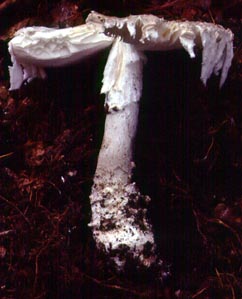
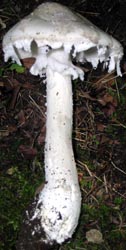
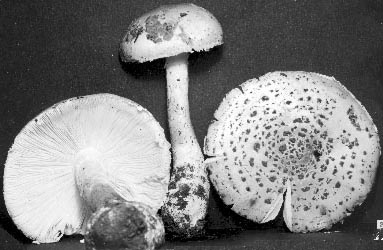
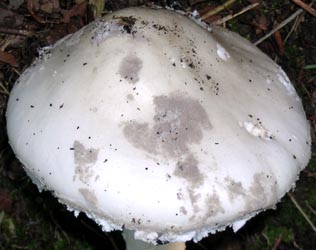
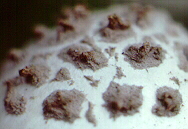
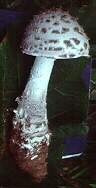
76 - 148 mm wide, whitish or white with sordid-silvery sheen, hemispheric at first, then convex; context white (whiter than lamellae), up to 10 mm thick over stipe; margin nonstriate, slightly incurved at first, appendiculate with submembranous patches of white partial veil; universal veil in lumpy (as if bearing tiny fingerprints) subpyramidal warts (up to 4 mm high) over disc and elongate irregular patches (up to 13 mm long) away from disc and margin, gray to brownish gray, darker (occasionally brown or reddish brown) in age, with admixture of white fibrillose material near margin, detersile, with warts leaving thin fibrillose patch (10× lens) when removed. |
| lamellae |
free, crowded, creamier than pileus context in side view, becoming whiter as spores mature, yellowing (e.g., pale primrose yellow) on drying, ?? mm broad, with edges white and minutely flocculose (lens); lamellulae subtruncate to attenuate. |
| stipe |
102 - 170 × 18 - 20 mm, white above, grayish to gray below, with gray region sometimes breaking into concentric bands, floccose in annular region, silky fibrillose below; bulb proportionately large (up to 64 × 35 mm), radicating, at times decorated with large rather broad (5 - 13 mm) rectangular scales in three rows; context solid, snow white, unchanging when cut or bruised; partial veil apical, submembranous, white, easily broken, sticks easily to fingers, striate on upper surface; universal veil in warts like those on pileus distributed over bulb surface or not notable other than grayish material on stipe below partial veil. |
| odor/taste |
Odor of biscuits or fresh biscuit dough, sometimes becoming unpleasant (“chlorine”) with age. Taste not recorded. |
macrochemical
tests |
none recorded. |
| pileipellis |
from protolog: filamentous hyphae 2 - 8 μm wide, interwoven, sometimes with pale brownish contents, distinctly gelatinized near surface; vascular hyphae scattered. |
| lamella trama |
from protolog: bilateral; "probaby with terminal inflated cells." |
| subhymenium |
from protolog: cellular to irregularly cellular. |
| basidia |
from protolog: 35 - 50 × 9 - 12 μm; clamps lacking. |
| universal veil |
from protolog: On pileus: elements irregularly disposed, filamentous hyphae 3 - 10 μm wide, rather abundant to abundant, sometimes with inflated ramifications; inflated cells pale yellowish-brownish to brown, ellipsoid to globose, sometimes pyriform or clavate or elongate, up to 80 × 60 μm, terminal singly or in short chains; vascular hyphae scattered. On stipe base: elements irregularly disposed; filamentous hyphae 2 - 10 μm wide, very abundant, often irregular, repeatedly branching; inflated cells pale grayish-brownish to nearly colorless, globose or ellipsoid or clavate or elongate cells up to 100 × 80 μm, terminal singly or in short chains. |
| stipe context |
from protolog: longitudinally acrophysalidic. |
| lamella edge tissue |
from protolog: consisting mainly of elongate-ellipsoid to clavate, but also pyriform, ellipsoid, and subglobose cells, 25 - 75 × 20 - 40 μm. |
| basidiospores |
from protolog: [80/7/7] 9.0 - 12.5 (-14.0) × 5.5 - 6.5 (-7.0) μm, (Q = 1.50 - 2.0 (-2.20); Q = 1.65 - 1.90), colorless, hyaline, thin-walled, amyloid, dominantly elongate, sometimes ellipsoid or cylindric, sometimes subreniform; apiculus not described; contents subgranular to subopaque, refractive; "almost pure white" in deposit.
composite of all data from material revised by RET: [170/7/7] (8.0-) 8.8 - 12.0 (-14.1) × (4.9-) 5.0 - 6.7 (-8.3) µm, (L = 9.5 - 10.9 µm; L’ = 10.1 µm; W = 5.4 - 6.1 µm; W’ = 5.9 µm; Q = (1.30-) 1.50 - 2.0 (-2.40); Q = 1.63 - 1.82; Q’ = 1.73), hyaline, colorless, smooth, thin-walled, amyloid, ellipsoid to elongate to cylindric, occasionally sublangeniform, occasionally swollen at one end, often slightly constricted; apiculus sublateral, cylindric; contents single "oil drop" with additional small granules; white in deposit. |
| ecology |
from protolog: [Maryland:] "...type collected in pine-forest."
Solitary or in pairs. Maine: At 21 m elev. New Jersey: At 214 m elev. In mixed broad leaf forest including Quercus spp. North Carolina: At 725 m elev. Pennsylvania: At 360 m elev. Rhode Island: In mixed forest with Abies, Acer, Fagus, Pinus, and Quercus after 3 weeks without rain in humid weather with temperatures 30° - 35° C. Vermont: At 630 m elev. In area of new growth with Acer, Populus grandidentata, and Quercus. Virginia: At 900 - 1000 m elev. In small clearing among conifers or in mixed woods. West Virginia: At 825 m elev. |
| material examined |
from protolog: U.S.A.:
MARYLAND—Montgomery Co. - Takoma Park, Sligo Crk. opposite Sanitarium, 24.viii.1919 C. C. Thomas s.n. (holotype, MICH as A. cinereovolvata Kauffman ined.).
MASSACHUSETTS—Franklin Co. - Mt. Toby, 25.viii.1963 C. Bas 3798B (paratype, L).
NORTH CAROLINA—Macon Co. - Highlands, 29.vii.1931 W. C. Coker 8989 (paratype, NCU), 4.viii.1938 W. C. Coker 10858 (paratype, NCU), 10.vii.1941 W. C. Coker 12365 (paratype, NCU). Watauga Co. - Blowing Rock, viii-ix.1899 G. F. Atkinson 3731C (paratype, CUP).
TENNESSEE—Blount Co. - GSMNP, Cades Cove, 1.vii.1955 L. R. Hesler & Campbell 21822 (paratype, TENN; paratype, L).
U.S.A.:
CONNECTICUT—Middlesex or Tolland Co. - Salmon R. St. For., viii.2005 COMA foray participant s.n. (RET 389-3).
MAINE—Cumberland Co. - Yarmouth, Pratt's Brook Park [43°49'54" N/ 70°10'37" W, 21 m], early ix.2000 Sheldon s.n. (RET 319-8).
NEW HAMPSHIRE—ca. Carroll Co. - vii.1985 Jean Hurley s.n. [Tulloss 7-87-JH2] (RET 180-6).
NEW JERSEY—Morris Co. - Mendham, Meadowood Twp. Pk. [40°47'31" N/ 74°38'43" W, 214 m], s.d. member N.J. Mycol. Assoc. s.n. [Tulloss NJMA-Herb.-21] (RET ??).
NORTH CAROLINA—Swain Co. - Deep Creek Campground, GSMNP, 19.vii.2006 C. Ovrebo s.n. [Tulloss 7-19-06-A] (TENN ??, TFB 13299).
PENNSYLVANIA—Clarion Co. - Fisher-Strattanville Rd., at Mill Crk. [41°14'13" N/ 79°17'11" W, 359 m], 7.viii.2011 Garrett Taylor s.n. [Tulloss 8-7-11-A] (F; RET 477-10, nrLSU seq'd.).
RHODE ISLAND—Kent Co. - ca. Greene, 19.vii.1998 "a young girl" s.n. (in herb. Boston Mycol. Club; RET 284-9).
TENNESSEE—Blount
Co. - GSMNP, Cades Cove, 1.vii.1955 L. R. Hesler
& Campbell H-21822 (TENN, paratype), TFB 13299
(??).
Sevier Co. - ca. Gatlinburg, GSMNP, Cherokee
Orchard [35.6811° N/ 83.4625° W, 945 m],
12.vii.2004
G. M. Mueller s.n. [Tulloss 7-12-04-AF]
(RET 374-7).
VERMONT—Pownal Co. - 13 mi S of Bennington, off County Road, E of Rt. 7 [ca. 42°47'11" N/ 73°09'21" W, 630 m], 29.viii.1981 A. Norarevian s.n. [Tulloss 8-29-81-C] (RET ??).
VIRGINIA—Madison Co. - Shenandoah Nat. Pk., Limberlost, S of Old Rag Rd. [38°34'38" N/ 78°22'41" W, 995 m; UTM 728400 4272900 NAD27], 9.ix.1994 M. A. Fox 136 (LFCC; RET 145-3); Shenandoah Nat. Pk., Mill Prong Tr. [38°29'36" N/ 78°25'33" W, 907 m; Fletcher Quad.—UTM 724500 4263500 NAD27], 10.ix.1994 Joanne J. Amberson 16 (LFCC; RET 143-8).
WEST VIRGINIA—Greenbrier Co. - Monongahela Nat. For., Lake Sherwood Recreation Area [38°00'24" N/ 80°06'40" W, 825 m], 31.viii.1982 R. E. Tulloss 8-31-82-E (RET 259-3, 320-9). |
| discussion |
t.b.d.
[Note: "Amanita cinereovolvata Kauffman ined." (Bas. 1969: 523) is a herbarium name on the label of a paratype (MICH) of this species.] |
| citations |
—R. E. Tulloss and C. Rodríguez Caycedo |
| editors |
RET |
|



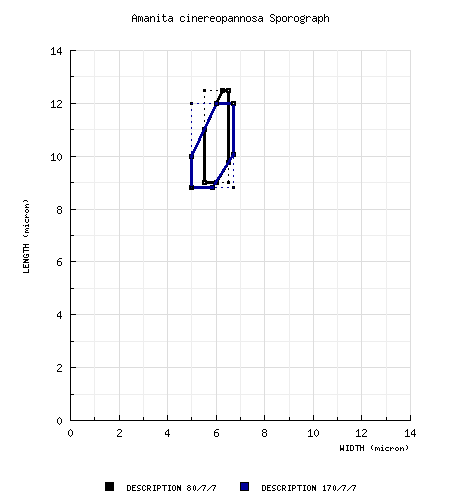
 Spore data sets and their composite