| name |
Amanita tephrea |
| author |
nom. prov. Bas. 1969. Persoonia 5: 452, figs. 192-195. |
| name status |
nomen provisorum |
| english name |
"Gray Chlorine Lepidella" |
| synonyms |
≡ Amanita tephrea "Bas ex Cifuentes" nom. inval. 1985. Rev. Mex. Micol. 1: 418. [Lacking Latin diagnosis and specification of holotype. ICBN §36.1, §37.1]
The editors of this site owe a great debt to Dr. Cornelis Bas
whose famous cigar box files of Amanita nomenclatural information
gathered over three or more decades were made available to RET for computerization
and make up the lion's share of the nomenclatural information presented on this site.
|
| GenBank nos. |
Due to delays in data processing at GenBank, some accession numbers may lead to unreleased (pending) pages.
These pages will eventually be made live, so try again later.
|
| intro |
The following text may make multiple use of each data field.
The field may contain magenta text presenting data from a type study
and/or revision of other original material cited in the protolog of the present taxon.
Macroscopic descriptions in magenta are a combination of data from the protolog and
additional observations made on the exiccata during revision of the cited original
material.
The same field may also contain black text, which is data from a revision of the present
taxon (including non-type material and/or material not cited in the protolog).
Paragraphs of black text will be labeled if further subdivision of
this text is appropriate.
Olive text indicates a specimen that has not been
thoroughly examined (for example, for microscopic details) and marks other places in the text
where data is missing or uncertain.
The following material is derived from (Bas 1969) and from original research of R. E. Tulloss. |
| pileus |
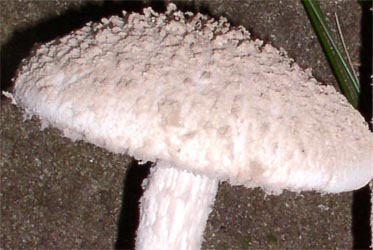
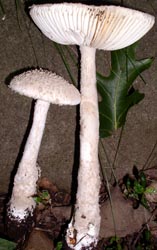
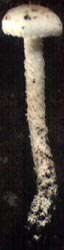
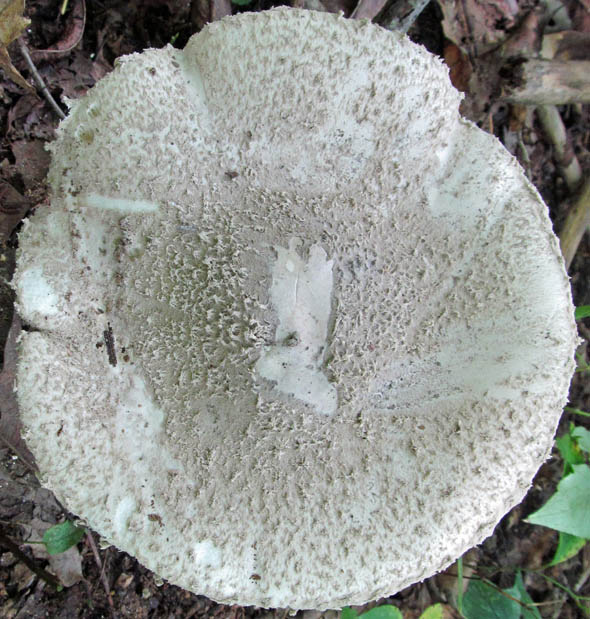
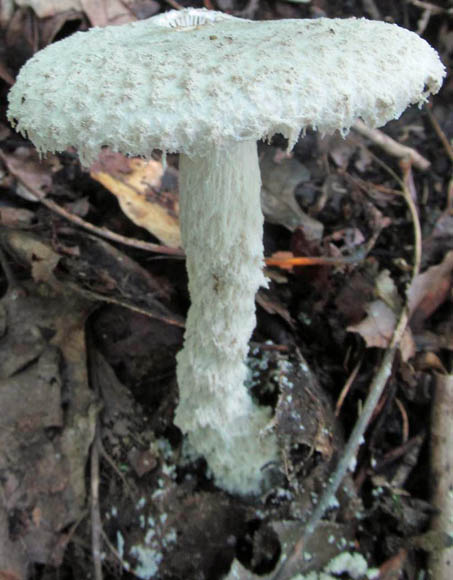
42 - 95 (-150) mm wide, white to cream to sordid white to pale gray to 6B2 with 6B4-5 tints, not changing when bruised or cut, broadly convex to convex to unevenly convex to unevenly hemispherical, sometimes broadly umbonate, dull to shiny, dry, waxy, ??; context 6 - 9 mm thick at stipe, thinning evenly to margin or thinning most rapidly to midpoint of radius and then evenly to margin, white to cream-white, not bruising or staining, sometimes watersoaked at interface to lamellae; margin nonstriate, appendiculate with small crumb-like pieces of subfelted to subfloccose to fluffy-floccose gray material (lost soon after collecting), sometimes downcurved; universal veil as loosely formed puffy floccose or pulverulent layer, not comprising warts or in irregularly surfaced polygonal warts over disc or in loosely formed lumps, more compressed toward margin, off-white to pale gray to pale grayish brown to pale tannish gray to 6B2 to pale beige to pale gray beige, sometimes with yellow tint, darkening if crushed or in age, upper portion easily lost/removed; pileipellis easily peeling. |
| lamellae |
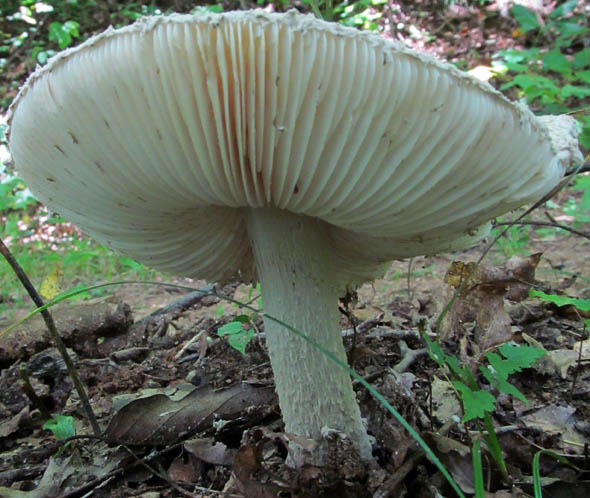
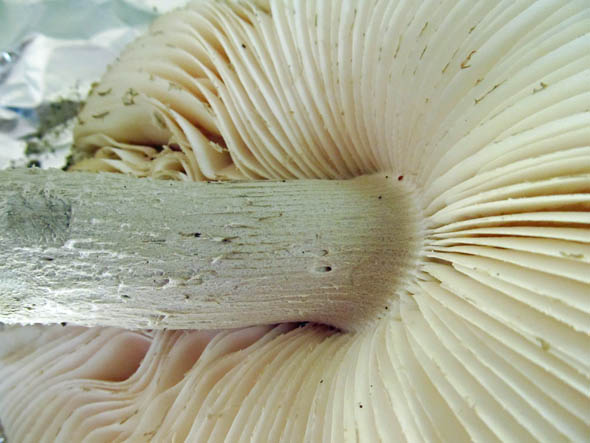
narrowly adnate to adnate, with or without decurrent line on upper stipe, close to subdistant to crowded, cream in mass, off-white to pale cream in side view, not staining or discoloring when damaged, 5 - 9 (-18) mm broad, with broadest point about 50-80% of distance from stipe to pileus margin, with edges bearing white loose flocculence and fibrils, in some collections forking occasionally; lamellulae truncate, subtruncate, subattenuate, attenuate, unevenly distributed, plentiful, of diverse lengths, in some collections anastomosing with lamellae. |
| stipe |
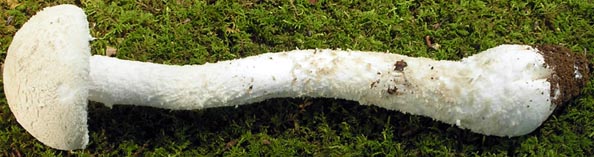
35 - 118 (-157) × 7 - 12.5 (-31) mm, shiny white to whitish to off-white (e.g., 6B2), not discoloring when damaged or slowly darkening from handling, cylindric to subcylindric or narrowing very slightly to top of bulb, occasionally subsinuate, sometimes flaring at apex, densely floccose to farinose in upper two-thirds with white to pale creamy white material (sometimes becoming distinctly gray at least near top of bulb), easily coming off on fingers when handled, sometimes longitudinally fibrillose with fibrils becoming raised when handled; bulb 40 - 48 × 14 - 28 (-45) mm, subfusiform, dog-legged to stipe, narrow, rounded below; context entirely solid or firmly stuffed above and solid by about mid-stipe, pale cream or off-white or white, not discoloring when cut or bruised (one specimen slightly rusty in larval tunnels), in stuffed portion having central cylinder 1± (-21) mm wide and stuffed with very firm white longitudinally striate material; partial veil superior, ragged, submembranous-subfloccose, easily removed in handling, detersile or exannulate; universal veil not observed on bulb, material similar to that on pileus is distributed over stipe (gray and white flocculence to soil line, becoming grayer and darker than pileus). |
| odor/taste |
Odor very faint in young material (e.g., faintly fungal) or mildly pleasant, becoming strong of decaying protein in older material; not tasted. |
macrochemical
tests |
KOH - on pileus, brown (6D7). Phenol - test area unknown, negative. Test voucher: Montoya-Esquivel 1211. |
| lamella trama |
Bas (1969): bilateral; with elements up to 25 μm wide. |
| subhymenium |
Bas (1969): ramose to inflated ramose. |
| basidia |
Bas (1969): 35 - 55 × 10 - 12 μm, 4-sterigmate; clamps present.
RET: ??, 4-sterigmate, with sterigmata ?? μm, ??; clamps ??. |
| universal veil |
On pileus: tissue disorderly; filamentous, undifferentiated hyphae ?, infrequent; inflated cells globose to subglobose to ellipsoid ovoid to subfusiform to pyriform to clavate, rather small and uniformly shaped ??what shape?? (up to 62 × 40 µm, but with most having major diam. < 35 µm), dominant; vascular hyphae ?. |
| lamella edge tissue |
sterile. |
| basidiospores |
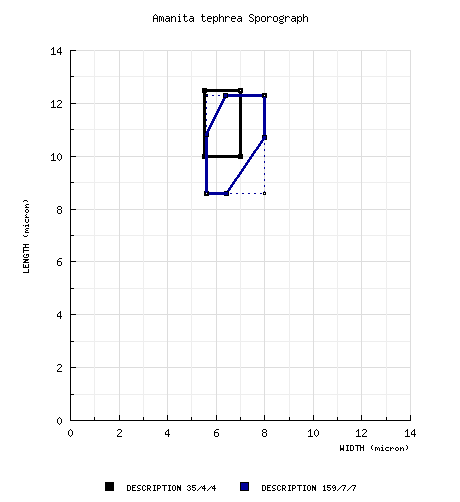
Bas (1969): [35/4/4] (9.0-) 10.0 - 12.5 (-14.0) × 5.5 - 7.0 (-7.5) μm, (Q = 1.40 - 2.50; Q = 1.65 - 1.80), colorless, hyaline, thin-walled, amyloid, elongate to cylinderic, often elongate-obovoid, sometimes slightly hooked near apiculus; apiculus not described; contents subgranular, refractive; color in deposit unrecorded.
RET: [159/7/7] (7.5-) 8.6 - 12.3 (-17.1) × (5.2-)
5.6 - 8.0 (-9.6) µm, (L = 9.1 - 11.2 µm;
L’ = 10.6 µm; W = 6.0 - 7.3 µm;
W’ = 6.7 µm; Q = (1.16-) 1.34 - 1.93 (-2.56);
Q = 1.47 - 1.75; Q’ = 1.59), hyaline,
colorless, smooth, thin-walled, amyloid, ellipsoid to
elongate, occasionally cylindric, often adaxially
flattened, sometimes swollen at one end;
apiculus sublateral, cylindric;
contents mono- to multiguttulate, with or
without additional granules; color in deposit not
recorded??. |
| ecology |
Solitary to paired, ca. sea level to 1200 m elev. New Jersey: In dark sandy loam on ridge in mature Quercus-Fagus grandifolia-Betula forest. New York: In sandy soil of public park.*nbsp; North Carolina: ??. South Carolina: In sand under loamy surface, in mixed forest with Carya ovata, Cornus florida, Juniperus virginiana, Pinus echinata, Quercus bicolor, Q. marilandica, and Q. nuttallii. Tennessee: In dark organic sand, associated with Quercus and other hardwoods and Tsuga canadensis. |
| material examined |
Bas (1969): U.S.A.: NORTH CAROLINA—Watauga Co. - Blowing Rock, 20.viii.1922 H. R. Totten 5625 (NCU). TENNESSEE—Carter Co. - Roan Mtn., 20.vii.1935 L. R. Hesler 8042 (TENN, L). Sevier Co. - GSMNP, Cades Cove, 18.vii.1958 L. R. Hesler 23016 (TENN), 13.viii.1938 A. H. Smith & Stupka [Smith 10114] (MICH).
RET: MÉXICO:
TLAXCALA—Camino S. Juan Totolac a S.
Tadeo Huilopan, 1 km NE of S. Ambrosio Texantla,
15.ix.1992 A. Montoya-Esquivel 1211 (RET 126-7;
TLAX).
U.S.A.:
CONNECTICUT—New London Co. - Nehantic St.
For., 2.viii.2008 David Wasilewski s.n. [Tulloss
8-2-08-C] (RET 446-8, nrLSU seq'd.).
NEW JERSEY—Hunterdon Co. - Oakmoss Mycol.
Preserve, Lebanon [40°38'50.07" N/ 74°47'50.92" W],
26.vii.2006 R. E. Tulloss, L. Possiel, and R.
Ballsley [Tulloss 7-26-06-A] (RET 394-4).
Monmouth Co. - Upper Freehold Twp., Cream Ridge, N
of abandoned segment of old Tower Rd., E of Rues
Rd., prop. of Ms. Ingrid Jordan, 2.viii.2005 R. E.
Tulloss 8-2-05-A (RET 386-2).
NEW YORK—Queens Co. - Cunningham Pk.,
4.viii.2004 J. L. & M. Horman s.n.
(RET 378-9).
NORTH CAROLINA—Buncombe Co. - unkn.
loc., 25.viii.2013 Mike Hopping s.n.
[mushroomobserver.org
#143634]
(RET 579-4). Watauga Co. - Blowing Rock,
20.viii.1922 H. R. Totten 5625 (NCU).
SOUTH CAROLINA—Oconee Co. - Seneca
[34°46'09" N/ 82°57'55" W, 263 m], 27.vi.1985 Mary
A. King and R. E. Tulloss 6-27-85-B
(RET 054-3).
TENNESSEE—Carter Co. - Roan Mtn.,
20.vii.1935 L. R. Hesler 8042 (TENN, L).
Sevier Co. - GSMNP, Cades Cove, 13.vii.1938 A. H.
Smith & Stupka [Smith] 10114 (MICH),
18.vii.1958 L. R. Hesler 23916 (TENN; L); ca.
Gatlinburg, GSMNP, Cherokee Orchard, along Rainbow
Falls Tr. [35.6811° N/ 83.4625° W, 945 m],
12.vii.2004 R. E. Tulloss 7-12-04-F (RET 375-10;
TENN, fragment for DNA sequencing). |
| discussion |
t.b.d.
This species has been called Amanita species S2 in RET's correspondence, foray checklists, or keys. |
| citations |
—R. E. Tulloss |
| editors |
RET |
|



 Spore data sets and their composite