| name |
Amanita cinereoconia var. cinereoconia |
| author |
G. F. Atk. 1909. Ann. Mycol. 7: 366. |
| name status |
nomen acceptum |
| english name |
"American Gray Dust Lepidella" |
| synonyms |
≡ Lepidella cinereoconia (G. F. Atk.) E.-J. Gilbert & Kühner. 1928. Bull. Trimestriel Soc. Mycol. France 44: 151.
≡ Armillaria cinereoconia (G. F. Atk.) Locq. 1952. Bull. Trimestriel Soc. Mycol. France 68: 167.
≡ Aspidella chlorinosma f. cinereoconia (G. F. Atk.) E.-J. Gilbert. 1940. Iconogr. Mycol. (Milan) 27, suppl. (1): 79, tab. 58 (fig. 4).
≡ Amanita chlorinosma f. cinereoconia (G. F. Atk.) E.-J. Gilbert. 1941. Iconogr. Mycol. (Milan) 27, suppl. (2): 395, tab. 66. [Misapplied to Amanita onusta (Howe) Sacc.]
The editors of this site owe a great debt to Dr. Cornelis Bas
whose famous cigar box files of Amanita nomenclatural information
gathered over three or more decades were made available to RET for computerization
and make up the lion's share of the nomenclatural information presented on this site.
|
| etymology |
cinereus "ash gray" + κονια (Grk.) "dust" |
| MycoBank nos. |
356779, 345946, 292692 |
| GenBank nos. |
Due to delays in data processing at GenBank, some accession numbers may lead to unreleased (pending) pages.
These pages will eventually be made live, so try again later.
|
| holotypes |
CUP-A |
| type studies |
Jenkins. 1982. Mycotaxon 14: 240. |
| revisions |
Bas. 1969. Persoonia 5: 463, figs. 209-214. |
| intro |
The following text may make multiple use of each data field.
The field may contain magenta text presenting data from a type study
and/or revision of other original material cited in the protolog of the present taxon.
Macroscopic descriptions in magenta are a combination of data from the protolog and
additional observations made on the exiccata during revision of the cited original
material.
The same field may also contain black text, which is data from a revision of the present
taxon (including non-type material and/or material not cited in the protolog).
Paragraphs of black text will be labeled if further subdivision of
this text is appropriate.
Olive text indicates a specimen that has not been
thoroughly examined (for example, for microscopic details) and marks other places in the text
where data is missing or uncertain.
The following material is based on original research by R. E. Tulloss except as otherwise noted in the text. |
| pileus |
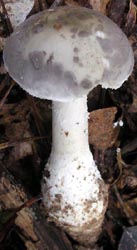
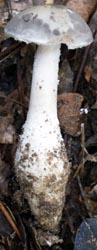
33 - 75 mm wide, gray or pale brownish gray over disc and paler toward margin, unchanging when cut or bruised, hemispheric at first, then convex, finally planoconvex, sometimes depressed in center, tacky, dull; context white to off-white, unchanging when cut or bruised, 3 - 5 mm thick over stipe, thinning evenly to margin; margin nonstriate, appendiculate with white floccose or floccose-fibrillose material in patches or icicle-like; universal veil in thin patches or warts or pulverulent layer, brownish gray, unchanging?? with age or exposure, very finely verruculose, sometimes with pyramidal warts over disc, detersile. |
| lamellae |
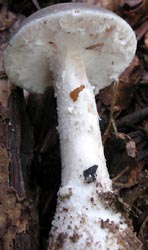
free to narrowly adnate without decurrent line on stipe apex, close to subcrowded, cream in mass, cream to white in side view, 3.5 - 10 mm broad, with floccose-fibrillose white edge; lamellulae rounded truncate to attenuate after a step to subattenuate to attenuate, in at least two tiers. |
| stipe |
41 - 113 × 7 - 9.5+ mm, white to pale grayish white, becoming pale tan from handling, narrowing upward, gradually expanding near apex or not at all, decorated with fine grayish pulverulence or finely flocculose-fibrillose material; bulb ovoid to fusiform, subradicating, sometimes dog-legged, 22± × 14 - 20 mm, sometimes with layer of grayish pulverulence above broadest point; context solid, white to whitish to cream, unchanging when cut or bruised, with larva tunnels concolorous to faintly tan; partial veil subapical, reduced to torn submembranous fragments (striate above) and flocculent or floccose-fibrillose zone, white; universal veil not evident or as irregular scattered crudely concentric partial rings from base of stipe to midheight of bulb, whitish. |
| odor/taste |
Odor “chloride of lime” or faintly of “chlorine.” Taste not recorded. |
macrochemical
tests |
Spot test for laccase (syringaldazine) - negative throughout basidiome. Spot test for tyrosinase (paracresol) - negative throughout basidiome. Test vouchers: Tulloss 10-25-86-D, 7-17-87-F. |
| pileipellis |
from Bas (1969): filamentous hyphae 2 - 8 μm wide, colorless, interwoven to subradially arranged, mostly not gelatinizing, may be slightly gelatinized (at surface only) over disc. |
| lamella trama |
from Bas (1969): bilateral; "with elements up to 12 μm wide"; vascular hyphae present. |
| subhymenium |
from Bas (1969): rather thick, subramose to rather irregularly cellular. |
| basidia |
from Bas (1969): 35 - 55 × 8 - 10 μm, 4-sterigmate; clamps lacking. |
| universal veil |
from Bas (1969): On pileus: filamentous hyphae very thin-walled, 3 - 7 μm wide, ascending over disc; inflated cells rather small, subglobose or ellipsoid or pyriform or clavate, often brownish, above base up to 60 × 50 μm or (rarely) 80 × 60 μm, near base occasionally elongate (up to 180 × 20 μm) or inflated-branching, on pileus limb loosely arranged and probably in ascending rows, over disc in denser parallel erect rows; vascular hyphae lacking. On stipe base: comprising scattered globose to pyriform to clavate cells. |
| stipe context |
from Bas (1969): longitudinally acrophysalidic. |
| lamella edge tissue |
from Bas (1969): consisting mainly of colorless, globose to pyriform cells 15 - 45 μm wide, partly in chains. |
| basidiospores |
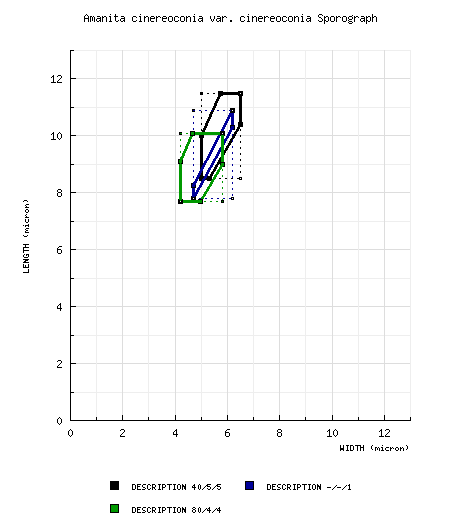
Bas (1969): [40/5/5] 8.5 - 11.5 (-12.5) × (4.5-) 5.0 - 6.5 µm, (Q = (1.40-) 1.60 - 2.0 (-2.3); Q = 1.70 - 1.90).
from type study of Jenkins (1982): [-/-/1] 7.8 - 10.9 × 4.7 - 6.2 μm, (Q = 1.66 - 1.76; Q' = 1.72),
hyaline, thin-walled amyloid, elongate; apiculus sublateral, cylindric; contents guttulate;
color in deposit not recorded.
composite data from material revised by RET: [80/4/4] (7.3-) 7.7 - 10.1 (-11.2) × (3.8-) 4.2 - 5.8 (-6.4) µm, (L = 8.8 - 9.5 µm; L’ = 9.1 µm; W = 4.2 - 5.5 µm; W’ = 4.9 µm; Q = (1.52-) 1.55 - 2.17 (-2.49); Q = 1.69 - 1.97; Q’ = 1.85), hyaline, colorless, smooth, thin-walled, amyloid, elongate to cylindric, sometimes slightly constricted or slightly curved, sometimes expanded at one end, adaxially flattened or depressed; apiculus sublateral, cylindric, proportionately small; contents guttulate; ?? in deposit. |
| ecology |
Solitary. Mississippi: In mixed forest with Pinus and hardwoods. Texas: In sandy soil of mixed forest including Pinus taeda and hardwoods. |
| material examined |
Bas (1969): U.S.A.: NORTH CAROLINA—Orange Co. - Chapel Hill, Battle's Pk., 21.ix.1908 W. C. Coker s.n. (holotype, CUP 22628). Macon Co. - Highlands, 7.viii.1938 W. C. Coker 10873 (NCU), 19.viii.1938 L. Stewart 10950 (NCU, 21.viii.1943 W. C. Coker 13518 (NCU).
VIRGINIA—Giles Co. - Mountain Lk., 17.viii.1941 L. R. Hesler 13976 (TENN).
Jenkins (1982): U.S.A.: NORTH CAROLINA—Orange Co. - Chapel Hill, Battle's Pk., 21.ix.1908 W. C. Coker s.n. (holotype, CUP 22628).
U.S.A.: MISSISSIPPI—Perry Co. - Black Creek Tr., 17.vii.1987 Huffman s.n. [Tulloss 7-17-87-F] (RET ??).
TENNESSEE—Blount Co. - GSMNP, Abram Crk. Tr., beyond camping area, 17.vii.2006 R. E. Tulloss 7-17-06-A [Tenn. Field Book 13315] (TENN ??, yellowing syndrome; RET 582-3). Fentress Co. - Colditz Cove State Natural Area, 6.ix.2009 Jay Justice TN-AM-17 (RET 452-5; yellowing syndrome).
TEXAS—Hardin Co. - Big Thicket Nat. Pres., Jack Gore Baygall Unit, 25.x.1986 D. P. Lewis s.n. [Tulloss 10-25-86-D] (RET 467-7). Polk Co. - Big Thicket Nat. Preserve, unkn. loc., 23.ix.2009 Ron Pastorino 9-23-09G [mushroomobserver.org #25870] (RET 473-2). Tyler Co. - Town Bluff, Farm to Mkt. Rd. 92, 30.v.1994 David P. Lewis 5213 (RET 285-7). |
| discussion |
t.b.d.
Tulloss 7-17-06-A became yellow-staining after it was
collected, but showed no signs of yellow staining in the
field. In addition, its spores were normal for
cinereoconia var. cinereoconia. From
this evidence, RET believes that var.
croceescens may be based upon specimens of A.
cinereoconia with the yellowing syndrome.
(See discussion under A. subsolitaria.)
The recorded values of spore length, width, and Q—as well
as the averages of these values—are probably depressed
because of the number of specimens examined that
exhibited the yellowing syndrome (for an example of this
syndrome, see A.
subsolitaria.
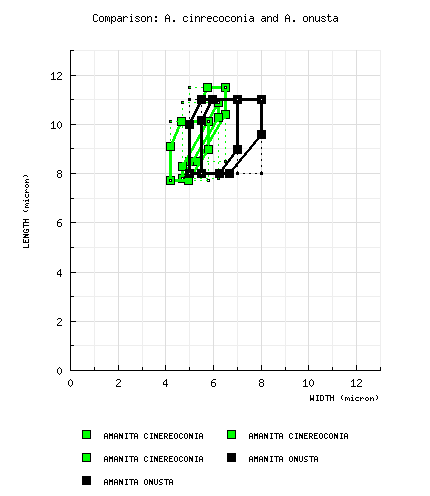
Sporographs of this species are compare with those of
A.
onusta in the following figure:
|
| citations |
—R. E. Tulloss |
| editors |
RET |
|


 Spore data sets and their composite