| name |
Amanita chrysoblema - yellow-orange |
| author |
Veselý. 1933. Ann. Mycol. 31(4): 254. |
| name status |
nomen acceptum |
| english name |
"American Fly Agaric (yellow variant)" |
| synonyms |
≡ Amanita muscaria var. formosa f. guessowii ("gussowii") (Veselý) Neville & Poumarat. 2002 ["2001"]. Bull. Trimestriel Soc. Mycol. France 117(4): 305. [Misapplication.]
= Venenarius muscarius sensu Murrill. 1913. Mycologia 5: 94, pl. 87 (fig. 3). [Misapplication.]
=Amanita muscaria sensu Güssow & O’dell. 1927. Mushr. Toadst.: 36, pl. 1 & 6. [Misapplication.]
= Amanita muscaria var. formosa sensu Dav. T. Jenkins. 1977. Biblioth. Mycol. 57: 53. [Misapplication. Amanita muscaria var. formosa Pers. is certainly not a North American taxon (Persoon said nothing to justify any such assumption) as proposed by Neville and Poumarat ( 2002, 2004), but more probably a color variant of the true A. muscaria.]
The editors of this site owe a great debt to Dr. Cornelis Bas
whose famous cigar box files of Amanita nomenclatural information
gathered over three or more decades were made available to RET for computerization
and make up the lion's share of the nomenclatural information presented on this site.
|
| etymology |
genetive of Latinized name, "Güssow's" or "of Güssow" |
| MycoBank nos. |
486234, 374047 |
| GenBank nos. |
Due to delays in data processing at GenBank, some accession numbers may lead to unreleased (pending) pages.
These pages will eventually be made live, so try again later.
|
| lectotypes |
[search for syntypes not completed] |
| intro |
Olive text indicates a specimen that has not been
thoroughly examined (for example, for microscopic details) and marks other places in the text
where data is missing or uncertain.
The following material not directly from the protolog of the present taxon is based upon
original research by R. E. Tulloss.
This description is obviously incomplete. Since recent studies suggest that this "taxon" may have to be reinterpreted as a cluster of genetically segregated yellow variants of Amanita amerimuscaria Tulloss & Geml nom. prov. (proposed new name based on A. muscaria subsp. flavivolvata Singer), it is suggested that readers interested in the probable microscopic anatomy of the "yellow variant" make reference to the reported microscopic characteristics of the just named taxon. |
| pileus |
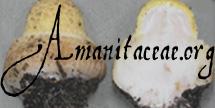
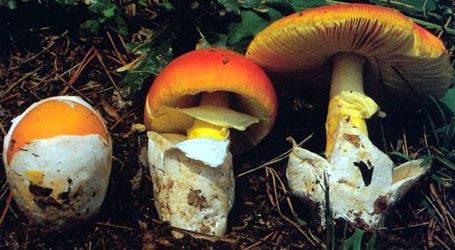
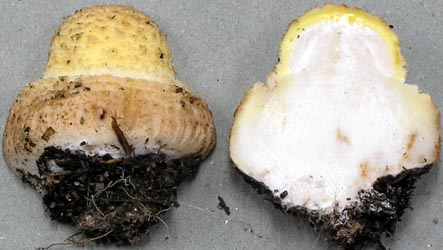
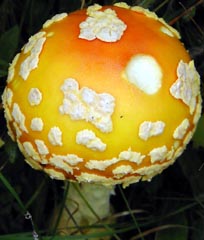
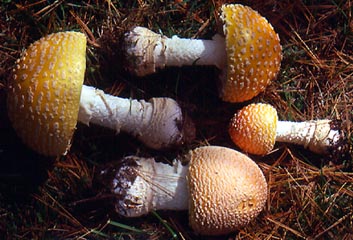
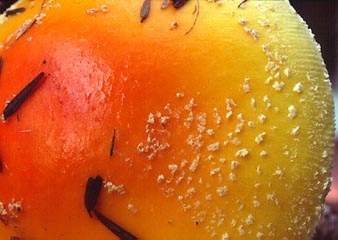
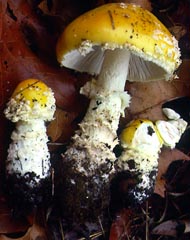
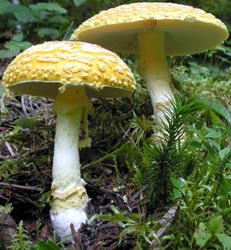
60 - 91 mm wide, margin yellow to pale yellow to orange-yellow with disk yellow-orange to orange to red-orange, sometimes entire pileus may be very pale if it is covered by detritus that protects it from sunlight, also decoloring in rain, hemispheric becoming convex then planoconvex and sometimes umbilicate, viscid when wet, tacky when drying, shiny when drying or dry; context ?, intense orange or yellow under pileipellis, fading to pale yellowish white in direction of lamellae, up to 10 mm thick over stipe, thinning evenly to margin; margin short striate (up to 0.2R), nonappendiculate; universal veil as warts or confluent warts irregularly distributed or approximately in concentric circles, subfloccose, pale yellow to pale sordid yellow fading to off-white to cream to sordid cream on exposure, detersile. |
| lamellae |
free to very narrowly adnate, sometimes with short decurrent line on stipe apex, subcrowded to crowded, cream in mass, white to pale cream to cream in side view, 7.5 - 9 mm broad, with edge minutely flocculose with white material except near margin of pileus where such material is yellowish; lamellulae truncate, unevenly distributed, of diverse lengths, plentiful. |
| stipe |
69 - 120 × 10- - 15 mm, white to yellowish cream to pale yellow (in latter cases white at apex), becoming deeper yellow when handled, narrowing upward or narrowest at mid-height, flaring at apex, pulverulent above annulus, fibrillose to fibrous to squamulose and more or less longitudinally striatulate below; context pale yellowish white, unchanging when cut or bruised (unless senile?, then yellowing), solid to stuffed, with stuffing material comprising cottony white densely packed hyphae having roughly longitudinal orientation, with central cylinder 4± mm wide; bulb 20± × 20.5± mm, subglobose to subovoid to subventricose, often strikingly white, ?; partial veil whitish to very pale yellowish, thin, membranous, with thickened edge, median, pulverulent on upper surface, floccose on underside; universal veil in rings or broken rings on base of stipe above bulb, sometimes extending over several cm of stipe, sometimes more yellow than on pileus, fading and/or becoming sordid as on pileus. |
| odor/taste |
Odor pleasantly fungoid. Taste not reported. |
macrochemical
tests |
information not yet organized for presentation. (t.b.d.) POISON. Producing the Pantherine Syndrome in humans. |
| lamella trama |
bilateral; wcs = 40 - 45 µm; (t.b.d.); clamps occasional. |
| subhymenium |
wst-near = 70 - 120 µm; wst-far = 95 - 150 µm; (t.b.d.); clamps occasional. |
| basidia |
(t.b.d.); clamps moderately common. |
| universal veil |
On pileus: filamentous, undifferentiated hyphae ?? µm wide, branching, ??, with many having yellowish subrefractive walls; inflated cells terminal (clavate to ellipsoid to ??, up to 114 × 56 µm) or intercalary (fusiform, up to 89 × 20 µm), singly or in short chains, with walls up to 1.5 µm thick, ??; vascular hyphae 3.0 - 14.0 µm wide, branching, scattered, ??; clamps present. On stipe base: ??. |
| basidiospores |
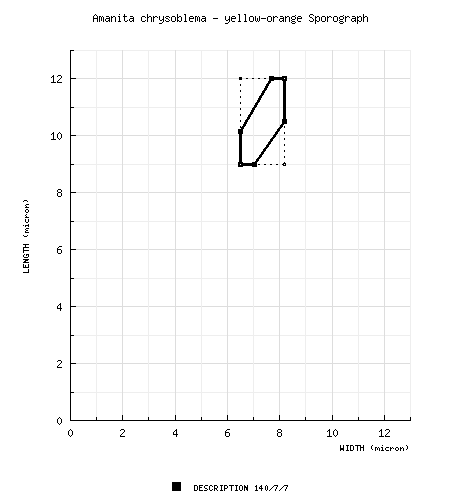
[140/7/7] (7.0-) 9.0 - 12.0 (-14.8) × (5.9-) 6.5 - 8.2 (-9.5) µm, (L = 9.2 - 11.4 µm; L’ = 10.5 µm; W = 7.1 - 7.8 µm; W’ = 7.4 µm; Q = (1.09-) 1.28 - 1.56 (-1.70); Q = 1.30 - 1.49; Q’ = 1.43), thin-walled, smooth, hyaline, colorless, inamyloid, broadly ellipsoid to ellipsoid, occasionally elongate, infrequently subglobose, often adaxially flattened; apiculus sublateral, truncate-conic; contents dominantly monoguttulate; white in deposit. |
| ecology |
In groups, often gregarious or in troops. Prov. Newfoundland and Labrador, Canada: In field, adjacent to forest edge with Picea glauca. Prov. Québec: In dry loam and duff of mixed forest including Betula, Pinus strobus, etc. New Jersey: Under Picea abies or Pinus spp. or under Tsuga canadensis or in mixed coniferous forest. North Carolina: On roadside under Picea engelmannii or under introduced Cedrus deodara. West Virginia: Under P. strobus or under P. resinosa. |
| material examined |
CANADA: NEWFOUNDLAND & LABRADOR—Isl. of Newfoundland - Corner Brook, Humber Village Pond, 29.ix.2003 Maria & Andrus Voitk & R. E. Tulloss s.n. [Tulloss 9-29-03-A] (RET 270-7); GMNP, Killdevil Anglican Church Camp, tr. from camp to Lemona R., 15.ix.2004 Maria Voitk & R. E. Tulloss [Tulloss 9-15-04-A] (RET 383-3, β-tubulin & tef1) & nrLSU seq'd.; Stanleyville [49.4665° N/ 57.7805° W, 30 m], 13.ix.2004 R. E. Tulloss, M. & A. Voitk s.n. (RET 383-7, nrITS seq'd.).
QUÉBEC—Région Saugenay-Lac-Saint-Jean - Lac-Bouchette, L’Ermitage St. Antoine, behind Le Béthanie beside pedestrian tr., 31.viii.2006 R. E. Tulloss 8-31-06-B (RET 395-2).
U.S.A.:
INDIANA—Monroe Co. - Bloomington, Leonard Springs [39.1104° N/ 86.0880° W, 286 m], 16.ix.2012 Stephen Russell s.n. [mushroomobserver. org #110016] (RET 534-9), 23.ix.2012 S. Russell s.n. [mushroomobserver. org #111015] (RET 533-3). Vigo Co. - NE of Prairie Creek, Prairie Creek Park [39.2860° N/ 87.4654° W, 169 m], 22.ix.2012 Patrick Harvey s.n. [mushroomobserver. org #110834] (RET 517-8, nrITS seq'd.).
MAINE—Hancock Co. - Crocker Pond, 12.viii.1991 McVeigh s.n. [RET 8-12-91-B] (RET 031-4).
MASSACHUSETTS—Hampden Co. - Springfield, Forest Park, 28.vii.1986 Ellen Greer s.n. [Tulloss 7-28-86-EG5] (RET 466-8). Unkn. Co. - N of Boston, x.1987 Al Ferry s.n. [Tulloss 10-87-AF1] (RET 124-2, nrITS seq'd.). Unkn. Co. - unkn. loc., eastern part of state, 1991 member Boston Mycol. Club s.n. (RET 034-4).
MICHIGAN—McComb Co. - Shelby Twp., ca. Washington, Stony Brook Metropolitan Pk. [42.73° N/ 83.07° W, 250-260 m], 30-31.viii.2011 Sandy Sheine s.n. (RET 491-2). Washtenaw Co. - N of Dexter, Hudson Mills Metropark, 26.ix.1998 Heather Hallen Amus.980826.2 (MSU; RET 325-10).
NEW JERSEY—Burlington Co. - Brendan T. Byrne
St. For., Pakim Pond picnic area [39°52’47” N/
74°31’59” W, 33 m], 15.x.1995 Sarah, Mary, & R. E.
Tulloss 10-15-95-A (RET 158-7, nrITS seq'd.);
Franklin Parker Preserve, w of Chatsworth [39°48.827’ N/ 74°32.857’ W, 29 m
elev.], 5.x.2013 N. Burghardt s.n. (RET 574-2,
nrITS & nrLSU seq'd.).
Camden Co. - Siklerville, 20.x.1998 19 mo. old female
poisoning victim s.n. [Tulloss 10-20-98-A]
(RET 289-1). Cape May Co. - Belleplain St. For.,
Jakes Landing Rd., E side of rd. ca. jct. with
St. Rte. 47, 21.x.2006 R. E. Tulloss
10-21-06-J (RET 398-9); Woodbine, 29.x.1998 45 yr. old
male poisoning victim s.n. [Tulloss 10-29-98-A]
(RET 289-3, β-tubulin & nrITS & nrLSU
seq'd.). Gloucester Co. - Glassboro, 14.x.1991
poisoning victim s.n. [Tulloss 10-14-91-B] (RET
034-1). Mercer Co. - Princeton, Princeton
Unitarian-Universalist Congregation, 21.vi.2009 Mary A.
Tulloss s.n. [Tulloss 6-21-09-A] (RET 429-1); Princeton
Jct., 1.ix.1979 R. E. Tulloss 9-1-79-A (RET ??); West Windsor Twp., Village
Rd. ca. Quaker Bridge Rd., 6.x.1980 R. E. Tulloss
10-6-80-A (RET ??),
16.ix.1981 Mary A. King & RET 9-16-81-D
(RET 173-9). Monmouth Co. - Roosevelt, Pine Dr.,
sewer treatment plant [40°12’49”N/74°28’19”W], 6.x.1996
Mary A. Tulloss & R. E. Tulloss 9-6-96-B
(RET 251-7); unkn. loc., 29.ix.1999 male Italian
immigrant poisoning victim s.n. [Tulloss 9-29-99-E]
(RET 303-4, tef1 & nrITS & nrLSU seq'd.).
Somerset Co. - South Plainfield, 17.ix.1997 Dorothy
Smullen s.n. (RET 271-3, nrITS & nrLSU
seq'd.). Sussex Co. - Stokes St. For., 25.vi.1983
Mary & R. E. Tulloss 6-25-83-C (RET 218-8); Stokes
St. Pk., Kittle Field Recreation Area, 28.ix.1997 NJMA
foray participants s.n. [Tulloss 9-28-97-C] (RET 271-2,
β-tubulin &
tef1 & nrITS & nrLSU seq'd.).
NORTH CAROLINA—Gaston Co. - Gaston Memorial Cemetery, ix.1995 Henry Rhyne s.n. (RET ??). Iredell Co. - 0.3 km N of Spring Shore Dr. on Pineville Rd., x.1995 A. Stanley s.n. (RET ??). McDowell Co. - Gooch Gap, along Blue Ridge Pkwy., 30.ix.2006 Pat & Owen Campbell & R. E. Tulloss s.n. [Tulloss 9-30-06-B] (RET 397-1).
PENNSYLVANIA—Allegheny Co. - North Park, 16.ix.2006 W. Penn. Mushr. Club foray participant s.n. [Tulloss 9-16-06-B] (RET 394-9); Pittsburgh, 216 Farmington Rd. [40.5032° N/ 79.9079° W, 325 m], 21.ix.2013 Cecily Franklin s.n. [WPMC 20130921-92] (RET 567-5). Luzerne Co. - W of Nanticoke, Hunlock Crk. [41.2014° N/ 76.0824° W, 380 m], 10.ix.2012 David Wasilewski s.n. [mushroomobserver #109404] (RET 526-9, nrITS seq'd.).
OHIO—Butler Co. - ca. Oxford, Miami University Bachelor Wildlife Preserve, 7.xi.1992 Jeffrey Studer 23 (RET), 26 (RET).
WEST VIRGINIA—Marion Co. - Fairmont, Fairmont St. Coll. campus, 30.x.1980(?) S. L. Stephenson 270 (FWVA), 13.ix.1982 Thais Salazar s.n. [S. L. Stephenson 601] (FWVA), 8.x.1982 Fred Tawny s.n. [S. L. Stephenson 603] (FWVA), 10.x.1982 Tom Asher s.n. [S. L. Stephenson 604] (FWVA).
WISCONSIN—Bayfield Co. - Cable [46.2019° N/ 91.2656° W, 400m], 23.ix.1013 Britt Bunyard s.n. (RET 572-9).
Unkn. State—unkn. loc., x.1991 W. Bakaitis s.n. (RET ??). |
| discussion |
This name is currently believed to apply to a group of yellow variants of Amanita muscaria subsp. flavivolvata, which, moreover, is not truly assignable to A. muscaria.
A phylogenetic study of the North American and Eurasian muscarioid taxa has appeared (Geml et al. 2008); allied taxonomic studies are in draft (by Tulloss, Geml, et al.).
t.b.d. |
| citations |
—R. E. Tulloss |
| editors |
RET |
|



 Spore data sets and their composite