| name |
Amanita
velatipes |
| author |
G. F. Atk. 1900. Studies Amer. Fungi: 63, figs. 64-67. |
| name status |
nomen acceptum |
| english name |
"Great Funnel-Veil Amanita" |
| synonyms |
≡ Venenarius velatipes (G. F. Atk.) Murrill. 1913. Mycologia 5: 75.
≡ Amanita pantherina var. velatipes (G. F. Atk.) Dav. T. Jenkins. 1977. Biblioth. Mycol. 57: 72.
The editors of this site owe a great debt to Dr. Cornelis Bas
whose famous cigar box files of Amanita nomenclatural information
gathered over three or more decades were made available to RET for computerization
and make up the lion's share of the nomenclatural information presented on this site.
|
| MycoBank nos. |
534910, 503904, 560220 |
| GenBank nos. |
Due to delays in data processing at GenBank, some accession numbers may lead to unreleased (pending) pages.
These pages will eventually be made live, so try again later.
|
| neotypes |
CUP |
| neotypifications |
Jenkins. 1977. op. cit.: 72. |
| type studies |
Jenkins. 1977. op. cit.: 98.
Jenkins. 1982. Mycotaxon 14: 245. |
| intro |
The following text may make multiple use of each data field.
The field may contain magenta text presenting data from a type study
and/or revision of other original material cited in the protolog of the present taxon.
Macroscopic descriptions in magenta are a combination of data from the protolog and
additional observations made on the exiccata during revision of the cited original
material.
The same field may also contain black text, which is data from a revision of the present
taxon (including non-type material and/or material not cited in the protolog).
Paragraphs of black text will be labeled if further subdivision of
this text is appropriate.
Olive text indicates a specimen that has not been
thoroughly examined (for example, for microscopic details) and marks other places in the text
where data is missing or uncertain.
The following macroscopic description is largely based on the protolog and the annotation deposited with the Bills collection at BPI. Microscopic detail comes from cited sources or (where citation is lacking) from original research of R. E. Tulloss. |
| pileus |
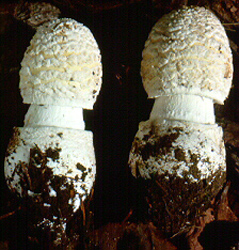
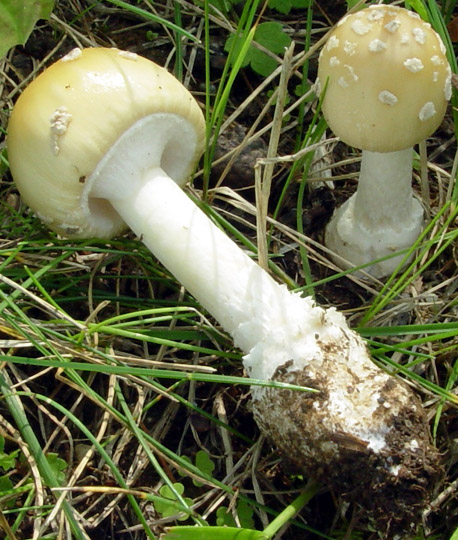
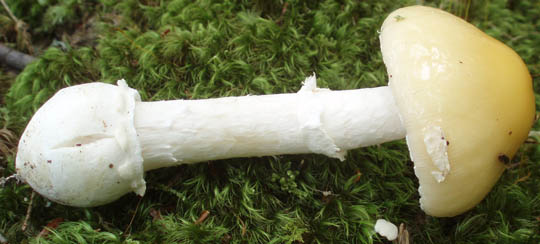
80 - 120 mm wide, buff or Buff Yellow (2.5Y 8.0/7.0) or Maize Yellow (2.5Y 8.5/6.0) or Hair Brown (10YR 4.4/1.0) or umbrinous brown [sometimes with tinge of Lemon Yellow (7.5Y 8.0/10.5)], with brownest tones over disc, often becoming cream color in age when predominantly yellow at first, subglobose at first, then convex, finally planar, viscid when moist; context ?; margin striate (?-0.5R), nonappendiculate; universal veil in warts and flat patches, often elongate (at least at first) in direction perpendicular to pileus radius, white to cream, with edges becoming upturned, detersile; pileipellis easily separable at margin. |
| lamellae |
free, crowded, white to pale cream, about 10 mm broad at midpoint, tapering thence to extremities; lamellulae ??. |
| stipe |
up to 170 × 10 - 20, white to cream, with brownish yellow stains in age, longitudinally striate, fibrous to floccose-scaly, cylindric or narrowing upward slightly; bulb globose to napiform; context ?, stuffed at first with loose cottony fibrils, becoming hollow; partial veil membranous, skirt-like, often opening upward at first, submedian to inferior; universal veil ocreate, with limb well separated from stipe, thick, white, at top of bulb, occasionally with additional ring of material on stipe above limb. |
| basidiospores |
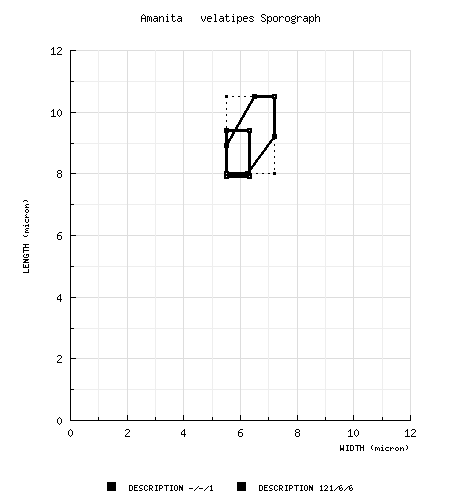
from type study of Jenkins (1982): [-/-/1] 7.9 - 9.4 × 5.5 - 6.3 μm, (Q = 1.25 - 1.71; Q' = 1.42), hyaline, thin-walled inamyloid, broadly ellipsoid to ellipsoid to elongate, often adaxially flattened; apiculus sublateral, cylindric; contents guttulate; color in deposit not recorded.
Composite of data from all specimens reviewed by RET & CRC: [121/6/6] (6.0-) 8.0 - 10.5 (-11.5) × (4.5-) 5.5 - 7.2 (-7.8) μm, (L = (6.9-) 8.9 - 10.1 μm; L' = 9.2 μm; W
= (5.1-) 5.9 - 6.8 μm; W' = 6.4 μm; Q = (1.13-) 1.28 - 1.62 (-1.73); Q = 1.35 - 1.51; Q' = 1.44), hyaline, colorless, smooth, thin-walled, inamyloid, broadly ellipsoid to ellipsoid, often adaxially flattened; apiculus sublateral, cylindric; contents predominantly monoguttulate; color in deposit not recorded. |
| ecology |
Subgregarious to gregarious. New Jersey: At ca. 210 m elev. In dominantly deciduous forest including Fagus grandifolia, Betula alleghaniensis, Acer, and some Quercus with understory including Cornus and Viburnum acerifolia. North Carolina: At ca. 1030 m elev. West Virginia: in mixed forest with Tsuga canadensis, Betula alleghaniensis, and Rhododendron sp. |
| material examined |
Jenkins (1982):
U.S.A.:
NEW YORK—Unkn. Co. - Cayuga Lk. Basin, 28.vii.1897 Hasselbring 3167 (neotype, CUP-A).
RET: CANADA:
ONTARIO—Bruce Co. - Albemarle Twp.
11.ix.1988 J. R. Parkin s.n. [Tullos 9-11-88-ONT1]
(RET 004-5).
U.S.A.:
MASSACHUSETTS—Berkshire Co. - Adams,
15.viii.1986 M. A. King & RET 8-15-86-D
(RET 002-6).
MICHIGAN—Lapeer Co. - Metamora-Hadley St.
Recreation Area [42.94° N/ 83.35° W, 280-315 m],
15.viii.2011 Sandy Sheine s.n. [Tulloss SS4] (RET
489-6, nrITS seq'd.). McComb Co. -
Shelby Twp., ca. Washington, Stony Creek
Metropolitan Pk. [42.73° N/ 83.07° W, 250-260 m],
30-31.viii.2011 Sandy Sheine s.n. [Tulloss SS5]
(HKAS, RET 489-2).
NEW JERSEY—Morris Co. - Mendham,
Meadowood Twp. Pk. [40°47'31" N/ 74°38'43" W,
214 m], 22.vii.1984 S. Hopkins, A. Gerenday, J.
Richards, & R. E. Tulloss [Tulloss] 7-22-84-C
(RET 008-5).
NEW YORK—Dutchess
Co. - Pine Plains, Thompson Pond Preserve,
13.viii.2011 Wm. Bakaitis s.n. (RET 494-6).
Madison Co. - unkn. loc., 8.vii.2010 Eric Smith s.n.
[www.mushroomobserver.org
#48272]
(RET 482-4, nrITS seq'd.). Monroe Co. - Rochester,
26.vii.1988 Leo J. Tanghe s.n. [Tulloss
7-26-88-LJT1] (RET 244-10).
Tompkins Co. - Ithaca,
9.viii.1981 Samuel S. Ristich s.n. [Tulloss
8-9-81-SSR] (RET 339-7).
NORTH CAROLINA—Macon Co. - Nantahala
Nat. For., Standing Indian Campground, tr. opposite
Lower Ridge Tr. [35.0786° N/ 83.5319° W, 1029 m],
10.vii.1990 R. E. Baird & Scott Gorden s.n.
[Tulloss 7-10-90-H] (in herb. Carmine Lavorato,
Zurich; RET 025-1).
PENNSYLVANIA—Luzerne Co. - Moon Lake
Park [41.2530° N/ 76.0470° W, 240-400 m], 3.vii.2015 David Wasilewski s.n.
[mushroomobserver
#138818]
(RET 551-1, nrITS seq'd.).
VERMONT—Bennington
Co. - Bennington, 23.viii.1980 unkn. coll. s.n.
[Tulloss 8-23-80-A] (RET ???-??).
WEST VIRGINIA—Webster Co. - Cranberry
River, 9.vii.1981 Gerald Bills 101 (BPI). |
| discussion |
The smallest (and narrowest) spores were encountered
in Tulloss 7-10-90-H, which was immature when
dried—even in the 20% of the gill length closest to
the stipe, basidia were predominantly
sterile.
In evaluating the collection in RET's herbarium as a
group, a set of collections from Cumberland Co.,
Maine, U.S.A. stood out because of their unusually
broad spores. These differed so greatly from
the spores of the other material reviewed that we
have segregated them for the moment—data from
these collections is not included in the description
above. The set of segregated collections is as
follows:
MAINE—Cumberland Co. - Cumberland Center,
22.vii.1984 S. S. Ristich 7-22-84-SSRA (RET 113-7);
Cumberland Center, Rte. 9, 25.vii.1984 S. S. Ristich
7-25-84-SSRA (RET 207-1), 28.vii.1984 S. S. Ristich
7-28-84-SSRA (RET 207-2); North Yarmouth,
5.viii.1990 S. S. Ristich s.n. [Tulloss 8-5-90-SSR1]
(RET 477-5).
Spore data for the excluded collections is as
follows:
[67/3/3] (8.1-) 8.5 - 10.5 (-12.1) × (6.3-)
6.6 - 8.2 (-10.5) μm, (L = 9.1 - 9.6 μm;
L' = 9.4 μm; W - 7.1 - 7.7 μm;
W' = 7.3 μm; Q = (1.10-) 1.13 - 1.46 (-1.51);
Q = 1.19 - 1.34; Q' = 1.30).
We note that spore length hardly differs on average
from spore length seen in the material determined
with greater confidence to be
A. velatipes. The sample size is small
in both groupings. Also, neither group has
been thoroughly evaluated anatomically.
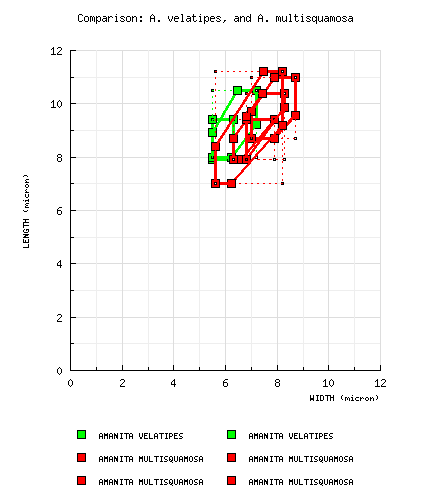
A comparison of the spores of the present species
with those of A. multisquamosa and
A. subvelatipes will be pesented in the
following diagram:
|
| citations |
—R. E. Tulloss |
| editors |
RET |
|




 Spore data sets and their composite