| name |
Amanita multisquamosa |
| author |
Peck. 1900b. Rep. (Annual) Regents Univ. State New York New York State Mus. Nat. Hist. 53: 840, pl. B, figs. 1-7. |
| name status |
nomen acceptum |
| english name |
"Small Funnel-Veil Amanita" |
| synonyms |
≡ Amanita pantherina var. multisquamosa (Peck) Dav. T. Jenkins. 1977. Biblioth. Mycol. 57: 65, pls. 9, 16, 22.
=Amanita cothurnata G. F. Atk. 1900. Studies Amer. Fung. : 66, figs. 68-70. ≡ Venenarius cothurnatus (G. F. Atk.) Murrill. 1913. Mycologia 5: 74. ≡ Amanitaria pantherina f.s. cothurnata (G. F. Atk.) E.-J. Gilbert. 1940. Iconogr. Mycol. (Milan) 27, suppl. (1): 77, tab. 19 (figs. 1-6). ≡ Amanita pantherina f.s. cothurnata (G. F. Atk.) E.-J. Gilbert. 1941. Iconogr. Mycol. (Milan) 27, suppl. (2): 270.
=Amanita glabriceps Peck. 1909. Bull. New York St. Mus. 131: 18, pl u. ≡ Venenarius glabriceps (Peck) Murrill. 1914a. N. Amer. Flora 10(1): 72.
The editors of this site owe a great debt to Dr. Cornelis Bas
whose famous cigar box files of Amanita nomenclatural information
gathered over three or more decades were made available to RET for computerization
and make up the lion's share of the nomenclatural information presented on this site.
|
| MycoBank nos. |
160865, 205816, 307629, 503899 |
| GenBank nos. |
Due to delays in data processing at GenBank, some accession numbers may lead to unreleased (pending) pages.
These pages will eventually be made live, so try again later.
|
| lectotypes |
A. multisquamosa—NYS. A. cothurnata—CUP. A. glabriceps—NYS. |
| lectotypifications |
A. cothurnata—Jenkins. 1977. op. cit.: 83. A. glabriceps—Ibid.: 86 . A. multisquamosa—Ibid.: 88. |
| type studies |
A. cothurnata—Jenkins. 1977. op. cit.: 83. A. glabriceps—Ibid.: 86. A. multisquamosa—Ibid.: 88.
A. glabriceps—Jenkins. 1978a. Mycotaxon 7: 30. A. multisquamosa—Ibid.: 32.
A. cothurnata—Jenkins. 1982. Mycotaxon 14: 240. |
| intro |
The following text may make multiple use of each data field.
The field may contain magenta text presenting data from a type study
and/or revision of other original material cited in the protolog of the present taxon.
Macroscopic descriptions in magenta are a combination of data from the protolog and
additional observations made on the exiccata during revision of the cited original
material.
The same field may also contain black text, which is data from a revision of the present
taxon (including non-type material and/or material not cited in the protolog).
Paragraphs of black text will be labeled if further subdivision of
this text is appropriate.
Olive text indicates a specimen that has not been
thoroughly examined (for example, for microscopic details) and marks other places in the text
where data is missing or uncertain.
The following material not directly from the protolog of the present taxon and not cited as the work
of another researcher is based on original research of R. E. Tulloss and C. Rodríguez Caycedo. |
| anatomical figures |
|
| basidiospores |
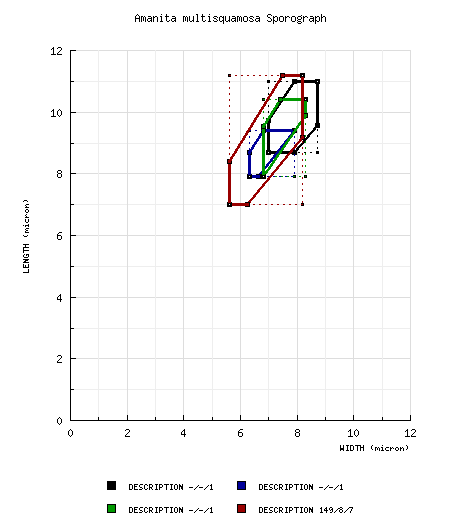
from type study of Jenkins (1978a): [-/-/1] 8.7 - 11.0 × 7.0 - 8.7 μm, (Q = 1.10 - 1.39; Q' = 1.22), hyaline, smooth, thin-walled, inamyloid, subglobose to broadly ellipsoid to ellipsoid, often adaxially flattened, rarely bearin crassospores; apiculus sublateral, truncate-conic; contents guttulate; color in deposit not recorded.
from type study of A. glabriceps by Jenkins (1978a): [-/-/1] 7.9 - 9.4 × 6.3 - 7.9 μm, (Q = 1.19 - 1.38; Q' = 1.28),
hyaline, smooth, inamyloid, broadly ellipsoid to ellipsoid, adaxially flattened; apiculus sublateral, cylindric to truncate-conic; contents guttulate;
color in deposit not recorded.
from Jenkins (1982) study of the type of A. cothurnata: [-/-/1] 7.9 - 10.4 (-11.8) × (6.3-) 6.8 - 8.3 (-9.0) μm, (Q = 1.19 - 1.40; Q' = 1.33), hyaline, thin-walled, smooth, inamyloid, broadly ellipsoid to ellipsoid, adaxially flattened; apiculus sublateral, truncate-conic; contents guttulate;
color in deposit not recorded.
composite of data from all material revised by RET and CRC: [149/8/7] (6.6-) 7.0 - 11.2 (-15.0) × (5.2-) 5.6 - 8.2 (-8.8) µm, (L = 7.8 - 9.8 µm; L’ = 8.8 µm; W = 6.3 - 7.6 µm; W’ = 6.8 µm; Q = (1.05-) 1.12 - 1.50 (-1.63); Q = 1.22 - 1.39; Q’ = 1.30), hyaline, colorless, smooth, thin-walled, inamyloid, subglobose to broadly ellipsoid to ellipsoid, infrequently globose, adaxially flattened; apiculus sublateral, cylindric, proportionately broad; contents granular to monoguttulate; ?? in deposit. |
| ecology |
Solitary to subgregarious. Connecticut: At 210± m elev. Maine: At 180± m elev. In sandy, hard-packed glacial deposit in mature mixed hardwood/conifer forest. Ohio: At 290± m elev. Pennsylvania: At 235± m elev. |
| material examined |
from type study of Jenkins (1978a): U.S.A.: NEW YORK—Suffolk Co. (Long Isl.) - Amagansett, vii C. H. Peck s.n. (lectotype, NYS).
from type study of A. glabriceps by Jenkins (1978a): U.S.A.: NEW YORK—Steuben Co. - Coopers Plains, vii C. H. Peck s.n. (lectotype, NYS).
from type study of A. cothurnata by Jenkins (1982):
U.S.A.:
NORTH CAROLINA—Watauga Co. - Blowing Rock, 19.vii.1899 to 10.ix.1899 G. F. Atkinson 3715 (lectotype of A. cothurnata, CUP).
U.S.A.:
CONNECTICUT—Tolland
Co. - Gay City St. Pk. [41°43’23” N/ 72°26’38” W,
209 m], 31.viii.1997 R. E. Tulloss et al. 8-31-97-I
(RET 268-2).
FLORIDA—Alachua Co. - Gainesville,
vii.1986 Dr. M. R. Goldman 7-86-MRG1 (RET 315-7),
11.viii.1985 Aaron Norarevian s.n. [Tulloss
8-11-85-AN6] (RET 091-5).
MAINE—Cumberland Co. -
Yarmouth, 17.vii.1988 S. S.
Ristich s.n.
[Tulloss 7-17-88-SSR1] (RET 124-8).
Knox Co. - Camden, Mt. Battie, Mt. Battie Carriage
Rd. [44°13’43” N/ 69°03’57” W, 178 m], 23.vii.2010
Wm. Bakaitis s.n. (RET 479-2).
Penobscot Co. - Orono, University of Maine,
University Forest [44°54'25" N/ 68°39'37" W, 43 m],
13.viii.1983 NEMF83 foray participant s.n. [Tulloss
8-13-83-F]
(RET ??).
MASSACHUSETTS—Berkshire Co. - North Adams,
16.viii.1986 N. Stern s.n. [Tulloss 8-16-86-H] (in
herb. Carmine Lavorato; RET 027-6); North Adams,
Appalachian Tr., Sherman Brk., 15.viii.1986 NEMF1986
participant s.n. [Tulloss 8-15-86-K]
(RET 465-8).
NEW JERSEY—Hunterdon Co. - Tewksbury Twp., 26.vii.1984 Geoffery
Kibby & R. E. Tulloss [Tulloss] 7-26-84-B
(RET 008-1), 7-26-84-D (RET 008-2),
Tewksbury Twp., Rockaway Rd., 9.viii.1986 R.
Phillips & Susan Hopkins [Phillips 3296]
(RET 089-8).
NEW YORK—Schenectady Co. - Mariaville,
18.viii.1986 M. A. King, Wayne & Jane Somers
& R. E. Tulloss 8-18-86-E (RET 079-6).
OHIO—Preble Co. - Somers Twp.,
Swan-Beatty Rd., Pleasant Vineyard Retreat Center
[39°35'49" N/ 84°40'12" W, 293 m], sect.
20, 2.viii.1992 Dr. Michael A. Vincent
5646 (MU f39175; RET 120-8).
PENNSYLVANIA—Pike Co. - Dingman's Ferry,
Pocono Environmental Education Center [41°10'17" N/
74°54'52" W, 235 m], 22.vi.1984 NJMA foray
participant s.n. [Tulloss 6-22-84-A]
(RET 057-3).
TENNESSEE—Sevier Co. - ca. Gatlinburg, GSMNP, btw. Cherokee Orchard & Grotto Falls, 12.vii.2004 Dr. R. E. Halling s.n. [Tulloss 7-12-04-N] (RET 378-3).
|
| discussion |
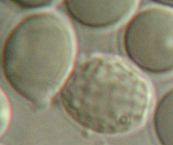
One collection (23.vii.2010 Wm. Bakaitis s.n.) bore crassospores of typical form [viewed at 1250× with Nomarski Differential Interference Constrast (DIC)]. |
| citations |
—R. E. Tulloss and C. Rodríguez Caycedo |
| editors |
RET |
|




 Spore data sets and their composite