| name |
Amanita albocreata |
| author |
(G. F. Atk.) E.-J. Gilbert. 1941. Iconogr. Mycol. (Milan) 27, suppl. (2): 259. |
| name status |
nomen acceptum |
| english name |
"Ringless Panther" |
| synonyms |
≡ Amanitopsis albocreata G. F. Atk. 1902. J. Mycology 8: 111.
≡ Vaginata albocreata (G. F. Atk.) Murrill. 1913. Mycologia 5: 84.
The editors of this site owe a great debt to Dr. Cornelis Bas
whose famous cigar box files of Amanita nomenclatural information
gathered over three or more decades were made available to RET for computerization
and make up the lion's share of the nomenclatural information presented on this site.
|
| MycoBank nos. |
517349, 156172, 517348 |
| GenBank nos. |
Due to delays in data processing at GenBank, some accession numbers may lead to unreleased (pending) pages.
These pages will eventually be made live, so try again later.
|
| lectotypes |
CUP |
| lectotypifications |
Jenkins. 1977. Biblioth. Mycol.: 29. |
| type studies |
Jenkins. 1977. Biblioth. Mycol. 57: 81.
Jenkins. 1982. Mycotaxon 14: 237. |
| revisions |
Jenkins. 1977. Biblioth. Mycol. 57: 29.
[suppl.] Tulloss and Jenkins. 1986. Mycotaxon 26: 81, figs. 1-3. |
| selected illustrations |
Jenkins. 1986. Amanita N. Amer.: figs. 67-68. |
| intro |
The following text may make multiple use of each data field.
The field may contain magenta text presenting data from a type study
and/or revision of other original material cited in the protolog of the present taxon.
Macroscopic descriptions in magenta are a combination of data from the protolog and
additional observations made on the exiccata during revision of the cited original
material.
The same field may also contain black text, which is data from a revision of the
species (including non-type material and/or material not cited in the protolog).
Paragraphs of black text will be labeled if further subdivision of
this text is appropriate.
Olive text indicates a specimen that has not been
thoroughly examined (for example, for microscopic details) and marks other places in the text
where data is missing or uncertain.
The following material not directly from the protolog of the present taxon is based upon
original research by R. E. Tulloss. |
| pileus |
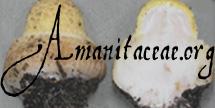
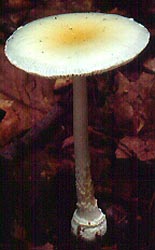
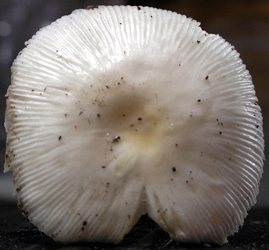
26 - 62 (-85) mm wide, broadly campanulate then planoconvex with decurved margin, eventually depressed over disc and with upward flaring margin, white (sometimes cream in senescence) with yellow to Maize Yellow (2.5Y 8.5/6.0) to yellow-tan disc, unchanging when cut or bruised, viscid when wet to tacky to waxy when dryer, shiny to subshiny; context white with infusion of yellow to Maize Yellow under pileipellis (especially strong in disc), unchanging when cut or bruised, 2± - 6 mm thick at stipe, narrowing evenly for one half to three-quarters of radius, then membranous to margin; margin striate to tuberculate-striate [(0.35R-) 0.45 - 0.5R], nonappendiculate; pileipellis becoming 1± mm thick in disc, sordid, waterlogged, yellowish, gelatinizing; universal veil absent or as white crumb-like warts or scant patches, detersile, friable, unchanging when damaged. |
| lamellae |
free to narrowly adnate, with or without small decurrent tooth (10× lens) but lacking decurrent line on stipe apex, subcrowded to crowded, pale cream in mass, white in side view, 3 - 10.5 mm broad, without decurrent lines on stipe, not staining or bruising, with edge minutely flocculose; lamellulae truncate to subtruncate to excavate-truncate, with or without attenuate tooth upon meeting pileus context, of diverse lengths, plentiful, unevenly distributed. |
| stipe |
71 - 119 × 6 - 8 mm, white to off-white, sometimes browning slightly from handling, narrowing upward slightly or cylindric, occasionally narrowest at midpoint, flaring at apex, smooth at apex, finely pruinose slightly lower, finely fibrillose in lower third, faintly longitudinally striatulate, with fibrils becoming raised slightly in age; context white (to off-white in age), sometimes with water-soaked streaks, sometimes with faint tint of brown in bulb or in wounds to stipipellis, stuffed (with firm white tissue comprising longitudinally oriented cottony fibrils) or hollow, possibly becoming hollow from the top down, having central cylinder 1 - 2 mm wide, with larvae tunnels pale orangish brown to brown; bulb stark white, 15 - 22 × 12.5 - 20 mm, napiform to subnapiform to subglobose to ovoid, occasionally flattened longitudinally, occasionally splitting longitudinally, sometimes with white pseudorhizae on bottom; exannulate; universal veil as complete (although occasionally somewhat irregular) white to off-white collar about 1 mm or less high, near top of bulb, occasionally with white shreds of submembranous limbus internus within collar and leaning on (or appressed to) stipe. |
| odor/taste |
Odor fungoid and pleasant. Taste not recorded. |
macrochemical
tests |
MACROCHEMICAL TESTS: L-tyrosinase spot test for tyrosinase - postive in all parts of the basidiocme; reaction particularly rapid and intense in pileus and on pileipellis. Syringaldazine spot test for laccase - negative throughout basidiome. Test vouchers: Tulloss 7-7-85-A, 8-2-97-A. |
| pileipellis |
double click in markup mode to edit. |
| universal veil |
On pileus: ??. At stipe base: filamentous undifferentiated hyphae 1.1 - 5.0 μm wide, plentiful to dominant, branching, singly and in fascicles, sometimes anastomosing, occasionally with subrefractive yellow walls (then up to 15.0 μm wide and branching); inflated cells common to plentiful, probably less so than on pileus, occasionally clustered, thin-walled, colorless, hyaline, terminal singly, ellipsoid to clavate to cylindric to fusiform (e.g., 29 - 37 × 10 - 23 μm); vascular hyphae not observed. |
| basidiospores |
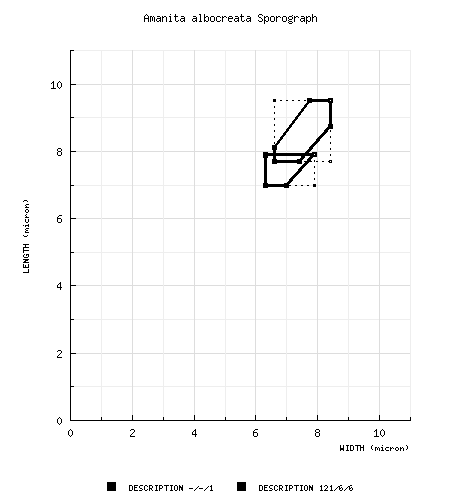
from type study of Jenkins (1982): [-/-/1] 7.0 - 7.9 × 6.3 - 7.9 μm, (Q = 1.0 - 1.25; Q' = 1.08),
hyaline, thin-walled inamyloid, globose to subglobose to broadly ellipsoid, adaxially flattened; apiculus sublateral, cylindric to truncate-conic; contents guttulate; color in deposit not recorded.
composite of data from all material revised by RET: [121/6/6] (7.3-) 7.7 - 9.5 (-11.6) × 6.6 - 8.4 (-9.4) µm, (L = 8.1 - 9.0 µm; L’ = 8.7 µm; W = 7.1 - 8.1 µm; W’ = 7.6 µm;
Q = (1.0-) 1.04 - 1.23 (-1.32); Q = 1.10 - 1.16; Q’ = 1.14), hyaline, colorless, smooth, thin-walled, inamyloid, globose to subglobose to broadly ellipsoid; apiculus sublateral; contents guttulate; white in deposit. |
| ecology |
Commonly solitary, sometimes scattered in small
numbers. Isl. of Newfoundland: In soil on
sparsely vegetated serpentine rock, with dwarf
Betula and Larix.
New Jersey: In loam in northern hardwood-hemlock
forest near Tsuga canadensis,
Quercus rubra, Acer sp.,
Betula lutea, et al. North Carolina:
[GSMNP Indian Gap] Under T. canadensis.
Pennsylvania: Under T. canadensis. |
| material examined |
from type study of Jenkins
(1982):
U.S.A.:
NEW YORK—Tompkins Co. - Ithaca,
Beebe Lk. woods, 12.vii.1902 H. H. Whetzel 9822
(lectotype, CUP).
CANADA: NEWFOUNDLAND &
LABRADOR—Isl. of Newfoundland - GMNP, lower
Green Garden Tr., 29.viii.2003 Andrus Voitk s.n.
(RET 329-10, nrITS seq'd.); GMNP, ca.
Waterhouse Brk., The Tablelands, Table Mtn.,
2.ix.2005 Noah Siegel s.n. [Tulloss 9-2-05-B]
(RET 388-1); Serpentine SIMMS, 8.ix.2007 A. Voitk
s.n. (RET 417-4, nrITS seq'd.).
ONTARIO—Norfolk Co. - Port Dover
[42.7863° N/ 80.198° W, 182 m] 29.vi.2013
Eva Skific s.n. [mushroomobserver #137988]
(RET 547-7, nrITS seq'd.).
U.S.A.:
MAINE—Penobscot Co. - Old Town,
12.viii.1983 J. Hurley s.n. [Tulloss 8-12-83-D]
(RET 105-6), NEMF1983 participant s.n. [Tulloss
8-12-83-F] (in herb. David T. Jenkins, Univ.
Alabama, Birmingham); Pushaw
Lk. SW of Pushaw, 12.viii.1991 "M. M. J." s.n.
[Tulloss 8-12-91-E] (RET 031-5, nrITS seq'd.). Unkn. Co. -
unkn. loc., "Mimi's," viii.1984 S. S. Ristich
s.n. [Tulloss 8-84-SSRA-1]
(RET 207-3).
MASSACHUSETTS—Unkn.
Co. - unkn. loc., NEMF1986, Trip #17, 16.viii.1986
H. Stoleson s.n. [Tulloss 8-16-86-B]
(RET 137-8).
NEW JERSEY—Sussex Co. - Stokes St. For.,
7.vii.1985 M. A. King, D. C. & R. E. Tulloss
7-7-85-A (RET 054-8, nrITS seq'd.).
PENNSYLVANIA—Luzerne Co. - Ricketts Glen
St. Pk., 12.vii.2014 David Wasilewski s.n.
[mushroomobserver #169760]
(RET 634-8,
nrITS seq'd.). Northampton Co. - ca.
Belfast, Jacobsburg St. Pk. [40.7882° N/
75.3044° W, 150 m], 2.viii.1997 NEMF1997
participant s.n. [Tulloss 8-2-97-A]
(RET 263-4, nrITS seq'd.),
Rhoda Roper s.n. [Tulloss 8-2-97-D]
(RET 263-5).
TENNESSEE— Swain Co. - GSMNP, Indian
Gap, 19.vii.1961 L. R. Hesler 24419 (TENN). |
| discussion |
t.b.d. |
| citations |
—R. E. Tulloss |
| editors |
RET |
|




 Spore data sets and their composite