| name |
Amanita brunnescens var. straminea |
| author |
E.-J. Gilbert. 1941. Iconogr. Mycol. (Milan) 27 suppl. (2-3): 338, tab. 46. |
| name status |
insufficiently known |
| english name |
"American Citrin Amanita" |
| synonyms |
≡ Amanitina brunnescens f. straminea E.-J. Gilbert. nom. nud 1940. Iconogr. Mycol. (Milan) 27 suppl. (1): 78, tab. LVIII (fig. 6).
non Amanita citrina f. straminea (Scop.) E.-J. Gilbert (q.v.)
non Amanita straminea Secr. (q.v.)
The editors of this site owe a great debt to Dr. Cornelis Bas
whose famous cigar box files of Amanita nomenclatural information
gathered over three or more decades were made available to RET for computerization
and make up the lion's share of the nomenclatural information presented on this site.
|
| etymology |
stramineus, "straw-colored" |
| MycoBank nos. |
345944 |
| GenBank nos. |
Due to delays in data processing at GenBank, some accession numbers may lead to unreleased (pending) pages.
These pages will eventually be made live, so try again later.
|
| lectotypes |
MICH (implicit) |
| lectotypifications |
proposed herein |
| type studies |
Tulloss (here) |
| intro |
Because it is now generally assumed that Gilbert’s
personal herbarium was lost after his
death, the holotype of A. brunnescens var.
straminea, which was in that herbarium must
also be assumed lost. Fortunately, A. H.
Smith, who collected the holotype, retained an
isotype with annotations and photographs in
MICH. This isotype is proposed as the
lectotype of the taxon herein. The
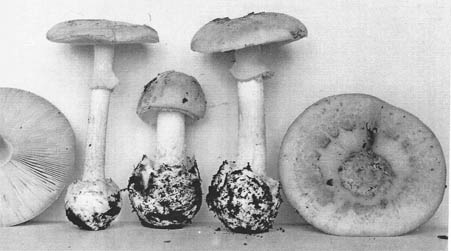
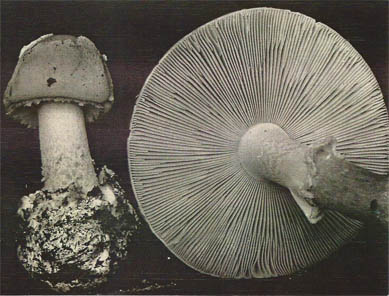
macroscopic description that accompanies this type
study is based on A. H. Smith’s original notes and
on photographs of the lectotype
collection.
The following text may make multiple use of each
data field.
The field may contain magenta text presenting data from a type study
and/or revision of other original material cited in the protolog of the present taxon.
Macroscopic descriptions in magenta are a combination of data from the protolog and
additional observations made on the exiccata during revision of the cited original
material.
The same field may also contain black text, which is data from a revision of the present
taxon (including non-type material and/or material not cited in the protolog).
Paragraphs of black text will be labeled if further subdivision of
this text is appropriate.
Olive text indicates a specimen that has not been
thoroughly examined (for example, for microscopic details) and marks other places in the text
where data is missing or uncertain.
The following material not directly from the
protolog of the present taxon and not cited as the
work of Dr. Z. L. Yang or another researcher is
based upon original research by R. E. Tulloss. |
| pileus |
40–80 mm wide, Light Chalcedony Yellow overall, convex to obtuse, becoming planar in age, viscid when young; context not recorded; margin nonstriate, usually somewhat decurved; universal veil Pale Olive Buff or more yellowish, with thicker patches near Avellaneous, as thin, very variable coating in young material, submembranous in some cases, floccose-fibrillose in others (and then breaking up into [radially striate, shingle]-like patches especially near margin), [minutely verruculose under 10× lens in exsiccata] with remnants usually rather evenly distributed or with large areas becoming glabrous with age, with small remnants at margin often remaining in older material. |
| peridium |
double click in markup mode to edit. |
| lamellae |
touching stipe, crowded (125–133 per pileus), Ivory Yellow, 5–7 mm broad, "broadest in front and outer ends, obtusely rounded behind," with edges crenulate under lens, [with edge minutely fimbriate and pallid under 10× lens in exsiccata]; lamellulae [in exsiccata, plentiful, of diverse lengths, rounded truncate to subattenuate to attenuate].
[Note: RET finds the phrase in quotation marks difficult to interpret. Suggestions would be appreciated.] |
| stipe |
60–100 × 10–15 mm, concolorous with lamellae, with thin coating of fine fibrils above partial veil (in age this layer sometimes breaking up into concentric [irregular zones, subcylindric or narrowing upward slightly, flaring very little at apex,] below partial veil sparsely fibrillose or with fibrillose scales or patches; context not recorded; bulb 20–35 mm wide, white, spongy; partial veil almost as greenish yellow as pileus, with ragged edges; universal veil as submembranous, lobed, limbate volva standing erect and distinctly separated from stipe by as much as 5± mm, sometimes with lobes large and irregular, with lobes placed along distinct bulb margin. |
| odor/taste |
Odor faint, but pungent, somewhat reminiscent of chlorine. Taste not recorded. |
macrochemical
tests |
none recorded. |
| pileipellis |
265–270 µm thick, slightly gelatinized just at surface, uniformly yellowish in 3% KOH soln.; filamentous undifferentiated hyphae 2.4–8.4 µm wide, branching, dominantly subradially arranged, densely interwoven in vertical section, some with walls more yellow than in others; vascular hyphae not observed. |
| pileus context |
filamentous undifferentiated hyphae 1.8–12.5 µm wide, with walls thin to 0.8 µm thick, branching, sometimes with fusiform intercalary cells (up to 14 µm wide and occasionally branched), in fascicles or singly, with fascicles and individual hyphae interwoven in loose matrix; acrophysalides elongate (e.g., 77 × 17 µm) or narrowly clavate (e.g., 186 × 35 µm), with walls thin or up to 0.7 µm thick; vascular hyphae not observed. |
| lamella trama |
bilateral; wcs = 55–70 µm; filamentous undifferentiated hyphae, with many intercalary segments slightly inflated, 2.0–22 µm wide; some inflated cells apparently terminal, similar to intercalary cells (e.g., 89 × 19.2 µm or 101 × 22 µm), with slightly thickened walls, with shallow angle of divergence eventually reach angle of up to 80° to central stratum, sometimes penetrating up to 10± µm into subhymenium.
[Note: Notes on the type study (which date from 1993) do not differentiate the hyphae and intercalary cells in the central stratum from those in the subhymenial base. RET feels that distinction should be drawn.] |
| subhymenium |
bilateral; wst-near = 50–65 µm; wst-far = 60–85 µm; pseudoparenchymatous (cellular), overall 28–42 µm thick, comprising 3–5 layers of inflated cells (globose to subglobose, to ovoid to clavate, up to 22 × 18.0 µm); clamps not observed. |
| basidia |
27–52 × 8.8–11.5 µm, dominantly 4-, infrequently 2- or 3-sterigmate; clamps not observed. |
| universal veil |
On pileus: pale grayish brown in mass; filamentous undifferentiated hyphae 2.5–8.2 µm wide, branching, in fascicles or singly, with walls thin to slightly thickened, plentiful; inflated cells dominating, terminal, often in chains of three or more, easily dissociated, collapsing, thin-walled or with walls up to 0.8 µm thick, subglobose to broadly ellipsoid (e.g., 48–56 × 42–50 µm) to broadly fusiform (e.g., 60 × 31 µm), colorless to slightly sordid; vascular hyphae not observed; clamps not observed. At stipe base: slightly orangish brown in mass, as on pileus, but with larger percentage of hyphae. |
| stipe context |
longitudinally acrophysalidic; filamentous undifferentiated hyphae 3.0–9.0 µm wide, thin-walled, branching, plentiful; acrophysalides up to 262 × 43 µm, thin-walled, dominant away from stipe surfaces; vascular hyphae not observed; clamps not observed. |
| partial veil |
filamentous undifferentiated hyphae 2.5–11.5 µm wide, subradially arranged, sometimes coiling loosely, with thin or slightly thickened, frequently branching, occasionally with yellowish walls, sometimes with refractive guttules decorating wall inner surfaces, densely interwoven but easily separated, in fascicles or singly; inflated cells, narrowly clavate or clavate or broadly clavate, terminal singly, common to plentiful, with thin walls, 26–40 × 8.5–19.5 µm; vascular hyphae not observed; clamps not observed. |
| lamella edge tissue |
not described. |
| basidiospores |
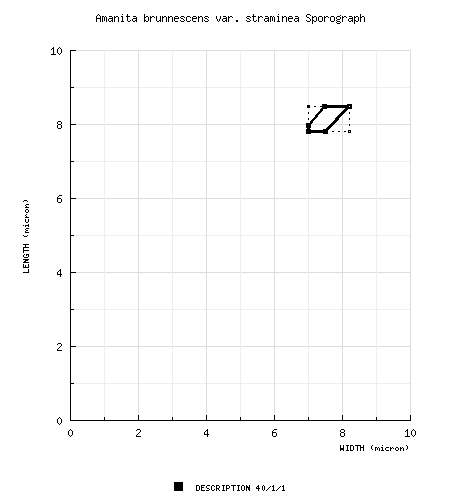
from type study of RET: [40/1/1] (7.5–) 7.8 – 8.5 (–9.2) × (6.8–) 7.0 – 8.2 (–9.0) µm, (L = 8.2 µm; W = 7.6; Q = (1.03–) 1.04 – 1.14 (–1.15); Q = 1.07), hyaline, colorless, smooth, thin-walled, globose to subglobose, infrequently broadly ellipsoid, adaxially flattened; apiculus proportionately small, cylindric, sublateral; contents mono- to multiguttulate, with additional small granules; color in deposit not recorded. |
| ecology |
no information recorded
non-type, RET: Solitary to subgregarious. New Jersey: Ca. sea level. In deep sandy soil of Atlantic coastal plain in Pinus-Quercus barrens. Tennessee: In moist loam and litter of upland Quercus-Pinus forest. |
| material examined |
RET: U. S. A.:
MICHIGAN—Washtenaw
Co. - Pinckney, George Reserve, 24.ix.1938 H. V.
& A. H. Smith 11066 (isotype, MICH 4953;
isotype fragment, RET 683-8).
WEST VIRGINIA—Tucker Co. - Fernow Exp.
For., 13.ix.1992 R. P. Bhatt & A. Kumar FMR-5
(FWVA), 25.ix.1992 S. L. Stephenson, R. P. Bhatt
& A. Kumar PW-2 (FWVA); Fernow Exp. For.,
Watershed 4, 8.x.1993 S. L. Stephenson 93-09 (FWVA). |
| discussion |
The epithet "straminea" is not available in
Amanita at species rank. Therefore
I chose to propose a new name (Amanita
americitrina) that would (in part) conserve the
name that North Americans have been using for the
present species.
Gilbert felt that A. brunnescens var.
straminea was distinguishable from
A.
mappa on several counts including habit,
pileus color, spore size, form of the universal
veil, etc.; but felt that neither taxon was
sufficiently well described so that the details
could be laid out.
??more—comparisons,
etc.??
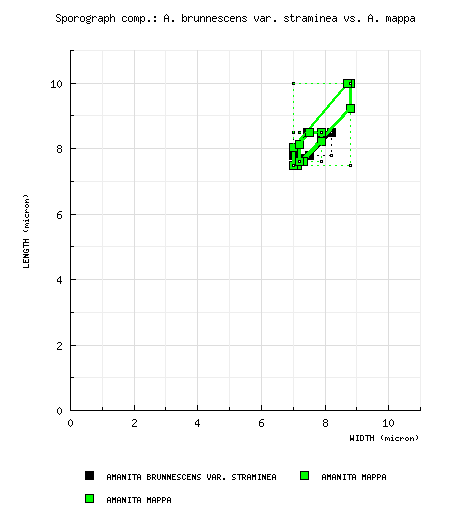
A sporograph comparing the present taxon with
A.
mappa (green figure) follows.
Smith notes that the limbate volva of the present
species is "not membranous as in [A.]
verna."
The major problem in the taxonomy of the present
taxon is the issue of whether it should be
segregated from A.
lavendula. A comparison sporograph
follows:
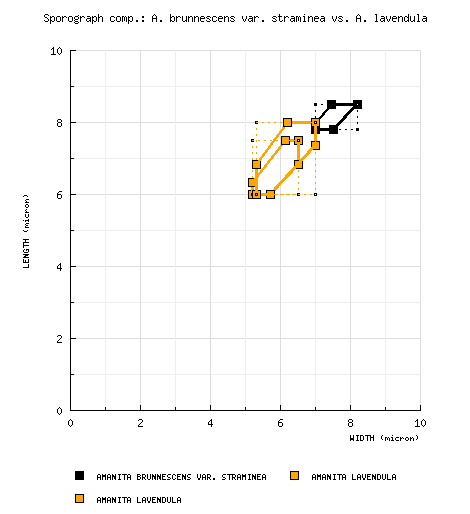
Preliminary genetic studies support the idea that
we have had for some time—that the present taxon
should be treated at the rank of species and is
distinct from A. lavendula as the above
sporograph suggests. These same studies
indicate that the present taxon probably will
turn lavender if the weather is sufficiently
cool. To the best of our current knowledge,
we think that the present taxon can be identified
with A.
americitrina. We await further
developments following a year of intensive
collecting in eastern North America by a group of
volunteer collectors to whom we owe a great deal
of thanks. |
| citations |
—R. E. Tulloss |
| editors |
RET |
|




 Spore data sets and their composite