

| name | Amanita brunneoconulus |
| name status | nomen acceptum |
| author | Bas & Gröger |
| english name | "Falsely Saccate Amanita" |
| intro | The following is based on the original description of Amanita brunneoconulus. |
| cap |
The cap of A. brunneoconulus is 22 - 80 mm wide, hemispherical when young, plano-convex when mature, without an umbo, not viscid, with a rather broad, striate margin (25 - 33% of the radius). The cap is ochraceous brown, somewhat darker and slightly more reddish brown to olivaceous brown at the center, and paler at the margin. The flesh of the cap is up to 4.5 mm thick above the middle of the gills, white. The volva is present as small, truncate-conical volval warts which tend toward larger patches toward the cap''s margin. The volva is the same color as the cap but at first are paler than the background in the center. It is not easily removed from the cap. |
| gills | The gills are free, crowded, up to 5 mm broad, sometimes forked, and whitish. Near the cap's margin, the gills may have a brown edge. The short gills are truncate and unevenly distributed. |
| stem | The stem is 52 - 83 (-150) × 8 - 14 (-20) mm, stuffed, becoming hollow, slightly narrowing upwards, and exannulate. The base is subbulbous. On the base of the stem, one or two incomplete ridges of volva are present which cause a splitting of the stem's tissue, giving rise to an incomplete, false volva, 15 - 30 mm above the bottom of the stem, giving the subbulbous base a lobed appearance. The flesh is predominantly white, but sometimes ochraceous at the base of the stem. |
| odor/taste | Odor and taste are practically absent. |
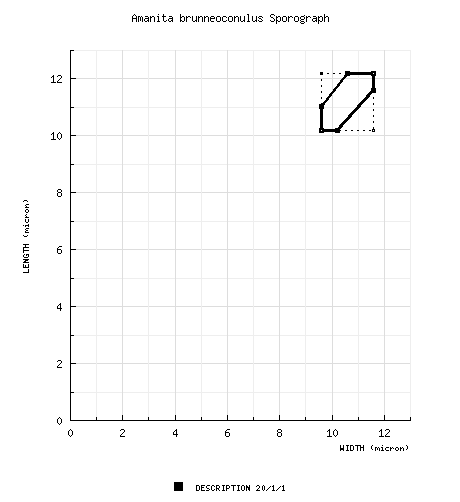
| spores | The spores measure (9.5-) 10.2 - 12.2 (-13.6) × (9.1-) 9.6 - 11.6 (-13.3) µm and are globose to subglobose and inamyloid. Clamps are absent at bases of basidia. |
| discussion |
Originally described from Germany from deciduous forests including Beech (Fagus), Oak (Quercus), Basswood (Tilia), Ash (Fraxinus), and Crattaegus. Bas and Gröger state the species is well-categorized based on the form of its volva, its colors, and its exannulate stem. Because of the subbulbous stem, Bas placed this species in section Amanita and suggested among its most similar taxa, A. friabilis (Karst.) Bas and A. hyperborea (Karst.) Fayod. See also, for example, A. farinosa Schwein. and A. basiana Tulloss & M. Traverso. Bas notes that the gelatization of the cap skin in this species is rather minimal. This and the fact that the warts are difficult to remove suggests that connection between the warts and the cap skin remains unbroken well after the expansion of the fruiting body. Amanita brunneoconulus has this character in common with the other species cited.—R. E. Tulloss |
| brief editors | RET |
| name | Amanita brunneoconulus | ||||||||||||||||||||
| author | Bas & Gröger in Bas. 1982. Persoonia 11: 432, fig. 2(a-d). | ||||||||||||||||||||
| name status | nomen acceptum | ||||||||||||||||||||
| english name | "Falsely Saccate Amanita" | ||||||||||||||||||||
| etymology | brunneus, "brown" + conus, "cone" + -ulus, diminutive; hence, "small brown cone," in reference to pileal warts | ||||||||||||||||||||
| MycoBank nos. | 110465 | ||||||||||||||||||||
| GenBank nos. |
Due to delays in data processing at GenBank, some accession numbers may lead to unreleased (pending) pages.
These pages will eventually be made live, so try again later. Search:
Showing 0 to 0 of 0 entries | ||||||||||||||||||||
| holotypes | L | ||||||||||||||||||||
| intro |
The following text may make multiple use of each data field. The field may contain magenta text presenting data from a type study and/or revision of other original material cited in the protolog of the present taxon. Macroscopic descriptions in magenta are a combination of data from the protolog and additional observations made on the exiccata during revision of the cited original material. The same field may also contain black text, which is data from a revision of the present taxon (including non-type material and/or material not cited in the protolog). Paragraphs of black text will be labeled if further subdivision of this text is appropriate. Olive text indicates a specimen that has not been thoroughly examined (for example, for microscopic details) and marks other places in the text where data is missing or uncertain. The following material is derived from the protolog of the present species. Note from protolog: "There are no field notes on the paratype available; as the dried carpophores of this collection are considerably larger than those of the type, the measurements of the fresh carpophores as estimated from the dried ones are included in this description." | ||||||||||||||||||||
| pileus | from protolog: 22 - 44 mm wide, ochraceous brown (also per field notes seen by Bas: pale brown, café au lait, wood brown), somewhat darker and slightly more reddish brown to olivaceous brown over disc and darker over margin due to darker ridges, almost hemispheric when young, becoming plano-convex at maturity, without umbo, smooth, not viscid; context white, moderately thick, up to 4.5 mm thick above middle of lamellae in holotype; margin rather broadly sulcate (0.25 - 0.3 (-0.4)R); universal veil over disc as small 0.5 - 1 mm wide, truncate-conic warts, toward margin as somewhat larger 2 - 3 mm wide usually angular patches, concolorous with pileus, at first paler than darker ground color over disc, later with conspicuous dark brown tips, "not easily removable but in paratype broad margin of pileus glabrous." | ||||||||||||||||||||
| lamellae | from protolog: free, crowded, color not recorded, up to 5 mm broad in type, sometimes forking near pileus margin, with minutely fimbriate whitish edge (often pale brown near pileus margin); lamellulae truncate, 0 - 1 (-3) between each pair of otherwise adjacent lamellae. | ||||||||||||||||||||
| stipe | from protolog: 52 - 83 × 8 - 14 mm in holotype (up to 150 × 20 mm in paratype), subcylindric or narrowing upward, with subflocculose covering whitish (near apex) to pale ochraceous brown breaking up into zebroid (zig-zag) zones on white ground; bulb irregular and splitting (per figure) 16 - 25 mm wide in holotype (up to 30 mm wide in paratype); context stuffed becoming hollow in late stages, white except somewhat ochraceous in stipe base; exannulate; universal veil as one or two narrow incomplete circular ridges, concolorous with warts and patches on pileus, often causing recurved splitting of superficial tissue of stipe base (as much as 15 - 30 mm above bottom of stipe) and, thus, producing lobes of such tissue on both stipe and bulb, giving false appearance of limbate or saccate volva. | ||||||||||||||||||||
| odor/taste | from protolog: Odor and taste "practically absent." | ||||||||||||||||||||
| macrochemical tests |
none recorded. | ||||||||||||||||||||
| pileipellis | from protolog: suprapellis colorless, gelatinized, 25± - 35± μm thick; subpellis brown, thick; filamentous hyphae 2 - 3.5 (-5) μm thick and criss-crossing in suprapellis, up to 6 μm thick with vacuolar pigment in subpellis. | ||||||||||||||||||||
| pileus context | not described. | ||||||||||||||||||||
| lamella trama | from protolog: "probably bilateral", "difficult to study in dried material." | ||||||||||||||||||||
| subhymenium | from protolog: "20 - 30 μm thick, broad-celled ramose, tending to become pseudoparenchymatic." | ||||||||||||||||||||
| basidia | from protolog: 52 - 74 × 13.5 - 19.5 μm, 4- or (rarely 2-sterimate; clamps absent. | ||||||||||||||||||||
| universal veil | from protolog: On pileus, in warts near center: elements more or less anticlinally aligned, with pigment vacuolar; filamentous hyphae abundant, but rather inconspicuous, 2 - 7.5 μm wide, branching; inflated cells (sub)globose to ellipsoid to clavate, 20 - 50 (-75) × 13 - 45 (-70) μm, thin-walled, brown, terminal singly or (more rarely and mostly smaller cells) in short chains, additionally (infrequently) elongate or somewhat irregular; vascular hyphae few. On pileus, in patches near margin: disordered, with elements similar to those in warts. On stipe base, in brown ridges: with same composition as patches on margin of pileus. | ||||||||||||||||||||
| stipe context | from protolog: longitudinally acrophysalidic; acrophysalides dominating up to 250 × 70 μm and 275 × 36 μm; vascular hyphae scattered; clamps absent. | ||||||||||||||||||||
| partial veil | absent. | ||||||||||||||||||||
| lamella edge tissue | from protolog: in young material up to 145 μm broad, as "brownish strip"; filamentous hyphae narrow, rather inconspicuous; inflated cells 18 - 47 × 12 = 27 μm, narrowly clavate to sphaeropedunculate, terminal singly or (rarely) in chains of 2 or 3, soon collapsing and reduced to "amorphous matter" with scattered remaining cells. | ||||||||||||||||||||
| basidiospores | from protolog: [20/1/1] (9.5-) 10.2 - 12.2 (-13.6) × (9.1-) 9.6 - 11.6 (-13.3) μm, (Q 1.0 - 1.15; Q =1.05; Q' = 1.05), hyaline, colorless, smooth,thin-walled, inamyloid, globose to subglobose; apiculus sublateral and cylindric (both per figure); contents mono- to multiguttulate; color in deposit not recorded. | ||||||||||||||||||||
| ecology | from protolog: Subgregarious. In deciduous forest (Fagus, Tilia cordata, Fraxinus, Prunus avium, Quercus petraea, Acer campestre, Crataegus with Arum maculatum, Asarum, Campanula trachelium, Hedera, Lathyrus vernus, Phyteuma spicata, Stellaria holostea, Micromphale foetidum, etc.) on calcareous loam over "Muschelkalk." | ||||||||||||||||||||
| material examined | from protolog: GERMANY: THURINGIA—Gotha Distr. - 2 km WSW of Haina, 27.vi.1981 F. Gröger s.n. (holotype, L). Unstrut-Hainich Distr. - Stadtwald, 6km WSW of Mühlhausen, 9.ii.1977 F. Gröger s.n. (paratype, L; paratype, JE). | ||||||||||||||||||||
| discussion |
from protolog: "Although in the field-notes the pileal surface is described as dry and the volval warts on the pileus as rather difficult to remove, in view of the presence of a thin ixocutis it is to be expected that the pileus becomes subviscid in rainy weather and that the volval warts are sometimes washed away. "Amanita brunneoconulus is fully chsracterized by the crowded, small, brown, truncate-conical warts on the central part of the brown pileus in combination with the exannulate stipe decorated with rather conspicuous whitish to pale brown zigzag zones of partial veil material and the few narrow strips of brown volval material on the base of the stipe. These volval strips sometimes provoke the formation of a 'pseudovolva' by splitting of the superficial tissue of the stipe. On account of the subbulbous base A. brunneoconulus has to be placed in section Amanita, in spite of its exannulate stipe. There it finds its place near the European species A. friabilis (Karst.) Bas and A. hyperborea (Karst.) Fayod and several extra-european species. This conclusion, however, is drawn from the morphology of the base of the stipe in just expanded and mature carpophores. The presence of a true primordial bulb in this species still as to be confirmed by observations on very young unexpanded carpophores. "Amanita brunneoconulus differs from A. friabilis by more (sub)globose spores (10 - 12 × 9.5 - 11.5 [μm} with Q = 1.0 - 1.15 in the former and 10 - 12.5 × 8 - 10 μm with mean Q = 1.2 - 1.35 in the latter), the complete lack of grey tinges and the strictly truncate-conical volval warts at the centre of the pileus. Moreover A. brunneoconulus seems to prefer rich deciduous forest without Alnus on calcareous loam, whereas A. friabilis grows in wetter deciduous forest where it is associated with Alnus. "Amanita hyperborea is completely white, has larger, more broadly ellipsoid spores (11.5 - 13 × 9.3 - 11 μm, Q = 1.1 - 13) than A. brunneoconulus, and is until now known only from Russian lapland." Dr. Bas repeatedly expressed concern to me as to whether I thought this this species might be based on abnormal basidiomes of a species assignable to section Vaginatae—for example, A. fulva. A sporograph comparison between the present species and A. fulva follows: More recently a set of photographs by J. J. Wuilbaut suggested to several persons, including Dr. Bas, the possibility that A. brunneoconulus might be a taxonomic synonym of A. beckeri. A sporograph comparison follows: The Wuilbaut photographs show a universal veil that is indeed paler than the cap at first, but rather than becoming concolorous with the cap in mature material, it become distinctly grayish and markedly darker than the the cap; moreover the ridges at the cap margin are quite pallid in the mature material shown in these images. The anticlinal structure noted in the volval warts over the disc of the holotype of the present species is very different from the more disordered appearance of the tissue in the species of section Vaginatae with friable, darkening universal veils. RET is inclined for the moment not to alter the original placement of the present species in section Amanita. Primordia of the present species with (or without) distinct basal bulbs are still awaited—to the knowledge of the editors. | ||||||||||||||||||||
| citations | —R. E. Tulloss | ||||||||||||||||||||
| editors | RET | ||||||||||||||||||||
Information to support the viewer in reading the content of "technical" tabs can be found here.
| name | Amanita brunneoconulus |
| bottom links | [ Keys & Checklists ] |
| name | Amanita brunneoconulus |
| bottom links | [ Keys & Checklists ] |
 Spore data sets and their composite
Each spore data set is intended to comprise a set of measurements from a single specimen made by a single observer; and explanations prepared for this site talk about specimen-observer pairs associated with each data set. Combining more data into a single data set is non-optimal because it obscures observer differences (which may be valuable for instructional purposes, for example) and may obscure instances in which a single collection inadvertently contains a mixture of taxa.

Text and User-Generated Sporographs are published under the Creative Commons License.

In the case of a taxon page, image credits are on the 'image' tab.